
Global EV Battery Market
The global electric vehicle battery market report is segmented by propulsion (HEV, PHEV, and BEV), by vehicle type (Passenger Car and Commercial Vehicle), by battery chemistry (LFP, LMFP, NMC, NCA, LTO, and Sodium-ion), by battery capacity (Below 25 kWh, 25–50 kWh, 51–75 kWh, 75–100 kWh, and Above 100 kWh), by battery form (Cylindrical, Prismatic, and Pouch), by components (Cathode, Anode, Electrolyte, Separator, Housing, Thermal System, and Others), by materials (Lithium, Nickel, Cobalt, Manganese, Iron, Phosphate, Graphite, Silicon, Solvents, Polyethylene/Polypropylene, Copper, Aluminum, and Others), and by region (North America, Latin America, Europe, Asia-Pacific, and Middle-East and Africa). The global electric vehicle (EV) battery market report includes market size in value (USD) and volume (GWh), and forecast up to 2031.
Global EV Battery Market
Market Size in USD Billion
Market Size Overview
USD Billion
Market Snapshot
- Study Period
- 2019-2031
- Forecast Period
- 2026-2031
- Base Year Market Size (2025)
- USD 151.8 Billion
- Market Size (2026)
- USD 177.47 Billion
- Market Size (2031)
- USD 306.79 Billion
- Growth Rate (2026-2031)
- 11.57% CAGR
- Market Concentration
- Highly Concentrated
Major Players*



*Disclaimer: Major Players sorted in no particular order
Market Overview
The global electric vehicle battery market value is anticipated to grow from USD 118.7 billion in 2025 to 152.2 billion in 2026 and expected to reach USD 225 billion in 2031 with a CAGR (2026-2031) of 8.13%.
Electric vehicle battery is one of the crucial components driving transition from traditional internal combustion engine to hybrid electric vehicles and battery electric vehicles. Battery accounts nearly 30% of the battery electric vehicle value; hence the cost trend of battery set the EV economics and positioned at the center of automotive electrification. Increasing electric vehicle adoption, expanding charging infrastructure, falling lithium prices, improving energy density, faster charging capabilities, and expansion of battery manufacturing capacity are the key attributes driving the growth of electric vehicle battery industry.
Global electric vehicle battery deployment reached 1,187 GWh (~1.2 TWh) in 2025, registering a growth of 31.6% from 901.4 GWh (0.9 TWh) in 2024 [Source: IEA]. Battery electric vehicle (BEV) remain the key demand base of EV batteries due to higher battery capacity requirements in comparison to HEVs and PHEVs. Among all battery chemistries, Lithium Iron Phosphate (LFP) registered highest demand due to its lower material cost, long cycle life, and thermal stability.
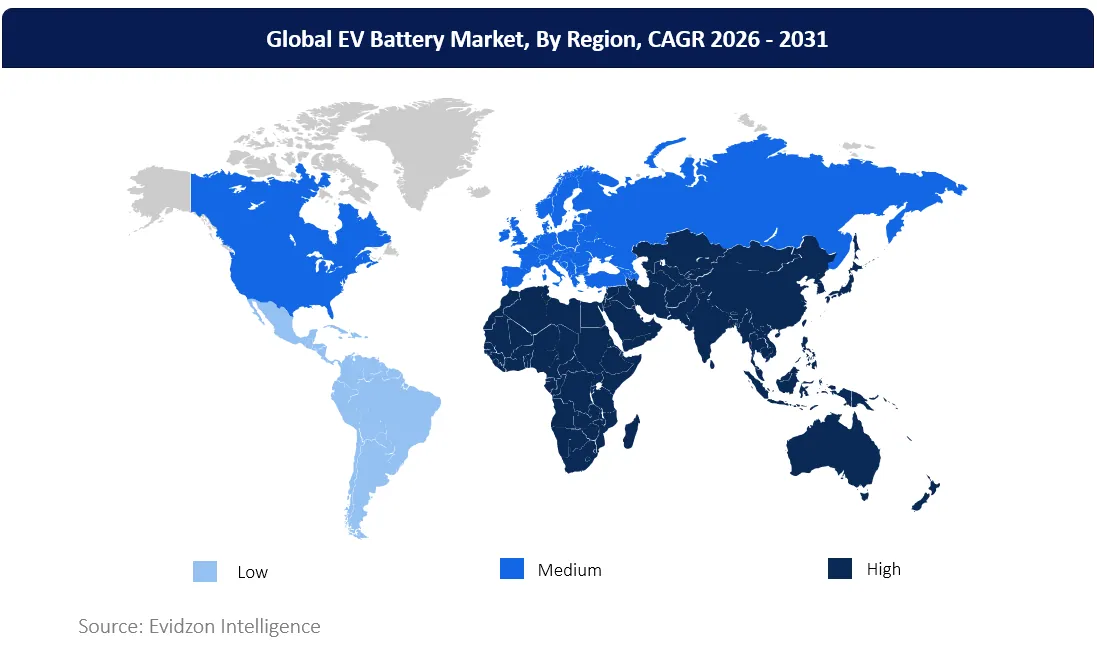
Asia pacific region is the dominating the market, China’s control across global battery manufacturing and supply-chain integration allowing to hold majority market share. Whereas, North America and Europe is aggressively focusing on setting up manufacturing plants and increase localized EV battery manufacturing to reduce dependency and uncertainty.
Key Takeaways
- By propulsion, battery electric vehicle (BEV) remains the largest sub-segment accounting for nearly 63.4% of the electric vehicle battery segment in 2025 and plug-in hybrid electric vehicle (PHEV) is expected to grow at 13% CAGR by 2031.
- By vehicle type, passenger accounts for nearly 87.6% market share in 2025. However, commercial electric vehicle battery market is expected to grow at a CAGR of 11.8% by 2031.
- By battery chemistry, Lithium Iron Phosphate (LFP) segment has registered the highest market value share of nearly 55% in 2025 of global electric vehicle battery market and sodium-ion chemistry is expected to ride at a 35% CAGR over the forecast period.
- By battery capacity, 51–75 kWh will remain the dominant demand base with more than 40% market share in 2025, while above 100 kWh battery capacity is projected to grow at 15% CAGR by 2031.
- By battery form, Prismatic cells accounts for 60% of the global electric vehicle battery market share in 2025. However the cylindrical cells are projected to witness a CAGR of more than 13.5% during 2026-2031.
- By components, cathode register 41% market share in 2025, whereas separators are anticipated to grow at 13% CAGR by 2031.
- By material, Lithium accounts for 12% market share in 2025, whereas silicon is anticipated to grow at 18% CAGR over the forecast period.
- By region, Asia-pacific accounts for 68% of the global Electric Vehicle Battery market and Middle East and Africa (MEA) is expected to grow at a CAGR of 12.8% through 2031.
About the Study
The global electric vehicle battery market study covers the rechargeable battery systems used in new passenger cars and commercial vehicles across HEV, PHEV, and BEV propulsion technologies, with analysis by battery chemistry, capacity, form, components, materials across major global regions and countries. The study excludes replacement batteries, standalone stationary energy-storage batteries, consumer electronics batteries, charging infrastructure, charging services, standalone electric motors, independently traded raw materials, battery recycling and second-life applications unless considered as part of the first-life automotive battery system.
Market Dynamics Analysis
Drivers
Growing EVs penetration is driving demand for battery cells, modules, and packs across passenger and commercial vehicle applications.
Expanding cell manufacturing scale, chemistry optimization, material efficiency, and production automation are reducing battery costs.
Stringent vehicle-emission regulations, incentives, subsidies, and localization policies are encouraging OEMs EV production.
Gigafactory investments are increasing cell-production capacity and supporting regional supply-chain development.
Improvements in energy density, charging, thermal management, cell design, BMS, and silicon-enhanced anodes are improving range and performance.
Consumer preference for high driving range is driving demand for higher-capacity battery and higher-energy-density chemistries.
Restraints
Concentrated supply chains for lithium, graphite, nickel, cobalt, and other battery materials expose manufacturers to commodity-price volatility, geopolitical risks, and supply disruptions.
Fluctuations in lithium, nickel, cobalt, graphite, copper, and aluminum prices affect cell manufacturing costs and battery profitability.
Rapid capacity additions is creating pricing pressure and shrink manufacturer margins.
Development of emerging battery technologies creates long-term battery chemistry and manufacturing investments uncertainty.
Technological, regulatory, and economic factors have a collective influence on the electric vehicle battery adoption across the globe. Advancements in battery chemistry, energy density, charging speed, thermal management, and manufacturing efficiency are acting as a tailwind for the economics of EV battery industry, while increasing electric vehicle adoption is creating a structured year-on-year incremental demand. Increasing adoption of LFP chemistry due to 40% cheaper than lithium nickel manganese cobalt oxide (NMC) alternatives per kWh allowing OEMs to reduce battery costs and dependence on nickel and cobalt.
In contrast to this, rare-earth minerals concentration, commodity-price volatility, manufacturing overcapacity, supply-chain localization requirements, and rapidly changing battery technologies are restricting the growth prospect of overall market. Geopolitical uncertainty and tariff war has increased the pressure on margins, the market share of LFP chemistries has seen nearly 50% market share reduction over a year due to increased tariffs on batteries importing from China.
Segment Analysis
By Propulsion
Battery electric vehicle battery (BEV) accounts for the highest market share of nearly 63.4% in 2025, meanwhile plug-in hybrid electric vehicle (PHEV) is projected to grow at 13% CAGR by 2031. The battery-content equation strengthens BEV dominance: a typical BEV requires a much larger battery compared to a PHEV or HEV, resulting in significantly more battery demand with each incremental BEV sale. In United States, Europe and China, the battery electric vehicle has an average battery capacity of 90 kWh, 70 kWh and 60 kWh respectively. Whereas, the plug-in hybrid vehicles have an average battery capacity of 20 kWh in United States and Europe and 25 kWh in China. Due to significant high battery capacity of BEVs, even PHEV sales increase faster, the PHEV battery demand does not increase proportionately.
PHEVs and HEVs are serving as a transitional technology from traditional internal combustion engine to BEVs, where charging infrastructure, driving range and consumer affordability remains a key constraint. Increasing PHEVs sales is not only contributing to the growth curve, but the increasing battery capacity reinforced by depleting lithium cost and structurally expensive PHEV battery back is also fuelling the growth projections. In China PHEV battery capacity increases from 14 kWh in 2019 to 26 kWh in 2025, while European PHEVs reach approximately 20–21 kWh. Meanwhile, battery electric vehicle batteries (BEVs) are anticipated to remain the principal segment of Electric Vehicle Battery market due to OEMs full electric platform prioritization, favorable regional policies, incentives and a positive advantage in total cost of ownership (TCO).
Global Electric Vehicle Battery Market, By Propulsion, Market Share, 2025
By Vehicle Type
Passenger cars represent the largest vehicle type category with 87.6% market share in global electric vehicle battery market; however the commercial vehicle is expected to foresee 11.8% CAGR through 2031. Favorable government incentives and regulation pushing EV market, expanding model availability across passenger vehicle types, increasing customer awareness on EVs is transitioning the customer buying pattern and dynamically shifting towards electric vehicle. This transition co-relate with the demand curve of electric vehicle batteries. Among all vehicle types in passenger car, SUV is likely to account for the largest demand category owing to its larger size, higher performance requirements, and longer-range specifications require larger battery packs.
Due to high utilization rate, low operating and maintenance cost, predictable routes, and centralized charging, commercial vehicle is projected to see a significant leap in growth over the forecast period. Commercial vehicles have significantly more battery capacity per vehicle, though passenger vehicles generate much higher unit volume. Commercial BEVs range from roughly 155 kWh to 240 kW, while passenger BEVs typically carry between 38–90 kWh, depending on the market, in trucks and busses, the distinction is very noticeable. Over 80% of the world's sales of electric medium- and heavy-duty trucks came from China, and in 2025, global sales of electric trucks doubled to over 400,000 units, accounting for 9% of all new truck sales. Sales of electric heavy-freight truck have tripled from around 84,000 units in 2024 to roughly 230,000 units in 2025 [Source: IEA].
Global Electric Vehicle Battery Market, By Vehicle Type, Market Share, 2025
Geographic Analysis
Largest Region
Asia Pacific registered the highest market share of 68% in 2025 of global electric vehicle battery market. China catapulted the Asia-Pacific to become the world's largest EV battery market by gaining absolute authority of the supply chain, driving rapid domestic EV adoption, giving enormous governmental backing, and pioneering cost-effective manufacturing advances. About 80% of the world's processing capacity for necessary battery components is controlled by China. The demand for batteries in the region is expanding beyond China, with Southeast Asia and India emerging as the next sources of incremental volume. In order to secure raw materials and localized manufacture, CATL and BYD have increased their presence throughout Southeast Asia and the larger APAC area. Lithium iron phosphate (LFP) batteries accounted for more than 50% of EV batteries in Southeast Asia and 30% cheaper per kWh than NMC batteries, reinforcing Chinese companies to play on this technology and cost diffusion.
Additionally, Japan and South Korea, along with China, are driving the Asia-Pacific electric vehicle (EV) battery industry with strategic global supply chain investments, vast component manufacturing capacity, and world-class research and development. Together, they are home to significant international battery leaders that supply automakers all over the world, including Panasonic, LG Energy Solution, and Samsung SDI.
Global Electric Vehicle Battery Market, By Region, Market Share, 2025
Fastest-Growing Region
Middle East and Africa is projected to be the fastest region in global electric vehicle battery by 2031 accounting for 12.8% CAGR. The Middle East and Africa region are starting from a much lower base of electric vehicle (EV) adoption, but the growth in the selected markets is expected to be significant enough to drive the expansion of the battery market from a low level. In the Middle East, electric car sales reached 75,000 units in 2025, registering over a 40% year-on-year increase. The United Arab Emirates (UAE) remained the largest market for electric cars, with nearly 50% of the region’s total sales, followed by Saudi Arabia and Qatar, together accounting for almost 45%.
Africa, in turn, is still at a relatively low level in terms of battery demand, but the growth is also accelerating in several key countries. Meanwhile, Morocco is positioned as the most promising market for battery production in Africa, as the country offer more than local demand. The country possesses natural resources, including phosphate rock, has a well-developed automotive industry, and serves as a bridge to the European Union and the United States. In June 2026, Chinese Gotion High-Tech has announced investments in Morocco in batteries, components, and mineral processing, including a 100 GWh battery manufacturing plant, making the country a major supplier of battery and automotive parts.
Competitive Landscape
Market Concentration Level: Highly Concentrated
The global electric vehicle battery market is highly concentrated with key players including Contemporary Amperex Technology Co. Limited (CATL), BYD Company Ltd., LG Energy Solution Ltd., CALB Group Co., Ltd., and Gotion High-tech Co., Ltd. Among these CATL and BYD has a combined hold on more than 55% of market share with around 660 GWh battery deployment. CATL, BYD, and LG Energy Solution's has shown significant year-on-year increase of battery deployment of 36%, 28%, and 11% respectively in 2025. The players are controlling the market share with robust vertically integrated supply chain, long-term OEM supply agreements, localized gigafactory investments, battery-chemistry diversification, and development of cell-to-pack and structural battery architectures.
Recent Development
LG Energy Solution Commenced Battery-Cell in Michigan
LG Energy Solution officially begun battery-cell production at its new 226-acre facility in Delta Township, Lansing, Michigan. With an annual capacity of more than 35 GWh, the USD 2 billion facility produces nickel-manganese-cobalt (NMC) cells for electric vehicles and lithium-iron phosphate (LFP) cells for energy storage.
CATL Launched Superfast Charging Battery for LCVs
The Tectrans II (Tianxing II) 8C superfast-charging battery for light-duty commercial vehicles was formally introduced by CATL in China. Restores an 80% charge in 6 minutes and 48 seconds, and a full charge in under 9 minutes. With a charge time almost similar to that of filling a conventional fuel tank at a pump, this innovation aims to reduce fleet downtime in the logistics industry.
CATL and SAIC-GM-Wuling Entered into a Strategic Partnership
An expanded strategic relationship between CATL and SAIC-GM-Wuling (SGMW) covers core battery supply for more than 15 new energy vehicle models, co-development of ultra-fast charging (10% to 80% in less than 10 minutes), nationwide battery swapping integration, and collaborative international market expansion.
Table of Content
- 1.Introduction
- 1.1Scope and Objective of the Study
- 1.2Market Definition & Study Assumptions
- 2.Research Methodology
- 3.Executive Summary
- 4.Market Outlook
- 4.1Market Overview
- 4.2Market Drivers
- 4.2.1Increasing EV adoption
- 4.2.2Declining battery costs
- 4.2.3Government support and emission regulations
- 4.2.4Expansion of battery manufacturing capacity
- 4.2.5Advancement in battery technology
- 4.2.6Increasing demand for long-range EVs
- 4.3Market Restraint
- 4.3.1Critical mineral supply risks
- 4.3.2Raw-material price volatility
- 4.3.3Battery manufacturing overcapacity
- 4.3.4Technology and chemistry uncertainty
- 4.4Regulatory Landscape
- 4.5Supply/Value Chain Analysis
- 4.6Porter's Five Forces Analysis
- 4.6.1Threat of New Entrants
- 4.6.2Bargaining Power of Buyers
- 4.6.3Bargaining Power of Suppliers
- 4.6.4Threat of Substitutes
- 4.6.5Competitive Rivalry
- 5.Market Segmentation (Includes market size in Value (USD) and Volume (Units), Forecast up to 2031, and market analysis with growth attributes)
- 5.1By Propulsion
- 5.1.1Battery Electric Vehicle (BEV)
- 5.1.2Hybrid Electric Vehicle (HEV)
- 5.1.3Plug-in Hybrid Electric Vehicle (PHEV)
- 5.2By Vehicle Type
- 5.2.1Passenger Car
- 5.2.1.1Hatchback
- 5.2.1.2Sedan
- 5.2.1.3SUV
- 5.2.1.4Multi-Purpose Vehicle (MPV)
- 5.2.1.5Others (Crossover, Coupe, Convertible, Wagon)
- 5.2.2Commercial Vehicle
- 5.2.2.1Light Commercial Vehicle
- 5.2.2.2Medium and Heavy-Duty Trucks
- 5.2.2.3Bus and Coach
- 5.3By Battery Chemistry
- 5.3.1Lithium Iron Phosphate (LFP)
- 5.3.2Lithium Manganese Iron Phosphate (LMFP)
- 5.3.3Lithium Nickel Manganese Cobalt Oxide (NMC)
- 5.3.4Lithium Nickel Cobalt Aluminum Oxide (NCA)
- 5.3.5Lithium-Titanate Oxide batteries (LTO)
- 5.3.6Sodium-ion
- 5.4By Battery Capacity
- 5.4.1Below 25 kWh
- 5.4.225 -50 kWh
- 5.4.351 - 75 kWh
- 5.4.475 - 100 kWh
- 5.4.5Above 100 kWh
- 5.5By Battery Form
- 5.5.1Cylindrical
- 5.5.2Prismatic
- 5.5.3Pouch
- 5.6By Components
- 5.6.1Cathode
- 5.6.2Anode
- 5.6.3Electrolyte
- 5.6.4Seperator
- 5.6.5Housing
- 5.6.6Thermal system
- 5.6.7Others (Structutal components, wiring, fuse, insulation, etc)
- 5.7By Materials
- 5.7.1Lithium
- 5.7.2Nickel
- 5.7.3cobalt
- 5.7.4Magnesium
- 5.7.5Iron
- 5.7.6Phosphate
- 5.7.7Graphite
- 5.7.8Silicon
- 5.7.9Solvents
- 5.7.10Polyethylene / polypropylene
- 5.7.11Copper
- 5.7.12Aluminum
- 5.7.13Others
- 5.8By Region
- 5.8.1North America
- 5.8.1.1United States
- 5.8.1.2Canada
- 5.8.2Latin America
- 5.8.2.1Brazil
- 5.8.2.2Argentina
- 5.8.2.3Mexico
- 5.8.2.4Rest of Latin America
- 5.8.3Europe
- 5.8.3.1Germany
- 5.8.3.2Italy
- 5.8.3.3France
- 5.8.3.4Spain
- 5.8.3.5United Kingdom
- 5.8.3.6Russia
- 5.8.3.7Rest of Europe
- 5.8.4Asia Pacific
- 5.8.4.1China
- 5.8.4.2India
- 5.8.4.3Japan
- 5.8.4.4South Korea
- 5.8.4.5Indonesia
- 5.8.4.6Australia
- 5.8.4.7Rest of Asia-Pacific
- 5.8.5Middle East & Africa
- 5.8.5.1Saudi Arabia
- 5.8.5.2United Arab Emirates (UAE)
- 5.8.5.3South Africa
- 5.8.5.4Egypt
- 5.8.5.5Rest of the Middle East & Africa
- 6.Competitive Landscape
- 6.1Market Concentration Overview
- 6.2Market Share Analysis
- 6.3Company Profiles
- 6.3.1Contemporary Amperex Technology Co. Limited (CATL)
- 6.3.2BYD Company Ltd.
- 6.3.3LG Energy Solution Ltd.
- 6.3.4CALB Group Co., Ltd.
- 6.3.5Gotion High-tech Co., Ltd.
- 6.3.6SK On Co., Ltd.
- 6.3.7Panasonic Energy Co., Ltd.
- 6.3.8EVE Energy Co., Ltd.
- 6.3.9Samsung SDI Co., Ltd.
- 6.3.10SVOLT Energy Technology Co., Ltd.
- 6.3.11Tesla, Inc.
- 6.3.12Toyota Battery Manufacturing North Carolina (TBMNC)
- 6.3.13Sunwoda Electronic Co., Ltd.
- 6.3.14Northvolt AB
- 6.3.15Envision AESC
- 7.Future Outlook
- 7.1Growth Opportunities & White-Space Analysis
- 7.2Analyst Recommendations
Market Size Methodology
The market value is calculated by multiplying the production volume of electric vehicles by the corresponding average battery capacity and battery pack price per kWh. As battery demand is driven by OEM vehicle production and battery installation requirements, production volumes are used as the primary demand indicator. To capture differentiation in vehicle configuration, technology and regional cost structures, battery demand is evaluated by propulsion type, vehicle type, battery chemistry, battery capacity, voltage architecture and country/region.
EV production data, OEM procurement and production disclosures, battery deployment data, government statistics, industry associations, battery manufacturer disclosures, trade data and corporate filings are used to benchmark historical demand.
Forecasts consider changes in OEM production volumes, propulsion mix, average battery capacity, chemistry adoption, battery pack prices, raw-material costs, manufacturing localization, technology development, vehicle mix, OEM production plans and regulatory conditions.
FAQ
What is the projected size of the global electric vehicle battery market by 2031?
The global electric vehicle battery market is projected to reach USD 306.79 billion by 2031, increasing from USD 177.47 billion in 2026, at a CAGR of 11.57% during 2026–2031.
Which propulsion segment dominates the global electric vehicle battery market?
Battery Electric Vehicles (BEVs) dominate the market, accounting for approximately 63.4% of the market in 2025.
Which vehicle type accounts for the largest share of the global electric vehicle battery market?
Passenger vehicles hold the largest share, accounting for approximately 87.6% of the market in 2025.
Which battery chemistry, capacity, and form dominate the global electric vehicle battery market?
Lithium Iron Phosphate (LFP) accounts for the highest battery chemistry market value share at approximately 55% in 2025. The 51–75 kWh capacity category represents more than 40% of the market, while prismatic cells account for approximately 60% of the market by battery form.
Who are the major players in the global electric vehicle battery market?
Contemporary Amperex Technology Co. Limited (CATL), BYD Company Ltd., LG Energy Solution Ltd., CALB Group Co., Ltd., and Gotion High-tech Co., Ltd are the major players in the global electric vehicle battery market.
Have a question about this report?
Talk to the analyst behind this research, or browse the full report catalogue.
Contact Us