
Global EV Battery Recycling Market
The global electric vehicle battery recycling market report is segmented by vehicle type (Two-wheeler, Three-wheeler, Passenger Car and Commercial Vehicle), by propulsion (HEV, PHEV, BEV), by battery chemistry (LFP, LMFP, NMC, NCA, LTO, and Sodium-ion), by battery capacity (Below 25 kWh, 25 -50 kWh, 51 - 75 kWh, 75 - 100 kWh, and Above 100 kWh), by battery form Cylindrical, Prismatic, and Pouch), by components (Cathode, Anode, Separator, Housing, Thermal system, and Others), by materials (Lithium, Nickel, cobalt, Magnesium, Iron, Phosphate, Graphite, Copper, Aluminum, and Others), and by region (North America, South America, Europe, Asia-Pacific, and Middle-East and Africa). The global electric vehicle battery recycling market report includes market size in value (USD) and forecast up to 2031.
Market Overview
The global electric vehicle battery recycling market value is anticipated to grow from USD 9.80 billion in 2025 to 11.10 billion in 2026 and expected to reach USD 21.13 billion in 2031 with a CAGR (2026-2031) of 13.74%.
Increasing electric vehicle sales penetration, early-age EVs reaching end-of-life or battery replacement cycle, increasing importance of critical minerals to mitigate supply chain risk of EV batteries, and tightening OEMs obligation on EV battery recycling are collectively reshaping the global electric vehicle battery recycling market. According to IEA, the global electric vehicle battery deployment has reached 1.2 TWh in 2025, seven times higher than 2020 and nearly 30% up in comparison to 2024 deployment, gradually creating a substantial value pool for coming years. Battery chemistry, pack size, material concentration, collection costs, state of health and processing yield are the key attributes determining the economics of EV battery recycling, despite of volume alone. As of 2025, LFP batteries accounts for highest share in overall EV battery deployment, while lower concentrations of high-value minerals and metals like nickel and cobalt than NMC chemistries may hinder the EV battery recycling economics.
Key players in electric vehicle battery recycling market are dynamically shifting towards integrated closed-loop battery-material ecosystem from conventional battery collection and metal recovery. OEMs, EV battery manufacturers, and recyclers are building dismantling facilities, developing collection networks, and forging partnership to secure feedstock. Additionally, increasing average battery pack size to 90 kWh in USA, 70 kWh in Europe, and 60 kWh in China is propelling players to build-up capabilities to capitalize on coming opportunity. Reliable feedstock access, chemistry-specific processing, recovery efficiency, compliance, and traceability are the primary competitive focus areas.
Asia-Pacific has the most significant presence in the global market due to its dominance of the largest economy in China in terms of electric vehicle production, battery manufacturing, material processing, and recycling. The vertically integrated battery ecosystem in China creates opportunities for recyclers by providing access to sources of cells and downstream material consumers. However, in Europe regulations are the primary market-forming mechanism. The EU regulations require recycling efficiency of Li-ion batteries to be at least 70% by 2030, with lithium content reaching 50% and other metals – 90% by 2027. The targets will increase to 85% by 2031. Such regulations will drive investment for the development of efficient collection and traceability solutions and promote the value of recycling in the EU.
Key Takeaways
- By vehicle type, passenger car electric vehicle battery recycling accounts for 86.4% market share of the global electric vehicle battery recycling market in 2025, while commercial electric vehicle battery recycling is expected to grow at a 24.5% CAGR during 2026–2031.
- By propulsion, battery electric vehicle (BEV) battery recycling accounts for 65.2% market share in 2025, while plug-in hybrid electric vehicle (PHEV) battery recycling is expected to grow at a 25.5% CAGR during 2026–2031.
- By battery chemistry, lithium nickel manganese cobalt oxide (NMC) battery recycling accounts for 48.8% market share in 2025, while lithium iron phosphate (LFP) battery recycling is expected to grow at a 25.5% CAGR during 2026–2031.
- By battery capacity, 51–75 kWh battery recycling accounts for 34.6% market share in 2025, while 75–100 kWh battery recycling is expected to grow at a 25.2% CAGR during 2026–2031.
- By battery form, prismatic battery recycling accounts for 58.1% market share in 2025, while cylindrical battery recycling is expected to grow at a 24.4% CAGR during 2026–2031.
- By components, cathode recycling accounts for 43.6% market share in 2025, while anode recycling is expected to grow at a 21.6% CAGR during 2026–2031.
- By materials, lithium recovery accounts for approximately 25.6% market share in 2025, while graphite recovery is expected to grow at a 20.6% CAGR during 2026–2031.
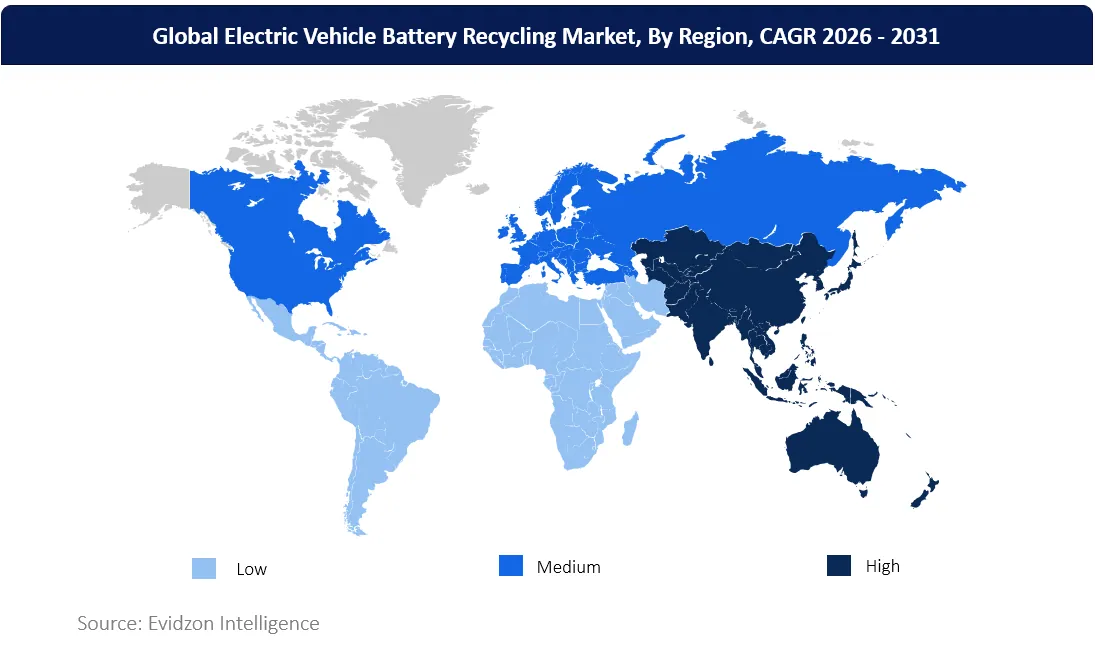
- By region, Asia-pacific accounts for 85.6% of the global EV battery recycling market, whereas Europe is anticipated to grow at 24.25% CAGR through 2031.
About the Study
The global electric vehicle battery recycling market study covers the recycling of batteries at end-of-life being removed from electric vehicles, analyzing by vehicle type, propulsion, battery chemistry, battery capacity, battery form, battery components, and recovered materials, with key regions and countries around the world. The study captures batteries being recycled from two-wheelers, three-wheelers, passenger cars, and commercial vehicles under HEV, PHEV, and BEV propulsion to understand the variations in battery chemistry, configuration and capacity, components, and materials recovered.
The study focuses exclusively on end-of-life batteries from electric vehicles and does not cover batteries being scrapped from the manufacturing process, batteries found defective or under warranty, batteries removed from non-vehicle applications, new battery production, second-life batteries being retired from service but not entering recycling, and downstream sales of recycled materials beyond the scope of the battery recycling market definition.
Market Dynamics Analysis
Drivers
Growing EV deployment is building a steadily expanding future recycling pipeline.
Recovery mandates increase the commercial value of recovered battery materials.
Battery tracking improves collection visibility and strengthens authorized recycling channels.
Higher-capacity packs increase recoverable quantities of lithium, graphite and other materials.
Hydrometallurgical and direct-recycling technologies improve recovery efficiency and material quality.
OEMs responsibility requirements increase collection coverage and channel batteries toward authorized recyclers.
Restraints
Lower lithium prices reduce revenue potential from recovered battery materials.
Installed processing capacity exceeds available battery feedstock across several recycling markets.
Lower nickel and cobalt content limits recoverable value from conventional recycling processes.
Transportation, sorting and safe handling increase costs before batteries enter recycling facilities.
The growing retirement pipeline, stricter recovery requirements for critical minerals and the development of improved recovery technologies, enhanced digital traceability, larger battery packs and OEM take-back obligations are driving the global EV battery recycling. Global EV battery deployment reached 1.2 TWh in 2025, up by nearly 30% year-on-year, which will significantly boost the future pool of EV battery recyclable content. Regional regulation like EU mandates 50% lithium recovery by 2027 and 80% by 2031, and recovery targets for cobalt, copper and nickel is 90% by 2027 and 95% by 2031 with 70% overall recycling efficiency by end of 2030, strengthening the EV battery-recycling ecosystem. Increasing battery pack sizes in battery electric vehicles has reached an average of 90 kWh in the U.S. and nearly 70 kWh in the EU in 2025, subsequently increasing the volume recovery per vehicle. Additionally, OEM responsibility frameworks and digital traceability of batteries will continue to influence collection visibility and formal recycling flows.
Recycling economics remain dependent on commodity prices, feedstock availability, collection costs and the chemistry of the batteries. Prices for lithium more than doubled between early 2025 and early 2026, demonstrating the impact that prices can have on the economics of recycling and the sensitivity of margins for recyclers. Global recycling capacity is facing high competition for material and utilization pressure due to ahead of available end-of-life battery feedstock. End-of-life EV batteries collection continues to be a key constraint, as the volumes of batteries available for recycling depend on the proportion of retired batteries that are collected. While the increasing penetration of LFP batteries in EVs significantly influencing the recycling economics due to the lower nickel and cobalt content compared to nickel-based battery chemistries, reducing the value content per end-of-life EV battery. High collection, transportation, dismantling and safe handling costs can affect the economics of recycling, particularly where prices of materials or yield rates are unattractive.
Segment Analysis
By Vehicle Type
Passenger electric car battery recycling accounts for the highest market share of 86.4% in 2025, while commercial electric vehicle battery recycling are anticipated to be the fastest vehicle type segment with 24.5% CAGR by 2031. Passenger vehicles are the primary source of recycling feedstock for electric vehicle batteries due to dominance in the installed base of electrified vehicles and the arrival of significant volumes of end-of-life battery packs.
The recycling potential is not only driven by vehicle parc size, but also by battery capacity, chemistry, vehicle age, accident retirements and the increasing number of packs reaching replacement thresholds. Commercial vehicles, while smaller in installed base, have the potential to drive faster recycling market growth as electric buses, vans and medium/heavy-duty trucks accumulate higher-capacity battery packs and operate under more aggressive duty cycles. Commercial vehicles are equipped with comparatively larger battery packs enabling higher value recovery per vehicle, offering enhanced economics of EV battery recycling.
Global Electric Vehicle Battery Recycling Market, By Vehicle Type, Market Share, 2025
Battery electric vehicle (BEV) represents the largest propulsion segment of power battery recycling accounting 65.2% market share in global power battery recycling market. However, plug-in hybrid electric vehicle (PHEV) battery recycling is anticipated to foresee a CAGR of 22.5% through 2031. The dominance of battery electric vehicle (BEV) recycling is not only shaped by the increasing representation of BEVs in sales and parc mix but also due to the comparatively larger battery pack size. The power battery recycling economics is primarily dictated by pack size, chemistry and material value content despite of vehicle volume. Larger BEV packs contain significantly more recoverable lithium, nickel, cobalt, copper and other materials that can be processed into battery feedstock.
Plug-in hybrid electric vehicle (PHEV) equipped with smaller battery packs and due to low parc volume, but offers a faster growing feedstock as early generation vehicles reaches ELV or replacement cycle. As PHEV adoption accelerates across Europe, China and other electrification-focused markets, its contribution to the overall recycling opportunity will grow in tandem with the BEV stream.
Global Electric Vehicle Battery Recycling Market, By Propulsion, Market Share, 2025
Geographic Analysis
Largest Region
Asia-pacific electric vehicle battery recycling market registered the highest market share of 85.6% in 2025 of the global electric vehicle battery recycling market. Asia-Pacific is the epicenter of global electric vehicle battery recycling market due to concentration of battery manufacturing, electric-vehicle (EV) deployment, cell supply chains and material-processing capacity. China in particular plays a special role in the EV battery recycling industry due to its large EV fleet, supported by a mature battery manufacturing industry, well-established cathode-material supply chains and growing end-of-life battery collection mandates. China's regulations effective from April 2026 create nationwide traceability of new-energy vehicle power batteries and apportion recovery responsibilities amongst battery manufacturers and vehicle producers.
The region extends beyond China as Japan, South Korea and India enhance their recycling infrastructure and capacity in tandem with growing EV and battery manufacturing industries. Asia-Pacific's competitive edge for recycling therefore derives from the proximity between End-of-Life batteries and dismantling/refining activity as well as cathode-material supply chains, limiting transport costs and enabling more attractive closed-loop recycling opportunities.
Global Electric Vehicle Battery Recycling Market, By Region, Market Share, 2025
Fastest-Growing Region
Europe electric vehicle battery recycling market is projected to be the fastest region in global electric vehicle battery recycling market by 2031 accounting for 24.25% CAGR. Europe is transforming from an emerging recycling market into a highly-regulated battery circular economy, with regulations tying battery placement, collection, recycling efficiency and material utilization. The EU Batteries Regulation stipulates lithium battery recycling efficiency of at least 70% by 2030, with material recovery requirements increasing to 50% for lithium and 90% for cobalt, copper, lead and nickel by 2027 and substantially higher targets by 2031.
Battery passports and lifecycle documentation also enhance traceability of chemistry, construction and recycled content to enable improved sorting and processing efficiency. With Europe's first large fleet of EVs entering the end-of-life phase, the combination of an increasing retired battery pool, high-stakes material recovery mandates, evolving domestic battery technologies and desire to reduce reliance on imported critical minerals will drive rapid progress on collection networks, hydrometallurgical and direct recycling capacity as well as closed-loop material supply arrangements.
Competitive Landscape
- 1Brunp Recycling Technology Co., Ltd.
- 2GEM Co., Ltd.
- 3Zhejiang Huayou Recycling Technology Co., Ltd. (Huayou Cobalt)
- 4Ganfeng Lithium Group Co., Ltd.
- 5BYD Company Limited
Market Concentration Level: Consolidated
The global electric vehicle battery recycling market comprises a fairly limited number of major recyclers, and vertically integrated battery/EV makers. The key companies includes Brunp Recycling Technology Co., Ltd. (CATL Group), GEM Co., Ltd., Zhejiang Huayou Recycling Technology Co., Ltd. (Huayou Cobalt), Ganfeng Lithium Group Co., Ltd., and BYD Company Limited, followed by next-tier including Tinci Materials Technology Co., Ltd., Jiangxi Ganzhou Highpower Technology Co., Ltd., Tianqi Lithium Corporation, Umicore SA, Redwood Materials, Inc., Glencore plc (Li-Cycle Corp), SungEel HiTech Co., Ltd., Fortum Battery Recycling, Cirba Solutions, and Ecobat Technologies Limited.
The industry witnesses a growing tendency of recyclers’ to scale up capacities to recover black-mass, close-loop material recovery loops, and establish vertically integrated chains of battery collection, dismantling, black-mass processing, and lithium, nickel, cobalt, manganese, and other metals extraction. Moreover, recycling companies are investing heavily in battery collection networks, hydrometallurgical, and direct-recycling technologies, regional processing hubs’ creation, and strategic partnerships to secure supply chains and optimize recovery and recycling.
Recent Development
U.S. Department of Commerce Ban Export of Lithium-ion Black Mass
The U.S. Department of Commerce's BIS prohibited the export of black mass from lithium-ion battery recycling and tungsten waste and scrap for one year, centralizing trade controls, critical minerals policy, and environmental regulation. Materials which were treated as waste management streams subjected to Resource Conservation and Recovery and Toxic Substances Control Act by battery recycling industry will now also subjected to defense production allocation requirements.
China Tightens Rules on Retired Battery Reuse
Ministry of Industry and IT removed the cascade utilization and revoked the approved status of 100 compliant cascade utilization operators including BYD, Huayou Resources, SVOLT Energy, Gotion High-tech, Rept Battero, and GEM, and restricts the reuse of retired electric vehicle batteries. The measure removes preferential regulatory treatment for retired batteries and subjects reused products to the same mandatory quality and safety responsibilities applicable to new products.
India and Europe has taken Joint Initiative to Strengthen EV Battery Recycling
Under the India-EU TTC, Working Group-2 on Green and Clean Energy Technologies, the EU and India has announced the launch of third coordinated call for proposals focused on EV Batteries Recycling aiming to secure critical raw material, accelerate transition to circular economy, and strengthen bilateral relations between India and the EU. A combined funding of 15.2 million Euro (USD 16.9 million) is announced for developing advanced recycling technologies.
Table of Content
- 1.Introduction
- 1.1Scope and Objective of the Study
- 1.2Market Definition & Study Assumptions
- 2.Research Methodology
- 3.Executive Summary
- 4.Market Outlook
- 4.1Market Overview
- 4.2Market Drivers
- 4.2.1Rising EV Retirements Expand Recoverable Battery Feedstock
- 4.2.2Critical-Mineral Recovery Targets Strengthen Recycling Economics
- 4.2.3Digital Traceability Formalizes Battery Collection and Handover
- 4.2.4Growing Battery Pack Sizes Increase Recoverable Material Value
- 4.2.5Advanced Recovery Technologies Improve Yield and Purity
- 4.2.6OEM Obligations Expand Formal Battery Collection Networks
- 4.3Market Restraint
- 4.3.1Falling Lithium Prices Compress Battery Recycling Economics
- 4.3.2Excess Recycling Capacity Intensifies Competition For Feedstock
- 4.3.3LFP Chemistry Reduces High-Value Material Recovery Incentives
- 4.3.4High Collection Costs Limit Economically Viable Recovery
- 4.4Regulatory Landscape
- 4.5Supply/Value Chain Analysis
- 4.6Porter's Five Forces Analysis
- 4.6.1Threat of New Entrants
- 4.6.2Bargaining Power of Buyers
- 4.6.3Bargaining Power of Suppliers
- 4.6.4Threat of Substitutes
- 4.6.5Competitive Rivalry
- 5.Market Segmentation (Includes market size in Value (USD), Forecast up to 2031, and market analysis with growth attributes)
- 5.1By Vehicle Type
- 5.1.1Two-wheeler
- 5.1.2Three-wheeler
- 5.1.3Passenger Car
- 5.1.4Commercial Vehicle
- 5.1.4.1Light Commercial Vehicle
- 5.1.4.2Medium and Heavy-Duty Trucks
- 5.1.4.3Bus and Coach
- 5.2By Propulsion
- 5.2.1Hybrid Electric Vehicle (HEV)
- 5.2.2Plug-in Hybrid Electric Vehicle (PHEV)
- 5.2.3Battery Electric Vehicle (BEV)
- 5.3By Battery Chemistry
- 5.3.1Lithium Iron Phosphate (LFP)
- 5.3.2Lithium Manganese Iron Phosphate (LMFP)
- 5.3.3Lithium Nickel Manganese Cobalt Oxide (NMC)
- 5.3.4Lithium Nickel Cobalt Aluminum Oxide (NCA)
- 5.3.5Lithium-Titanate Oxide batteries (LTO)
- 5.3.6Sodium-ion
- 5.4By Battery Capacity
- 5.4.1Below 25 kWh
- 5.4.225 -50 kWh
- 5.4.351 - 75 kWh
- 5.4.475 - 100 kWh
- 5.4.5Above 100 kWh
- 5.5By Battery Form
- 5.5.1Cylindrical
- 5.5.2Prismatic
- 5.5.3Pouch
- 5.6By Components
- 5.6.1Cathode
- 5.6.2Anode
- 5.6.3Separator
- 5.6.4Housing
- 5.6.5Thermal system
- 5.6.6Others (Structutal components, wiring, fuse, insulation, etc)
- 5.7By Materials
- 5.7.1Lithium
- 5.7.2Nickel
- 5.7.3cobalt
- 5.7.4Magnesium
- 5.7.5Iron
- 5.7.6Phosphate
- 5.7.7Graphite
- 5.7.8Copper
- 5.7.9Aluminum
- 5.7.10Others
- 5.8By Region
- 5.8.1North America
- 5.8.1.1United States
- 5.8.1.2Canada
- 5.8.2Latin America
- 5.8.2.1Brazil
- 5.8.2.2Argentina
- 5.8.2.3Mexico
- 5.8.2.4Rest of Latin America
- 5.8.3Europe
- 5.8.3.1Germany
- 5.8.3.2Italy
- 5.8.3.3France
- 5.8.3.4Spain
- 5.8.3.5United Kingdom
- 5.8.3.6Russia
- 5.8.3.7Rest of Europe
- 5.8.4Asia Pacific
- 5.8.4.1China
- 5.8.4.2India
- 5.8.4.3Japan
- 5.8.4.4South Korea
- 5.8.4.5Indonesia
- 5.8.4.6Australia
- 5.8.4.7Rest of Asia-Pacific
- 5.8.5Middle East & Africa
- 5.8.5.1Saudi Arabia
- 5.8.5.2United Arab Emirates (UAE)
- 5.8.5.3South Africa
- 5.8.5.4Egypt
- 5.8.5.5Rest of the Middle East & Africa
- 6.Competitive Landscape
- 6.1Market Concentration Overview
- 6.2Market Share Analysis
- 6.3Company Profiles
- 6.3.1Brunp Recycling Technology Co., Ltd. (CATL Group)
- 6.3.2GEM Co., Ltd.
- 6.3.3Zhejiang Huayou Recycling Technology Co., Ltd. (Huayou Cobalt)
- 6.3.4Ganfeng Lithium Group Co., Ltd.
- 6.3.5BYD Company Limited
- 6.3.6Tinci Materials Technology Co., Ltd.
- 6.3.7Jiangxi Ganzhou Highpower Technology Co., Ltd.
- 6.3.8Tianqi Lithium Corporation
- 6.3.9Umicore SA
- 6.3.10Redwood Materials, Inc.
- 6.3.11Glencore plc (Li-Cycle Corp)
- 6.3.12SungEel HiTech Co., Ltd.
- 6.3.13Fortum Battery Recycling
- 6.3.14Cirba Solutions
- 6.3.15Ecobat Technologies Limited
- 7.Future Outlook
- 7.1Growth Opportunities & White-Space Analysis
- 7.2Analyst Recommendations
Market Size Methodology
The market value is calculated by multiplying the number of end-of-life EV batteries entering the recycling stream by the corresponding average recoverable value per battery or ton of battery material processed. EOL battery volumes are estimated using the EV parc, new EV registrations, battery survival rates, average vehicle and battery lifespan, battery replacement patterns, vehicle retirement rates, and battery retirement rates. Market is segmented by vehicle type, propulsion, battery chemistry, battery capacity, battery form, battery components, recovered materials, and country/region to capture differences in battery composition, pack size, recoverable material content, recovery efficiency, and recycling economics.
Government statistics, vehicle and EV registrations, battery-recycling authorities, industry associations, company disclosures, regulatory filings, and industry studies are used to benchmark historical values.
Forecasts consider EV parc, EV sales, vehicle age, battery retirement rates, battery chemistry and capacity mix, EV adoption, recycling penetration, collection rates, recovery yields, recycled-material prices, battery replacement rates, recycling capacity, recycling infrastructure, regulatory requirements, and regional battery recycling policies.
FAQ
What is the projected size of the global electric vehicle battery recycling market by 2031?
The global electric vehicle battery recycling market is projected to grow from USD 9.80 billion in 2025 to USD 21.13 billion by 2031, registering a CAGR of 13.74% during 2026–2031.
Which vehicle type dominates the global electric vehicle battery recycling market?
Passenger car battery recycling dominates the market, accounting for 86.4% of the market share in 2025.
Which battery chemistry accounts for the largest market share, and which is expected to grow fastest?
Lithium nickel manganese cobalt oxide (NMC) battery recycling holds the largest share at 48.8% in 2025, while lithium iron phosphate (LFP) battery recycling is projected to grow at a CAGR of 25.5% during 2026–2031.
Which region dominates the global electric vehicle battery recycling market, and which is expected to grow fastest?
Asia-Pacific leads the market, accounting for 85.6% of the global market in 2025. Europe is projected to be the fastest-growing region, with a CAGR of 24.25% during 2026–2031.
Who are the key players in the global electric vehicle battery recycling market?
Brunp Recycling Technology Co., Ltd. (CATL Group), GEM Co., Ltd., Zhejiang Huayou Recycling Technology Co., Ltd. (Huayou Cobalt), Ganfeng Lithium Group Co., Ltd., and BYD Company Limited are the key players in the global electric vehicle battery recycling market.
Have a question about this report?
Talk to the analyst behind this research, or browse the full report catalogue.
Contact Us