
Global Electric Vehicle Market
The global electric vehicle market report is segmented by propulsion (HEV, PHEV, BEV, and FCEV), by vehicle type (Passenger car and commercial vehicle), by battery chemistry (LFP, NMC, NCA, and Others), by motor architecture type (Permanent-Magnet Synchronous Motors (PMSM/IPM), Induction Motors (IM), and Others (SRM, Axial Flux, etc.)), by voltage range ( Low Voltage (Below 200 Volt), Medium Voltage (200-400 Volt), and High Voltage (Above 400 Volt)), and by region (North America, South America, Europe, Asia-Pacific, and Middle-East and Africa). The global electric vehicles market report includes market size in Value (USD) and Volume (Units), and Forecast up to 2031.
Global Electric Vehicle Market
Market Size in USD Billion
Market Size Overview
USD Billion
Market Snapshot
- Study Period
- 2019-2031
- Forecast Period
- 2026-2031
- Base Year Market Size (2025)
- USD 1,194 Billion
- Market Size (2026)
- USD 1,280.8 Billion
- Market Size (2031)
- USD 2,037.9 Billion
- Growth Rate (2026-2031)
- 9.73% CAGR
- Market Concentration
- Consolidated
Major Players*




*Disclaimer: Major Players sorted in no particular order
Market Overview
The global electric vehicle market value is anticipated to grow from USD 1,194 billion in 2025 to 1,280.8 billion in 2026 and expected to reach USD 2,037.9 billion in 2031 with a CAGR (2026-2031) of 9.73%.
The global electric vehicle industry structure is dynamically shifting from new-age propulsion to mainstream automotive segment fueled by expanding infrastructure readiness, increasing model availability across vehicle types, improving battery technology coupled with government initiatives aimed to reduce the carbon footprint from mobility segment. OEMs are increasing focused on the research and development of electric powertrain across passenger cars and commercial vehicle portfolio owing to corporate average fuel efficiency (CAFE) norms to meet average fuel efficiency and carbon dioxide (CO₂) emission targets across their entire fleet of vehicles sold. For new passenger cars, the European Union enforces fleet-wide CO2 emission performance criteria aiming for 93.6 g CO2/km from 2025 to 2029, tightening to 49.5 g CO2/km from 2030 to 2034, and reaching a 100% reduction (zero-emission target) beginning in 2035 [Source: European Environment Agency].
Battery electric vehicle remain at the center of the electric vehicle market, whereas hybrid electric vehicle (HEV) and plug-in hybrid electric vehicle is acting as a transition technology from conventional internal combustion engine (ICE) to battery electric vehicles (BEVs). Additionally, battery economics are making EVs more commercially viable. While LFP batteries made up more than 55% of the world's EV battery deployment in 2025, average battery prices fell by an additional 8% [Source: IEA]. Charging infrastructure, vehicle affordability, and supply chain disruptions are impacting the overall market potential.
Regional governments are driving mobility electrification through regulatory support, incentives, and infrastructure developments, whereas, OEM investment in emerging markets with affordable EV models and localized manufacturing will remain key attribute of success. However, the concentration of the battery supply chain continues to be a significant factor: China produced almost 90% of the anode active material, 85% of the cathode active material, and nearly 80% of the battery cells globally [Source: IEA].
Key Takeaways
- By propulsion, battery electric vehicle (BEV) remains the largest sub-segment accounting for nearly 70% of the electric vehicle segment in 2025. Whereas, fuel-cell electric vehicles (FCEVs) are expected to be the fastest growing electric vehicle segment at 22% CAGR by 2031.
- By vehicle type, passenger accounts for nearly 90% market share in 2025. However, commercial electric vehicles are expected to grow at a CAGR of 16.5% by 2031.
- By battery chemistry, lithium iron phosphate (LFP) segment has registered the highest market value share of nearly 55% in 2025 of global electric vehicle market and is expected to ride at a 14% CAGR over the forecast period.
- By motor architecture type, permanent-magnet synchronous motors (PMSM/IPM) will remain the dominant demand base with more than 67% market share in 2025, and projected to grow at 13.5% CAGR by 2031.
- By voltage range, medium voltage (200-400 Volt) accounts for 47% global electric vehicle market share in 2025. However the high voltage (Above 400 Volt) is projected to witness a CAGR of more than 15% during 2026-2031.
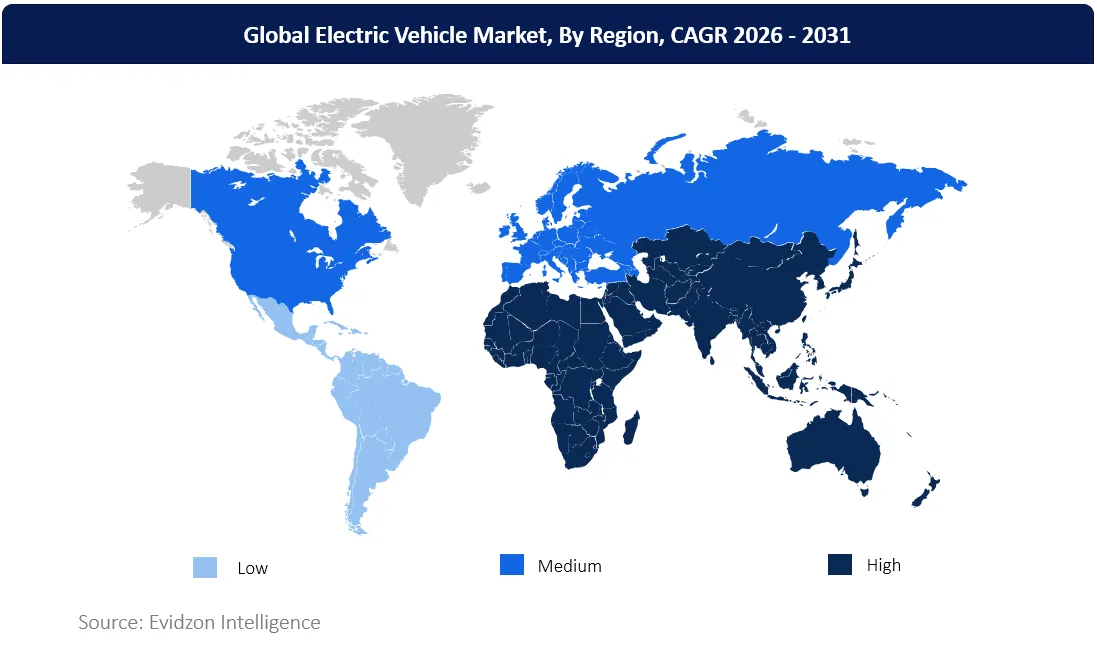
- By region, Asia-pacific accounts for 49% of the global electric vehicle market and Middle East & Africa expected to grow at a CAGR of 18.3% through 2031.
About the Study
The global electric vehicle market study covers the new passenger cars and commercial vehicles across different propulsion technologies, vehicle types, battery chemistry, motor architecture type, voltage range, with analysis across major global regions and countries. The study excludes used electric vehicles, two-wheelers, three-wheelers, standalone batteries, battery raw materials, charging infrastructure, charging services, and standalone electric motors.
Market Dynamics Analysis
Drivers
Lower battery costs enable broader pricing and consumer accessibility.
Tighter regulations push automakers toward lower-emission vehicle portfolios.
Wider charging access improves convenience and strengthens consumer confidence.
High utilization and predictable routes strengthen fleet electrification economics.
Expanded model choices serve varied budgets and performance requirements.
Better batteries, motors, and power electronics enhance vehicle capabilities.
Restraints
Infrastructure gaps limit convenient charging across multiple user settings.
Higher upfront costs deter budget-conscious buyers despite potential savings.
Concentrated mineral supplies expose manufacturers to cost and geopolitical risks.
Policy changes create demand volatility and complicate investment decisions.
Technological, regulatory, and economic factors have a collective influence on the electric vehicle adoption across the globe. Increasing battery chemistry technology allows OEMs to overcome the customer’s ambiguity on range anxiety. Tightening emission regulations and CAFÉ norms are encouraging OEMs to expand their portfolio across electric vehicles resulting in increased investment in EV platforms. While LFP pack prices were more than 40% less per kWh than NMC in 2025, average EV battery prices decreased by 8%, expanding the cost advantage of less expensive battery technologies. Falling battery pack cost improves the overall price dynamics of electric vehicle allowing OEMs to offer higher battery capacity vehicle, reducing the price gaps and go beyond the premium product lines which is further fuelling the mass adoption. Large-scale improvements in charging availability are also occurring: in 2025, the world's public charging infrastructure grew by more than 33%, adding about 1.8 million new charging stations, bringing the total to over 7 million [Source: IEA].
Despite such appealing market drivers, charging infrastructure readiness level, high upfront cost, critical-mineral supply risks, fluctuating government incentives and electrification policies are some of the major headwinds restricting the adoption potential of electric vehicles. In addition to this, increasing competitiveness from Chinese manufacturers with vertically integrated supply chains and cost-competitive EV portfolios is consolidating the market and established OEMs are expected to feel the pressure over the coming years. Geographical disparities in battery pricing persist, in 2025, battery packs in China were roughly 30% cheaper than in North America and 35% less expensive than in Europe, giving Chinese-based EV and battery manufacturers a cost advantage [Source: IEA]. Affordability, infrastructure, technology development and policy stability will remain key attributes despite strong adoption trend.
Segment Analysis
By Propulsion
Battery electric vehicle (BEV) accounts for the highest market share of nearly 70% in 2025 while, fuel-cell electric vehicles (FCEVs) are expected to grow at 22% CAGR by 2031. Increasing OEM investment in dedicated electric vehicle architecture, improving battery economics, expanding charging infrastructure coupled with increasing customer acceptance for battery electric vehicles are the key attributes aiding in high market share. Customers seeking high driving flexibility and markets with low and developing charging infrastructure are transitioning towards plug-in hybrid electric vehicles (PHEVs). The combination of electric propulsion system and internal combustion engine serves as a transitional solution for customers concern of range and charging infrastructure readiness level.
Whereas, hybrid electric vehicles (HEVs) are making their ground and allowing an option of low-emission mobility in markets with limited charging infrastructure. However, fuel-cell electric vehicles (FCEVs) is still a niche segment with concentrated adoption in limited application due to low hydrogen fuelling stations and unfavorable vehicle economics. Battery electric vehicles (BEVs) is anticipated to remain the principal segment of electric vehicle market due to OEMs full electric platform prioritization, favorable regional policies, incentives and a positive advantage in total cost of ownership (TCO).
Global Electric Vehicle Market, By Propulsion, Market Share, 2025
By Vehicle Type
Passenger cars represent the largest vehicle type category with 90% market share in global electric vehicles market, whereas commercial electric vehicles are expected to grow at a CAGR of 16.5% by 2031. Increasing consumer adoption, expanding product availability across passenger vehicle types and rapid inclusion of electrification in mainstream automotive portfolios will continue to support the growth curve of passenger cars over the forecast period. Increasing consumer preference for spacious interiors, higher seating positions, perceived safety, versatility and lifestyle-oriented designs has created electric SUVs a lucrative cross border passenger car segment. Whereas, hatchbacks are preferred for its compact dimensions, affordability and urban maneuverability.
Commercial electric vehicles offer a potential growth opportunity due to its predictable routes, centralized charging and lower total cost of ownership (TCO). Electric light commercial vehicle is gaining tractions in last-mile delivery applications. Whereas, electric buses and coaches demand is increasing on the back of regional public transport and fleet decarbonization targets.
Global Electric Vehicle Market, By Vehicle Type, Market Share, 2025
Geographic Analysis
Largest Region
Asia Pacific registered the highest market share of 49% in 2025 of global electric vehicle market. Asia pacific electric vehicle market dominance is majorly supported by China’s electric vehicle ecosystem and control across the EV supply chain from critical minerals mining to EV recycling. Such integrated supply chain allows China to be at the center of EVs demand and production. Whereas, India electric vehicle market is fuelling by the favorable localized manufacturing policies like PLI (Production Linked Scheme) and increasing EV adoption with expansion of production capacities. Cutting-edge technology, mature automotive ecosystem and increasing battery manufacturing capacity are the tailwind for South Korea and Japan electric vehicle market. Continued expansion of Asia Pacific electric vehicle market is poised to be on the back of further increasing customer adoption of EVs, expanding charging infrastructure, improving EV battery economics, increasing localized manufacturing in potential countries like India and South-East Asia electric vehicle markets.
However, China will remain the primary growth engine with highest market share driven by high adoption rate, while countries like India and South-East Asia region with greater headroom left for further penetration will drive the growth curve. Strong battery manufacturing capabilities, expanding EV model availability and significant investment across the electric vehicle supply chain will enables region to be in a center role of automobile electrification. Moreover, high manufacturing scale, supplier availability, integrated supply-chain, governments support and customer adoption has been the key attributes which allows Asia Pacific to be on the top of global electric vehicle market.
Global Electric Vehicle Market, By Region, Market Share, 2025
Fastest-Growing Region
Middle East & Africa is projected to be the fastest region in global electric vehicle by 2031 accounting for 18.3% CAGR. In 2025, the Middle East new EVs sales were around 75,000 units, while Africa sold about 25,000 units. In South Africa, EV sales remained below 1% of all new cars sold [Source: IEA]. Provides a significantly greater CAGR-growth opportunity than established EV markets. As Saudi Arabia, Qatar, and other markets grew, the UAE's share of Middle Eastern electric car sales decreased from >60% in 2023 to over 50% in 2025. Together, Saudi Arabia and Qatar accounted for approximately 45% of the Middle East's EV demand in 2025; these two markets have been among the fastest-growing in the region.
More than 80% of EVs in certain Middle Eastern and African regions are imported from China; in 2025, Chinese brands accounted for over 60% of Middle Eastern EV sales, compared to about 15% for Tesla. In 2025, Africa imported 44,358 EVs from China, more than double of 19,386 EVs in 2024.
Competitive Landscape
- 1BYD Company Ltd.
- 2Tesla Inc.
- 3Geely Auto Group
- 4SAIC Motor Corporation Ltd.
- 5Volkswagen AG
Market Concentration Level: Consolidated
Chinese manufacturers, Tesla, and a small number of established global OEMs dominate the worldwide electric car industry. In 2025, Chinese automakers accounted for around 60% of the world's electric car sales, with North American and European manufacturers each contributing roughly 15%. This gave Chinese brands a distinct volume edge. Battery economics, vehicle pricing, driving range, charging performance, software capabilities and manufacturing efficiency are the core areas where players are competing. With a wide range of BEV and PHEV models, vertical battery integration, and a presence at several price points, BYD continues to be the top Chinese EV maker.
Aggressive international expansion, broad product portfolios, vertically integrated supply chain; technology upper-hand allows China based players to establish their presence globally. With the Model Y and Model 3, Tesla continues to be a significant worldwide pure-play rival. The next competitive tier is made up of Geely, SAIC, Chery, Changan, Volkswagen Group, Hyundai-Kia, and BMW, which combine well-established distribution networks with growing EV portfolios. Battery cost, software, intelligent driving, low-cost models, and overseas manufacturing are becoming more competitive.
Recent Development
Ford Announced USD 2 billion manufacturing upgrade for Fathom EV Production
Ford stated that its future Fathom electric vehicle, costing around USD 28,000, will begin production in early 2027 at its fully refurbished Louisville Assembly Plant. As part of Ford's larger electrification strategy, the facility is being converted for EV production. The Fathom will be powered by Ford's new Universal EV Platform, demonstrating the industry's growing emphasis on low-cost EV architectures and production efficiency.
BYD Plan to Install 3,000 Flash-Charging 1,500 kW Stations Across Europe
As part of a strategy to install 3,000 ultra-fast 1,500 kW charging stations throughout Europe by the end of 2026, BYD has inaugurated its first commercial flash-charging station in Germany. By the end of 2026, BYD intends to deploy 6,000 flash-charging stations outside of China, half of which will be across Europe.
Volkswagen ID. Polo and CUPRA Raval will manufactured at the SEAT & CUPRA Facility in Martorell
Production of the CUPRA Raval and Volkswagen ID. Polo begins at the SEAT & CUPRA facility in Martorell, Barcelona, Catalonia, Spain, a project spearheaded by SEAT & CUPRA on behalf of the Volkswagen Group's Brand.
Table of Content
- 1.Introduction
- 1.1Scope and Objective of the Study
- 1.2Market Definition & Study Assumptions
- 2.Research Methodology
- 3.Executive Summary
- 4.Market Outlook
- 4.1Market Overview
- 4.2Market Drivers
- 4.2.1Declining Battery Costs Expand Electric Vehicle Affordability
- 4.2.2Stricter Emission Standards Accelerate Automotive Electrification
- 4.2.3Expanding Charging Networks Reduce Adoption Barriers
- 4.2.4Fleet Electrification Improves Commercial Vehicle Operating Economics
- 4.2.5Broader EV Portfolios Address Diverse Consumer Preferences
- 4.2.6Technological Advances Improve Electric Vehicle Performance
- 4.3Market Restraint
- 4.3.1Uneven Charging Access Constrains Electric Vehicle Adoption
- 4.3.2High Purchase Prices Restrict Mainstream EV Adoption
- 4.3.3Critical Mineral Concentration Increases Battery Supply Vulnerability
- 4.3.4Uncertain Incentive Policies Disrupt Electric Vehicle Demand
- 4.4Regulatory Landscape
- 4.5Supply/Value Chain Analysis
- 4.6Porter's Five Forces Analysis
- 4.6.1Threat of New Entrants
- 4.6.2Bargaining Power of Buyers
- 4.6.3Bargaining Power of Suppliers
- 4.6.4Threat of Substitutes
- 4.6.5Competitive Rivalry
- 5.Market Segmentation (Includes market size in Value (USD), Forecast up to 2031, and market analysis with growth attributes)
- 5.1By Propulsion
- 5.1.1Hybrid Electric Vehicle (HEV)
- 5.1.2Plug-in Hybrid Electric Vehicle (PHEV)
- 5.1.3Battery Electric Vehicle (BEV)
- 5.1.4Fuel Cell Electric Vehicle (FCEV)
- 5.2By Vehicle Type
- 5.2.1Passenger Car
- 5.2.1.1Hatchback
- 5.2.1.2Sedan
- 5.2.1.3SUV
- 5.2.1.4Multi-Purpose Vehicle (MPV)
- 5.2.1.5Others (Crossover, Coupe, Convertible, Wagon)
- 5.2.2Commercial Vehicle
- 5.2.2.1Light Commercial Vehicle
- 5.2.2.2Medium and Heavy-Duty Trucks
- 5.2.2.3Bus and Coach
- 5.3By Battery Chemistry
- 5.3.1Lithium Iron Phosphate (LFP)
- 5.3.2Lithium Nickel Manganese Cobalt Oxide (NMC)
- 5.3.3Lithium Nickel Cobalt Aluminum Oxide (NCA)
- 5.3.4Others (LMFP, LTO, etc.)
- 5.4By Motor Architecture Type
- 5.4.1Permanent-Magnet Synchronous Motors (PMSM/IPM)
- 5.4.2Induction Motors (IM)
- 5.4.3Others (SRM, Axial Flux, etc.)
- 5.5By Voltage Range
- 5.5.1Low Voltage (Below 200 Volt)
- 5.5.2Medium Voltage (200-400 Volt)
- 5.5.3High Voltage (Above 400 Volt)
- 5.6By Region
- 5.6.1North America
- 5.6.1.1United States
- 5.6.1.2Canada
- 5.6.2Latin America
- 5.6.2.1Brazil
- 5.6.2.2Argentina
- 5.6.2.3Mexico
- 5.6.2.4Rest of Latin America
- 5.6.3Europe
- 5.6.3.1Germany
- 5.6.3.2Italy
- 5.6.3.3France
- 5.6.3.4Spain
- 5.6.3.5United Kingdom
- 5.6.3.6Russia
- 5.6.3.7Rest of Europe
- 5.6.4Asia Pacific
- 5.6.4.1China
- 5.6.4.2India
- 5.6.4.3Japan
- 5.6.4.4South Korea
- 5.6.4.5Indonesia
- 5.6.4.6Australia
- 5.6.4.7Rest of Asia-Pacific
- 5.6.5Middle East & Africa
- 5.6.5.1Saudi Arabia
- 5.6.5.2United Arab Emirates (UAE)
- 5.6.5.3South Africa
- 5.6.5.4Egypt
- 5.6.5.5Rest of the Middle East & Africa
- 6.Competitive Landscape
- 6.1Market Concentration Overview
- 6.2Market Share Analysis
- 6.3Company Profiles
- 6.3.1BYD Company Ltd.
- 6.3.2Tesla Inc.
- 6.3.3Geely
- 6.3.4SAIC Motor Corporation Ltd.
- 6.3.5Volkswagen AG
- 6.3.6Hyundai Motor Company
- 6.3.7Nissan Motor Co. Ltd.
- 6.3.8Stellantis N.V.
- 6.3.9General Motors Company
- 6.3.10Ford Motor Company
- 6.3.11Toyota Motor Corporation
- 6.3.12BMW AG
- 6.3.13Honda Motor Co. Ltd.
- 6.3.14Volvo Car AB
- 6.3.15Rivian Automotive Inc.
- 7.Future Outlook
- 7.1Growth Opportunities & White-Space Analysis
- 7.2Analyst Recommendations
FAQ
What is the projected size of the global electric vehicle market by 2031?
The global electric vehicle market is projected to reach USD 2,037.9 billion by 2031, increasing from USD 1,194 billion in 2025. The market is expected to grow at a CAGR of 9.73% during 2026–2031.
Which propulsion segment dominates the global electric vehicle market?
Battery Electric Vehicles (BEVs) dominate the market, accounting for approximately 70% of the market in 2025.
Which electric vehicle segment is expected to grow fastest by propulsion type?
Fuel Cell Electric Vehicles (FCEVs) are projected to be the fastest-growing propulsion segment, with a CAGR of 22% through 2031.
Which region holds the largest share of the global electric vehicle market?
Asia-Pacific accounts for approximately 49% of the global electric vehicle market in 2025.
Which companies are the major players in the global electric vehicle market?
YD Company Ltd., Tesla Inc., Geely Auto Group, SAIC Motor Corporation Ltd., and Volkswagen AG as the five major players. Competition focuses on vehicle pricing, battery costs, driving range, charging performance, software capabilities, manufacturing efficiency, and product availability across price categories.
Market Size Methodology
The market value is determined by multiplying the sales volume of new electric vehicles by the corresponding average selling price (ASP). To account for variations in vehicle mix, battery content, and cost, ASP is evaluated by propulsion type, vehicle type, battery chemistry, battery capacity, voltage architecture, and country.
EV registrations, OEM sales disclosures, government statistics, trade groups, and corporate filings are used as benchmarks for historical projections. While, changes in EV sales volumes, propulsion mix, battery costs, vehicle pricing, charging infrastructure, model availability, technological uptake, consumer preferences, and regulatory conditions are taken into account for forecast.
Have a question about this report?
Talk to the analyst behind this research, or browse the full report catalogue.
Contact Us