
Global Electric Vehicle Financing Market
The global electric vehicle financing market report is segmented by vehicle type (Passenger Car and Commercial Vehicle), by propulsion (Hybrid Electric Vehicle (HEV), Plug-in Hybrid Electric Vehicle (PHEV), and Battery Electric Vehicle (BEV)), by finance source (Bank, NBFCs, OEM Captive Finance, and Credit Unions), by customer type (Individual, Fleet Operator, Enterprise/Corporate, and Government/Public Sector), by loan tenure (Less than 3 Years, 3-5 Years, and More than 5 Years), and by region (North America, Latin America, Europe, Asia-Pacific, and Middle-East and Africa). The global electric vehicle financing market report includes market size in Value (USD) and forecast up to 2031.
Global Electric Vehicle Financing Market
Market Size in USD Billion
Market Size Overview
USD Billion
Market Snapshot
- Study Period
- 2019-2031
- Forecast Period
- 2026-2031
- Base Year Market Size (2025)
- USD 681.87 Billion
- Market Size (2026)
- USD 743.01 Billion
- Market Size (2031)
- USD 1,279.62 Billion
- Growth Rate (2026-2031)
- 11.5% CAGR
- Market Concentration
- Moderate
Major Players*





*Disclaimer: Major Players sorted in no particular order
Market Overview
The global electric vehicle financing market value is anticipated to grow from USD 681.9 billion in 2025 to 743 billion in 2026 and expected to reach USD 1,279.6 billion in 2031 with a CAGR (2026-2031) of 11.5%.
The electric-vehicle-finance market is evolving as EVs cross the threshold to becoming a mainstream new-vehicle category. Surging EV sales, higher-than-average vehicle prices, shifting payment preferences, growing OEM captive-finance programs, electrification of commercial fleets and the emergence of EV-specific underwriting are the core attributes fuelling the global electric vehicle financing market. Global electric-car sales passed 20 million units in 2025, representing 25% of all new-car sales - an order of magnitude increase in potential financed vehicles.
Plug -in hybrids financing is emerging rapidly due to sales growth from smaller base, while battery electric vehicles dominate EV finance landscape. BEVs accounted for approximately 65% of global electric-car sales in 2025, with China alone selling more than 13 million electric cars - representing around six in ten electric cars sold worldwide. EVs often require battery condition and degradation expectations, technology obsolescence, charging infrastructure requirements and residual value analysis in addition to standard borrower credit analysis. Such factors affect loan-to-value expectations, residual assumptions, payment structures and liquidation values.
OEM captive finance is gaining strategic importance by enabling financing to be integrated into the EV-sales and leasing process. Bundle discounted interest rates, leasing options, insurance products, maintenance packages and vehicle replacement programs are the factors on which OEM captive financing companies are playing to corner larger market chunk, Meanwhile, banks and NBFCs are competing by offering finance across brands and vehicle types with tailored services.
Asia Pacific continues to drive the EV-finance opportunity, with China leading the way through both extraordinary EV sales and an expanding domestic credit ecosystem. Europe is emerging with increasing electric vehicle sales on the back of stringent emissions regulations, while macros economic factors interest rates, vehicle pricing and tax policy changes are driving the demand in North America. Entry-level EVs create affordability opportunities across developing markets across Southeast Asia, Latin America and other emerging economies.
Key Takeaways
- By vehicle type, passenger car electric vehicle financing accounts for 82.4% market share of the global electric vehicle financing market in 2025 , while commercial vehicle electric vehicle financing is expected to grow at a 14.8% CAGR during 2026–2031.
- By propulsion, battery electric vehicle (BEV) financing accounts for 65.8% market share in 2025, while plug-in hybrid electric vehicle (PHEV) financing is expected to grow at a 13.6% CAGR during 2026–2031.
- By finance source, banks accounts for 42.1% market share in 2025, while OEM captive finance is expected to grow at a 12.7% CAGR during 2026–2031.
- By customer type, individual customer accounts for 78.6% market share in 2025, while fleet operators is expected to grow at a 13.4% CAGR during 2026–2031.
- By loan tenure, 3-5 years segment accounts for 56.7% market share in 2025, while more than 5 years is expected to grow at 13.7% CAGR during 2026–2031.
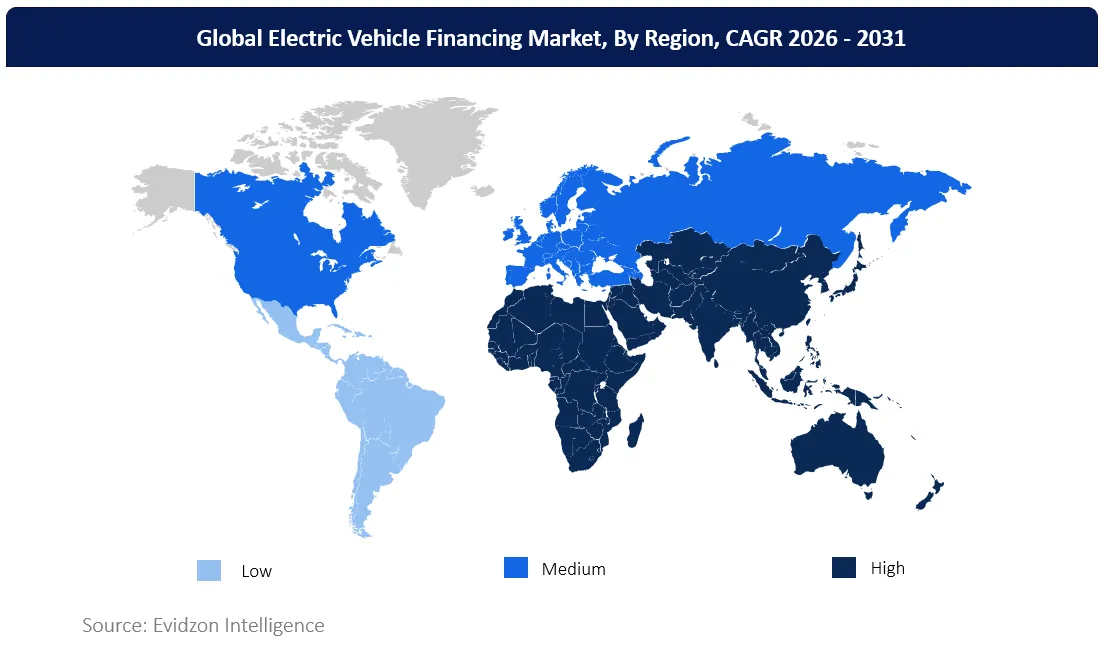
- By region, Asia Pacific accounts for 46.2% of the global electric vehicle financing market in 2025 whereas Middle-East and Africa anticipated to grow at a 21.4% CAGR through 2031.
About the Study
The global electric vehicle financing market study covers financing for new passenger cars and commercial vehicles across EV powertrains, finance sources, customer types, loan tenures, and major global regions. The study analyzes financing provided by banks, NBFCs, OEM captive finance companies, credit unions and other providers, covering individuals, fleet operators, enterprises/corporates and government/public-sector customers with key regions and countries around the world. The study excludes used vehicle financing, along with two-wheelers, three-wheelers, dealer floor-plan financing, non-vehicle asset financing, insurance, maintenance and aftermarket services, charging infrastructure, and other mobility or financial services not directly associated with financing the acquisition of new vehicles.
Market Dynamics Analysis
Drivers
Larger financed balances increase interest income and overall portfolio value.
Captive finance offers loans directly within vehicle sales.
Battery-health information improves collateral assessment and financing risk differentiation.
Commercial replacement cycles generate larger contracts and repeat financing.
Lenders incorporate charging equipment and related costs into financing structures.
Integrated applications accelerate approvals and reduce friction across dealer and online channels.
Restraints
Rapid model launches and price cuts complicate future vehicle-value assumptions.
Battery replacement exposure affects collateral assessment and borrower economics.
Limited charging availability weaken utilization assumptions for commercial electric fleets.
Changes in purchase incentives alter monthly payments and borrower demand.
Increasing transaction value, EV penetration and lenders portfolio with dedicated EV lending is collectively driving the EV financing market. Higher-priced electric SUVs, premium vehicles, vans and trucks drive larger financing balances per contract, expanding revenue potential per originated contract. OEM captives have the added benefit of being able to embed the financing directly into the vehicle transaction. Information on battery health is proving increasingly valuable to underwriting as it can enhance the evaluation of the vehicle's collateral value and projected resale value. Fleet electrification offers another high-value channel as commercial operations replace vehicles on a recurring basis. The scope of EV financing is expanding beyond vehicle, allowing eligible EV to include the cost of associated charging stations, led to increase the overall addressable base.
The key EV financing market constraints includes asset risk and portfolio-economics and not limited to EV affordability. Sharp price reductions on new-EVs can quickly reduce the value of the financed vehicles, resulting in losses to the lender/lessor upon return or repossession. Key OEM captive companies like Volkswagen Financial Services has highlighted risk around residual values, advancement in battery technology devalue existing electric vehicles as newer technologies come to market. Repair economics around EVs present a second issue, as batteries, power electronics and integrated electronics can comprise a large value component within a vehicle, potentially reducing salvage recoveries on severe damage or default. Finally, the cost of funding continues to loom large, as lenders fund their EV portfolios through deposits, capital markets, bank funding and securitization; Toyota singles out changing interest rates and funding costs as an issue around financial-services profitability.
Segment Analysis
By Vehicle Type
Passenger car financing accounts for the highest market share of 82.4% in 2025, while commercial electric vehicle financing is anticipated to be the fastest vehicle-financing segment with 14.8% CAGR by 2031. Passenger cars continue to dominate electric vehicle to the high EV adoption, where financing is used to offset higher transaction prices at purchase. Electric vehicle financing is most acute for battery-electric SUVs, crossovers and premium vehicles, which tend to have significantly higher purchase values than conventional compact passenger cars. Indeed, in China, electric cars accounted for around 50% of new-car sales in 2025, with Europe also seeing a large increase in battery-electric registrations in the same period, creating a strong tailwind effect.
Meanwhile, commercial vehicle financing is increasing at an accelerating rate as electric vans, buses and trucks transition from early adopter segments to mainstream fleet replacement. According to IEA, the global sales of electric trucks has surpassed 400,000 unit sales volume in 2025, with increasing adoption of electric vans across Europe. Large ticket sizeand recurring fleet replacement drives the commercial EV financing while, higher vehicle prices, charging requirements and uncertain residual values add uncertainty and constraint the growth potential.
Global Electric vehicle Financing Market, By vehicle Type, Market Share, 2025
By Propulsion
Battery electric vehicle (BEV) represents the largest propulsion segment of electric vehicle financing accounting 65.8% market share while, plug-in hybrid electric vehicle (PHEV) is anticipated to foresee a CAGR of 13.6% through 2031. BEVs comprise the largest category of propulsion for electric vehicle financing due to their dominance in global electric-car sales and higher financing exposure per unit compared to conventional hybrids. IEA reported more than 20 million electric cars sold worldwide in 2025, with BEVs dominating the category. Battery warranties, residual values, charging costs and rapid technology depreciation are increasingly factored into BEV financing models.
PHEVs are growing more rapidly from a smaller base as consumers and fleets seek electrification without the reliance on public charging infrastructure. PHEV financing is supported by reduced range anxiety and applicability to markets with uneven public charging availability. HEVs maintain financing relevance, but face headwinds in growth due to the smaller value premium of the technology and lack of zero-emission transition benefits relative to battery-electric vehicles.
Global Electric vehicle Financing Market, By Propulsion, Market Share, 2025
Geographic Analysis
Largest Region
Asia-pacific electric vehicle financing market registered the highest market share of 46.2% in 2025 of the global electric vehicle financing market. Asia Pacific offers the largest geographic opportunity for electric vehicle financing due to strong new-car sales volumes, growing consumer-credit penetration, large domestic banking systems and significant OEM captive-finance activity. China dominates the region as the world's largest electric vehicle market with electric cars representing around 60% of new-car sales in 2025, providing a substantially larger addressable financing opportunity than most other markets. India is building a different financing opportunity with electric vehicles gaining traction in both passenger cars and commercial three-wheelers while banks,
NBFCs and OEM-linked financiers develop products specific to the segment. Southeast Asia is also emerging as a growth region with increasing production and sales of electric vehicles in Thailand, Indonesia, Malaysia and Vietnam. The region's potential is enhanced by both the expansion of EV units and the growth in loan penetration, digital origination, competitive interest rates and the shift of EV purchases from early adopters to mainstream consumers.
Global Electric vehicle Financing Market, By Region, Market Share, 2025
Fastest-Growing Region
Middle-East and Africa electric vehicle financing market is projected to be the fastest region in global electric vehicle financing market by 2031 accounting for 21.4% CAGR. Middle East and Africa is set to become the fastest growing region for EV financing from a relatively low penetrated base. Premium EV adoption across GCC, fleet electrification, government sustainability programs and the emergence of vehicle-finance channels are collectively driving the growth. The opportunity pocket varies across the MEA region, UAE offers a developed EV ecosystem featuring high premium vehicle penetration, growing charging infrastructure and government electrification programs.
While, Saudi Arabia demand is building through domestic automotive investments and economy diversification programs, creating opportunities for EV finance providers as local supply increases. In Africa, adoption is still concentrated in certain markets and commercial segments - electric buses and urban mobility fleets - where financing structures can be more important than traditional auto retail lending.
Competitive Landscape
- 1Bank of America
- 2JPMorgan Chase – Chase Auto
- 3Toyota Financial Services
- 4GM Financial
- 5Volkswagen Financial Services
Market Concentration Level: Moderate
The global electric vehicle financing market is becoming increasingly competitive as sales evolve from early-adopter to mainstream consumer and fleet adoption. Competitive landscape is increasingly defined by access to low-cost funding, EV-specific underwriting, OEM distribution, residual-value assessment, battery-risk management, digital origination and financing flexibility, rather than the scale of vehicle financing.
Key OEM Captive finance organization including Volkswagen Financial Services, Toyota Financial Services, Ford Credit, GM Financial, Hyundai Capital and BMW Financial Services combining vehicle pricing, financing incentives, leasing, insurance and after-sales relationships. Funding depth, broad customer relationships and ability to finance EVs at high volume across brands enables banks to remain a key competitive segment. Bank of America and JPMorgan Chase compete on established auto-loan infrastructure, while regional banks are increasingly building EV-specific propositions.
Recent Development
VinFast India Partners Tata Capital for Financing
VinFast India signs a Memorandum of Understanding (MoU) with Tata Capital to offer tailored financing solutions for its dealer financing programs, including inventory financing, working capital and expansion of showrooms. The partnership is focused to enhance VinFast dealer’s liquidity while supporting the company’s expansion plans in India.
Renault Ampere Launches China EV Investment Fund
Renault’s EV business segment Ampere has joined forces with several Chinese companies, including CICC Capital PE, to create an EV industry investment fund in Hangzhou, China. The fund will focus on batteries, smart driving, smart cockpits and embodied intelligence to bolster Renault’s position in the Chinese EV market.
Tesla Partnered with Axis Bank
Axis bank, one of the India’s largest private sector bank announced to become a preferred finance partner for Tesla to offer customized financing solution to Tesla customers. Axis bank is offering tailored payment schemes, loan tenure up to 10 years, and digital onboarding and disbursement.
Table of Content
- 1.Introduction
- 1.1Scope and Objective of the Study
- 1.2Market Definition & Study Assumptions
- 2.Research Methodology
- 3.Executive Summary
- 4.Market Outlook
- 4.1Market Overview
- 4.2Market Drivers
- 4.2.1Higher EV Ticket Values Expand Financing Revenue Per Unit
- 4.2.2OEM Financing Penetration Converts EV Sales into Credit Demand
- 4.2.3Battery Data Improves EV Credit and Residual Value Underwriting
- 4.2.4Fleet Electrification Creates Recurring High Value Financing Portfolios
- 4.2.5Charging Infrastructure Financing Broadens EV Credit Opportunities
- 4.2.6Digital Onboarding and Disbursement Reduces Acquisition Costs
- 4.3Market Restraint
- 4.3.1EV Residual-Value Volatility Increases Lender Collateral Risk
- 4.3.2Higher Battery Repair Costs Increase Credit Underwriting Uncertainty
- 4.3.3Uneven Charging Infrastructure Constrains Commercial EV Financing
- 4.3.4EV Policy Incentive Changes Affect Financing Affordability
- 4.4Regulatory Landscape
- 4.5Supply/Value Chain Analysis
- 4.6Porter's Five Forces Analysis
- 4.6.1Threat of New Entrants
- 4.6.2Bargaining Power of Buyers
- 4.6.3Bargaining Power of Suppliers
- 4.6.4Threat of Substitutes
- 4.6.5Competitive Rivalry
- 5.Market Segmentation (Includes market size in Value (USD), Forecast up to 2031, and market analysis with growth attributes)
- 5.1By Vehicle Type
- 5.1.1Passenger Car
- 5.1.1.1Hatchback
- 5.1.1.2Sedan
- 5.1.1.3SUV/MUV
- 5.1.1.4Others (Crossover, Coupe, Convertible, Wagon)
- 5.1.2Commercial Vehicle
- 5.1.2.1Light Commercial Vehicle
- 5.1.2.2Medium and Heavy-Duty Trucks
- 5.1.2.3Bus and Coach
- 5.2By Propulsion
- 5.2.1Hybrid Electric Vehicle (HEV)
- 5.2.2Plug-in Hybrid Electric Vehicle (PHEV)
- 5.2.3Battery Electric Vehicle (BEV)
- 5.3By Finance Source
- 5.3.1Bank
- 5.3.2NBFCs
- 5.3.3OEM Captive Finance
- 5.3.4Credit Unions
- 5.3.5Others
- 5.4By Customer Type
- 5.4.1Individual
- 5.4.2Fleet Operator
- 5.4.3Enterprise/Corporate
- 5.4.4Government/Public Sector
- 5.5By Loan Tenure
- 5.5.1Less than 3 Years
- 5.5.23-5 Years
- 5.5.3More than 5 Years
- 5.6By Region
- 5.6.1North America
- 5.6.1.1United States
- 5.6.1.2Canada
- 5.6.2Latin America
- 5.6.2.1Brazil
- 5.6.2.2Argentina
- 5.6.2.3Mexico
- 5.6.2.4Rest of Latin America
- 5.6.3Europe
- 5.6.3.1Germany
- 5.6.3.2Italy
- 5.6.3.3France
- 5.6.3.4Spain
- 5.6.3.5United Kingdom
- 5.6.3.6Russia
- 5.6.3.7Rest of Europe
- 5.6.4Asia Pacific
- 5.6.4.1China
- 5.6.4.2India
- 5.6.4.3Japan
- 5.6.4.4South Korea
- 5.6.4.5Indonesia
- 5.6.4.6Australia
- 5.6.4.7Rest of Asia-Pacific
- 5.6.5Middle East & Africa
- 5.6.5.1Saudi Arabia
- 5.6.5.2United Arab Emirates (UAE)
- 5.6.5.3South Africa
- 5.6.5.4Egypt
- 5.6.5.5Rest of the Middle East & Africa
- 6.Competitive Landscape
- 6.1Market Concentration Overview
- 6.2Market Share Analysis
- 6.3Company Profiles
- 6.3.1Bank of America
- 6.3.2JPMorgan Chase – Chase Auto
- 6.3.3Toyota Financial Services
- 6.3.4GM Financial
- 6.3.5Volkswagen Financial Services
- 6.3.6Hyundai Capital
- 6.3.7Santander Consumer Finance
- 6.3.8Capital One Auto Finance
- 6.3.9BMW Financial Services
- 6.3.10Ford Credit
- 6.3.11Mahindra Finance
- 6.3.12Regions Bank
- 6.3.13Logix Federal Credit Union
- 6.3.14Clean Energy Credit Union
- 6.3.15TD Auto Finance
- 7.Future Outlook
- 7.1Growth Opportunities & White-Space Analysis
- 7.2Analyst Recommendations
Market Size Methodology
The market value is calculated by new electric passenger and commercial vehicles sales multiplied by the applicable average vehicle transaction value, financing penetration rate, and average financed-value share (loan-to-value). The number of new electric vehicle sales is estimated using vehicle registrations, OEM sales disclosures, government statistics, industry associations, financing-company disclosures and regional automotive databases. The market size is segmented by vehicle type, propulsion, finance source, customer type, loan tenure and country/region to reflect the different vehicle prices, financing penetration, LTV, credit availability, customer mix, and financing structures.
Government statistics, central-bank data, vehicle registrations, OEM annual reports, financing-company disclosures, regulatory filings and industry associations are used as a basis to benchmark historical values. The forecast considers new electric vehicle sales, vehicle prices, EV adoption, financing penetration, average financed value, LTV, interest rates, credit availability, loan tenure, customer and fleet mix, OEM captive-finance penetration, bank/NBFC lending capacity, credit conditions, residual values and regional financing regulations.
FAQ
What is the projected size of the global electric vehicle financing market by 2031?
The global electric vehicle financing market is projected to grow from USD 681.87 billion in 2025 to USD 1,279.62 billion by 2031, registering a CAGR of 11.5% during 2026–2031.
Which vehicle type dominates the global electric vehicle financing market?
Passenger cars dominate the market, accounting for 82.4% of the global electric vehicle financing market in 2025.
Which propulsion segment holds the largest market share, and which is expected to grow fastest?
Battery electric vehicle (BEV) financing holds the largest share at 65.8% in 2025, while plug-in hybrid electric vehicle (PHEV) financing is projected to grow at a CAGR of 13.6% during 2026–2031.
Which region dominates the global electric vehicle financing market, and which is expected to grow fastest?
Asia-Pacific leads the market with a 46.2% share in 2025. The Middle East and Africa is projected to be the fastest-growing region, with a CAGR of 21.4% through 2031.
Who are the key players in the global electric vehicle financing market?
Bank of America, JPMorgan Chase – Chase Auto, Toyota Financial Services, GM Financial, and Volkswagen Financial Services are the key players in the global electric vehicle financing market.
Have a question about this report?
Talk to the analyst behind this research, or browse the full report catalogue.
Contact Us