
Global Electric Vehicle DC-DC Converter Market
The global electric vehicle DC-DC converter market is segmented by propulsion (BEV, HEV, PHEV, FCEV), by vehicle type (Passenger Car and Commercial Vehicle), by type (HV-to-LV DC-DC Converter and Fuel-Cell Stack DC-DC Converter), by power rating (Below 2 kW, 2-5 kW, 6-15 kW, and Above 15 kW), by output voltage (12V, 24V, and 48V), by sales channel (OEM and Aftermarket), and by region (North America, Latin America, Europe, Asia-Pacific, and Middle-East and Africa). The global electric vehicle DC-DC converter market report includes market size in Value (USD) and forecast up to 2031.
Global Electric Vehicle DC-DC Converter Market
Market Size in USD Billion
Market Size Overview
USD Billion
Market Snapshot
- Study Period
- 2019-2031
- Forecast Period
- 2026-2031
- Base Year Market Size (2025)
- USD 4.04 Billion
- Market Size (2026)
- USD 4.37 Billion
- Market Size (2031)
- USD 7.21 Billion
- Growth Rate (2026-2031)
- 10.5% CAGR
- Market Concentration
- Moderate
Major Players*





*Disclaimer: Major Players sorted in no particular order
Market Overview
The global electric vehicle DC-DC converter market value is anticipated to grow from USD 4.04 billion in 2025 to 4.37 million in 2026 and expected to reach USD 7.21 million in 2031 with a CAGR (2026-2031) of 10.5%.
The rising adoption of electric propulsion across both passenger and commercial vehicles is boosting the market for DC-DC converters, which are required to regulate different voltage levels in order to power auxiliary electrical systems. DC-DC converters are executing a power conversion function and providing the low-voltage systems (such as lighting, infotainment, control units and safety electronics) with power from the vehicle’s high-voltage electrical architecture. The transition towards 400V and 800V platforms, plus increased onboard electronic content, is affecting converter efficiency, power rating and thermal management requirements. Fuel-cell vehicles add a distinct requirement for converters that can condition the fuel-cell stack’s output for the high-voltage bus.
The competitive landscape pulls together automotive electronics suppliers, dedicated power-electronics manufacturers and companies that are specifically focused at electric vehicle charging and conversion systems. Competition is increasingly shaped by conversion efficiency, power density, thermal performance, packaging, reliability and compatibility with vehicle electrical systems. Integration with onboard chargers and other power-electronics functions can reduce component counts and installation spaces, but suppliers distinguish the value of the DC-DC converter from the overall integrated system.
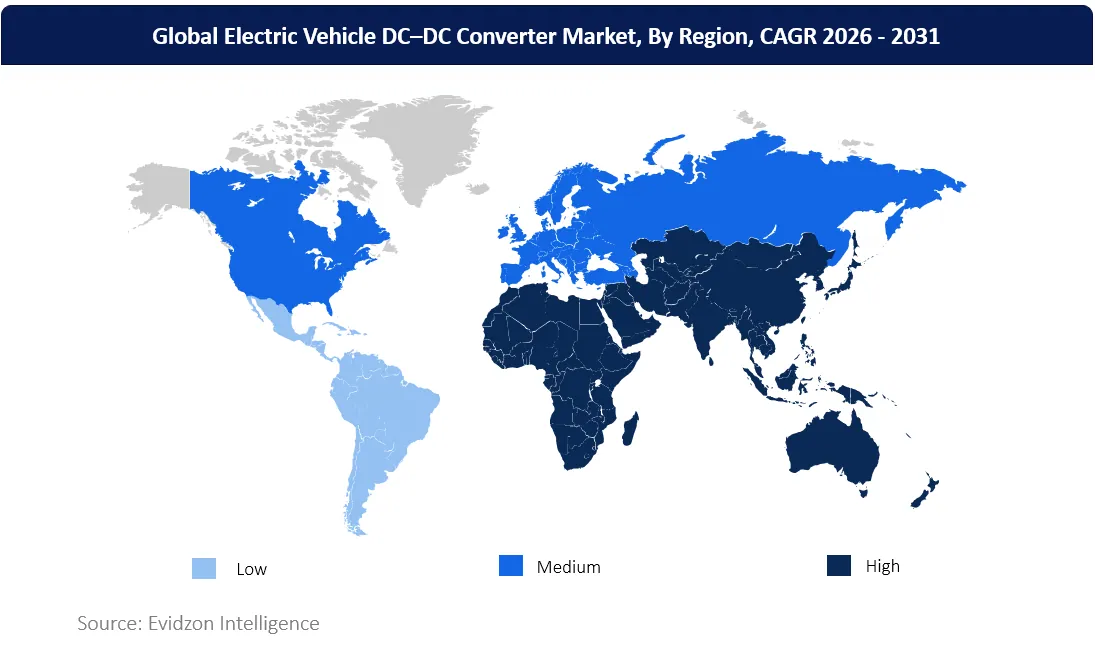
Asia-Pacific has a central role in the global market through its extensive electric vehicle production base, established automotive electronics supply chains and concentration of power-electronics manufacturing capabilities. China, Japan, South Korea and India contribute in a variety of ways through differing combinations of vehicle production, component development and domestic EV adoption. Europe and North America are crucial markets as automakers continue to introduce new electric platforms, adopt higher-voltage architectures and work with suppliers to develop vehicle-specific power-conversion requirements. The Middle East and Africa market is more dependent on the availability of imported EVs, fleet electrification and the development of supporting infrastructure, with demand varying between countries.
Key Takeaways
- By propulsion, battery electric vehicle (BEV) remains the largest sub-segment accounting for nearly 64.3% of the electric vehicle DC-DC converter market in 2025. Whereas, fuel cell electric vehicle (FCEV) is expected to be the fastest-growing propulsion segment expanding at 29.4% CAGR by 2031.
- By vehicle type, passenger car accounts for nearly 82.7% market share in 2025 and expected to grow at a CAGR of 17.6% by 2031.
- By type, HV-to-LV DC-DC converter segment has registered the highest market value share of nearly 98.4% in 2025 of global electric vehicle DC-DC converter market and fuel-cell stack DC-DC converter is expected to ride at a 30.7% CAGR over the forecast period.
- By power rating, 2–5 kW remains the dominant demand base with nearly 39.3% market share in 2025, and projected to grow at 24.7% CAGR by 2031.
- By output voltage, 12V segment accounts for nearly 70.3% market share in 2025. However, 48V is expected to grow at a CAGR of 21.7% by 2031.
- By sales channel, OEM accounts for 95.6% global electric vehicle DC-DC converter market share in 2025. However, aftermarket is projected to witness a CAGR of 26.3% during 2026–2031.
- By region, Asia-Pacific accounts for 65.7% global electric vehicle DC-DC converter market share in 2025. However, Middle East & Africa is projected to witness a CAGR of 16.3% during 2026–2031.
About the Study
The study covers high-voltage-to-low-voltage DC-DC converters providing power to vehicle auxiliary systems, and fuel-cell stack DC-DC converters conditioning the fuel-cell output for the vehicle's high-voltage bus. The study includes both standalone DC-DC converters and the DC-DC conversion hardware within power-electronics integrated units with only the attributable value for the DC-DC converter included. The study excludes onboard chargers, traction inverters, complete power distribution units, battery management systems, fuel cell stacks, battery packs and charging infrastructure excluding system components containing identifiable DC-DC converter functionality.
Market Dynamics Analysis
Drivers
Expanding BEV, HEV, PHEV, and FCEV production increases converter installations.
Advanced vehicle electronics increase low-voltage power conversion requirements.
800V platforms increase demands for compatible conversion systems.
Electric buses and trucks require converters for auxiliary systems.
Integrated systems create opportunities for optimized converter designs.
Localized production strengthens supplier access to regional OEM programs.
Restraints
Heat and electrical stress increase validation and durability demands.
Competitive sourcing compresses supplier margins and limits pricing flexibility.
Different voltage systems complicate standardization and product scalability.
Combined power-electronics assemblies can reduce separately sold converter content.
Increasing production volume of BEVs, HEVs, PHEVs, and FCEVs across the globe has widen the demand base of electric vehicle DC-DC converter. In addition, growing electronic content, auxiliary loads, and electrified sub-systems are driving low-voltage power delivery in passenger cars and commercial vehicles. The transition of electric cars toward higher-voltage platforms is driving the demand for DC-DC converters that can handle voltage classes and support evolving power distribution topologies, creating opportunities for suppliers of highly integrated platforms. The integration of DC-DC conversion capabilities in combined power-electronics modules creates opportunities for suppliers that optimize the system packaging and thermal performance. Regional concentration of electric vehicle manufacturing and localization of production will have impact on supply chain management strategies and supplier technology roadmaps.
DC-DC converters is expected to operate reliability under repeated electrical loading, temperature variation, vibration, and vehicle duty cycles, to meet such safety and durability expectations increases engineering, validation, and manufacturing cost. At the same time, OEMs’ purchasing power and the competitive nature of the supplier base can limit prices in order to ensure the cost of development and production is recovered in a timely manner. Additionally, variations in automotive voltage architecture, output requirements, power ratings, and regional platform differences can reduce the economies of scale for suppliers who have to offer DC-DC converters, which have to cover a variety of requirements. Further, increasing integration of DC-DC converter in broader power-electronics assemblies may reduce demand for separate units, leading to intensify the competitive landscape.
Segment Analysis
By Propulsion
Battery electric vehicle (BEV) accounts for the highest electric vehicle DC-DC converter market share of 64.3% in 2025, meanwhile fuel cell electric vehicle (FCEV) is projected to grow at 29.4% CAGR by 2031. Battery electric vehicles (BEVs) are the primary demand-driving segment of DC-DC converters to supply low-voltage auxiliary systems from high-voltage traction batteries. EV DC-DC converters requirements vary according to vehicle electrical architecture, auxiliary load, output-voltage configuration, and the number of onboard electronic systems.
Whereas, to support vehicle electronics, lighting, control units, and other auxiliary functions across different operating modes in Hybrid electric vehicles (HEVs) and plug-in hybrid electric vehicles (PHEVs) DC-DC converters is employed. While, fuel cell electric vehicles (FCEVs) require auxiliary HV-to-LV converters and may also use dedicated fuel-cell stack DC-DC converters to condition fuel-cell output for the high-voltage bus. Such distinct powertrain configurations influence DC-DC converter design, power requirements, thermal performance, and integration strategies.
Global Electric Vehicle DC-DC Converter Market, By Propulsion, Market Share, 2025
By Vehicle Type
Passenger cars represent the largest vehicle type category with 82.7% market share in global electric vehicle DC-DC converter market and expected to foresee 17.6% CAGR through 2031. Passenger cars are equipped with DC-DC converters to supply low-voltage devices, such as electronics, lights, infotainment systems, safety features, control units, and numerous other devices with electricity. The specifications of a converter vary depending on the vehicle class, the power system’s architecture, the equipment’s level, and the amount of electronics needed for the functioning of a car.
Whereas, commercial vehicles including light commercial vehicle and medium and heavy-duty trucks have distinct requirement of DC-DC converter in comparison to passenger cars owing to high auxiliary loads, duty cycles, and operating time. While electric buses systems allow them to provide comfort for passengers and equip the vehicles with necessary devices, trucks have to be equipped with powerful conversion systems for the proper functioning of controls and electronics. The different requirement across commercial vehicles requires variance of specification to meet the specific application, leading suppliers to develop distinct products across the commercial vehicle type. However dynamically shifting commercial vehicles towards EV powertrain from smaller base unfolds exponential opportunity over the forecast period.
Global Electric Vehicle DC-DC Converter Market, By Vehicle Type, Market Share, 2025
Geographic Analysis
Largest Region
Asia-Pacific registered the highest market share of 65.7% in 2025 of global electric vehicle DC-DC converter market. Demand for electric vehicle DC-DC converters in Asia-Pacific is supported by established EV manufacturing, growing EV adoption, and robust automotive electronics and power semiconductor vertical supply chain integration. China, Japan, South Korea, and India, among others, have varying levels of EV manufacturing and production chains for related components.
The presence of wide range electric vehicles in the Asia Pacific region supports the demand for DC-DC converters that fit across passenger cars, commercial vehicles, and varying propulsion mechanisms. Local production in region facilitates cost competitiveness and better partnerships between converter producers and original equipment manufacturers (OEMs). Additionally, continuous investment flow in EV DC-DC converter is anticipated to influences component sourcing, converter integration, and compatiblity with changing vehicle voltage architectures and auxiliary power requirements.
Global Electric Vehicle DC-DC Converter Market, By Region, Market Share, 2025
Fastest-Growing Region
Middle East and Africa is projected to be the fastest region in global electric vehicle DC-DC converter market by 2031 accounting for 29.4% CAGR. Growing EV adoption, fleet electrification initiatives, and the gradual development of charging infrastructure is collectively influencing the demand curve of Middle East and Africa DC-DC converter market. Demand opportunities exist for electric passenger cars, buses, delivery vehicles, and other commercial applications, but the pace of adoption varies considerably by country. Hot operating conditions in some parts of the region make thermal management, component protection, and converter durability particularly crucial.
Electric vehicle model availability, import economics, distribution network, investment in EV ecosystem development, adoption of electric public transportation are the attributes which will shape the growth trajectory of Middle East and Africa EV DC-DC converter market over the coming years. As vehicle electrification progresses, suppliers can look to OEM requirements and, over time, replacement demand from an expanding electric vehicle fleet.
Competitive Landscape
- 1FORVIA HELLA
- 2Bosch Mobility
- 3Valeo
- 4Eaton Corporation
- 5Shinry Technologies Co., Ltd.
Market Concentration Level: Moderate
The global electric vehicle DC-DC converter market competitive landscape is moderately concentrated across automotive electronics suppliers and specialized power-conversion manufacturers. FORVIA HELLA, Bosch Mobility, Valeo, Eaton Corporation and Shinry Technologies are the key players accounting for majority of market share. Established automotive electronics competencies and strong OEM supply partnerships are FORVIA HELLA and Bosch Mobility's competitive advantage, while high-voltage power-conversion offerings for both passenger cars and commercial vehicles represent Valeo and Eaton's avenue to growth. Dedicated EV power-electronics portfolios of Shinry Technologies, Hyundai KEFICO and Shindengen Electric Manufacturing is adding a further layer of competition.
Converter efficiency, power density, thermal management, operating voltage, reliability and integration with onboard chargers and other power-electronics systems are the key competing attributes of DC-DC converter players. Moreover, companies are focusing on developing solutions for 400V and 800V architectures for both passenger cars and commercial vehicles, as well as low-voltage and high-power demands in auxiliary systems and commercial EVs, respectively. EV OEMs are promoting suppliers to integrate DC-DC converters with onboard charging and power distribution to reduce the component count, packaging requirements and system complexity.
Recent Development
FORVIA HELLA Secures Integrated Power Electronics Orders
FORVIA HELLA has received two major series orders for integrated EnergyCore solutions, including a 48V PowerPack combining a low-voltage DC-DC converter and battery management functionality, with combined value in the mid-three-digit million-euro range.
Sterling E‑Mobility Partners with Landworld
Sterling E‑Mobility Solutions Limited, an India based electric vehicle components manufacturer has signed technology license and supply agreements with Landworld, a China based DC/DC converters and EV power systems manufacturer to jointly manufacture intergrate chargers, converters, and power distribution functions in Faridabad, India.
Valeo Launches 48V Aftermarket DC-DC Converter
Valeo launches 48V DC-DC Converter for IAM (Independent Aftermarket) for mild-hybrid 48V and low power electric vehicles engineered for performance and energy efficiency.
Table of Content
- 1.Introduction
- 1.1Scope and Objective of the Study
- 1.2Market Definition & Study Assumptions
- 2.Research Methodology
- 3.Executive Summary
- 4.Market Outlook
- 4.1Market Overview
- 4.2Market Drivers
- 4.2.1Rising Electrified Vehicle Production Across Propulsion Types
- 4.2.2Increasing Auxiliary Electrical Loads in Modern Vehicles
- 4.2.3Transition Toward Higher Voltage Vehicle Architectures
- 4.2.4Growing Electrification of Commercial Vehicle Fleets
- 4.2.5Integration of Power Electronics in Compact Units
- 4.2.6Expansion of Regional EV Manufacturing and Localization
- 4.3Market Restraint
- 4.3.1High Reliability Requirements under Thermal Stress
- 4.3.2Price Pressure from OEM Purchasing Consolidation
- 4.3.3Architecture Variation across Vehicle Platforms and Regions
- 4.3.4Integration Reduces Demand For Standalone Converter Units
- 4.4Regulatory Landscape
- 4.5Supply/Value Chain Analysis
- 4.6Porter's Five Forces Analysis
- 4.6.1Threat of New Entrants
- 4.6.2Bargaining Power of Buyers
- 4.6.3Bargaining Power of Suppliers
- 4.6.4Threat of Substitutes
- 4.6.5Competitive Rivalry
- 5.Market Segmentation (Includes market size in Value (USD), Forecast up to 2031, and market analysis with growth attributes)
- 5.1By Propulsion
- 5.1.1Battery Electric Vehicle (BEV)
- 5.1.2Hybrid Electric Vehicle (HEV)
- 5.1.3Plug-in Hybrid Electric Vehicle (PHEV)
- 5.1.4Fuel Cell Electric Vehicle (FCEV)
- 5.2By Vehicle Type
- 5.2.1Passenger Car
- 5.2.1.1Hatchback
- 5.2.1.2Sedan
- 5.2.1.3SUV
- 5.2.1.4Multi-Purpose Vehicle (MPV)
- 5.2.1.5Others (Crossover, Coupe, Convertible, Wagon)
- 5.2.2Commercial Vehicle
- 5.2.2.1Light Commercial Vehicle
- 5.2.2.2Medium and Heavy-Duty Trucks
- 5.2.2.3Bus and Coach
- 5.3By Type
- 5.3.1HV-to-LV DC-DC Converter
- 5.3.2Fuel-Cell Stack DC-DC Converter
- 5.4By Power Rating
- 5.4.1Below 2 kW
- 5.4.22-5 kW
- 5.4.36-15 kW
- 5.4.4Above 15 kW
- 5.5By Output Voltage
- 5.5.112V
- 5.5.224V
- 5.5.348V
- 5.6By Sales Channel
- 5.6.1OEM
- 5.6.2Aftermarket
- 5.7By Region
- 5.7.1North America
- 5.7.1.1United States
- 5.7.1.2Canada
- 5.7.2Latin America
- 5.7.2.1Brazil
- 5.7.2.2Argentina
- 5.7.2.3Mexico
- 5.7.2.4Rest of Latin America
- 5.7.3Europe
- 5.7.3.1Germany
- 5.7.3.2Italy
- 5.7.3.3France
- 5.7.3.4Spain
- 5.7.3.5United Kingdom
- 5.7.3.6Russia
- 5.7.3.7Rest of Europe
- 5.7.4Asia Pacific
- 5.7.4.1China
- 5.7.4.2India
- 5.7.4.3Japan
- 5.7.4.4South Korea
- 5.7.4.5Indonesia
- 5.7.4.6Australia
- 5.7.4.7Rest of Asia-Pacific
- 5.7.5Middle East & Africa
- 5.7.5.1Saudi Arabia
- 5.7.5.2United Arab Emirates (UAE)
- 5.7.5.3South Africa
- 5.7.5.4Egypt
- 5.7.5.5Rest of the Middle East & Africa
- 6.Competitive Landscape
- 6.1Market Concentration Overview
- 6.2Market Share Analysis
- 6.3Company Profiles
- 6.3.1FORVIA HELLA
- 6.3.2Bosch Mobility
- 6.3.3Valeo
- 6.3.4Eaton Corporation
- 6.3.5SHINRY Technologies Co., Ltd.
- 6.3.6Hyundai KEFICO
- 6.3.7Shindengen Electric Manufacturing
- 6.3.8Zhejiang Yiwei New Energy Technology
- 6.3.9Delta-Q Technologies
- 6.3.10Delta Electronics
- 6.3.11Dilong New Energy Technology
- 6.3.12Landworld Technology
- 6.3.13Hangzhou CTS Power Electronics Technology
- 6.3.14eDrift Electric
- 6.3.15Echelon Energy Technology
- 7.Future Outlook
- 7.1Growth Opportunities & White-Space Analysis
- 7.2Analyst Recommendations
Market Size Methodology
The value of the global electric vehicle DC-DC converter market is calculated by estimating the number of new vehicles produced and/or sold and multiplying it by the corresponding value of DC-DC converters per unit. The replacement is included in the aftermarket estimate.
The value of DC-DC converters is assessed by the propulsion type, vehicle type, converter function, power rating, output voltage, and country to account for variations in electrical architecture, power requirements, and configuration. The analysis is based on the data gathered from the number of registered and produced vehicles, OE announcements, suppliers, company reports, government databases, and industry platforms to determine historical values of DC-DC converters.
EV production volume, propulsion mix, 400V and 800V architectures, auxiliary electrical loads, power ratings, output-voltage requirements, onboard charger integration, sourcing strategies, supplier pricing, vehicle parc growth, and replacement cycles are the key attributes considered in forecasting.
FAQ
What is the projected size of the global electric vehicle DC-DC converter market by 2031?
The global electric vehicle DC-DC converter market is projected to reach USD 7.21 billion by 2031, increasing from USD 4.04 billion in 2025 at a CAGR of 10.5% during 2026–2031.
Which propulsion segment dominates the global electric vehicle DC-DC converter market?
Battery Electric Vehicles (BEVs) account for the largest share, representing 64.3% of the market in 2025.
Which type of DC-DC converter accounts for the largest market share?
High-voltage-to-low-voltage (HV-to-LV) DC-DC converters dominate the market, accounting for 98.4% of market value in 2025.
Which region holds the largest share of the global electric vehicle DC-DC converter market?
Asia-Pacific accounts for 65.7% of the global market in 2025, supported by electric vehicle manufacturing, established automotive electronics supply chains, power-electronics manufacturing capabilities, and demand across passenger cars, commercial vehicles, and different propulsion types.
Who are the major players in the global electric vehicle DC-DC converter market?
FORVIA HELLA, Bosch Mobility, Valeo, Eaton Corporation, and Shinry Technologies Co., Ltd. as the five major players. Competition focuses on conversion efficiency, power density, thermal management, reliability, voltage compatibility, and integration with other power-electronics systems.
Have a question about this report?
Talk to the analyst behind this research, or browse the full report catalogue.
Contact Us