
Global Electric Vehicle Battery Management System Market
The global electric vehicle battery management system market is segmented by propulsion (BEV, HEV, PHEV, FCEV), by vehicle type (Passenger Car and Commercial Vehicle), by battery chemistry (LFP, LMFP, NMC, NCA, LTO, and Sodium-ion), by battery capacity (Below 25 kWh, 25 -50 kWh, 51 - 75 kWh, 75 - 100 kWh, and Above 100 kWh), by BMS component (Battery Management IC / Analog Front End (AFE), Microcontroller / Processor, Current Sensor, Voltage Sensor, Temperature Sensor, Cell Balancing Circuit, Contactor & Protection Circuit, Communication Interface, Memory, Power Management IC, Software / Algorithms, and Others), by BMS architecture (Centralized BMS, Modular BMS, Distributed BMS, and Wireless BMS), by Sales Channel (OEM and Aftermarket), and by region (North America, Latin America, Europe, Asia-Pacific, and Middle-East and Africa). The global electric vehicle battery management system market report includes market size in Value (USD) forecast up to 2031.
Global Electric Vehicle Battery Management System Market
Market Size in USD Billion
Market Size Overview
USD Billion
Market Snapshot
- Study Period
- 2019-2031
- Forecast Period
- 2026-2031
- Base Year Market Size (2025)
- USD 16.12 Billion
- Market Size (2026)
- USD 17.41 Billion
- Market Size (2031)
- USD 27.95 Billion
- Growth Rate (2026-2031)
- 9.93% CAGR
- Market Concentration
- Moderate
Major Players*





*Disclaimer: Major Players sorted in no particular order
Market Overview
The global electric vehicle battery management system market value is anticipated to grow from USD 16.12 billion in 2025 to 17.41 million in 2026 and expected to reach USD 27.95 million in 2031 with a CAGR (2026-2031) of 9.93%.
The increasing penetration of electric propulsion across passenger cars and commercial vehicles with increasing OEM emphasis on higher capacities and faster charging while enabling tighter battery safety controls is stimulating demand for battery management systems. BMS has evolved beyond basic cell monitoring to a key electronic layer involved in state-of-charge, state-of-health, cell balancing, thermal monitoring, fault detection and protection functions. Increasing adoption of higher voltage (400 V/800 V) platforms with increased charging rates by OEMs has intensified the role of BMS. As electric passenger car accounts for the largest sales volume, the opportunity pocket is comparatively deeper in comparison to electric commercial vehicles. While, bigger packs, higher duty cycles and thermal loads requirements are channeling battery monitoring system demand at higher pace.
Battery electric vehicles dominate the application space, but plug-in hybrids also require BMS for their high voltage battery systems. This led to bifurcate competitive landscape among battery cells, modules and packs suppliers and automotive electronics suppliers with broader control system competencies. CATL, LG Energy Solution and Samsung SDI have an advantage where battery systems are embedded with BMS, enabling the development of cell chemistries, thermal management approaches and control algorithms in unison. Bosch and BorgWarner are in a stronger competitive position as vehicle-system suppliers, providing BMS architectures that can be deployed seamlessly across battery architectures and OEM platforms. Semiconductor suppliers such as Infineon Technologies, NXP Semiconductors, Texas Instruments and Analog Devices provide the underlying battery-monitoring ICs and control electronics. Cell-count monitoring, faster diagnostics, functional safety, cyber security and software-driven battery intelligence will be the key attributes further shaping the competitive landscape beyond voltage and temperature measurements.
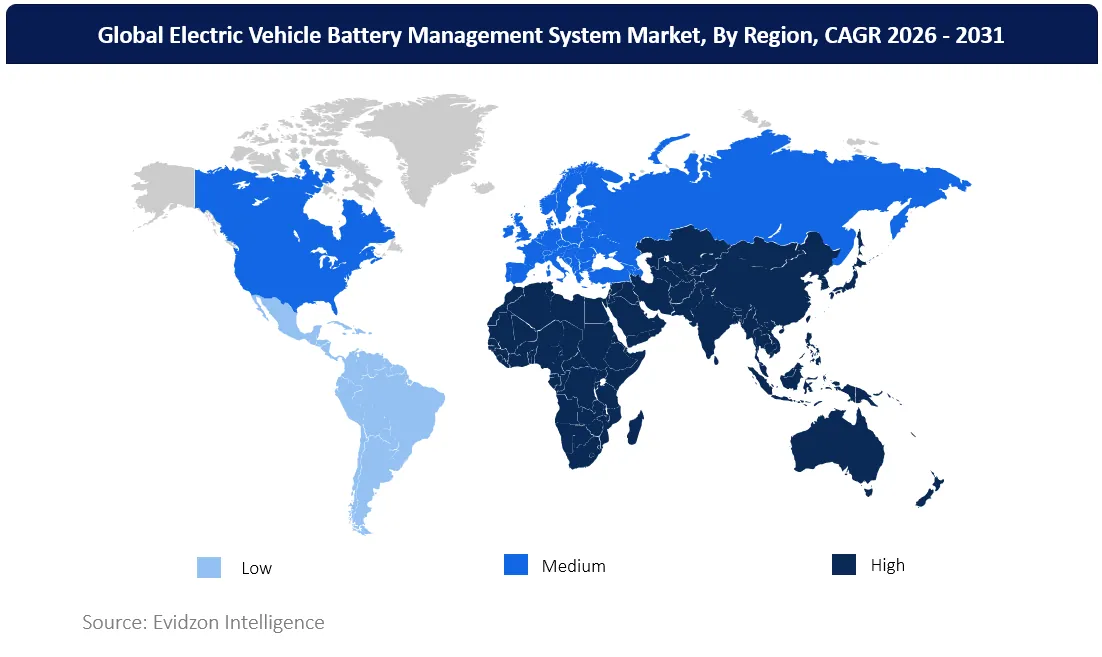
Asia-Pacific continues to be the dominant region for both demand and manufacturing as China accounts for most EV production globally and has an extensive supply base for cells, battery packs, power electronics and BMS components. Europe and North America are becoming more crucial with increasing localized battery manufacturing and OEM-specific BMS development, as automakers gain greater control over battery software and supply chains. The Middle East & Africa continues to be a smaller market where BMS adoption depends on the rate of EV imports, fleet electrification and local charging infrastructure development.
Key Takeaways
- By propulsion, battery electric vehicle (BEV) remains the largest sub-segment accounting for 68.7% of the electric vehicle battery management system market in 2025. Whereas, fuel cell electric vehicle (FCEV) is expected to be the fastest growing propulsion segment expanding at 14.8% CAGR by 2031.
- By vehicle type, passenger car accounts for 84.3% market share in 2025 and expected to grow at a CAGR of 11.7% by 2031.
- By battery chemistry, lithium iron phosphate (LFP) segment accounts for 53.8% market share in 2025. However, sodium-ion is expected to grow at a CAGR of 15.9% by 2031.
- By battery capacity, 51–75 kWh segment has registered the highest market value share of 37.6% in 2025 of global electric vehicle BMS market and above 100 kWh is expected to ride at a 12.8% CAGR over the forecast period.
- By BMS component, Battery Management IC / Analog Front End (AFE) segment accounts for 26.4% global EV BMS market share in 2025. However, software / algorithms is projected to witness a CAGR of 13.7% during 2026–2031.
- By BMS architecture, modular BMS remain the dominant demand base with 46.7% market share in 2025, and projected to grow at 15.2% CAGR by 2031.
- By sales channel, OEM accounts for 96.4% global electric vehicle battery management system market share in 2025. However, aftermarket is projected to witness a CAGR of 24.9% during 2026–2031.
- By region, Asia-Pacific accounts for 66.6% global electric vehicle battery management system market share in 2025. However, Middle East and Africa is projected to witness a CAGR of 14.1% during 2026–2031.
About the Study
The global electric vehicle battery management system market study covers BMS systems used across passenger cars and commercial vehicles, segmented by propulsion, battery chemistry, battery capacity, BMS component, BMS architecture, and sales channel, with analysis across major global regions and countries. The global electric vehicle battery management system market study scope includes BMS hardware, electronic components, sensors, protection circuits, communication interfaces, embedded software, and algorithms used to monitor, control, balance, and protect vehicle batteries. The study excludes battery cells, standalone battery manufacturing, complete vehicle manufacturing, charging infrastructure, fuel-cell systems, hydrogen storage, and downstream battery recycling markets.
Market Dynamics Analysis
Drivers
Growing electric vehicle production directly increases BMS demand.
Compliance increases monitoring, diagnostics, protection, and fault detection.
High-voltage architectures require tighter sensing and protection.
Higher charging currents intensify thermal monitoring and control.
Advanced algorithms improve estimation, diagnostics, and battery utilization.
Platform integration shapes hardware, software, and communication requirements.
Restraints
Platform-specific integration requires extensive validation resources.
Specialized monitoring IC shortages can delay BMS production
Different chemistries architectures require varied control strategies
Retrofitting BMS requires application-specific integration and certification
In electric vehicles, the significance of sensing precision, isolation, and protection requirements has increased due to high battery voltage architecture, resulting more sophisticated and technologically advance BMS content per vehicle. Increasing integration of fast charging in EVs require more responsive monitoring and control across cells and packs due to thermal and electrical stress. While, diagnostic, fault-detection, isolation, and protection functions due to regional stricter battery safety requirements is increasing system complexity. Depleting lithium prices has influenced OEMs to increasingly offer large battery packs in EVs as product differentiator and to address the range anxiety, resulting to raise the number of monitored cells and balancing channels, supporting higher component content and BMS value. Whereas, the value of BMS platforms algorithms is increasing on the back of software-based state estimation, predictive diagnostics, and battery-life management.
Batteries Management System engineering expenses are high owing to the need to integrate and test BMS solutions in a wide range of vehicle platforms, battery technologies, battery pack configurations and communication protocols. The semiconductor supply chains can disrupt the supply of specialized ICs, processors, sensors and protection devices used in battery management systems, causing significant delays in the manufacturing process if alternative solutions need to be identified and qualified. The proliferation of battery technologies (LFP, NMC, NCA, LTO and sodium-ion) also creates challenges in terms of having to develop different solutions for different battery technologies or introducing complexity in the development of standardized BMS solutions. The aftermarket opportunity is also challenging to engineer owing to the need to adapt BMS hardware and software in existing vehicle platforms through extensive compatibility testing, vehicle electronics integration, safety validation and certification processes.
Segment Analysis
By Propulsion
Battery electric vehicle (BEV) accounts for the highest electric vehicle battery management system market share of 68.7% in 2025, meanwhile fuel cell electric vehicle (FCEV) is projected to grow at 14.8% CAGR by 2031. As battery is the source of electric vehicle propulsion, increasing BEV adoption is directly influencing the requirements for electric vehicle battery management system. The BEV BMS typically manages cell voltage, temperature, current, state of charge, state of health and cell balancing functions while providing protection against overcharging, over-discharging and abnormal thermal conditions. Increasing battery pack size and higher voltage architecture in BEVs has further strengthen the demand for BMS.
In contrast to this, FCEVs use a fuel-cell stack as the primary electricity source with the battery used mainly as a buffer for transient power requirements, regenerative braking and load balancing. As such, FCEV BMS requirements are more about managing a smaller high-voltage battery and coordinating it with the fuel-cell powertrain. Software is also becoming more critical as automakers deliver more accurate state-of-charge and state-of-health estimates, early fault detection and battery degradation monitoring. FCEVs are still reliant on battery systems despite the smaller size of the battery relative to a comparable BEV.
Global Electric Vehicle Battery Management System Market, By Propulsion, Market Share, 2025
By Vehicle Type
Passenger cars represent the largest vehicle type category with 84.3% market share in global electric vehicle battery management system market and expected to foresee 11.7% CAGR through 2031. Passenger cars dominate electric vehicle BMS demand due to the concentration of EV production in this segment and the fact that each vehicle requires a dedicated battery monitoring and control system. The BMS is significantly different for various architectures of EVs: small urban EVs have smaller battery packs with simpler structures, while electric SUVs, luxury cars and long-range EVs have larger battery packs that include higher amount of cells, more sensors coverage and more thermal and balancing functions.
Commercial vehicles pose distinct BMS requirements owing to the larger battery packs and the more challenging duty cycles compared to passenger cars plus the need for frequent charging, higher average daily miles, increased payloads and a wider range of operating conditions, which makes the accurate estimation of temperature, cell balancing and battery health assessment particularly relevant for commercial electric vehicles. Electric commercial vehicles can therefore involve higher levels of battery monitoring per vehicle despite lower unit volume of passenger cars.
Global Electric Vehicle Battery Management System Market, By Vehicle Type, Market Share, 2025
Geographic Analysis
Largest Region
Asia Pacific registered the highest market share of 66.6% in 2025 of global electric vehicle battery management system market. Asia Pacific is a major region for electric vehicle BMS demand due to its concentration of battery electric vehicle production and a well-established battery and automotive electronics supply chain. China is the key market with extensive production of battery electric passenger cars, buses, commercial vehicles and battery packs. The proximity of battery-cell manufacturers, pack assemblers, electronics suppliers and automakers enables tighter integration of BMS hardware and software into vehicle platforms. Chinese manufacturers are also evolving their BMS needs to accommodate higher voltage systems, larger battery packs, and more integrated battery electronics.
Japan and South Korea contribute another key BMS market that leverages their established automotive, battery and electronics industries. Companies in these countries have extensive expertise in battery control systems, power electronics and automotive safety technologies that enable more advanced BMS architectures. India is also emerging as a BMS market as local production of battery electric vehicles spans multiple segments though at a less developed stage than in China. Overall, the Asia Pacific region enables automakers to obtain many of the components needed for battery management systems from local suppliers.
Global Electric Vehicle Battery Management System Market, By Region, Market Share, 2025
Fastest-Growing Region
Middle East and Africa is projected to be the fastest region in global electric vehicle battery management system market by 2031 accounting for 14.1% CAGR. The Middle East and Africa BMS markets start from a relatively small base of EV sales, the requirements are growing in relevance as electric passenger cars, buses and commercial vehicles increase in popularity in key markets. In the Middle East, the UAE, Saudi Arabia and other Gulf states are seeing increased adoption of electric vehicles, supported by investments in charging infrastructure, government electrification programs and the entry of electric vehicle models from major global automakers.
The commercial vehicle segment presents opportunities in both the Middle East and in African markets as municipalities and private operators acquire electric buses, delivery trucks and other specialized commercial vehicles. In Africa, electric vehicle sales are still limited to specific markets, but the EV value chain is starting taking shape. Key automotive markets with emerging charging infrastructure are laying the groundwork for local battery production and electric vehicle manufacturing. Morocco, in particular, is positioned to play a major role in this emerging market due to its existing automotive industry and battery supply chain activities. As African markets develop, BMS suppliers will need to adapt to the higher operating temperatures, different charging infrastructures and specialized vehicle applications rather than simply porting solutions from other, more mature EV markets.
Competitive Landscape
- 1Robert Bosch GmbH
- 2BorgWarner Inc.
- 3Contemporary Amperex Technology Co., Limited (CATL)
- 4LG Energy Solution Ltd.
- 5Samsung SDI Co., Ltd.
Market Concentration Level: Moderate
The global electric vehicle battery management system market competitive landscape is moderately concentrated among EV battery manufacturers and automotive electronics suppliers. Robert Bosch GmbH, BorgWarner Inc., Contemporary Amperex Technology Co., Limited (CATL), LG Energy Solution Ltd., and Samsung SDI Co., Ltd. are the key players accounting for majority of market share. Robert Bosch GmbH and BorgWarner Inc. hold strong positions as independent vehicle-system suppliers of BMS hardware and battery control units with monitoring and balancing functions and diagnostic and functional-safety capabilities for BEV and PHEV architectures. While, CATL, LG Energy Solution Ltd. and Samsung SDI Co., Ltd. take an integrated approach, covering BMS with cells, modules and packs, and battery controls.
The competition in battery management systems for electric vehicles is driven by the control of battery architecture than by individual BMS electronics. Meanwhile, the competition in battery management systems for electric vehicles is driving the transition to higher voltages, functional safety, cyber security, predictive diagnostics and software-centric battery management.
Recent Development
FORVIA HELLA Secures Major EnergyCore Orders
FORVIA HELLA secured significant series orders for integrated EnergyCore solutions including its first 3-in-1 high-voltage BMS. The architecture integrates battery management functions and high-voltage electronics to reduce vehicle cost, weight, complexity and packaging requirements, enhancing the company's position in integrated battery and power-electronics systems.
Schaeffler CATL Deepen BMS Collaboration
Schaeffler and CATL signed MoU regarding joint development of automotive BMS and X-in-1 Integrated PowerBox solutions. The partners will combine engineering and manufacturing capabilities in the field of BMS architectures targeting automotive OEMs in Europe, building on a customer project already secured by both partners and addressing broader international applications.
ELECTRA AI Partners With Omega Seiki
ELECTRA AI partnered with Omega Seiki Mobility to embed battery-health intelligence into OSM's electric vehicle ecosystem. The partnership will enable real-time battery monitoring and analysis as well as battery state-of-health insights to help extend battery life, enhance vehicle performance and increase transparency for customers, financiers and fleet operators.
Table of Content
- 1.Introduction
- 1.1Scope and Objective of the Study
- 1.2Market Definition & Study Assumptions
- 2.Research Methodology
- 3.Executive Summary
- 4.Market Outlook
- 4.1Market Overview
- 4.2Market Drivers
- 4.2.1Rising EV sales expand BMS installation volumes
- 4.2.2Regional safety regulations strengthen BMS requirements
- 4.2.3Higher battery voltages increase BMS monitoring complexity
- 4.2.4Fast charging raises BMS thermal management requirements
- 4.2.5Software intelligence increases battery management system value
- 4.2.6OEM integration drives customized BMS architecture adoption
- 4.3Market Restraint
- 4.3.1Complex integration increases BMS engineering costs
- 4.3.2Semiconductor supply constraints disrupt BMS component availability
- 4.3.3Battery platform fragmentation limits BMS standardization
- 4.3.4Aftermarket adoption faces limited vehicle BMS compatibility
- 4.4Regulatory Landscape
- 4.5Supply/Value Chain Analysis
- 4.6Porter's Five Forces Analysis
- 4.6.1Threat of New Entrants
- 4.6.2Bargaining Power of Buyers
- 4.6.3Bargaining Power of Suppliers
- 4.6.4Threat of Substitutes
- 4.6.5Competitive Rivalry
- 5.Market Segmentation (Includes market size in Value (USD), Forecast up to 2031, and market analysis with growth attributes)
- 5.1By Propulsion
- 5.1.1Hybrid Electric Vehicle (HEV)
- 5.1.2Plug-in Hybrid Electric Vehicle (PHEV)
- 5.1.3Battery Electric Vehicle (BEV)
- 5.1.4Fuel Cell Electric Vehicle (FCEV)
- 5.2By Vehicle Type
- 5.2.1Passenger Car
- 5.2.1.1Hatchback
- 5.2.1.2Sedan
- 5.2.1.3SUV
- 5.2.1.4Multi-Purpose Vehicle (MPV)
- 5.2.1.5Others (Crossover, Coupe, Convertible, Wagon)
- 5.2.2Commercial Vehicle
- 5.2.2.1Light Commercial Vehicle
- 5.2.2.2Medium and Heavy-Duty Trucks
- 5.2.2.3Bus and Coach
- 5.3By Battery Chemistry
- 5.3.1Lithium Iron Phosphate (LFP)
- 5.3.2Lithium Manganese Iron Phosphate (LMFP)
- 5.3.3Lithium Nickel Manganese Cobalt Oxide (NMC)
- 5.3.4Lithium Nickel Cobalt Aluminum Oxide (NCA)
- 5.3.5Lithium-Titanate Oxide batteries (LTO)
- 5.3.6Sodium-ion
- 5.4By Battery Capacity
- 5.4.1Below 25 kWh
- 5.4.225 -50 kWh
- 5.4.351 - 75 kWh
- 5.4.475 - 100 kWh
- 5.4.5Above 100 kWh
- 5.5By BMS Component
- 5.5.1Battery Management IC / Analog Front End (AFE)
- 5.5.2Microcontroller / Processor
- 5.5.3Current Sensor
- 5.5.4Voltage Sensor
- 5.5.5Temperature Sensor
- 5.5.6Cell Balancing Circuit
- 5.5.7Contactor & Protection Circuit
- 5.5.8Communication Interface
- 5.5.9Memory
- 5.5.10Power Management IC
- 5.5.11Software / Algorithms
- 5.5.12Others
- 5.6By BMS Architecture
- 5.6.1Centralized BMS
- 5.6.2Modular BMS
- 5.6.3Distributed BMS
- 5.6.4Wireless BMS
- 5.7By Sales Channel
- 5.7.1OEM
- 5.7.2Aftermarket
- 5.8By Region
- 5.8.1North America
- 5.8.1.1United States
- 5.8.1.2Canada
- 5.8.2Latin America
- 5.8.2.1Brazil
- 5.8.2.2Argentina
- 5.8.2.3Mexico
- 5.8.2.4Rest of Latin America
- 5.8.3Europe
- 5.8.3.1Germany
- 5.8.3.2Italy
- 5.8.3.3France
- 5.8.3.4Spain
- 5.8.3.5United Kingdom
- 5.8.3.6Russia
- 5.8.3.7Rest of Europe
- 5.8.4Asia Pacific
- 5.8.4.1China
- 5.8.4.2India
- 5.8.4.3Japan
- 5.8.4.4South Korea
- 5.8.4.5Indonesia
- 5.8.4.6Australia
- 5.8.4.7Rest of Asia-Pacific
- 5.8.5Middle East & Africa
- 5.8.5.1Saudi Arabia
- 5.8.5.2United Arab Emirates (UAE)
- 5.8.5.3South Africa
- 5.8.5.4Egypt
- 5.8.5.5Rest of the Middle East & Africa
- 6.Competitive Landscape
- 6.1Market Concentration Overview
- 6.2Market Share Analysis
- 6.3Company Profiles
- 6.3.1Robert Bosch GmbH
- 6.3.2BorgWarner Inc.
- 6.3.3Contemporary Amperex Technology Co., Limited (CATL)
- 6.3.4LG Energy Solution Ltd.
- 6.3.5Samsung SDI Co., Ltd.
- 6.3.6FORVIA HELLA
- 6.3.7Marelli Holdings Co., Ltd.
- 6.3.8AUMOVIO SE
- 6.3.9AVL List GmbH
- 6.3.10Infineon Technologies AG
- 6.3.11NXP Semiconductors N.V.
- 6.3.12Texas Instruments Incorporated
- 6.3.13Analog Devices, Inc.
- 6.3.14DENSO Corporation
- 6.3.15Xbattery Energy Private Limited (Bharat BMS)
- 7.Future Outlook
- 7.1Growth Opportunities & White-Space Analysis
- 7.2Analyst Recommendations
FAQ
What is the projected size of the global electric vehicle battery management system market by 2031?
The global electric vehicle battery management system (BMS) market is projected to reach USD 19.92 billion by 2031 from USD 16.12 billion in 2025 at a CAGR of 9.93% during 2026–2031.
Which propulsion segment dominates the global electric vehicle battery management system market?
Battery Electric Vehicles (BEVs) dominate the market, accounting for 68.7% of the market in 2025.
Which BMS component segment is expected to grow fastest during the forecast period?
The software and algorithms segment is projected to grow at a CAGR of 13.7% during 2026–2031.
Which region holds the largest share of the global electric vehicle battery management system market?
Asia-Pacific accounts for 66.6% of the global electric vehicle BMS market in 2025.
Who are the major players in the global electric vehicle battery management system market?
Robert Bosch GmbH, BorgWarner Inc., Contemporary Amperex Technology Co., Limited (CATL), LG Energy Solution Ltd., and Samsung SDI Co., Ltd. as the five major players. Competition focuses on BMS hardware and software, battery-system integration, monitoring and balancing capabilities, functional safety, diagnostics, and advanced battery management architectures.
Market Size Methodology
The global electric vehicle battery management system market value is determined by multiplying the production or sales volume of new passenger and commercial vehicles by the corresponding average BMS value per vehicle, with replacement cycles considered for aftermarket analysis. To account for differences in vehicle architecture, battery chemistry, capacity, voltage, electrification technology, and BMS content, the BMS value is assessed by vehicle type, propulsion, battery chemistry, battery capacity, component, architecture, and country.
Vehicle production and registration data, OEM disclosures, BMS supplier filings, semiconductor supplier reports, government statistics, industry associations, and company reports are used as benchmarks for historical estimates.
EV adoption, battery capacity, cell count, chemistry, BMS architecture, sensing requirements, semiconductor content, software complexity, functional-safety requirements, wireless BMS adoption, OEM sourcing strategies, vehicle production patterns, and replacement cycles are the key attributes considered in forecasting.
Have a question about this report?
Talk to the analyst behind this research, or browse the full report catalogue.
Contact Us