
Global Automotive Fasteners Market
The global automotive fastener market report is segmented by product (Threaded Fasteners, Non-Threaded Fasteners and Specialty Fasteners), by material type (Steel & Iron, Stainless Steel, Aluminum, Brass, Plastic, and Composite Fasteners), by functions (Detachable Fasteners and Non-Detachable Fasteners), by vehicle type (Passenger Cars and Commercial Vehicles), by vehicle application (Body &Exterior, Chassis, Powertrain / Engine & Transmission ,Electronics &Electrical Joints, Interior Trim and Others), by propulsion type (Internal Combustion Engine (ICE) Vehicles and Electric Vehicles (EVs)), by distribution channel (OEM and Aftermarket), by region (North America, Latin America, Europe, Asia Pacific and Middle East & Africa). The global automotive fastener market report includes market size in value and (USD) and Volume (Units), forecasts through 2031.
Global Automotive Fasteners Market
Market Size in USD Billion
Market Size Overview
USD Billion
Market Snapshot
- Study Period
- 2019-2031
- Forecast Period
- 2026-2031
- Base Year Market Size (2025)
- USD 25.32 Billion
- Market Size (2026)
- USD 28.07 Billion
- Market Size (2031)
- USD 50.4 Billion
- Growth Rate (2026-2031)
- 12.42% CAGR
- Market Concentration
- Moderate
Major Players*





*Disclaimer: Major Players sorted in no particular order
Market Overview
The global automotive fastener market is driven by increasing vehicle production, growing demand for lightweight vehicle structures, advancements in automotive engineering and growing electric vehicle adoption. Automotive fasteners secure critical components across body and exterior structures, chassis, powertrains, interiors and electrical systems, supporting vehicle safety, structural integrity and durability. Threaded fasteners maintain leading position due to their widespread use in detachable joints, maintenance and component replacement, while specialty fasteners gaining importance in applications requiring specific strength, precision and corrosion resistance. Moreover, steel and iron widely used due to their strength and cost efficiency, whereas aluminum and engineered plastic fasteners support lightweighting requirements. As well as passenger vehicles represent a major demand base, while commercial vehicle and electric vehicles is shaping additional opportunities through expanding production and specialized assembly requirements.
Competitive landscape is shaped by established automotive fastener manufacturer and specialized component suppliers. Key players include Illinois Tool Works, Stanley Black & Decker, Nifco Inc, KAMAX and LISI Automotive. Competition based on product quality, fastening performance, engineering capabilities, cost efficiency, material innovation and compliance with automotive manufacturers specifications. While suppliers with global manufacturing networks and established OEM relationship are well positioned to support large-scale vehicle production and customized fastening requirements.
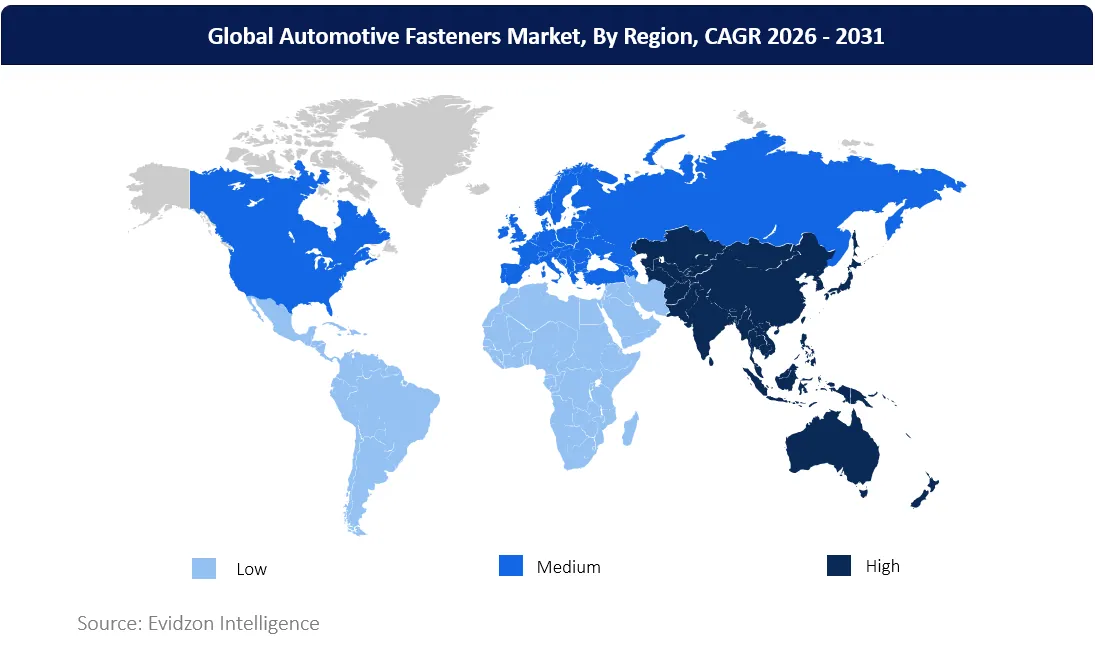
Asia Pacific is a demand epicenter, fueled by large automotive production base across China, India, Japan and South Korea. Europe benefits from premium vehicle production, advanced engineering and demand for specialized fasteners. North America is supported by passenger vehicle, pickup truck and commercial vehicle manufacturing. While, Latin America and the Middle East and Africa offer opportunities through expanding vehicle fleets, local assembly and supply chain demand.
Key Takeaways
- By product, threaded fasteners account for 62.70% of global automotive fastener market share in 2025, while specialty fasteners are expected to grow at a CAGR of 14.60% during 2026–2031.
- By material type, steel and iron fasteners account for 68.40% market share in 2025, while plastic and composite fasteners are expected to grow at a CAGR of 15.30% during 2026–2031.
- By function, detachable fasteners account for 70.60% of global automotive fastener market share in 2025, while non-detachable fasteners are expected to grow at a CAGR of 13.40% during 2026–2031.
- By vehicle type, passenger cars account for 74.30% market share in 2025, while commercial vehicle fasteners are expected to grow at a CAGR of 13.20% during 2026–2031.
- By vehicle application, body and exterior fasteners account for 28.60% market share in 2025, while electronics and electrical joint fasteners are expected to grow at a CAGR of 15.70% during 2026–2031.
- By propulsion type, internal combustion engine (ICE) vehicles account for 73.50% of global automotive fastener market share in 2025, while electric vehicle (EV) fasteners are expected to grow at a CAGR of 16.60% during 2026–2031.
- By distribution channel, OEM sales account for 79.20% market share in 2025, while the aftermarket is expected to grow at a CAGR of 13.10% during 2026–2031.
- By region, Asia Pacific accounts for 46.80% of global automotive fastener market share in 2025 and is expected to grow at a CAGR of 14.20% during 2026–2031.
About the Study
The global automotive fasteners market study is segmented by fastener types, product type, material type, vehicle type, vehicle applications, functions, propulsion, distribution channels across major global regions and countries. The study analyzes across OEM and aftermarket channels and evaluates automotive fastener requirements based on vehicle design, joint strength, material compatibility, fastening specifications, safety requirements, corrosion resistance, and assembly applications. The study excludes complete vehicles, general industrial fasteners unrelated to automotive applications, fastening tools, repair services, and other activities outside the automotive fastener supply chain.
Market Dynamics Analysis
Drivers
Higher assembly volumes require more fastening components per vehicle.
Mixed-material structures require specialized joints and compatible fasteners.
Battery packs and electric drivetrains require application-specific fastening solutions.
Critical joints demand controlled clamping force and reliable performance.
Standardized components improve robotic installation speed and process repeatability.
Sensors and control modules require secure, compact mounting solutions.
Restraints
Steel and alloy price swings disrupt cost planning.
Vehicle validation adds time before supplier approval.
Annual cost-down demands continually restrict pricing and margins.
Different joint designs increase tooling and inventory complexity.
Automotive fastener demand is driven by vehicle production, material diversification, electrification, safety requirements and manufacturing automation. Higher vehicle output increases original equipment (OE) fasteners volumes across body, chassis, powertrain, and interior applications. While, the growing use of aluminum, plastics, and composite materials changing fastening requirements. Shaping demand for solutions compatible with different material properties and joint conditions. Electric vehicles add specific fastening across battery packs, electric motors, cooling assemblies, and thermal management systems. Moreover, vehicle safety requirements emphasize joint strength and reliability in structural applications. At the same time, automated production lines favour standardized fasteners with consistent dimensions and installation performance, and expanding electronic systems increase demand for application-specific fastening solutions.
Automotive fastener suppliers face profitability and operational challenges from fluctuating raw material prices, qualification processes, pricing pressure from automakers, and vehicle-specific engineering requirements. Changes in steel, aluminium, stainless steel, and alloy prices can compress margins, Customer contract prevent immediate price adjustments. Meanwhile, new fasteners designs, vehicle-specific testing and supplier approval before commercial production, extending development timelines and delaying returns on investment. Annual cost-reduction targets and supplier switching by automaker reduce pricing power, even suppliers meet technical and quality requirements. Differences in joint geometrics, materials, load conditions, and assembly processes across vehicle platforms also increase tooling, inventory, and development requirements adding complexity for suppliers serving multiple automotive functions.
Segment Analysis
By Product
By product, threaded fasteners accounts for the highest market share of 62.70% in 2025, driven by extensive integration in vehicle assembly and ability to form reliable, serviceable joints across a wide range of components, Bolts, nuts, screws and studs are fitted throughout engines, transmissions, chassis structures, suspension systems, braking assemblies and body panels. Adoptions of components reflecting established manufacturing processes, standardized specifications and ability to withstand mechanical loads. Manufacturers benefits from the ease of tightening, inspection and replacement in components that require periodic servicing. While demand is dependent on the worldwide automotive production, with fastener strength, dimensional accuracy and corrosion resistance influencing supplier selection.
Specialty fasteners are the fastest growing segment with 14.60% CAGR by 2031, while vehicle designs grow more complex and manufacturers seek solutions for applications that conventional threaded products cannot adequately addressed, including lightweight fastening designs, precision-engineered joints and products developed for challenging installation conditions. EVs is shaping additional requirements of battery enclosures, electric drive systems and thermal management assemblies, while fastening performance needs to account for vibration, temperature variation and material compatibility. The use of aluminum, high-strength steel and mixed-material structures increases the demand for fasteners engineered to prevent loosening, material damage and joint failure. Manufacturer strive for lighter vehicles and more efficient assembly processes, specialty fasteners are gaining foothold in new vehicle system, adoption is dependent on performance validation, production cost and OEM qualification requirements.
Global Automotive Fastener Market, By Product, Market Share, 2025
By Material Type
Steel and Iron fasteners account for 68.40% of market share in 2025 of global automotive fasteners market, driven by extensive fasteners application in vehicle structures and mechanical assemblies providing high tensile strengths, load-bearing capacity and durability required for demanding the applications needed in chassis systems, suspension assemblies, engines, transmissions and body structures. Manufacturers gaining benefits from established production methods, wide material availability, and compatibility with existing assembly lines. Different steel grades and surface coatings allow manufacturers to meet specific requirements for strength, fatigue resistance, and corrosion protection without major changes in manufacturing processes. While cost is another significant factor for mass-market passenger cars and commercial vehicles, where automakers monitor small differences in component prices making significant impact at high production volumes.
Composite fasteners are expected to grow at a CAGR of 15.30% by 2031, as vehicle manufacturers seeking to reduce vehicle weight and improve material efficiency. While, lower weight and resistance to corrosion make suitable selected interior components, plastic body assemblies, and battery-related applications. However, use depends on the demands of polymers and other lightweight materials. Composite fasteners meet applications for specific requirements includes clamping force, withstand temperature resistance, durability and long-term joint stability. Higher material costs and limitations under heavy mechanical loads limit their use in demanding structural applications, as automakers expand EVs and lightweight vehicle productions composite fasteners find more opportunities in applications of weight savings and material compatibility.
Global Automotive Fastener Market, By Material Type, Market Share, 2025
Geographic Analysis
Largest Region
Asia Pacific holds the largest growing market share of 46.80% in 2025 of global automotive fasteners market, driven by extensive vehicle manufacturing hubs across China, India, Japan and South Korea. China possesses a thriving passenger car and commercial vehicle productions alongside a large electric vehicle that requires fasteners for battery enclosures, chassis assemblies, body structures and electric drive systems. While, India offers additional demand through passenger car production, two-wheeler manufacturing and commercial vehicle assembly while Japan and South Korea sustain demand for precision-engineered fasteners used in vehicles that meet strict standards for fit, durability, and vehicles performance.
The regions benefit from established component manufacturing networks, access to steel and other raw materials and broad supplier base offers domestic and export markets. Large production runs sustain demand for standard bolts, nuts, and screws, while EVs and complex vehicle designs creates an opportunity for specialized fastening products. Local sourcing strategies and competitive manufacturing costs in the region strengthen the market growth of Asia Pacific's.
Global Automotive Fastener Market, By Region, Market Share, 2025
Fastest-Growing Region
Asia-Pacific is the fastest-growing regional automotive fastener market, with a CAGR of 14.20% by 2031, supported by rising vehicle production, increasing electric vehicle sales, and new investment in manufacturing facilities. China is expanding Electric vehicle manufacturer are witnessing demand for fasteners in battery packs, lightweight body structures, electric motors and thermal management systems. In India, higher vehicle output and investments in local component manufacturing are driving the demand from OEM and the replacement market.
While changes in vehicle design are influencing fasteners requirements. Growing integration of ADAS (advanced driver assistance systems) and increasingly complex vehicle electronics creating demand for fastening requirements in sensor mounts, electronic housings and interior assemblies. Suppliers are investing in production automation, quality control, and engineering capabilities to meet OEM specifications. Additionally, the growth is dependent on vehicle production trends, raw material prices and ability of suppliers to meet qualification standards while remaining cost-competitive.
Competitive Landscape
- 1Illinois Tool Works Inc. (ITW)
- 2Stanley Black & Decker, Inc.
- 3LISI Group
- 4Nifco Inc.
- 5SFS Group AG
Market Concentration Level: Moderate
The global automotive fastener market is moderate, manufacturer compete on product quality, engineering support, pricing, and ability to supply vehicle assembly plant with consistent volumes. Key players operating in global automotive fasteners market includes Illinois Tool Works Inc. (ITW), Stanley Black & Decker, Inc., LISI Group, Nifco Inc., and SFS Group AG. The companies compete with tensile strength, dimensional accuracy, corrosion resistance, weight reduction, joint reliability, production efficiency, and compliance with vehicle manufacturers’ engineering specifications. The companies serve automotive OEMs with portfolios spanning bolts, nuts, screws, rivets, studs, and specialized joining systems used across vehicle structures, powertrains, chassis, interiors, and electronic assemblies.
Meanwhile, product engineering is an essential element for decision-making process of automotive suppliers. Automotive industry needs fasteners that maintain the grip under vibrations and resist corrosion, and perform reliably across different materials and operating temperatures. Increasing demand of lightweight fasteners suited to aluminium structures, high-strength steel, plastics, and mixed-material assemblies. Additionally, EVs production is shaping new requirements for battery enclosures electric drive systems, and thermal management components, creating opportunities for suppliers with specific designs and validated manufacturing processes. Customer relationship and Manufacturing reach are two significant forces that influence the competitive advantages between manufacturer. Original equipment manufacturers (OEMs) prefer suppliers that can meet strict quality requirements, maintain traceability, and deliver consistently across multiple production locations. Regional manufacturers compete with local sourcing, shorter lead times, and cost-effective production.
Recent Development
Norm Fasteners Expands North American Manufacturing Capacity Through Plymouth Acquisition
Norm Fasteners acquired 121,000-square-foot automotive fastener manufacturing capacity Plymouth, Michigan, including equipment, employees, and ongoing customer programmes. This acquisition expands regional production capacity and brings manufacturing closer to North American automotive customers.
Sherex Broadens Metric Blind Rivet Nut Portfolio Across North America
Sherex part of Penn Engineering, launched a complete metric blind rivet nut range with round, half-hex, and full-hex designs. The expanded portfolio gives manufacturers more options for standardizing fastening across North America.
EJOT Launches MAXX Tip for Ultra-High-Strength Steel Fastening
EJOT introduced MAXX tip for direct fastening into ultra-high-strength steel up to 1,500 MPa. Its resistance to hydrogen embrittlement supports coated fasteners for crash-relevant structures, potential to reducing reliance on conventional joining methods.
Table of Content
- 1.Introduction
- 1.1Scope and Objective of the Study
- 1.2Market Definition & Study Assumptions
- 2.Research Methodology
- 3.Executive Summary
- 4.Market Outlook
- 4.1Market Overview
- 4.2Market Drivers
- 4.2.1Rising Global Vehicle Production Increases Fastener Demand
- 4.2.2Lightweight Vehicle Designs Increase Advanced Fastener Adoption
- 4.2.3Electric Vehicle Platforms Create New Fastening Requirements
- 4.2.4Stricter Vehicle Safety Standards Support Precision Fasteners
- 4.2.5Automated Vehicle Assembly Favors Consistent Fastener Specifications
- 4.2.6Growing Electronics Content Expands Small Fastener Applications
- 4.3Market Restraint
- 4.3.1Raw Material Volatility Pressures Fastener Manufacturer Margins
- 4.3.2Qualification Requirements Lengthen New Fastener Adoption Cycles
- 4.3.3Intense OEM Purchasing Pressure Limits Supplier Profitability
- 4.3.4Diverse Vehicle Platforms Complicate Fastener Standardization
- 4.4Supply/Value Chain Analysis
- 4.5Regulatory Landscape
- 4.6Porter's Five Forces Analysis
- 4.6.1Threat of New Entrants
- 4.6.2Bargaining Power of Buyers
- 4.6.3Bargaining Power of Suppliers
- 4.6.4Threat of Substitutes
- 4.6.5Competitive Rivalry
- 5.Market Segmentation (Includes market size in Value (USD) and Volume (Units), Forecast up to 2031, and market analysis with growth attributes)
- 5.1By Product
- 5.1.1Threaded Fasteners
- 5.1.2Non-Threaded Fasteners
- 5.1.3Specialty Fasteners
- 5.2By Material Type
- 5.2.1Steel & Iron
- 5.2.2Stainless Steel
- 5.2.3Aluminum
- 5.2.4Brass
- 5.2.5Plastic & Composite Fasteners
- 5.3By Functions
- 5.3.1Detachable Fasteners
- 5.3.2Non-Detachable Fasteners
- 5.4By Vehicle Type
- 5.4.1Passenger Cars
- 5.4.1.1Hatchback
- 5.4.1.2Sedan
- 5.4.1.3SUV/MUV
- 5.4.2Commercial Vehicles
- 5.4.2.1Light Commercial Vehicles (LCV)
- 5.4.2.2Medium & Heavy Duty Truck
- 5.4.2.3Buses & Coaches
- 5.5By Vehicle Application
- 5.5.1Body & Exterior
- 5.5.2Chassis
- 5.5.3Powertrain / Engine & Transmission
- 5.5.4Electronics & Electrical Joints
- 5.5.5Interior Trim
- 5.5.6Others
- 5.6By Propulsion Type
- 5.6.1Internal Combustion Engine (ICE) Vehicles
- 5.6.2Electric Vehicles (EVs)
- 5.7By Distribution Channel
- 5.7.1OEM
- 5.7.2Aftermarket
- 5.8By Region
- 5.8.1North America
- 5.8.1.1United States
- 5.8.1.2Canada
- 5.8.2Latin America
- 5.8.2.1Brazil
- 5.8.2.2Argentina
- 5.8.2.3Mexico
- 5.8.2.4Rest of Latin America
- 5.8.3Europe
- 5.8.3.1Germany
- 5.8.3.2Italy
- 5.8.3.3France
- 5.8.3.4Spain
- 5.8.3.5United Kingdom
- 5.8.3.6Russia
- 5.8.3.7Rest of Europe
- 5.8.4Asia Pacific
- 5.8.4.1China
- 5.8.4.2India
- 5.8.4.3Japan
- 5.8.4.4South Korea
- 5.8.4.5Indonesia
- 5.8.4.6Australia
- 5.8.4.7Rest of Asia-Pacific
- 5.8.5Middle East & Africa
- 5.8.5.1Saudi Arabia
- 5.8.5.2United Arab Emirates (UAE)
- 5.8.5.3South Africa
- 5.8.5.4Egypt
- 5.8.5.5Rest of the Middle East & Africa
- 6.Competitive Landscape
- 6.1Market Concentration Overview
- 6.2Market Share Analysis
- 6.3Company Profiles
- 6.3.1Illinois Tool Works Inc. (ITW)
- 6.3.2Stanley Black & Decker, Inc.
- 6.3.3LISI Group
- 6.3.4Nifco Inc.
- 6.3.5SFS Group AG
- 6.3.6Bulten AB
- 6.3.7KAMAX
- 6.3.8Bossard Group
- 6.3.9Nedschroef
- 6.3.10Sundram Fasteners Limited
- 6.3.11Agrati Group
- 6.3.12Fontana Gruppo
- 6.3.13Würth Group
- 6.3.14Araymond
- 6.3.15Aoyama Seisakusho Co., Ltd.
- 7.Future Outlook
- 7.1Growth Opportunities & White-Space Analysis
- 7.2Analyst Recommendations
Market Size Methodology
Market value is calculated based on automotive fastener sales volumes multiplied by corresponding average selling price (ASP), estimated by fastener type, product type, vehicle type, propulsion, end -use, and region to capture fastener material, vehicle type, propulsion type, application, distribution channel, and region to capture fastening specifications, vehicle assembly requirements, pricing variations, OEM purchasing patterns, aftermarket demand, and regional consumption.
Historical market estimates are benchmarked against automotive fastener shipments, vehicle production, vehicle parc, new vehicle registrations, OEM fitment volumes, fastener manufacturing output, import-export data, aftermarket replacement demand, and company disclosures.
Forecasts incorporate expected changes in vehicle production, electric vehicle penetration, lightweight vehicle designs, advanced material adoption, fastener prices, vehicle platform development, safety requirements, automated assembly processes, electronic component integration, OEM sourcing strategies, aftermarket activity, and regional vehicle parc growth.
FAQ
What is the projected size of the global automotive fastener market by 2031?
The global automotive fastener market is projected to grow from USD 25.32 billion in 2025 to USD 50.40 billion by 2031, at a CAGR of 12.42% during 2026–2031.
Which product segment holds the largest share of the global automotive fastener market?
Threaded fasteners hold the largest share, accounting for 62.70% of the global automotive fastener market in 2025.
Which automotive fastener segment is expected to grow the fastest?
Electric vehicle (EV) fasteners are expected to grow at the fastest CAGR of 16.60% during 2026–2031 among the listed propulsion-type segments.
Which region dominates the global automotive fastener market?
Asia Pacific dominates the market, accounting for 46.80% of the global automotive fastener market in 2025.
Who are the major players in the global automotive fastener market?
Illinois Tool Works Inc. (ITW), Stanley Black & Decker, Inc., LISI Group, Nifco Inc., and SFS Group AG are the major players in the global automotive fastener market.
Have a question about this report?
Talk to the analyst behind this research, or browse the full report catalogue.
Contact Us