
Global Automotive Parts Die Casting Market
The global automotive parts die casting market is segmented by by vehicle type,(Passenger Car and Commercial Vehicle), by propulsion (Internal Combustion Engine (ICE) and Electric Vehicle (EV)), by component (Powertrain & transmission, EV & e-powertrain, Structural components, Chassis & suspension, Electronics & housings, Body components, and Other), by die casting process (Gravity die casting, Permanent-mold casting, Tilt casting, and Semi-permanent mold casting), by sales channel (OEM and Aftermarket), by material (Aluminum, Zinc, Magnesium, and Others), and by region (North America, Latin America, Europe, Asia-Pacific, and Middle-East and Africa). The global automotive parts die casting market report includes market size in Value (USD) and forecast up to 2031.
Global Automotive Parts Die Casting Market
Market Size in USD Billion
Market Size Overview
USD Billion
Market Snapshot
- Study Period
- 2019-2031
- Forecast Period
- 2026-2031
- Base Year Market Size (2025)
- USD 76 Billion
- Market Size (2026)
- USD 80.9 Billion
- Market Size (2031)
- USD 123.8 Billion
- Growth Rate (2026-2031)
- 8.88% CAGR
- Market Concentration
- Fragmented
Major Players*



*Disclaimer: Major Players sorted in no particular order
Market Overview
The global automotive parts die casting market value is anticipated to grow from USD 76 billion in 2025 to 80.9 billion in 2026 and expected to reach USD 123.9 billion in 2031 with a CAGR (2026-2031) of 8.88%.
The global automotive parts die casting market is dynamically shifting from traditional ICE vehicle engine and transmission castings towards electric vehicle parts components including chassis, electric vehicle powertrain, and electronics die casting. Increasing penetration of electric vehicle penetration across passenger cars and commercial vehicles shaping the automotive parts die casting market demand sphere. HPDC (high pressure die casting) has manufacturing capability in high-volume production of complex aluminum parts, while lower pressure die casting and gravity/permanent-mold casting has a role to play in applications requiring precise filling, heat treatment, and integrity of the casting process.
While competition is likely to intensify across the industry, the ability to expand capabilities rather than just conventional casting capacity will be a key growth driver. For instance, In March 2025, Ryobi Limited officially commenced operations of a 6,500-ton ultra-large die-casting machine at its Kikugawa Plant located in Shizuoka Prefecture, Japan, while Handtmann is now entering the series production of battery trays and structural components. In February 2026, Nemak completed its purchase of GF Casting Solution's automotive business, adding nine production facilities and a product portfolio in which approximately 80% of components were associated with e-mobility and structure-and-chassis applications. Suppliers are therefore looking to target higher-value structural and EV applications, while maintaining their investment in internal combustion engine (ICE) programs that provide current levels of volume.
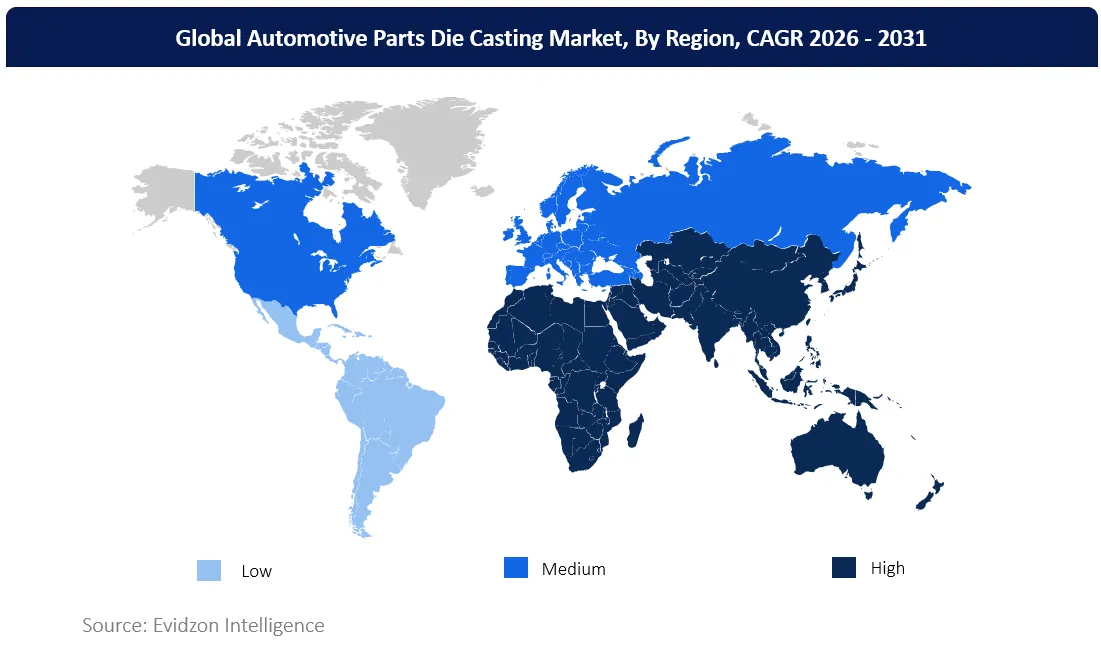
Asia-Pacific is the largest automotive die casting region in terms of production value and volume. China’s production of vehicles, developed foundry and equipment base in Japan, and the growing automobile industry in India and Southeast Asia are the key attributes driving Asi Pacific demand. Europe is stepping up its efforts to produce large structural castings and European OEMs are preparing to implement their own large-casting programs. While the Middle East and Africa have the least developed market, but it is expected to grow in the future due to the emphasis on localized automobile production.
Key Takeaways
- By vehicle type, passenger car accounts for nearly 54.23% market share in 2025 and expected to grow at a CAGR of 9.59% by 2031.
- By propulsion, internal combustion engine (ICE) remains the largest sub-segment accounting for nearly 72.6% of the automotive parts die casting market in 2025. Whereas, electric vehicle (EV) is expected to be the fastest growing propulsion segment expanding at 14.70% CAGR by 2031.
- By component, powertrain & transmission segment has registered the highest market value share of nearly 29.4% in 2025 of global automotive parts die casting market and EV & E-powertrain is expected to ride at a 17.6% CAGR over the forecast period.
- By die casting process, high-pressure die casting (HPDC) remain the dominant demand base with more than 77.3% market share in 2025, and projected to grow at 9.65% CAGR by 2031.
- By sales channel, OEM accounts for 88.86% global automotive parts die casting market share in 2025. However, aftermarket is projected to witness a CAGR of 10.22% during 2026–2031.
- By material, aluminum segment accounts for nearly 78.4% market share in 2025. However, Magnesium is expected to grow at a CAGR of 10.9% by 2031.
- By region, Asia-Pacific accounts for 41.25% global automotive parts die casting market share in 2025. However, Middle-East & Africa is projected to witness a CAGR of 10.65% during 2026–2031.
About the Study
The global automotive parts die casting market study covers die-cast components for new passenger cars and commercial vehicles, with segmentation by vehicle type, propulsion, component, casting process, sales channel and material, with analysis by region and country. This study only covers automotive parts produced by die casting, and does not include production of raw metals, die casting of non-automotive parts, complete vehicle production, machining and assembly processes not directly related to die-cast components, and downstream recycling and secondary materials markets.
Market Dynamics Analysis
Drivers
Battery housings and motor components increase casting requirements.
Consolidated structures reduce assembly count and welding operations.
Rising production directly increases cast component requirements.
Weight reduction encourages aluminum replacement across vehicle architectures.
Lower porosity enables structural parts requiring higher mechanical integrity.
Automated production improve efficiency, consistency, and material utilization.
Restraints
Large dies require substantial upfront capital and qualification.
Porosity and dimensional variation can raise rejection rates.
Melting and holding processes remain significant energy consumers.
Aluminum and magnesium fluctuations complicate long-term component pricing.
Die casting is emerging as a key manufacturing process across the automotive industry, due to the increasing importance of part consolidation, reduced weight and improved manufacturing efficiency in vehicle design. EV platforms see particular advantages, as battery housings, motor housings, inverter cases, and structural castings open up new applications that previously would not have been cost effective in traditional ICE powertrains. Additionally is well suited in large structural casting providing high structural integrity by minimizing stamps and welds, reducing manufacturing complexity and improving manufacturing efficiency. Aluminum remains the dominant die-casting material due to its favorable strength to weight ratio and availability in the automotive supply chain. Meanwhile, the global production of vehicles provides a large production volume base for cast components. Automation is improving process consistency, productivity, while advances in molds, vacuum casting and process control makes larger, and more complex components viable for commercial production.
The economics of automotive die-casting remain extremely dependent on tooling costs, process qualification, energy costs and material prices at any given time. A significant upfront cost is requirement of large dies and specialized casting cells, restraint new entrants in the market. In addition, the quality of castings can sometimes be an issue due to porosity, shrinkage, and other defects that may require machining, repair, or inspection of castings for critical or structural components. Furthermore, foundries have to deal with large expenditures on electricity and thermal energy when melting, holding, and casting metals. The costs of materials are also a concern due to the risk of not being able to pass on higher prices to OEMs. Such factors may affect the appeal of die-casting as a manufacturing method, particularly for manufacturers with existing production lines or less capital-intensive manufacturing methods.
Segment Analysis
By Vehicle Type
Passenger cars represent the largest vehicle type category with 54.23% market share in global automotive parts die casting market and expected to grow at a CAGR of 9.59% by 2031. Passenger cars parts die casting growth is supported by a wide variety of die-cast applications ranging from powertrain and transmission components, structural parts, chassis and suspension components, electronics housings, and body applications. The high production volumes of passenger vehicles offer a consistent component basis, while the increasing vehicle electronics and structural integration are broadening the number and value of die-cast parts per vehicle.
Commercial vehicles have a different component mix emphasizing on durability, load-bearing performance, thermal management, and long operating cycles. The transition towards electric commercial vehicles is imposing additional demand on motor housings, reduction-gear components, inverter housings, battery-related structures, and thermal-management parts. The transition is altering the composition of the die-casting demand rather than simply adding volume as the EV components require different geometries, alloy specifications, dimensional tolerances, and joining requirements.
Global Automotive Parts Die Casting Market, By Vehicle Type, Market Share, 2025
By Propulsion
Internal combustion engine (ICE) accounts for the highest market share of 72.6% in 2025 while, electric vehicles (EVs) are expected to grow at 14.7% CAGR by 2031. ICE vehicles will continue to drive demand for die-casting through established applications including engine and transmission housings, covers, brackets, and other powertrain components. While, electric vehicles are changing the component mix fundamentally by replacing the conventional engine and transmission assemblies.
However, EVs are shaping distant demand ecosystem by components like electric motors, reduction gears, inverters, battery systems, cooling circuits, and structural assemblies, creating dedicated casting demand. In EVs Aluminum will remain the most preferred material type due to low density with thermal conductivity and established casting processes. As tighter control over alloy composition, porosity, dimensional stability, heat treatment, and machining are required for larger components, the supplier requirements is also evolving use of integrated castings. The die-casting suppliers are therefore increasingly confronted with the need to have competencies spanning from conventional powertrain components and higher value electrified applications.
Global Automotive Parts Die Casting Market, By Propulsion, Market Share, 2025
Geographic Analysis
Largest Region
Asia Pacific registered the highest market share of 41.25% in 2025 of global automotive parts die casting market. Asia-Pacific underpinned concentration of vehicle production, die-casting, aluminum-processing facilities, and automotive-supply-chain suppliers. China, Japan, India, South Korea, Thailand, and Indonesia combine to form a large manufacturing ecosystem encompassing both passenger and commercial vehicles, across internal combustion engine (ICE) and EV powertrains.
China manufactured 34.53 million vehicles in 2025 with 16.63 million new-energy vehicles, and 5.54 million and 1.17 million passenger and commercial vehicles respectively has been produced in India in 2025. The Asia Pacific region has extensive die-casting capability for the traditional automotive industry. At the same time, the boom in EV production is boosting demand for battery housings, motor housings, inverter cases, structural castings, and thermal-management castings. In addition, the presence of well-established Tier-1 and Tier-2 supply chains supports integrated casting, machining, heat-treatment, and finishing operations near vehicle assembly plants.
Global Automotive Parts Die Casting Market, By Region, Market Share, 2025
Fastest-Growing Region
Middle East & Africa is projected to be the fastest region in global automotive parts die casting market by 2031 accounting for 10.65% CAGR. The Middle East & Africa region is growing, with its key markets building up both around existing manufacturing centers (Morocco and South Africa) as well as emerging opportunities around localized automotive production. Die casting play an important role in the development of such markets, as most of the components that have potential in this region do not necessarily have to be made in the highest-volume, highest-integration HPDC programs.
Areas of opportunity include housings, brackets, chassis components, powertrain components, and certain structural components that can be manufactured localized as part of broader automotive value chains. Increasing EV penetration in region also unfold opportunities around motor housings, inverter cases, battery structures, and thermal management components. Meanwhile, ICE production is still going to be a part of the local automotive industry, and so there is an opportunity to evolve the product mix with more casting content without overhauling existing programs.
Competitive Landscape
- 1Nemak, S.A.B. de C.V.
- 2Ryobi Limited
- 3Wencan Group Co., Ltd.
- 4Ahresty Corporation
- 5Linamar Corporation
Market Concentration Level: Fragmented
The global automotive parts die casting market is fragmented, competitive landscape spans high-pressure die casting, low-pressure die casting, gravity/permanent-mold casting, and other processes (material capabilities, and downstream machining). The key factors influencing the competitive structure of market includes the scale of casting, varying levels of specialization in the production process, tooling know-how, complexity of manufactured components, production sites geographical location, and the ability to support customers in bringing new products to market through all stages of development and serial production. Nemak, S.A.B. de C.V., Ryobi Limited, Wencan Group Co., Ltd., Ahresty Corporation and Linamar Corporation offer the most comprehensive solutions in terms of the portfolio of automotive powertrain, structural, and lightweight components produced.
The industry’s competitive forces are shifting from capacity-focused production toward the large and technically complex castings and structures, as well as integrated EV housing solutions, tight dimensional tolerances, machining, recycling capabilities, and the establishment of production sites closer to OEMs. Ahresty’s global production platform and standardization of manufacturing processes allow for producing high-quality automotive parts with consistent quality across production sites.
Recent Development
Jaya Hind announces expansion of die-casting
Jaya Hind announced a two-year INR 600 crore (USD 62 million) investment in its manufacturing facilities, including a new facility in Chennai with over 12 new HPDC machines with a capacity of between 1,200 and 3,500 tonnes, and enhanced machining and processing capabilities.
Alicon Castalloy Announced to Set-up New LPDC and GDC Plant
Alicon Castalloy’s Board of Director has announced an capital of INR 125.5 crore (USD 13 million) to set-up a new plant for GDC (Gravity Die Castings), LPDC (Low-Pressure Die Castings) and machining operations in Shikrapur, Pune, Maharashtra.
SSWL announced alloy-wheel manufacturing expansion
Steel Strips Wheels Limited (SSWL) announced capital expenditure (capex) program of INR 500–600 crore (~USD 52-62 million) at its Bhuj facility in Gujarat on higher-margin, lightweight aluminum products utilizing Low-Pressure Die Casting (LPDC) technology.
Table of Content
- 1.Introduction
- 1.1Scope and Objective of the Study
- 1.2Market Definition & Study Assumptions
- 2.Research Methodology
- 3.Executive Summary
- 4.Market Outlook
- 4.1Market Overview
- 4.2Market Drivers
- 4.2.1EV Architecture Expands High-Value Die-Cast Applications
- 4.2.2Structural Integration Drives Large Casting Adoption
- 4.2.3Vehicle Production Growth Expands Die-Cast Component Demand
- 4.2.4Aluminum Substitution Supports Lightweight Component Design
- 4.2.5Vacuum Casting Expands Safety-Critical Applications
- 4.2.6Automation Improves High-Volume Casting Economics
- 4.3Market Restraint
- 4.3.1Tooling Investment Raises Entry Barriers For Suppliers
- 4.3.2Casting Defects Increase Quality Control Requirements
- 4.3.3Energy Consumption Pressures Foundry Operating Costs
- 4.3.4Metal Price Volatility Compresses Supplier Margins
- 4.4Regulatory Landscape
- 4.5Supply/Value Chain Analysis
- 4.6Porter's Five Forces Analysis
- 4.6.1Threat of New Entrants
- 4.6.2Bargaining Power of Buyers
- 4.6.3Bargaining Power of Suppliers
- 4.6.4Threat of Substitutes
- 4.6.5Competitive Rivalry
- 5.Market Segmentation (Includes market size in Value (USD), Forecast up to 2031, and market analysis with growth attributes)
- 5.1By Vehicle Type
- 5.1.1Passenger Car
- 5.1.1.1Hatchback
- 5.1.1.2Sedan
- 5.1.1.3SUV/MUV
- 5.1.1.4Others (Crossover, Coupe, Convertible, Wagon)
- 5.1.2Commercial Vehicle
- 5.1.2.1Light Commercial Vehicle
- 5.1.2.2Medium and Heavy-Duty Trucks
- 5.1.2.3Bus and Coach
- 5.2By Propulsion
- 5.2.1Internal Combustion Engine (ICE)
- 5.2.1.1Petrol / Gasoline
- 5.2.1.2Diesel
- 5.2.1.3CNG/LPG
- 5.2.2Electric Vehicle (EV)
- 5.2.2.1Hybrid Electric Vehicle (HEV)
- 5.2.2.2Plug-in Hybrid Electric Vehicle (PHEV)
- 5.2.2.3Battery Electric Vehicle (BEV)
- 5.3By Component
- 5.3.1Powertrain & transmission
- 5.3.2EV & e-powertrain
- 5.3.3Structural components
- 5.3.4Chassis & suspension
- 5.3.5Electronics & housings
- 5.3.6Body components
- 5.3.7Other
- 5.4By Die Casting process
- 5.4.1High-pressure die casting (HPDC)
- 5.4.2Low-pressure die casting (LPDC)
- 5.4.3Gravity/permanent-mold casting
- 5.4.4Others (Sand casting, Forging, Extrusion, Stamping, etc.)
- 5.5By Sales Channel
- 5.5.1OEM
- 5.5.2Aftermarket
- 5.6By Material
- 5.6.1Aluminum
- 5.6.2Zinc
- 5.6.3Magnesium
- 5.6.4Others
- 5.7By Region
- 5.7.1North America
- 5.7.1.1United States
- 5.7.1.2Canada
- 5.7.2Latin America
- 5.7.2.1Brazil
- 5.7.2.2Argentina
- 5.7.2.3Mexico
- 5.7.2.4Rest of Latin America
- 5.7.3Europe
- 5.7.3.1Germany
- 5.7.3.2Italy
- 5.7.3.3France
- 5.7.3.4Spain
- 5.7.3.5United Kingdom
- 5.7.3.6Russia
- 5.7.3.7Rest of Europe
- 5.7.4Asia Pacific
- 5.7.4.1China
- 5.7.4.2India
- 5.7.4.3Japan
- 5.7.4.4South Korea
- 5.7.4.5Indonesia
- 5.7.4.6Australia
- 5.7.4.7Rest of Asia-Pacific
- 5.7.5Middle East & Africa
- 5.7.5.1Saudi Arabia
- 5.7.5.2United Arab Emirates (UAE)
- 5.7.5.3South Africa
- 5.7.5.4Egypt
- 5.7.5.5Rest of the Middle East & Africa
- 6.Competitive Landscape
- 6.1Market Concentration Overview
- 6.2Market Share Analysis
- 6.3Company Profiles
- 6.3.1Nemak, S.A.B. de C.V.
- 6.3.2Ryobi Limited
- 6.3.3Wencan Group Co., Ltd.
- 6.3.4Ahresty Corporation
- 6.3.5Linamar Corporation
- 6.3.6Endurance Technologies Limited
- 6.3.7Rheinmetall AG
- 6.3.8Sundaram-Clayton Limited
- 6.3.9Rockman Industries Limited
- 6.3.10Jaya Hind Industries Private Limited
- 6.3.11Pace Industries, LLC
- 6.3.12Meridian Lightweight Technologies Inc.
- 6.3.13Form Technologies Inc. (Dynacast)
- 6.3.14Handtmann Unternehmensgruppe
- 6.3.15Le Bélier S.A.
- 7.Future Outlook
- 7.1Growth Opportunities & White-Space Analysis
- 7.2Analyst Recommendations
Market Size Methodology
To arrive at the market size, new production of vehicles multiplied by a corresponding average sales value of selected die-cast components per vehicle. The calculation includes adjustments by component type, considering differences in penetration and material intensity. This approach is applied to respective segments including propulsion type, vehicle type, component type, casting process, material type, and sales channel. The difference between the die-cast content of an ICE and EV in both light and commercial vehicle segments is accounted in the calculation. New vehicle production and circulation data, including OEM production reports, supplier data, government statistics, industry reports, technical publications, and company reports, has used for historical context and to establish production and penetration benchmarks.
Forecast is based on vehicle production, with consideration given to the balance between passenger car and commercial vehicles, ICEs and EVs, and the choice of powertrain architecture for EVs, the inclusion of die-cast components, penetration rates for passenger car and commercial vehicles in relation to component type, material, sales channel, structural casting requirements, consolidation rates per component type, manufacturing processes, component value, metal prices, manufacturing technology, OEM sourcing preferences, capacity expansions, and shifts in regional manufacturing. Aftermarket sales of die-cast components is calculated on the basis of the circulatory stock of vehicles, with consideration given to component replacements, vehicle ages, and replacement intervals, as well as the proportion of components sold via independent and OEM service channels.
FAQ
What is the projected size of the global automotive parts die casting market by 2031?
The global automotive parts die casting market is projected to reach approximately USD 123.8 billion by 2031, growing from USD 76.0 billion in 2025 at a CAGR of 8.88% during 2026–2031.
Which vehicle propulsion segment dominates the automotive parts die casting market?
Internal combustion engine (ICE) vehicles dominate the market, accounting for 72.6% of market value in 2025.
Which component segment holds the largest market share?
The powertrain and transmission segment holds the largest share, accounting for 29.4% of the global automotive parts die casting market in 2025.
Which region dominates the global automotive parts die casting market?
Asia-Pacific is the largest regional market, accounting for 41.25% of market value in 2025, supported by vehicle production, established die-casting capabilities, aluminum-processing facilities, and automotive supply chains.
Who are the key players in the global automotive parts die casting market?
The market is fragmented, with Nemak, Ryobi, Wencan Group, Ahresty Corporation, and Linamar Corporation identified as the five major players.
Have a question about this report?
Talk to the analyst behind this research, or browse the full report catalogue.
Contact Us