
Global Automotive High-pressure Die Casting Market
The global automotive parts high-pressure die casting (HPDC) market is segmented by vehicle type (Passenger Car and Commercial Vehicle), by propulsion (Internal Combustion Engine (ICE) and Electric Vehicle (EV)), by component (Powertrain & transmission, EV & e-powertrain, Structural components, Chassis & suspension, Electronics & housings, Body components, and Other), by die casting process (Gravity die casting, Permanent-mold casting, Tilt casting, and Semi-permanent mold casting), by sales channel(OEM and Aftermarket), by material (Aluminum, Zinc, Magnesium, and Others), and by region (North America, Latin America, Europe, Asia-Pacific, and Middle-East and Africa). The global automotive parts high-pressure die casting (HPDC) market report includes market size in Value (USD) and forecast up to 2031.
Global Automotive High-pressure Die Casting Market
Market Size in USD Billion
Market Size Overview
USD Billion
Market Snapshot
- Study Period
- 2019-2031
- Forecast Period
- 2026-2031
- Base Year Market Size (2025)
- USD 58.7 Billion
- Market Size (2026)
- USD 63 Billion
- Market Size (2031)
- USD 99.9 Billion
- Growth Rate (2026-2031)
- 9.65% CAGR
- Market Concentration
- Fragmented
Major Players*




*Disclaimer: Major Players sorted in no particular order
Market Overview
The global automotive parts high-pressure die casting (HPDC) market value is anticipated to grow from USD 58.7 billion in 2025 to 63 billion in 2026 and expected to reach USD 99.9 billion in 2031 with a CAGR (2026-2031) of 9.65%.
High-pressure die-casting (HPDC) is expanding into applications beyond engine blocks and transmission housings as OEMs move toward aluminum-intensive vehicle architectures for improved performance and reduced weight. Evolving automotive electrification strategies are spurring increased use of high-pressure die-casting in powertrain housing, inverter housings, reduction gears, battery housings and thermal management. While, large-format casting is transforming the economics further. Key companies operating in the market are emphasizing on large capacity machine for large automotive-part prototyping, targeting components assembled from number of parts. Such shift to larger, more integrated components is forcing HPDC toward more significant, integrated parts.
Competitive landscape is increasingly inclined towards structural casting capability, EV specific parts, and the ability to support OEM programs from design. Key players in market are aggressively pursuing organic and inorganic growth strategies to capture larger market chunk. For instance, in February 2026, Nemak completed its acquisition of the automotive business of GF Casting Solutions adding nine production facilities and enhancing its capabilities in its own aluminum and magnesium structural components, chassis, and EV capabilities. Ryobi is taking a different approach by investing directly in ultra-large HPDC and offering prototyping capabilities for large body and chassis parts. Across the supplier base, there is a shift away from simple high-volume castings towards vacuum HPDC, large structural parts, battery-related components, integrated castings, and higher-value machining.
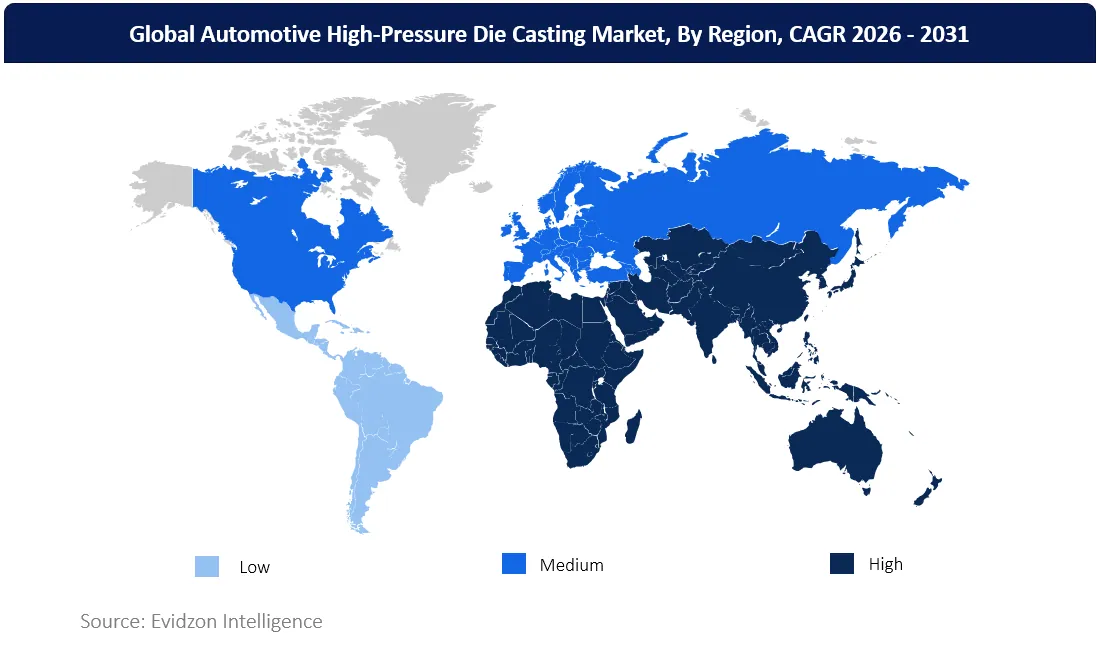
In global automotive component HPDC market, Asia Pacific region has the largest growth potential due to its strong vehicle manufacturing sector, foundry, aluminum processing and automotive supply chains. China, Japan, India, South Korea, Thailand and Indonesia contribute to the manufacturing environment across both ICE and electric vehicle segments. Europe is a key market with automotive manufacturers looking to increase the usage of large casting structures. While, demand in North America is driven by automotive manufacturing, and light electric vehicle components.
Key Takeaways
- By vehicle type, passenger car accounts for nearly 72.1% market share in 2025 and expected to grow at a CAGR of 10.2% by 2031.
- By propulsion, internal combustion engine (ICE) remains the largest sub-segment accounting for nearly 74.1% of the automotive parts high-pressure die casting (HPDC) market in 2025. Whereas, electric vehicle (EV) is expected to be the fastest growing propulsion segment expanding at 15.8% CAGR by 2031.
- By component, powertrain & transmission segment has registered the highest market value share of nearly 28.5% in 2025 of global automotive parts high-pressure die casting (HPDC) market and EV & E-powertrain is expected to ride at a 17.4% CAGR over the forecast period.
- By die casting process, cold-chamber HPDC remain the dominant demand base with more than 70.1% market share in 2025, and projected to grow at 18.7% CAGR by 2031.
- By sales channel, OEM accounts for 93.1% global automotive parts high-pressure die casting (HPDC) market share in 2025. However, aftermarket is projected to witness a CAGR of 10.4% during 2026–2031.
- By material, aluminum segment accounts for nearly 90.1% market share in 2025. However, magnesium is expected to grow at a CAGR of 11.6% by 2031.
- By region, Asia Pacific accounts for 47.1% global automotive parts high-pressure die casting (HPDC) market share in 2025. However, Middle East & Africa is projected to witness a CAGR of 10.7% during 2026–2031.
About the Study
The global automotive parts high-pressure die casting (HPDC) market study covers die-cast components for new passenger cars and commercial vehicles, with segmentation by vehicle type, propulsion, component, casting process, sales channel and material, with analysis by region and country. This study only covers automotive parts produced by die casting, and does not include production of raw metals, die casting of non-automotive parts, complete vehicle production, machining and assembly processes not directly related to die-cast components, and downstream recycling and secondary materials markets.
Market Dynamics Analysis
Drivers
Large-format presses consolidate body structures into fewer castings.
Lower gas entrapment improves ductility and joining performance.
Advanced filling enables thinner sections without sacrificing performance.
Sensors and process models support faster defect detection.
Lower density creates additional weight reduction potential.
High-scrap alloys increasingly retain required mechanical performance.
Restraints
Repeated thermal cycling accelerates cracking and die deterioration.
Mega-casting machines require exceptionally high locking forces.
Entrapped gas can limit structural component performance.
Residual stresses can create geometry deviations after ejection.
HPDC is evolving beyond standard housings and brackets as large-format machines begin to make structural castings commercially viable. Mega-casting tends to replace multiple body components and reduce joining operations while vacuum-assisted processes overcome the porosity impediments that have previously constrained HPDC to structural applications. It has been observed that strength, ductility, and consistency are enhanced by higher vacuum making it more attractive to critical automotive component manufacturing. The thin-wall parts processing enables improved material efficiency where large castings are developed to control mass without increasing numbers of part. Magnesium offers an alternative route as it offers capacity for super-sized structural components due to a significantly lower density than aluminum. At the process level sensors, simulation, and digital control are beginning to enable improved monitoring of the short cycles of HPDC where minor variations can have a significant impact on casting quality.
The economics of HPDC becomes increasingly difficult to manage as component size and structural requirements dictates. Tool degradation and thermal cracking is one of the significant challenge emerging as large-format tooling experiences extensive heating, cooling, injection pressure, and mechanical loading. Mega-casting also demands extremely high clamping forces, currently demands of greater than 16,000 tons for integrated structures, which raises the capital and infrastructure investment is required. Conventional HPDC is also constrained by gas-porosity limitations particularly when components demand high ductility, weldability, and fatigue performance. Vacuum systems, while improving overall integrity require additional steps, seal management, process control, and maintenance. Large castings pose additional distortion challenges due to thermal gradients, residual stresses, cooling behaviors, and ejection constraints which makes the process qualification far more challenging as HPDC transitions into larger structural applications.
Segment Analysis
By Vehicle Type
Passenger cars represent the largest vehicle type category with 72.1% market share in global automotive parts high-pressure die casting (HPDC) market and expected to grow at a CAGR of 10.2% by 2031. By vehicle type, the majority of HPDC demand is driven by passenger cars, as the process is well suited to high-volume production of complex aluminum components with high dimensional tolerances. Transmission housings, motor housings, structural parts, chassis components, suspension parts, electronics housings and body structures are areas in which the HPDC process is used. HPDC is lucrative across components and parts requiring complex aluminum geometry at a high cycle rate owing to precised control on weight and machining requirements.
While commercial trucks carry somewhat different design criteria, with higher requirements for durability and thermal management and longer service intervals, the demand trends are still shifting towards electrified powertrains, meaning more opportunities for housing-type applications. Meanwhile, larger casting machines produce larger structural components allowing suppliers to broaden their HPDC scope towards larger structures beyond traditional, smaller powertrain components.
Global Automotive Parts High-Pressure Die Casting (HPDC) Market, By Vehicle Type, Market Share, 2025
By Propulsion
Internal combustion engine (ICE) accounts for the highest market share of 74.1% in 2025 while, electric vehicles (EVs) are expected to grow at 15.8% CAGR by 2031. By propulsion, ICE vehicles continue to sustain HPDC demand across transmission housings, engine related components, oil pans, covers, brackets, and other aluminum castings. The shift towards EVs is transforming the applications mix substantially. Electric platforms eliminate a number of traditional ICE components but also add motor housings, reduction gear housings, inverter cases, battery enclosures, cooling components and integrated structural castings.
EV platforms require tighter tolerances, higher thermal conductivity, leak tightness and mechanical integrity as several castings interface directly with electrical and thermal systems. Vacuum assisted HPDC is emerging for structural applications as reducing gas entrapment improves ductility and joining performance. Large format presses are also enabling extended use of HPDC in body structures that were manufactured from multiple stamped and welded components.
Global Automotive Parts High-Pressure Die Casting (HPDC) Market, By Propulsion, Market Share, 2025
Geographic Analysis
Largest Region
Asia Pacific registered the highest market share of 47.1% in 2025 of global automotive parts high-pressure die casting (HPDC) market. Asia-Pacific has a mature HPDC ecosystem featuring an extensive vehicle production capability, aluminum supply chain, established Tier-1 and Tier-2 suppliers, and emerging electric vehicle (EV) manufacturing capabilities. China is the demand epicenter with 34.53 million units of annual vehicle production in 2025, including 16.63 million new-energy vehicles.
While, India manufactured of 5.54 million passenger cars and 1.17 million commercial trucks in 2025. Japan, South Korea, Thailand, and Indonesia, is shaping demand with their established automotive industry and foundry capacity, form a critical demand base for conventional transmission and powertrain castings and provide ample opportunities in terms of battery housing, motor housing, inverter case, structural automotive castings, and thermal management systems. Additionally, Asia Pacific hosts a concentration of equipment manufacturers, die casters, aluminum foundries, machining companies, and automakers with vertically integrated supply chain which is anticipated to continue the large scale HPDC adoption in automotive parts over the coming years.
Global Automotive Parts High-Pressure Die Casting (HPDC) Market, By Region, Market Share, 2025
Fastest-Growing Region
Middle East & Africa is projected to be the fastest region in global automotive parts high-pressure die casting (HPDC) market by 2031 accounting for 10.7% CAGR. Middle East & Africa is developing its HPDC opportunity alongside automakers’ assembly and component localization efforts as well as automotive industry investments. Morocco, South Africa, and other countries offer manufacturing bases, and new investment into components is also opening opportunities for localized production. HPDC has a role in regions where automakers are looking to achieve high-repetition manufacturing of medium- to large-sized aluminum components for automotive applications – housings, chassis and structure parts, and powertrain components.
The move toward EVs also creates a role for HPDC in propulsion components, motor and inverter housings, battery structures and thermal management, and other components. The Middle East & Africa automotive parts high-pressure die casting (HPDC) market growth potential will be primarily driven by the presence of strong supplier networks with aluminum, machining, and foundry resources, as well as OEMs’ interest in localizing components. This will require a sufficient level of production volumes to support the cost of HPDC equipment.
Competitive Landscape
- 1Nemak, S.A.B. de C.V.
- 2Ryobi Limited
- 3Wencan Group Co., Ltd.
- 4Ahresty Corporation
- 5Linamar Corporation
Market Concentration Level: Fragmented
The global automotive parts high-pressure die casting (HPDC) market is fragmented with players vying to offer higher casting capacity, greater machine tonnages, structurally superior and dimensionally precise castings, advanced tooling capabilities and ability to deliver machined components at automotive production volumes. Nemak, S.A.B. de C.V., Ryobi Limited, Wencan Group Co., Ltd., Ahresty Corporation and Linamar Corporation have carved out a niche in the industry with complex aluminum HPDC applications, underpinned by engineering, tooling, process simulation and downstream machining capabilities.
The competitive landscape is increasingly focused on large, thin-wall and structurally integrated castings as automakers re-platform vehicles to reduce weight and electrification. Key companies has invested significantly in HPDC capacity for body structural components and integrated body castings, including very large machines for mega-casting applications. Competitive advantage is gained through high-tonnage and vacuum-assisted HPDC, complex structural and EV components, integrated tooling-to-machining capabilities, faster program launches and proximity to global OEM manufacturing networks.
Recent Development
Jaya Hind Announces Expansion of Die-Casting
Jaya Hind announced a two-year INR 600 crore (USD 62 million) investment in its manufacturing facilities, including a new facility in Chennai with over 12 new HPDC machines with a capacity of between 1,200 and 3,500 tonnes, and enhanced machining and processing capabilities.
Nemak Completes GF Casting Solutions Automotive Acquisition
Nemak has completed acquisition of the automotive business of GF Casting Solutions, including nine production facilities and an R&D center. Approximately 80% of the acquired businesses are e-mobility and structure/chassis applications related, strengthening Nemak's position in complex aluminum and magnesium casting and add significant capacity and technology in high-pressure die casting (HPDC) as well as enhanced commercial presence among premium automakers in Europe and China.
Handtmann Develops HPDC Aluminum Wheel Technology
Handtmann has developed technology to manufacture complete aluminum wheels by high-pressure die-casting (HPDC), a process previously used for low-pressure die-casting (LPDC). The new wheels are 20-30% lighter than conventional low-pressure die-cast wheels.
Table of Content
- 1.Introduction
- 1.1Scope and Objective of the Study
- 1.2Market Definition & Study Assumptions
- 2.Research Methodology
- 3.Executive Summary
- 4.Market Outlook
- 4.1Market Overview
- 4.2Market Drivers
- 4.2.1Mega-Casting Expands Large Structural Component Applications
- 4.2.2Vacuum Casting Reduces Porosity in Structural Components
- 4.2.3Thin-Wall Casting Improves Material Utilization Efficiency
- 4.2.4Digital Process Control Improves Casting Consistency
- 4.2.5Magnesium Alloys Broaden Super-Sized Casting Opportunities
- 4.2.6Recycled Alloy Development Supports Lower-Carbon HPDC
- 4.3Market Restraint
- 4.3.1Thermal Fatigue Limits Tooling Service Life
- 4.3.2Extreme Clamping Requirements Increase Equipment Cost
- 4.3.3Porosity Control Restricts Conventional HPDC Applications
- 4.3.4Large Casting Distortion Complicates Dimensional Quality
- 4.4Regulatory Landscape
- 4.5Supply/Value Chain Analysis
- 4.6Porter's Five Forces Analysis
- 4.6.1Threat of New Entrants
- 4.6.2Bargaining Power of Buyers
- 4.6.3Bargaining Power of Suppliers
- 4.6.4Threat of Substitutes
- 4.6.5Competitive Rivalry
- 5.Market Segmentation (Includes market size in Value (USD), Forecast up to 2031, and market analysis with growth attributes)
- 5.1By Vehicle Type
- 5.1.1Passenger Car
- 5.1.1.1Hatchback
- 5.1.1.2Sedan
- 5.1.1.3SUV/MUV
- 5.1.1.4Others (Crossover, Coupe, Convertible, Wagon)
- 5.1.2Commercial Vehicle
- 5.1.2.1Light Commercial Vehicle
- 5.1.2.2Medium and Heavy-Duty Trucks
- 5.1.2.3Bus and Coach
- 5.2By Propulsion
- 5.2.1Internal Combustion Engine (ICE)
- 5.2.1.1Petrol / Gasoline
- 5.2.1.2Diesel
- 5.2.1.3CNG/LPG
- 5.2.2Electric Vehicle (EV)
- 5.2.2.1Hybrid Electric Vehicle (HEV)
- 5.2.2.2Plug-in Hybrid Electric Vehicle (PHEV)
- 5.2.2.3Battery Electric Vehicle (BEV)
- 5.3By Component
- 5.3.1Powertrain & transmission
- 5.3.2EV & e-powertrain
- 5.3.3Structural components
- 5.3.4Chassis & suspension
- 5.3.5Electronics & housings
- 5.3.6Body components
- 5.3.7Other
- 5.4By Die Casting process
- 5.4.1Cold-chamber HPDC
- 5.4.2Hot-chamber HPDC
- 5.4.3Vacuum-assisted HPDC
- 5.4.4Squeeze / high-integrity die casting
- 5.4.5Ultra-large / mega die casting
- 5.5By Sales Channel
- 5.5.1OEM
- 5.5.2Aftermarket
- 5.6By Material
- 5.6.1Aluminum
- 5.6.2Zinc
- 5.6.3Magnesium
- 5.6.4Others
- 5.7By Region
- 5.7.1North America
- 5.7.1.1United States
- 5.7.1.2Canada
- 5.7.2Latin America
- 5.7.2.1Brazil
- 5.7.2.2Argentina
- 5.7.2.3Mexico
- 5.7.2.4Rest of Latin America
- 5.7.3Europe
- 5.7.3.1Germany
- 5.7.3.2Italy
- 5.7.3.3France
- 5.7.3.4Spain
- 5.7.3.5United Kingdom
- 5.7.3.6Russia
- 5.7.3.7Rest of Europe
- 5.7.4Asia Pacific
- 5.7.4.1China
- 5.7.4.2India
- 5.7.4.3Japan
- 5.7.4.4South Korea
- 5.7.4.5Indonesia
- 5.7.4.6Australia
- 5.7.4.7Rest of Asia-Pacific
- 5.7.5Middle East & Africa
- 5.7.5.1Saudi Arabia
- 5.7.5.2United Arab Emirates (UAE)
- 5.7.5.3South Africa
- 5.7.5.4Egypt
- 5.7.5.5Rest of the Middle East & Africa
- 6.Competitive Landscape
- 6.1Market Concentration Overview
- 6.2Market Share Analysis
- 6.3Company Profiles
- 6.3.1Nemak, S.A.B. de C.V.
- 6.3.2Ryobi Limited
- 6.3.3Wencan Group Co., Ltd.
- 6.3.4Ahresty Corporation
- 6.3.5Linamar Corporation
- 6.3.6Endurance Technologies Limited
- 6.3.7Rheinmetall AG / KS AluTech
- 6.3.8Sundaram-Clayton Limited
- 6.3.9Rockman Industries Limited
- 6.3.10Jaya Hind Industries Private Limited
- 6.3.11Sunbeam Lightweighting Solutions
- 6.3.12Pace Industries, LLC
- 6.3.13Meridian Lightweight Technologies Inc.
- 6.3.14Form Technologies Inc. (Dynacast)
- 6.3.15Spark Minda
- 7.Future Outlook
- 7.1Growth Opportunities & White-Space Analysis
- 7.2Analyst Recommendations
Market Size Methodology
To arrive at the market size, new production of vehicles multiplied by a corresponding average sales value of selected automotive parts high-pressure die-cast (HPDC) components per vehicle. The calculation includes adjustments by component type, considering differences in penetration and material intensity. This approach is applied to respective segments including propulsion type, vehicle type, component type, casting process, material type, and sales channel. The difference between the die-cast content of an ICE and EV in both light and commercial vehicle segments is accounted in the calculation. New vehicle production and circulation data, including OEM production reports, supplier data, government statistics, industry reports, technical publications, and company reports, has used for historical context and to establish production and penetration benchmarks.
Forecast is based on vehicle production, with consideration given to the balance between passenger car and commercial vehicles, ICEs and EVs, and the choice of powertrain architecture for EVs, the inclusion of die-cast components, penetration rates for passenger car and commercial vehicles in relation to component type, material, sales channel, structural casting requirements, consolidation rates per component type, manufacturing processes, component value, metal prices, manufacturing technology, OEM sourcing preferences, capacity expansions, and shifts in regional manufacturing. Aftermarket sales of die-cast components is calculated on the basis of the circulatory stock of vehicles, with consideration given to component replacements, vehicle ages, and replacement intervals, as well as the proportion of components sold via independent and OEM service channels.
FAQ
What is the projected size of the global automotive parts HPDC market by 2031?
The global automotive parts high-pressure die casting (HPDC) market is projected to reach USD 99.9 billion by 2031, growing from USD 58.7 billion in 2025 at a CAGR of 9.65% during 2026–2031.
Which vehicle propulsion segment dominates the automotive parts HPDC market?
Internal combustion engine (ICE) vehicles dominate the market, accounting for 74.1% of market value in 2025.
Which component segment holds the largest market share?
The powertrain and transmission segment holds the largest share, accounting for 28.5% of the global automotive parts HPDC market in 2025.
Which region dominates the global automotive parts HPDC market?
Asia-Pacific is the largest regional market, accounting for 47.1% of market value in 2025, supported by vehicle production, established foundry capabilities, aluminum supply chains, and automotive manufacturing networks.
Who are the key players in the global automotive parts HPDC market?
Nemak, Ryobi Limited, Wencan Group, Ahresty Corporation, and Linamar Corporation are the key players in the global automotive parts HPDC market.
Have a question about this report?
Talk to the analyst behind this research, or browse the full report catalogue.
Contact Us