
Global Automotive Low-pressure Die Casting Market
The global automotive parts low-pressure die casting (LPDC) market is segmented by vehicle type (Passenger Car and Commercial Vehicle), by propulsion (Internal Combustion Engine (ICE) and Electric Vehicle (EV)), by component (Powertrain & transmission, EV & e-powertrain, Structural components, Chassis & suspension, Electronics & housings, Body components, and Other), by die casting process (Gravity die casting, Permanent-mold casting, Tilt casting, and Semi-permanent mold casting), by sales channel (OEM and Aftermarket), by material (Aluminum, Magnesium, and Others), and by region (North America, Latin America, Europe, Asia-Pacific, and Middle-East and Africa). The global automotive parts low-pressure die casting (LPDC) market report includes market size in Value (USD) and forecast up to 2031.
Global Automotive Low-pressure Die Casting Market
Market Size in USD Billion
Market Size Overview
USD Billion
Market Snapshot
- Study Period
- 2019-2031
- Forecast Period
- 2026-2031
- Base Year Market Size (2025)
- USD 11 Billion
- Market Size (2026)
- USD 11.5 Billion
- Market Size (2031)
- USD 15.9 Billion
- Growth Rate (2026-2031)
- 6.64% CAGR
- Market Concentration
- Fragmented
Major Players*




*Disclaimer: Major Players sorted in no particular order
Market Overview
The global automotive parts low-pressure die casting (LPDC) market value is anticipated to grow from USD 11 billion in 2025 to 11.5 billion in 2026 and expected to reach USD 15.9 billion in 2031 with a CAGR (2026-2031) of 6.64%.
Automotive parts required controlled metal filling, casting quality, and mechanical properties, rather than a high production rate manufacturing process is primarily fuelling the global automotive parts low-pressure die casting (LPDC) market. Passenger vehicles continue to dominate production volumes by extensive aluminum content across wheels, suspension parts, housings, brake components and specific powertrain applications. Internal combustion engine (ICE) is the demand driver with established engine and transmission low-pressure die casting castings, while emerging components like motor housings, reduction gear cases, cooling components and specific structural parts from electric vehicle is anticipated to be the growth engine. With increasing OEMs emphasis on weight reduction, low density, corrosion resistance and established recycling routes, aluminum is projected to remain the dominant material type. The market currently stands at the convergence of established wheel and powertrain alongside emerging electric vehicle ecosystem.
Key players operating in the global automotive parts low-pressure die casting (LPDC) market is aggressively shifting toward process control, automation, tooling capability and downstream finishing from basic casting capacity. Automated casting, heat treatment, X-ray inspection and machining are the key focus areas to achieve consistency across high-volume parts manufacturing to minimize rejection rates and warranty exposure. Key companies are also investing heavily on in-house design, simulation, tooling, metallurgical testing and machining capabilities to meet the OEM engineering requirements. Therefore, the competitive landscape is shifting from isolated foundry LPDC operation to complete component manufacturing.
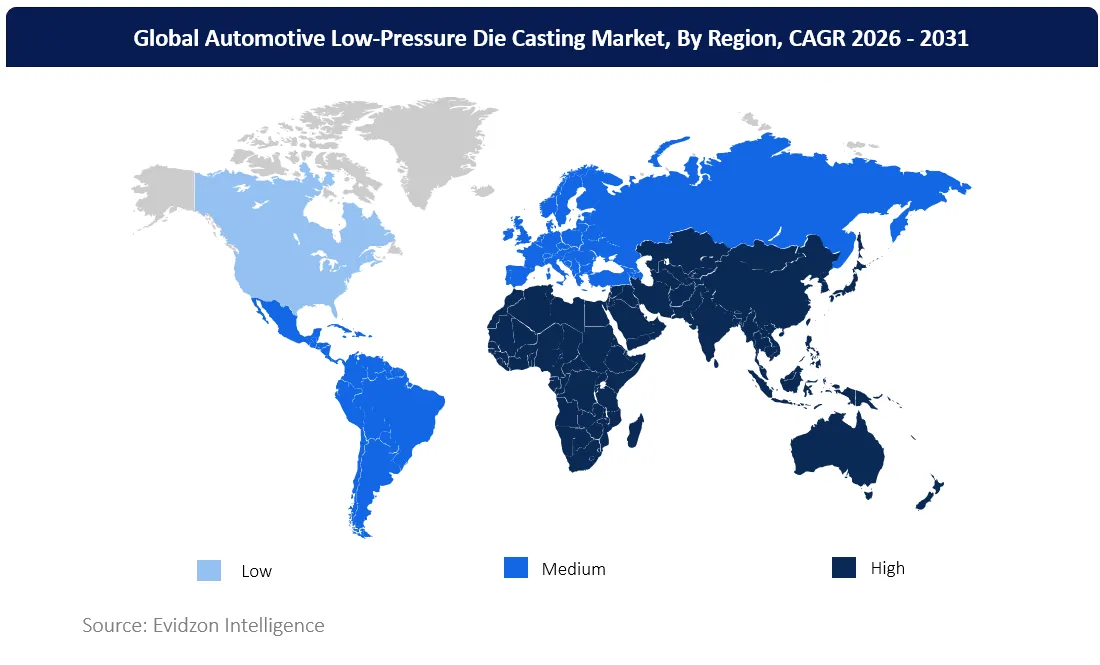
Asia-Pacific continues to be the primary manufacturing region for LPDC due to the concentration of vehicle production, aluminum processing, alloy-wheel manufacturing and automotive supplier networks in China, Japan, India, South Korea and Southeast Asia. Premium wheels and performance components are the key segment driving demand curve in Europe, while stringent regulation is driving demand for light weight automotive components. North America is witnessing increased emphasis on localized casting and weight reduction as OEMs seek to minimize logistics costs, meet regulations, and increase domestic content. Middle East & Africa represents a growing opportunity as vehicle assembly, industrial localization and component manufacturing capabilities develop.
Key Takeaways
- By vehicle type, passenger car accounts for nearly 68.1% market share in 2025 and expected to grow at a CAGR of 7.4% by 2031.
- By propulsion, internal combustion engine (ICE) remains the largest sub-segment accounting for nearly 78.1% of the automotive parts low-pressure die casting (LPDC) market in 2025. Whereas, electric vehicle (EV) is expected to be the fastest growing propulsion segment expanding at 11.8% CAGR by 2031.
- By component, powertrain & transmission segment has registered the highest market value share of nearly 27.0% in 2025 of global automotive parts low-pressure die casting (LPDC) market and EV & E-powertrain is expected to ride at a 13.7% CAGR over the forecast period.
- By die casting process, conventional LPDC remain the dominant demand base with more than 72.1% market share in 2025, and projected to grow at 10.1% CAGR by 2031.
- By sales channel, OEM accounts for 91.6% global automotive parts low-pressure die casting (LPDC) market share in 2025. However, aftermarket is projected to witness a CAGR of 7.6% during 2026–2031.
- By material, aluminum segment accounts for nearly 91.1% market share in 2025. However, magnesium is expected to grow at a CAGR of 8.5% by 2031.
- By region, Asia Pacific accounts for 44.1% global automotive parts low-pressure die casting (LPDC) market share in 2025. However, Middle East & Africa is projected to witness a CAGR of 8.2% during 2026–2031.
About the Study
The global automotive parts low-pressure die casting (LPDC) market study covers die-cast components for new passenger cars and commercial vehicles, with segmentation by vehicle type, propulsion, component, casting process, sales channel and material, with analysis by region and country. This study only covers automotive parts produced by low-pressure die casting, and does not include production of raw metals, die casting of non-automotive parts, complete vehicle production, complete automotive parts die-casting market, automotive high-pressure die casting (HPDC) market, gravity mold die casting market, machining and assembly processes not directly related to die-cast components, and downstream recycling and secondary materials markets.
Market Dynamics Analysis
Drivers
High-volume wheel programs provide repeatable casting demand.
Lower turbulence supports integrity in safety-critical castings.
Sand cores enable lightweight internal passages and cavities.
Central filling reduces riser losses and machining requirements.
Digital models refine cooling before tooling commitment.
Lower density supports premium wheel weight reduction programs.
Restraints
Longer solidification reduces output versus faster casting processes.
Uneven thermal conditions alter microstructure and strength.
Internal pores can initiate cracks under cyclic loading.
Counter-pressure casting targets higher integrity aluminum applications.
LPDC is best suited to components where casting integrity is of equal importance to geometry, aluminum wheels represent the largest established LPDC application base. The process is suitable to load bearing suspension components where controlled metal filling minimize defects caused by turbulent injection. Low-pressure die cast (LPDC) automotive parts has an edge of manufacturing more efficient hollow passages and internal cavities keeping the mass minimum in comparison to conventional processes. LPDC's central metal feed also aids in realizing high material yield through the reduction in the need for risers. At the process level, simulation is becoming increasingly useful for predicting cooling and solidification prior to a costly commitment to tooling. Magnesium represents an emerging opportunity particularly for lightweight wheel applications.
LPDC's key limitation is its relatively low throughput. The same slow filling and controlled solidification that give good integrity on casting, also result in a lower output as compared to HPDC. Thermal management is an another limitation, intricate parts like wheels with widely varying thickness from hub to spokes to rim to flange can have significantly different cooling rates resulting in unacceptable variation in microstructure and mechanical properties. Porosity is a more fundamental limitation with shrinkage pores acting as stress raisers that may lead to reduced fatigue strength. This becomes an important consideration for safety critical wheels. Finally, LPDC have to contend with alternative processes, among counter-pressure casting. Such emerging technology is considered for aluminum automotive parts, where the application of increased pressure during the filling phase can improve quality.
Segment Analysis
By Vehicle Type
Passenger cars represent the largest vehicle type category with 68.1% market share in global automotive parts low-pressure die casting (LPDC) market and expected to grow at a CAGR of 7.4% by 2031. A growing volume of LPDC in passenger cars is driven by applications where controlled metal filling and casting integrity are more critical than extremely short cycle times. Aluminum wheels continue to be a key application, as well as selected suspension components, housings, brake components and others involving consistently sound mechanical properties. LPDC process best suited for components that have relatively substantial sections and complex shapes that benefit from slow filling and directional solidification.
Commercial vehicles demand is evolving around additional requirements of durability, load carrying, thermal performance, and extended operating cycles. These are shifting some LPDC applications to motor housings, reduction gear components, thermal management and certain structural applications as electrification becomes more prevalent in commercial vehicles. The mix of vehicles will drive both the volume of castings and the type of tooling, alloy, heat-treatment and machining capabilities required from a supplier.
Global Automotive Parts Low-Pressure Die Casting (LPDC) Market, By Vehicle Type, Market Share, 2025
By Propulsion
Internal combustion engine (ICE) accounts for the highest market share of 78.1% in 2025 while, electric vehicles (EVs) are expected to grow at 11.8% CAGR by 2031. By propulsion, ICE vehicles continue to drive demand for LPDC in established applications on engine-related castings, transmission parts, wheels, and other aluminum components. Shifting automotive landscape to electric vehicle is changing the component mix despite of replacement for every ICE part.
Electric vehicles introduce motor housings, reduction gear housings, cooling components, and certain structural parts while eliminating a number of engine parts. LPDC has a key role where controlled filling, minimizing turbulence and obtaining sound castings are important. THE LPDC process is widely adopted in the manufacturing of aluminum alloy wheels due to complex geometry and controlled filling and solidification requirements. As the penetration of EVs increasing, the suppliers across the globe are emphasizing on diversification from wheels and conventional engine parts towards electric-drive and thermal management applications.
Global Automotive Parts Low-Pressure Die Casting (LPDC) Market, By Propulsion, Market Share, 2025
Geographic Analysis
Largest Region
Asia Pacific registered the highest market share of 44.1% in 2025 of global automotive parts low-pressure die casting (LPDC) market. Asia-Pacific has robust LPDC base on the back of high vehicle production, aluminum foundry, wheel manufacturing, and automotive component supply chains. China, Japan, India, South Korea, Thailand, Indonesia, and Vietnam have a passenger and commercial vehicles manufacturing base. China has manufactured 34.53 million vehicles in 2025, including 16.63 million new-energy vehicles, while India manufactured 5.54 million passenger vehicles and 1.17 million commercial vehicles in 2025.
Such extensive vehicle manufacturing supports LPDC applications across wheels, suspension parts, housings, and some powertrain components. The shift to EVs will increase applications of LPDC in motor housings, reduction-gear components, thermal-management parts, and other aluminum components. Asia-Pacific also has a strong value chain for casting, heat treatment, machining, finishing, and wheels manufacturing.
Global Automotive Parts Low-Pressure Die Casting (LPDC) Market, By Region, Market Share, 2025
Fastest-Growing Region
Middle East and Africa is projected to be the fastest region in global automotive low-pressure die casting (LPDC) market by 2031 accounting for 8.2% CAGR. Middle East & Africa is developing its LPDC opportunity alongside vehicle assembly, component localization, and industrial investment. Morocco and South Africa offer well-established automotive manufacturing platforms, while expanding supplier networks present additional opportunities for locally produced metal components. LPDC is applied to applications where production volumes justify permanent tooling, but extremely high-pressure equipment is not required.
Wheels, housings, suspension components, brake-related parts, and select powertrain components present viable applications for this manufacturing profile. Increasing electric vehicle penetration in MEA unfolds additional opportunities across EV architecture components including electric motor housings, gear components, and thermal management parts. The Middle East and Africa automotive low-pressure die casting (LPDC) market will continue to be dictate by vehicle production volumes, local aluminum availability, foundry availability, machining capabilities, OEM localization, and suppliers control on supply chain.
Competitive Landscape
- 1Nemak, S.A.B. de C.V.
- 2Ryobi Limited
- 3Wencan Group Co., Ltd.
- 4Endurance Technologies Limited
- 5Linamar Corporation
Market Concentration Level: Fragmented
The global automotive parts low-pressure die casting (LPDC) market is a fragmented space where companies are vying against each other on aluminum casting expertise, metallurgical, tooling, heat-treatment know-how, dimensional control and the ability to produce high-integrity castings at high production volumes. Nemak, S.A.B. de C.V., Ryobi Limited, Wencan Group Co., Ltd., Endurance Technologies Limited and Linamar Corporation leverage metal forming solutions that combine casting with engineering, process development, machining and other downstream services. Linamar, has LPDC in tandem with gravity and HPDC for producing complex thin-walled and hollow parts with casting design and process engineering expertise. The company is also involved in machining processes. The company is also involved in machining processes.
Auto parts manufacturers are focusing on high-integrity aluminum components that require controlled filling and reduced porosity as well as heat-treatment capabilities. This makes the process ideal for producing wheels, cylinder heads, housings, suspensions and other safety or performance-critical automotive parts. The market is also witnessing a shift from conventional low-pressure die casting towards more integrated casting-to-machining solutions involving advanced process control, heat-treated parts, electric vehicle or lightweighting-centric technologies, automated inspection, tooling and other capabilities to create localized supply chains in proximity to original equipment manufacturers (OEM) and first-tier suppliers.
Recent Development
SSWL Announced Alloy-Wheel Manufacturing Expansion
Steel Strips Wheels Limited (SSWL) announced capital expenditure (capex) program of INR 500–600 crore (~USD 52-62 million) at its Bhuj facility in Gujarat on higher-margin, lightweight aluminum products utilizing Low-Pressure Die Casting (LPDC) technology.
Alicon Castalloy Announced to Set-up New LPDC and GDC Plant
Alicon Castalloy’s Board of Director has announced an capital of INR 125.5 crore (USD 13 million) to set-up a new plant for GDC (Gravity Die Castings), LPDC (Low-Pressure Die Castings) and machining operations in Shikrapur, Pune, Maharashtra.
Uno Minda Approves LPDC Alloy-Wheel Manufacturing Investment
Uno Minda approved an amount of INR 764 crore (~USD 79 Million) for setting up a new greenfield four-wheeler alloy-wheel facility in Maharashtra. The plant will be employing a combination of LPDC and gravity die casting processes and is expected to have an annual capacity of around 1.8 million wheels.
Table of Content
- 1.Introduction
- 1.1Scope and Objective of the Study
- 1.2Market Definition & Study Assumptions
- 2.Research Methodology
- 3.Executive Summary
- 4.Market Outlook
- 4.1Market Overview
- 4.2Market Drivers
- 4.2.1Aluminum Wheel Demand Sustains High LPDC Utilization
- 4.2.2Load-Bearing Suspension Components Favor Controlled Filling
- 4.2.3Hollow Geometries Expand LPDC Component Designability
- 4.2.4High Metal Yield Improves Production Economics
- 4.2.5Simulation Optimizes Cooling and Solidification Control
- 4.2.6Magnesium Adoption Broadens Lightweight LPDC Applications
- 4.3Market Restraint
- 4.3.1Extended Cycle Times Limit LPDC Throughput
- 4.3.2Cooling Nonuniformity Creates Localized Property Variations
- 4.3.3Shrinkage Porosity Reduces Fatigue Performance Margins
- 4.3.4Alternative Casting Technologies Challenge Complex-Part Economics
- 4.4Regulatory Landscape
- 4.5Supply/Value Chain Analysis
- 4.6Porter's Five Forces Analysis
- 4.6.1Threat of New Entrants
- 4.6.2Bargaining Power of Buyers
- 4.6.3Bargaining Power of Suppliers
- 4.6.4Threat of Substitutes
- 4.6.5Competitive Rivalry
- 5.Market Segmentation (Includes market size in Value (USD), Forecast up to 2031, and market analysis with growth attributes)
- 5.1By Vehicle Type
- 5.1.1Passenger Car
- 5.1.1.1Hatchback
- 5.1.1.2Sedan
- 5.1.1.3SUV/MUV
- 5.1.1.4Others (Crossover, Coupe, Convertible, Wagon)
- 5.1.2Commercial Vehicle
- 5.1.2.1Light Commercial Vehicle
- 5.1.2.2Medium and Heavy-Duty Trucks
- 5.1.2.3Bus and Coach
- 5.2By Propulsion
- 5.2.1Internal Combustion Engine (ICE)
- 5.2.1.1Petrol / Gasoline
- 5.2.1.2Diesel
- 5.2.1.3CNG/LPG
- 5.2.2Electric Vehicle (EV)
- 5.2.2.1Hybrid Electric Vehicle (HEV)
- 5.2.2.2Plug-in Hybrid Electric Vehicle (PHEV)
- 5.2.2.3Battery Electric Vehicle (BEV)
- 5.3By Component
- 5.3.1Powertrain & transmission
- 5.3.2EV & e-powertrain
- 5.3.3Structural components
- 5.3.4Chassis & suspension
- 5.3.5Electronics & housings
- 5.3.6Body components
- 5.3.7Other
- 5.4By Die Casting process
- 5.4.1Conventional LPDC
- 5.4.2Vacuum-assisted LPDC
- 5.4.3Low-pressure structural casting
- 5.5By Sales Channel
- 5.5.1OEM
- 5.5.2Aftermarket
- 5.6By Material
- 5.6.1Aluminum
- 5.6.2Magnesium
- 5.6.3Others
- 5.7By Region
- 5.7.1North America
- 5.7.1.1United States
- 5.7.1.2Canada
- 5.7.2Latin America
- 5.7.2.1Brazil
- 5.7.2.2Argentina
- 5.7.2.3Mexico
- 5.7.2.4Rest of Latin America
- 5.7.3Europe
- 5.7.3.1Germany
- 5.7.3.2Italy
- 5.7.3.3France
- 5.7.3.4Spain
- 5.7.3.5United Kingdom
- 5.7.3.6Russia
- 5.7.3.7Rest of Europe
- 5.7.4Asia Pacific
- 5.7.4.1China
- 5.7.4.2India
- 5.7.4.3Japan
- 5.7.4.4South Korea
- 5.7.4.5Indonesia
- 5.7.4.6Australia
- 5.7.4.7Rest of Asia-Pacific
- 5.7.5Middle East & Africa
- 5.7.5.1Saudi Arabia
- 5.7.5.2United Arab Emirates (UAE)
- 5.7.5.3South Africa
- 5.7.5.4Egypt
- 5.7.5.5Rest of the Middle East & Africa
- 6.Competitive Landscape
- 6.1Market Concentration Overview
- 6.2Market Share Analysis
- 6.3Company Profiles
- 6.3.1Nemak, S.A.B. de C.V.
- 6.3.2Ryobi Limited
- 6.3.3Wencan Group Co., Ltd.
- 6.3.4Endurance Technologies Limited
- 6.3.5Linamar Corporation
- 6.3.6Alphacraft
- 6.3.7Rheinmetall AG / KS AluTech
- 6.3.8Sundaram-Clayton Limited
- 6.3.9Rockman Industries Limited
- 6.3.10Jaya Hind Industries Private Limited
- 6.3.11Sunbeam Lightweighting Solutions
- 6.3.12Spark Minda
- 6.3.13SOM Autotech
- 6.3.14Roots Cast Private Limited
- 6.3.15Impression Auto Components Private Limited
- 7.Future Outlook
- 7.1Growth Opportunities & White-Space Analysis
- 7.2Analyst Recommendations
Market Size Methodology
To arrive at the market size, new production of vehicles multiplied by a corresponding average sales value of selected automotive parts low-pressure die cast (LPDC) components per vehicle. The calculation includes adjustments by component type, considering differences in penetration and material intensity. This approach is applied to respective segments including propulsion type, vehicle type, component type, casting process, material type, and sales channel. The difference between the die-cast content of an ICE and EV in both light and commercial vehicle segments is accounted in the calculation. New vehicle production and circulation data, including OEM production reports, supplier data, government statistics, industry reports, technical publications, and company reports, has used for historical context and to establish production and penetration benchmarks.
Forecast is based on vehicle production, with consideration given to the balance between passenger car and commercial vehicles, ICEs and EVs, and the choice of powertrain architecture for EVs, the inclusion of die-cast components, penetration rates for passenger car and commercial vehicles in relation to component type, material, sales channel, structural casting requirements, consolidation rates per component type, manufacturing processes, component value, metal prices, manufacturing technology, OEM sourcing preferences, capacity expansions, and shifts in regional manufacturing. Aftermarket sales of die-cast components is calculated on the basis of the circulatory stock of vehicles, with consideration given to component replacements, vehicle ages, and replacement intervals, as well as the proportion of components sold via independent and OEM service channels.
FAQ
What is the projected size of the global automotive parts LPDC market by 2031?
The global automotive parts low-pressure die casting (LPDC) market is projected to reach USD 15.9 billion by 2031, growing from USD 11 billion in 2025 at a CAGR of 6.64% during 2026–2031.
Which vehicle propulsion segment dominates the automotive parts LPDC market?
Internal combustion engine (ICE) vehicles dominate the market, accounting for 78.1% of market value in 2025.
Which component segment holds the largest market share?
The powertrain and transmission segment holds the largest share, accounting for 27% of the global automotive parts LPDC market in 2025.
Which region dominates the global automotive parts LPDC market?
Asia-Pacific is the largest regional market, accounting for 44.1% of market value in 2025, supported by vehicle production, established foundry capabilities, aluminum supply chains, and automotive manufacturing networks.
Who are the key players in the global automotive parts LPDC market?
Nemak, Ryobi Limited, Wencan Group, Endurance Technologies, and Linamar Corporation are the key players in the global automotive parts LPDC market.
Have a question about this report?
Talk to the analyst behind this research, or browse the full report catalogue.
Contact Us