
Global Automotive Parts and Components Market
The global automotive parts and components market report is segmented by Component (Engine & Powertrain, Transmission, Drivetrain & Steering, Suspension & Braking, Electrical and Electronic, ADAS & Safety, Infotainment, Connectivity & Telematics, Body & Structural Components, Interior, Glass & Exterior components, Wheel, Tires and Wheel Components, EV-Specific Components, and Others ), by Sales Channel (OEM and Aftermarket), by Vehicle (Passenger car and Commercial vehicle), by Propulsion (ICE, BEV, HEV, PHEV, and FCEV), by region (North America, Latin America, Europe, Asia Pacific, and Middle east & Africa). The global automotive parts and components market report includes market size in value (USD) and volume (Units) forecasts through 2031.
Global Automotive Parts and Components Market
Market Size in USD Billion
Market Size Overview
USD Billion
Market Snapshot
- Study Period
- 2019 - 2031
- Forecast Period
- 2026 - 2031
- Base Year Market Size (2025)
- USD 2,741.99 Billion
- Market Size (2026)
- USD 3,690 Billion
- Market Size (2031)
- USD 5,792.62 Billion
- Growth Rate (2026 - 2031)
- 13.54% CAGR
- Market Concentration
- Consolidated
Major Players*





*Disclaimer: Major Players sorted in no particular order
Market Overview
The global automotive parts and components market value is anticipated to grow from USD 2,741.99 billion in 2025 to 3,690.0 billion in 2026 and is expected to reach USD 5,792.62 billion in 2031, with a CAGR (2026-2031) of 13.54%
The global automotive parts and components market expansion is supported by rising vehicle production, growing global vehicle parc, accelerating electrification, rising automotive electronic content, and expanding aftermarket demand. In 2025, worldwide vehicles production has reached 96.4 million, registering an increase of 3.9% year-on-year, from 92.7 million in 2024 [Source: OICA]. While the global vehicle parc has reached almost 1.7 billion vehicles in 2026, in addition to this, the sales volume of electric cars has increased by 20% from 2024, surpassing 20 million units in 2025 [Source: IEA].
The dynamic transition toward BEVs, HEVs, and PHEVs are unfolding opportunities for batteries, power electronics, thermal-management components and other high-value systems. Increasing integration of ADAS, sensors, connectivity, ECUs, and advanced software is increasing the electronic content and component value per vehicle. Moreover, longer vehicle ownership and higher vehicle utilization are sustaining replacement-parts demand. Whereas, digitalization is transforming parts distribution channel through e-commerce platforms, digital catalogues, real-time inventory management, and broader geographic access.
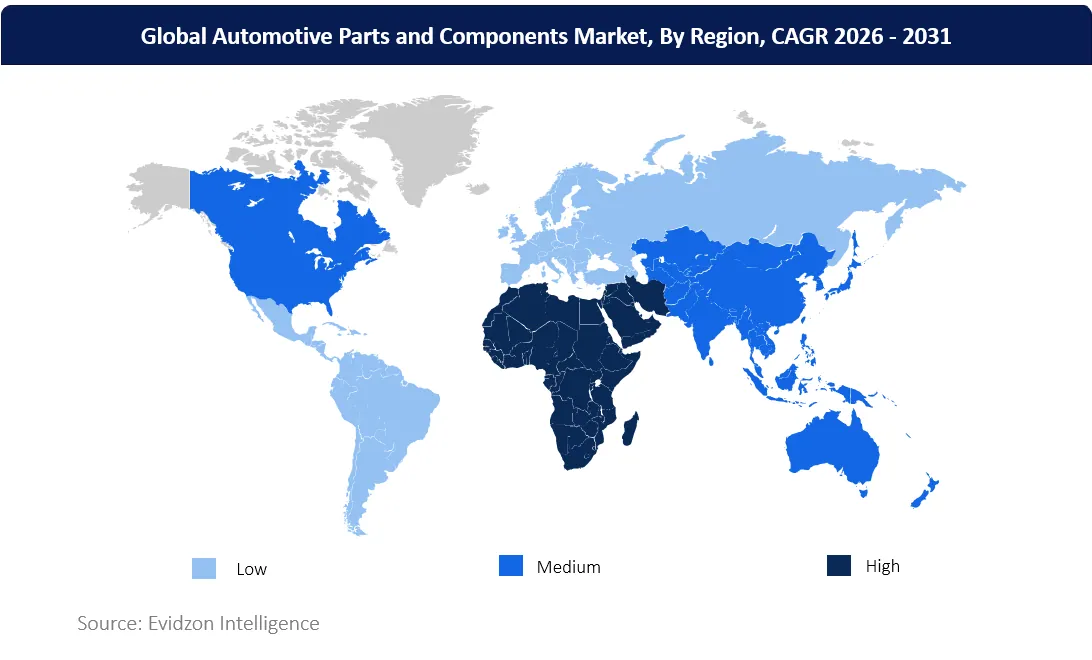
Asia-Pacific automotive parts and components market remains the leading regional market, supported by strong manufacturing capabilities, robust supply chain, large domestic market, and established supplier networks. China, Japan, India, and South Korea are the key countries with strong vehicle production along with established supplier ecosystems and expanding EV manufacturing capabilities. Europe and North America remain crucial markets for advanced automotive technologies, premium components, EV systems, and ADAS components. Latin America and the Middle East & Africa offer emerging opportunities through aftermarket expansion and increasing automotive investment. Electrification, electronics, lightweighting, localization, and technological innovation are the major anticipated factors shaping the market curve over the next decade.
Key Takeaways
- By component, engine & powertrain led the largest segment market, accounting for 22.40% in 2025. EV-specific components is expected to be the faster-growing segment, with a projected 17.33% CAGR through 2031.
- By sales channel, OEMs dominate the disruption with 62.36% of the largest market in 2025. However, the aftermarket expected to grow at a CAGR of 15.54% by 2031.
- By vehicle, passenger cars remain accounts the largest global automotive parts and components market shares of 70.96% in 2025 and also expected to be the fastest-growing category, registering a 13.9% CAGR through 2031.
- By propulsion, ICE led the market with 69.54% in 2025, whereas BEV is expected to grow at a 16.50% CAGR through 2031.
- By region, Asia Pacific dominated with a 62.50% market share in 2025. The Middle East & Africa region is expected to grow at 15.06% CAGR by 2031.
About the Study
The global automotive parts and components market study covers the automotive components integrated in passenger cars and commercial vehicles across different components, sales channels, vehicle types, propulsion, and regions with countries. The study excludes complete vehicle sales, used vehicle sales, standalone repair and maintenance services, charging infrastructure, mobility services, and other mobility services.
Market Dynamics Analysis
Drivers
Increasing Vehicle production generating sustained demand for automotive components across the OEM demand channel.
BEV, HEV, PHEV, expanding addressable demand base leading increased adoption for EV-specific components.
Increasing integration of ADAS is driving higher electronic content resulting to increase the components value.
Growing vehicle population, rising ownership periods, and higher utilization, generating recurring revenue beyond OEM sales channel.
Adoption of online sales channels, broader geographic reach, improved inventory utilization and greater aftermarket penetration.
Increasing vehicle efficiency requirements driving lightweight components to improve ICE vehicle fuel efficiency and EV driving range.
Restraints
Fluctuating costs and rising production expenses create uncertainty and sustained pressure on automotive components.
Intense OEM pricing pressure limits supplier ability to pass on rising production costs resulting in margin compression and lower profitability.
Transition to EVs, software-defined vehicles, and advanced manufacturing is creating short-fall of skilled technical professionals.
Geopolitical uncertainties and transportation disruptions and tariffs increase costs, delay production and constrain profitability.
The global automotive parts and components market is underpinned by expanding vehicle production, generating sustained demand across the OEM supply chain, while BEV, HEV, and PHEV adoption is creating new opportunities for EV-specific components. The integration of ADAS, connectivity sensors, ECUs and digital system increasing electronic content, further growing the global vehicle parc, longer ownership periods and higher utilization sustained aftermarket demand. Digital distribution and lightweight materials are improving distribution efficiency and component innovation.
The market faces structural and operational challenges of cost volatility, margin pressure, talent shortages, and supply-chain vulnerabilities. Price volatility in aluminum, steel, copper, battery materials, and semiconductors increases production and manufacturing costs led procurement uncertainty; high OEM bargaining power and cost reduction requirements limit suppliers' ability to pass higher production costs to customers, leading margin shrinkage. The transition towards EVs, Software-defined vehicles, ADAS, and advanced manufacturing is increasing demand for specialized technical professionals, workforce gaps hinder the supply chain efficiency. Additionally, geopolitical uncertainties, tariffs, transportation disruptions, and regional concentration of critical component dependencies raise cost, delay manufacturing, and increase exposure to supply-chain risks.
Segment Analysis
By Component
Engine & Powertrain led the revenue contribution in global automotive parts and components market, accounting for 22.40% in 2025. This engine & powertrain segment includes engines, transmissions, driveline systems, fuel systems, exhaust and emission-control components. A large global ICE and vehicle base supports long-term growth however, increasing transition towards battery electric powertrains is likely to adverse influence the demand curve.
EV-specific components are anticipated to be the fastest growing component segment of the automotive parts and components market expanding at 17.33% CAGR during 2026-2031. The EV-specific components market growth is supported by accelerating adoption of EVs and increasing regional policies, incentives, and subsidies to promoting electric powertrain technologies. EVs account for approximately one-quarter of global new-car sales in 2025. The EV-specific components segment comprises battery pack, BMS, DC-DC converter, inverter, E-axle, charging module, thermal-management systems, and others. Among these, Batteries represent the largest value and high contribution in EV-specific components . Overall, positioned as a principal growth area as global EV sales and production scale up.
Global Automotive Parts and Components Market, By Components, Market Share, 2025
By Sales Channel
OEM sales channel accounts 62.36% og global automotive parts and components market share in 2025, while aftermarket is anticipated to grow at 15.54% during 2026-2031. OEM channels are driven by vehicle production and increasing the value and complexity of components integrated in vehicles. Adoption of EVs, ADAS, connectivity, advanced electronics, and lightweight materials is increasing demand for high-value components. OEMs are strengthening supplier partnerships and supply-chain diversification to improve resilience and manage geopolitical and logistics risks.
Aftermarket remained a resilient demand segment in 2025, supported by the expanding global vehicle parc, increasing average vehicle age, regular maintenance and decreasing vehicle affordability. Demand is shifting towards higher-value electronic components, sensors, braking systems, batteries, and thermal-management parts, while E-commerce, digital catalogues, online ordering, and predictive diagnostics are transforming aftermarket distribution and improving parts availability. Aftermarket provides a stable, technology-driven revenue supported by vehicle ageing, maintenance requirements, and digitalization.
Global Automotive Parts and Components Market, By Sales Channel, Market Share, 2025
Geographic Analysis
Largest Region
Asia Pacific registered the highest global automotive parts and components market share of 62.50% in 2025. Asia Pacific's dominance in the global automotive parts and components market is primarily supported by China, Japan, India, and South Korea. China's well-established automotive manufacturing and EV ecosystem, supported by an integrated battery supply chain and rising vehicle exports are collectively driving demand for automotive parts and components.
China manufactured nearly 34.53 million vehicles in 2025, making it the largest automotive production hub, while extensive OEM and Tier-1/Tier-2 supplier network supports demand for powertrain, body, chassis, electrical and electronic components. India manufactured approximately 6.49 million vehicles in 2025 by expanding production capacity, growing aftermarket demand, increasing domestic demand, localization initiatives, and rising component exports. With increasing localization, governments and OEMs supporting the domestic manufacturing of critical components, EV batteries, semiconductors and electric motors. This is encouraging Tier-1 suppliers to establish or expand regional production facilities. While Japan and South Korea remain strong in advanced electronics, hybrid powertrains, semiconductors, and precision components are the key attributes allowing Asia Pacific to be at the top of global automotive parts and components.
Global Automotive Parts and Components Market, By Region, Market Share, 2025
Fastest-Growing Region
Middle East & Africa is projected to be the fastest region in global automotive parts and components by 2031, accounting for 15.06% CAGR. Continued expansion of the global automotive parts and components market is poised to be driven by vehicle-parc expansion, increasing electric vehicle adoption, ageing fleets, automotive localization, digital parts distribution, and increasing commercial-vehicle activity. GCC countries, South Africa, and Egypt remain key regional markets, while expanding manufacturing investments create opportunities for local and international component suppliers. Increasing vehicle utilization, and rising investment in automotive manufacturing.
GCC countries provide product demand via significant vehicle ownership, extensive driving and a strong appetite for reliable replacement components, plus South Africa has a mature automotive manufacturing industry and supply chain. Egypt also represents a growth opportunity as automotive assembly and industrial investment develops.
The UAE and Saudi Arabia are investing heavily in electric vehicle infrastructure to support EV adoption, this will drive demand for charging components, power electronics, thermal-management systems and specialized replacement parts. But conventional internal-combustion vehicles will continue to dominate due to the installed base, supporting strong demand for brake parts, suspension components, filters, batteries, and engine & powertrain related components.
Competitive Landscape
- 1Robert Bosch GmbH
- 2Denso Corporation
- 3Magna International
- 4ZF Friedrichshafen
- 5Contemporary Amperex Technology Co., Limited (CATL)
Market Concentration Level: Consolidated
Global automotive parts and components market competitive landscape is moderately consolidated, Robert Bosch GmbH, Denso Corporation, Magna International, ZF Friedrichshafen, and Contemporary Amperex Technology Co., Limited (CATL) are the key players owing to suppliers' OEM relationships, technology, cost efficiency, and geographic manufacturing capabilities. Competition is increasingly centered on electrification, batteries, ADAS, and automotive electronics, vehicles, lightweighting, and software-defined vehicle technologies. CATL's entry into the top three suppliers illustrates the increasing influence of electrification-component focused companies, while rising Chinese supplier capabilities are intensifying competitive and pricing pressure across established markets.
Cost competitiveness and manufacturing coverage are increasingly crucial, as automakers emphasize to reduce components costs, reliable sourcing channel and ensure supply resilience. Large suppliers capitalize on extensive manufacturing footprint, engineering centers and production facilities close vehicles assembly planets to meet the OEMs demands, while focus remain on sensors, connectors, steering, bearings, thermal systems or lightweight structures.
Recent Development
Schaeffler and CATL Expand Battery Systems Collaboration
Schaeffler and CATL signed an MoU to expand their strategic collaboration on battery management systems and Integrated Power Box solutions. This partnership is expected to support the technology integration, product development and commercialization for the next-generation EV automotive components market.
DENSO and Sona Comstar Establish Two Powertrain Joint Ventures
DENSO and Sona Comstar established two joint ventures for electric and hybrid powertrain systems. Strengthening EV component, technology capabilities, and market presence across India's growing electrification.
Motherson Partners ADIO to Establish KEZAD Manufacturing Hub
Samvardhana Motherson’s International Limited has announced a partnership with Abu Dhabi Investment Office to set up an 87,652-square-foot large-scale automotive manufacturing facility in Khalifa Economic Zones Abu Dhabi (KEZAD). This manufacturing facility will serve as an integrated manufacturing hub for Motherson’s global operations and OEM customers.
Table of Content
- 1.Introduction
- 1.1Scope and Objective of the Study
- 1.2Market Definition & Study Assumptions
- 2.Research Methodology
- 3.Executive Summary
- 4.Market Outlook
- 4.1Market Overview
- 4.2Market Drivers
- 4.2.1Expansion of Global Vehicle Production
- 4.2.2Accelerating Vehicle Electrification
- 4.2.3Rising Automotive Electronic Content
- 4.2.4Expansion of Automotive Aftermarket
- 4.2.5Digitalization of Automotive Parts Distribution
- 4.2.6Lightweighting and Efficiency Requirements
- 4.3Market Restraint
- 4.3.1Raw-material and Semiconductor Cost Volatility
- 4.3.2OEM Pricing Pressure Shrinking Margins
- 4.3.3Shortage of Specialized Technical Talent
- 4.3.4Supply-chain/Geopolitical Disruptions and Tariffs
- 4.4Supply/Value Chain Analysis
- 4.5Regulatory Landscape
- 4.6Porter's Five Forces Analysis
- 4.6.1Threat of New Entrants
- 4.6.2Bargaining Power of Buyers
- 4.6.3Bargaining Power of Suppliers
- 4.6.4Threat of Substitutes
- 4.6.5Competitive Rivalry
- 5.Market Segmentation (Includes market size in Value (USD) and Volume (Units), Forecast up to 2031, and market analysis with growth attributes)
- 5.1By Component Type
- 5.1.1Engine & Powertrain (Engine blocks, Cylinder head, Piston, Injector, Cooling and exhaust components, turbocharger, and others)
- 5.1.2Transmission, Drivetrain & Steering (Transmission, gear, clutch, driveshaft, diffrential, steering gear and column, and others)
- 5.1.3Suspension & Braking (Shock absorber, struts, control arms, brake disc, drum, pads and calliper, and others)
- 5.1.4Electrical and Electronic (Battery, alternator, wiring harness, ECU, Sensor, actuator, lights, and Others)
- 5.1.5ADAS & Safety (Camera, LiDAR, radar, ADAS ECU, airbag, seat belt, and others)
- 5.1.6Infotainment, Connectivity & Telematics (Infotainment system, head-up displays, telematics control unit, connectivity module and others)
- 5.1.7Body & Structural Components (Body-in-white, frame, door, hood, fender, bumper, and others)
- 5.1.8Interior (Seat, dashboard, door trim, headliner, carpet, HVAC, steering wheel, light, and others)
- 5.1.9Glass & Exterior components (Windshield, sunroof, side glass, rear glass, mirror, grill, spoiler, and others)
- 5.1.10Wheel, Tires and Wheel Components (Tire, wheel, hub, bearing, TPMS, fasteners, and others)
- 5.1.11EV-Specific Components (Battery Pack, BMS, DC-DC converter, inverter, E-Axle, charging module, therma mangement system, and Others)
- 5.1.12Others (Filter, hoses, seals, belt, rubber components, and miscellaneous consumables)
- 5.2By Sales Channel
- 5.2.1OEM (Original Equipment Manufacturer)
- 5.2.2Aftermarket
- 5.3By Vehicle Type
- 5.3.1Passenger Cars
- 5.3.2Commercial Vehicles
- 5.4By Propulsion Type
- 5.4.1Internal Combustion Engine (ICE)
- 5.4.2Battery Electric vehicle (BEV)
- 5.4.3Hybrid Electric Vehicle (HEV)
- 5.4.4Plug-in Hybrid Electric Vehicle (PHEV)
- 5.4.5Fuel-Cell Electric Vehicle (FCEV)
- 5.5By Region
- 5.5.1North America
- 5.5.1.1United States
- 5.5.1.2Canada
- 5.5.2Latin America
- 5.5.2.1Brazil
- 5.5.2.2Argentina
- 5.5.2.3Mexico
- 5.5.2.4Rest of Latin America
- 5.5.3Europe
- 5.5.3.1Germany
- 5.5.3.2Italy
- 5.5.3.3France
- 5.5.3.4Spain
- 5.5.3.5United Kingdom
- 5.5.3.6Russia
- 5.5.3.7Rest of Europe
- 5.5.4Asia Pacific
- 5.5.4.1China
- 5.5.4.2India
- 5.5.4.3Japan
- 5.5.4.4South Korea
- 5.5.4.5Indonesia
- 5.5.4.6Australia
- 5.5.4.7Rest of Asia-Pacific
- 5.5.5Middle East & Africa
- 5.5.5.1Saudi Arabia
- 5.5.5.2United Arab Emirates (UAE)
- 5.5.5.3South Africa
- 5.5.5.4Egypt
- 5.5.5.5Rest of the Middle East & Africa
- 6.Competitive Landscape
- 6.1Market Concentration Overview
- 6.2Market Share Analysis
- 6.3Company Profiles
- 6.3.1Robert Bosch GmbH
- 6.3.2Denso Corporation
- 6.3.3Magna International
- 6.3.4ZF Friedrichshafen
- 6.3.5CATL
- 6.3.6Hyundai Mobis
- 6.3.7Aisin Corporation
- 6.3.8FORVIA
- 6.3.9Continental AG
- 6.3.10Lear Corporation
- 6.3.11Motherson Group
- 6.3.12Aptiv
- 6.3.13Valeo
- 6.3.14Schaeffler
- 6.3.15Sumitomo Electric Industries
- 6.3.16Yazaki Corporation
- 6.3.17Uno Minda
- 6.3.18Tata Autocomp
- 6.3.19Hitachi Astemo
- 6.3.20BorgWarner
- 7.Future Outlook
- 7.1Growth Opportunities & White-Space Analysis
- 7.2Analyst Recommendations
FAQ
What is the projected size of the global automotive parts and components market by 2031?
The global automotive parts and components market is projected to grow from USD 2,741.99 billion in 2025 to USD 5,792.62 billion by 2031, registering a CAGR of 13.54% during 2026–2031.
Which component segment holds the largest market share, and which is expected to grow fastest?
Engine and powertrain components held the largest market share at 22.40% in 2025. EV-specific components are expected to be the fastest-growing component segment, with a projected CAGR of 17.33% through 2031.
How are OEM and aftermarket sales channels performing in the global automotive parts and components market?
OEMs accounted for 62.36% of the market in 2025, supported by vehicle production and demand for integrated components. The aftermarket is expected to grow at a CAGR of 15.54% through 2031, driven by the expanding vehicle parc, longer vehicle ownership, replacement demand, and digital parts distribution.
Which region dominates the global automotive parts and components market, and which is expected to grow fastest?
Asia Pacific dominated the market with a 62.50% share in 2025, supported by automotive manufacturing and supplier networks in China, Japan, India, and South Korea. The Middle East & Africa region is projected to be the fastest-growing region, with a CAGR of 15.06% during 2026–2031.
Who are the major players in the global automotive parts and components market?
The five major players includes Robert Bosch GmbH, Denso Corporation, Magna International, ZF Friedrichshafen, and Contemporary Amperex Technology Co., Limited (CATL). Competition focuses on OEM relationships, technology, cost efficiency, manufacturing capabilities, electrification, batteries, ADAS, and automotive electronics.
Have a question about this report?
Talk to the analyst behind this research, or browse the full report catalogue.
Contact Us