
Global Automotive Aluminum Components Market
The global automotive aluminum components market is segmented by vehicle type (Passenger Car and Commercial Vehicle), by propulsion (ICE and EV), by component (Body & Structural Components, Closures & Exterior Components, Chassis & Suspension Components, Wheels, Braking & Steering Components, Powertrain & Driveline Components, Thermal Management Components, EV-Specific Components, and Others (Seat, Brackets, Housings, etc.)), by manufacturing process (Die Casting, Extrusion, Stamping/Forming, Forging, Machining, and Fabrication & Joining), by sales channel (OEM and Aftermarket), and by region (North America, Latin America, Europe, Asia-Pacific, and Middle-East and Africa). The global automotive aluminum components market report includes market size in Value (USD) Forecast up to 2031.
Global Automotive Aluminum Components Market
Market Size in USD Billion
Market Size Overview
USD Billion
Market Snapshot
- Study Period
- 2019-2031
- Forecast Period
- 2026-2031
- Base Year Market Size (2025)
- USD 79.7 Billion
- Market Size (2026)
- USD 88.5 Billion
- Market Size (2031)
- USD 165.8 Billion
- Growth Rate (2026-2031)
- 13.4 CAGR
- Market Concentration
- Fragmented
Major Players*





*Disclaimer: Major Players sorted in no particular order
Market Overview
The global automotive aluminum components market value is anticipated to grow from USD 79.7 billion in 2025 to 88.5 billion in 2026 and expected to reach USD 165.8 billion in 2031 with a CAGR (2026-2031) of 13.4%.
Increasing OEMs emphasis on reducing vehicle weight while ensuring the structural integrity to minimize the carbon footprint and increase the efficiency of vehicle, coupled with increasing EV adoption is driving the global automotive aluminum components market. ICE vehicles continue to provide the largest demand base as aluminum has been intensively utilized across engine-blocks, cylinder-heads, transmission-cases, and other power-train components. However, increasing EVs penetration is changing the value pool as battery-packs add considerable mass and lightweight structures become commercially relevant above engineering preference. This signifies that opportunity is no longer restricted to conventional power-train castings, while electric-motor housings, inverter-housings, structural castings and lightweight chassis-components are the emerging segments.
Consequently, the competitive structure is spread out across aluminum-producers, processors, casting-specialists, and diversified Tier-1 suppliers. Companies like Constellium, Novelis, and Norsk Hydro dominate the rolled products, extrusion, recycling, and material-supply spaces, while Nemak, CITIC Dicastal, Ryobi, Ahresty, Endurance Technologies, and Sundaram-Clayton have stronger presence in the casting and machined-component spaces. Magna International, Linamar, and MINTH Group, are competing in broader vehicle-systems where aluminum-components are integrated into chassis, body, power-train and battery applications.
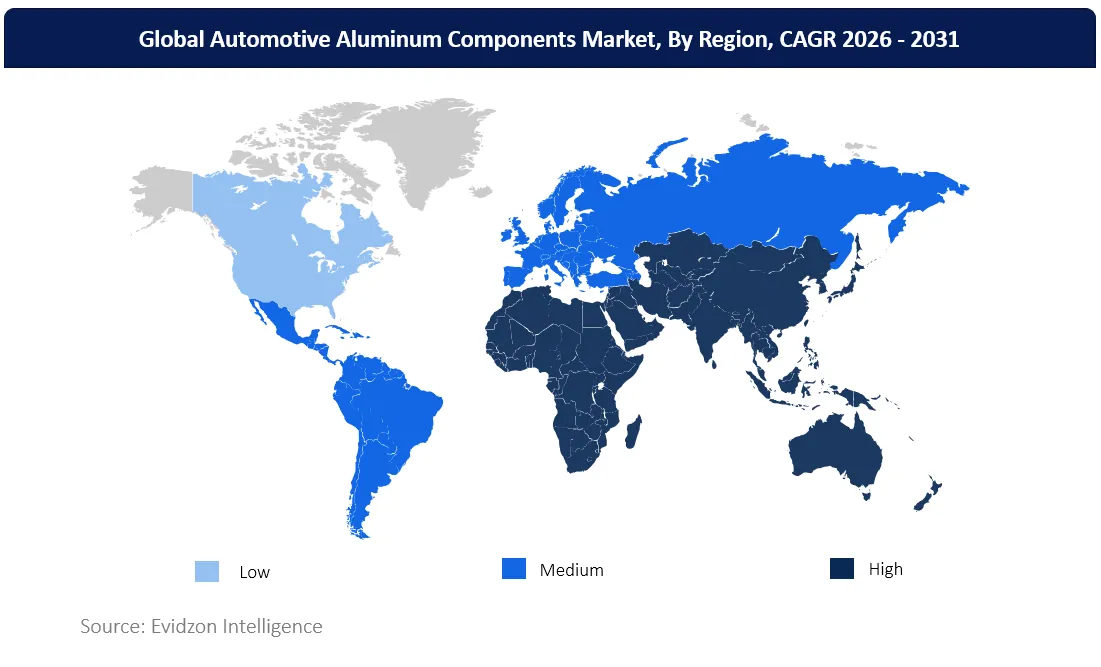
Asia-Pacific continues to be the largest manufacturing base due to China, Japan, India, and other Asian markets accounting for a substantial proportion of the world's vehicle-production. North America and Europe continue to be significant for higher-value aluminum-applications like structural-components, premium-vehicle architectures, battery enclosures, and lightweight-body systems. Middle East & Africa is smaller in terms of absolute volume, but has potential for rapid capacity-development as vehicle-assembly, localization programs, and regional supply-chains expand.
Key Takeaways
- By propulsion, internal combustion engine (ICE) vehicles remain the largest sub-segment accounting for nearly 72.4% of the global automotive aluminum components market in 2025. Whereas, Electric Vehicle (EV) components are expected to be the fastest growing at 19% CAGR by 2031.
- By vehicle type, passenger car accounts for nearly 78.2% market share in 2025. However, commercial vehicle aluminum components are expected to grow at a CAGR of 15.8% by 2031.
- By component, powertrain & driveline components have registered the highest market value share of nearly 24.6% in 2025 of the global automotive aluminum components market and EV-specific components are expected to grow at a 20.8% CAGR over the forecast period.
- By manufacturing process, die casting will remain the dominant demand base with more than 74.7% market share in 2025, and extrusion is projected to grow at 15.7% CAGR by 2031.
- By sales channel, OEM accounts for 72.8% global automotive aluminum components market share in 2025. However, aftermarket is projected to witness a CAGR of 13.8% during 2026–2031.
- By region, Asia-pacific accounts for 40.2% of the global electric vehicle market and Middle East & Africa expected to grow at a CAGR of 16.3% through 2031.
About the Study
The global automotive aluminum components market study covers aluminum components used across passenger cars and commercial vehicles, segmented by vehicle type, propulsion, component, manufacturing process, and sales channel, with analysis across major global regions and countries. The global automotive aluminum components market study scope includes automotive components manufactured by aluminum and excludes raw aluminum, primary aluminum production, aluminum used outside automotive components, standalone vehicle manufacturing, and downstream scrap and recycling markets.
Market Dynamics Analysis
Drivers
Aluminum reduces vehicle mass and improves efficiency without sacrificing structural performance.
Battery enclosures and motor housings create new component requirements.
Mega-casting consolidates multiple structural components into fewer assemblies.
Lower component weight can increase payload or operating efficiency.
Recycled metal reduces primary material requirements and embedded emissions.
Extrusion and stamping enable lighter chassis and body structures.
Restraints
Energy-intensive smelting can increase material cost and carbon exposure.
Material and conversion economics can limit penetration in cost-sensitive applications.
Dissimilar-material joining requires specialized processes and corrosion controls.
Metal prices and alloy availability can pressure supplier margins.
The application of aluminum is evolving across automotive landscape from traditional engine and transmission castings towards OEMs increasing emphasis on weight reduction to reduce the overall fleet carbon footprint and increase efficiency of vehicles. The aluminum content per vehicle has increased to approximately 150-155 kg on average, up from about 35 kg in the 1970s. Battery enclosures, electric-motor housings and structural chassis elements in EVs complement the decline in aluminum content for powertrain components. Battery boxes is estimated to contribute 12.38 kg of aluminum per vehicle between 2019 and 2025, compared to 2.69 kg for housing electric motors. An integrated casted automotive component improves structural simplicity by replacing multiple stamp and weld. Extrusions, rolled products and recycling are complementing cast aluminum in structural elements of the chassis, closures and battery systems.
The key challenge in aluminum automotive components is not engineering feasibility, the concern is whether the weight reduction can be achieved without incurring excessive cost on a system level. As aluminum production is energy intensive, the material's carbon footprint significantly varies as per the electricity mix. Which might create cost and procurement challenges in comparison to advanced high-strength steel. Manufacturing processes also become more involved when aluminum is joined with steel, due to galvanic corrosion, differences in thermal expansion and joining integrity requirements. The high cost of qualifying tools and processes for large casting components and scrap cost, compared to substitute materials increase the adoption complexity for OEMs. Additionally, fluctuating aluminum prices and trade barriers keeps a continuous pressure in price and aluminum sourcing. Suppliers ensuring alloy content, billet and sheet availability, energy costs and recycled content without passing cost variations directly to OEM customers will corner greater market share.
Segment Analysis
By Vehicle Type
Passenger cars represent the largest vehicle type category with 78.2% market share in global automotive aluminum components market, whereas commercial electric vehicles are expected to grow at a CAGR of 15.8% by 2031. More than 96 million motor vehicles has been manufactured globally in 2025, and with increasing popularity of SUVs and large passenger cars is a key driver, as the higher vehicles mass allows more potential scope for aluminum wheels, structural castings, closures, chassis parts and other components.
Commercial vehicles, while having lower volumes, have different economics, as every kilogram of weight saved contributes directly to the operating economy of the vehicle (payload, fuel consumption, range). Electrification enhances this dynamic, as battery-electric commercial vehicles will have a significant battery mass, and aluminum can be used to advantage in strategic locations (chassis structures, battery enclosures, wheels, etc.) where weight reduction will have a beneficial effect on operating economy. In addition, component demand is becoming less reliant on a powertrain-centric market, and electrification-specific components represent a growing area of demand.
Global Automotive Aluminum Components Market, By Vehicle Type, Market Share, 2025
By Propulsion
Internal combustion engine (ICE) accounts for the highest market share of nearly 72.4% in 2025 while, electric vehicles (EVs) are expected to grow at 19% CAGR by 2031. The aluminum in automotive components is increasingly determined by the potential to reduce weight while avoiding cost, durability or production-rate penalties at the point of manufacture. ICE vehicles currently provide the largest installed-base demand drivers because aluminum is used extensively in engine blocks, cylinder heads, transmission housings, wheels, structural castings and other powertrain components. Aluminum content in conventional powertrains is therefore still significant, particularly in castings and housings where the advantages of aluminum's strength-to-weight properties and casting characteristics are well understood by OEMs and Tier-1 suppliers.
However, a growing proportion of aluminum content is being driven by EV-specific components. Battery enclosures, electric motor housings, inverter housings, structural castings and thermal-management components are enabling new applications for aluminum. The International aluminium Institute’s automotive outlook, identifies battery boxes, body closures, electric-motor housings and chassis applications as key areas for additional aluminum content, while some engine and transmission applications decline as electrification progresses.
Global Automotive Aluminum Components Market, By Propulsion, Market Share, 2025
Geographic Analysis
Largest Region
Asia Pacific registered the highest market share of 40.2% in 2025 of global automotive aluminum components market. Asia-Pacific is the largest regional market supported by its vast vehicle manufacturing base and aluminum-intensive automotive supply chains. Asia-Pacific manufactured 59.2 million vehicles in 2025, accounting for over 61% of the global output, while China remains the dominant market in the region. China's size impacts the cost-economics of aluminum components as foundries, extruders, machining facilities and recyclers are located close to major vehicle production centers.
China automotive production in 2025 has reached 34.53 million units, while the new-energy vehicle production has recorded a 29% year-on-year growth by reaching 16.63 million units production. India is emerging as a key market for component suppliers with intensifying vehicle production levels and growing local production content. OICA reported 6.49 million vehicles produced in India in 2025, compared to 4.52 million units in 2021. India's extensive passenger-car and commercial-vehicle manufacturing complex creates a strong demand for conventional aluminum castings, wheels, transmission components and lightweight structural elements, with electric-vehicle production contributing to the battery and power-electronics content.
Global Automotive Aluminum Components Market, By Region, Market Share, 2025
Fastest-Growing Region
Middle East & Africa is projected to be the fastest region in global automotive aluminum components market by 2031 accounting for 16.3% CAGR. The region is starting from a much smaller vehicle-manufacturing base, so that incremental OEM localization will have a big impact on demand for aluminum castings, extrusions, wheels, chassis parts, heat-management components and other lightweight structures. The strongest near-term manufacturing base will be found in South Africa, Morocco, Egypt and selected Gulf markets, rather than spread out across the region.
EV adoption will influence the regional component mix, if not overwhelm it, still needing aluminum suppliers to focus on conventional powertrain and chassis applications while preparing for battery enclosures, electric-motor housings, power-electronics housings and thermal-management systems. South Africa's 2025 NEV sales totaled 16,716 units, up from 15,611 in 2024, but those only accounted for 2.8% of total new-vehicle sales. Thus, the region's aluminum-component suppliers continue to support ICE powertrains and chassis components while also preparing for battery enclosures, electric-motor housings, power-electronics housings and thermal-management systems. The region's greater projected growth in automotive aluminum components needs to balance against its relatively small installed base. New assembly capacity, component localization and rising demand for lightweight commercial vehicles can have a big impact on component volumes, even as total vehicle production remains well behind Asia, Europe or North America.
Competitive Landscape
- 1CITIC Dicastal Co., Ltd.
- 2Norsk Hydro ASA
- 3Nemak, S.A.B. de C.V.
- 4Constellium SE
- 5Novelis Inc.
Market Concentration Level: Fragmented
The global automotive aluminum components market competitive landscape is fragmented. Key player have end-to-end value chain capabilities that span from material selection through casting/forming, machining, finishing and delivery into OEM programs. Nemak, S.A.B. de C.V., CITIC Dicastal Co., Ltd., Constellium SE, Novelis Inc. and Norsk Hydro ASA have strong positions in aluminum products that feed automotive component manufacturing. Constellium SE portfolio covers body sheet, structural applications, battery enclosures and extrusion-based components. Novelis operates at a much larger overall aluminum scale, Its automotive exposure is concentrated in rolled products rather than finished cast components, so it competes in a different part of the value chain. Similarly, a combination of primary aluminum, recycling and extrusion capabilities provides Hydro a greater hold on material supply and downstream conversion.
Recycling and material efficiency are the other key area of competition. Novelis have recycling capabilities across major geographic regions, whereas Constellium primarily operates with closed-loop recycling alongside automotive sheet and extrusion solutions. This is increasingly relevant as OEMs move beyond weight reduction toward the carbon footprint of the aluminum. The next competitive step is therefore less about simply using more aluminum and more about supplying the right alloy, in the right form, with predictable recycled content, traceability and manufacturing yield.
Recent Development
Novelis Expands Coated Aluminum Battery Solutions
Novelis has expanded its offerings of value-added coated aluminum products for battery enclosures, casings, bus bars and other battery-related components. The solution is automotive-grade aluminum and feature specialized coatings that improve corrosion protection, formability and electrical insulation for next-generation EV battery technologies.
Hydro Supplies Recycled Aluminum to General Motors
Norsk Hydro ASA has supplied Hydro CIRCAL aluminum to General Motors for the front bumper system of Cadillac OPTIQ electric vehicles. The material contains at least 75% post-consumer scrap and is produced at Hydro's Cassopolis, Michigan, recycling facility. Shape Corp. has engineered and assembled the bumper system to GM's specifications.
Hydro Expands Mercedes-Benz Low-Carbon Aluminum Partnership
Hydro and Mercedes-Benz have agreed to widen their cooperation in Europe, with a focus on using more recycled and low-carbon aluminum products. As a result, Mercedes-Benz will become the first European automaker to spec Hydro CIRCAL aluminum, which contains at least 75% post-consumer scrap, for the series production of its next large EV platform.
Table of Content
- 1.Introduction
- 1.1Scope and Objective of the Study
- 1.2Market Definition & Study Assumptions
- 2.Research Methodology
- 3.Executive Summary
- 4.Market Outlook
- 4.1Market Overview
- 4.2Market Drivers
- 4.2.1Reducing Vehicle Weight Raises Aluminum Component Penetration
- 4.2.2EV Platforms Expand Demand for Aluminum Applications
- 4.2.3Integrated Casting Reduces Vehicle Part Complexity
- 4.2.4Commercial Vehicle Payload Economics Support Aluminum Adoption
- 4.2.5Aluminum Recycling Strengthens Circular Automotive Material Supply
- 4.2.6Advanced Forming Broadens Aluminum Structural Component Applications
- 4.3Market Restraint
- 4.3.1Primary Aluminum Production Carries High Energy Requirements
- 4.3.2Aluminum Processing Costs Exceed Conventional Steel Alternatives
- 4.3.3Complex Joining Increases Manufacturing Process Requirements
- 4.3.4Supply Volatility Complicates Long-Term Component Cost Planning
- 4.4Regulatory Landscape
- 4.5Supply/Value Chain Analysis
- 4.6Porter's Five Forces Analysis
- 4.6.1Threat of New Entrants
- 4.6.2Bargaining Power of Buyers
- 4.6.3Bargaining Power of Suppliers
- 4.6.4Threat of Substitutes
- 4.6.5Competitive Rivalry
- 5.Market Segmentation (Includes market size in Value (USD), Forecast up to 2031, and market analysis with growth attributes)
- 5.1By Vehicle Type
- 5.1.1Passenger Car
- 5.1.1.1Hatchback
- 5.1.1.2Sedan
- 5.1.1.3SUV/MUV
- 5.1.1.4Others (Crossover, Coupe, Convertible, Wagon)
- 5.1.2Commercial Vehicle
- 5.1.2.1Light Commercial Vehicle
- 5.1.2.2Medium and Heavy-Duty Trucks
- 5.1.2.3Bus and Coach
- 5.2By Propulsion
- 5.2.1Internal Combustion Engine (ICE)
- 5.2.1.1Petrol / Gasoline
- 5.2.1.2Diesel
- 5.2.1.3CNG/LPG
- 5.2.2Electric Vehicle (EV)
- 5.2.2.1Hybrid Electric Vehicle (HEV)
- 5.2.2.2Plug-in Hybrid Electric Vehicle (PHEV)
- 5.2.2.3Battery Electric Vehicle (BEV)
- 5.3By Component
- 5.3.1Body & Structural Components
- 5.3.2Closures & Exterior Components
- 5.3.3Chassis & Suspension Components
- 5.3.4Wheels
- 5.3.5Braking & Steering Components
- 5.3.6Powertrain & Driveline Components
- 5.3.7Thermal Management Components
- 5.3.8EV-Specific Components
- 5.3.9Others (Seat, Brackets, Housings, etc.)
- 5.4By Manufacturing Process
- 5.4.1Die Casting
- 5.4.1.1High-Pressure Die Casting
- 5.4.1.2Low-Pressure Die Casting
- 5.4.1.3Gravity Die Casting
- 5.4.2Extrusion
- 5.4.3Stamping/Forming
- 5.4.4Forging
- 5.4.5Machining
- 5.4.6Fabrication & Joining
- 5.5By Sales Channel
- 5.5.1OEM
- 5.5.2Aftermarket
- 5.6By Region
- 5.6.1North America
- 5.6.1.1United States
- 5.6.1.2Canada
- 5.6.2Latin America
- 5.6.2.1Brazil
- 5.6.2.2Argentina
- 5.6.2.3Mexico
- 5.6.2.4Rest of Latin America
- 5.6.3Europe
- 5.6.3.1Germany
- 5.6.3.2Italy
- 5.6.3.3France
- 5.6.3.4Spain
- 5.6.3.5United Kingdom
- 5.6.3.6Russia
- 5.6.3.7Rest of Europe
- 5.6.4Asia Pacific
- 5.6.4.1China
- 5.6.4.2India
- 5.6.4.3Japan
- 5.6.4.4South Korea
- 5.6.4.5Indonesia
- 5.6.4.6Australia
- 5.6.4.7Rest of Asia-Pacific
- 5.6.5Middle East & Africa
- 5.6.5.1Saudi Arabia
- 5.6.5.2United Arab Emirates (UAE)
- 5.6.5.3South Africa
- 5.6.5.4Egypt
- 5.6.5.5Rest of the Middle East & Africa
- 6.Competitive Landscape
- 6.1Market Concentration Overview
- 6.2Market Share Analysis
- 6.3Company Profiles
- 6.3.1Nemak, S.A.B. de C.V.
- 6.3.2CITIC Dicastal Co., Ltd.
- 6.3.3Constellium SE
- 6.3.4Novelis Inc.
- 6.3.5Norsk Hydro ASA
- 6.3.6Magna International Inc.
- 6.3.7Linamar Corporation
- 6.3.8Minth Group Limited
- 6.3.9Ryobi Limited
- 6.3.10Rheinmetall Aktiengesellschaft
- 6.3.11UACJ Corporation
- 6.3.12Ahresty Corporation
- 6.3.13Endurance Technologies Limited
- 6.3.14Aludyne, Inc.
- 6.3.15Sundaram-Clayton Limited
- 7.Future Outlook
- 7.1Growth Opportunities & White-Space Analysis
- 7.2Analyst Recommendations
Market Size Methodology
The market value is determined by multiplying the production or sales volume of new passenger and commercial vehicles by the corresponding average aluminum component value per vehicle, and replacement cycle for aftermarket analysis. To account for differences in vehicle architecture, aluminum intensity, propulsion technology, and component mix, the aluminum component value is assessed by vehicle type, propulsion, component category, manufacturing process, and country.
Vehicle production and registration data, OEM production disclosures, supplier filings, government statistics, industry associations, and company reports are used as benchmarks for historical estimates.
Automotive vehicle production, aluminum content per vehicle, weight reducing requirements of vehicles, EV adoption, vehicle mix, aluminum prices, manufacturing technology, component penetration, OEM sourcing strategies, and regional production patterns are the key attributes considered in forecasting.
FAQ
What is the projected size of the global automotive aluminum components market by 2031?
The global automotive aluminum components market is projected to grow from USD 79.7 billion in 2025 to USD 165.8 billion by 2031, registering a CAGR of 13.4% during 2026–2031.
Which vehicle type accounts for the largest share of the automotive aluminum components market?
Passenger cars account for the largest share, representing 78.2% of the global automotive aluminum components market in 2025. Demand is supported by aluminum applications across wheels, structural components, closures, chassis parts and powertrain systems.
Which propulsion segment dominates the global automotive aluminum components market?
Internal combustion engine (ICE) vehicles dominate the market, accounting for 72.4% of market value in 2025.
Which region dominates the global automotive aluminum components market, and which is expected to grow fastest?
Asia-Pacific leads the market, accounting for 40.2% of market value in 2025, supported by its extensive vehicle manufacturing base and established automotive component supply chains. The Middle East and Africa region is projected to grow at the fastest rate, with a CAGR of 16.3% during 2026–2031.
What are the key factors driving and restraining the global automotive aluminum components market?
Key growth drivers include vehicle lightweighting, increasing EV adoption, integrated casting technologies, commercial vehicle payload efficiency, aluminum recycling and advances in forming processes. Market growth is constrained by energy-intensive aluminum production, higher processing costs compared with conventional steel alternatives, complex joining requirements and volatility in aluminum prices and supply.
Have a question about this report?
Talk to the analyst behind this research, or browse the full report catalogue.
Contact Us