
Global Commercial Vehicle Financing Market
The global commercial vehicle financing market report is segmented by vehicle type (Light Commercial Vehicle, Medium and Heavy-Duty Trucks, and Bus and Coach), by propulsion (Internal Combustion Engine (ICE) and Electric Vehicle (EV)), by finance source (Bank, NBFCs, OEM Captive Finance, and Credit Unions), by customer type (Individual, Fleet Operator, Enterprise/Corporate, and Government/Public Sector), by loan tenure (Less than 3 Years, 3-5 Years, and More than 5 Years), and by region (North America, Latin America, Europe, Asia-Pacific, and Middle-East and Africa). The global commercial vehicle financing market report includes market size in Value (USD), and forecast up to 2031.
Global Commercial Vehicle Financing Market
Market Size in USD Billion
Market Size Overview
USD Billion
Market Snapshot
- Study Period
- 2019-2031
- Forecast Period
- 2026-2031
- Base Year Market Size (2025)
- USD 1,093.56 Billion
- Market Size (2026)
- USD 1,180.51 Billion
- Market Size (2031)
- USD 1,872.69 Billion
- Growth Rate (2026-2031)
- 9.67% CAGR
- Market Concentration
- Moderate
Major Players*





*Disclaimer: Major Players sorted in no particular order
Market Overview
The global commercial vehicle financing market value is anticipated to grow from USD 1,093.56 billion in 2025 to 1,180.51 billion in 2026 and expected to reach USD 1,872.69 billion in 2031 with a CAGR (2026-2031) of 9.67%.
The global commercial vehicle financing market is being reshaped by financing needs tied to fleet replacements, logistics and distribution, rising commercial-vehicle acquisition costs, electrification, emissions regulations and the convergence of financing with vehicle, maintenance and fleet-management services. Unlike passenger-car financing, commercial-vehicle financing is strongly tied to the cash-generating power of the vehicle. Financing decisions reflect not only interest rates and credit considerations but also the utilization of the vehicle, route optimization, payloads, residual values, cost of maintenance, energy or fuel consumption and overall profitability of the vehicle in terms of cost per mile or ton.
Light commercial vehicles dominate the market in terms of value, while medium- and heavy-duty commercial vehicles typically have a disproportionately high financing value due to their higher sale prices. The EU registered a total of 1.45 million vans, 307,460 trucks and 38,238 buses in 2025. Renewals are set to play a primary role in commercial vehicle financing in the coming years, as logistics, construction, distribution, rental and public transport companies seek to finance fleets to free up working capital while maintaining transport capacity. Electrification is set to create a new financing need across all commercial-vehicle segments, though adoption rates are set to vary widely depending on the end-market need. As per ACEA, electric commercial vehicles in EU penetration reached 13.2% for vans, 4.8% for trucks and 27.7% for buses in H1 2026.
The competitive financing structure is therefore being transformed into a more integrated and asset-centric ecosystem. While banks are dominating through large capital access, strong presence, and relationships with small businesses, NBFCs are capitalizing on faster disbursal and tailored repayment schedules targeting small-fleet customers. OEM captives secure an edge via their access to commercial-vehicle sales, dealer networks, maintenance and repair shops and residual-value estimates.
Key Takeaways
- By vehicle type, light commercial vehicle financing accounts for 49.6% market share of the global commercial vehicle financing market in 2025 and Medium & heavy-duty commercial vehicles financing is expected to grow at 11.3% CAGR during 2026–2031.
- By propulsion, internal combustion engine (ICE) vehicle financing accounts for 91.6% market share in 2025, while electric vehicle (EV) financing is expected to grow at a 21% CAGR during 2026–2031.
- By finance source, banks accounts for 42% market share in 2025, while OEM captive finance is expected to grow at 11.2% CAGR during 2026–2031.
- By customer type, fleet operators accounts for 52.3% market share in 2025 and expected to grow at a 11.3% CAGR during 2026–2031.
- By loan tenure, 3-5 years segment accounts for 52.3% market share in 2025, while more than 5 years is expected to grow at 12.6% CAGR during 2026–2031.
- By region, North America accounts for 59.7% of the global commercial vehicle financing market whereas South America is anticipated to grow at 11.3% CAGR through 2031.
About the Study
The global commercial vehicle financing market study covers financing for new commercial vehicles across ICE and EV powertrains, finance sources, customer types, loan tenures, and major global regions. The study analyzes financing provided by banks, NBFCs, OEM captive finance companies, credit unions and other providers, covering individuals, fleet operators, enterprises/corporates and government/public-sector customers with key regions and countries around the world. The study excludes used vehicle financing, along with two-wheelers, three-wheelers, passenger cars, dealer floor-plan financing, non-vehicle asset financing, insurance, maintenance and aftermarket services, charging infrastructure, and other mobility or financial services not directly associated with financing the acquisition of new vehicles.
Market Dynamics Analysis
Drivers
Aging fleets require regular vehicle replacement, creating recurring financing requirements.
Expensive trucks and buses generate substantially larger financed amounts per transaction.
Freight distribution growth increases vehicle additions and replacement financing requirements.
Electrification expands financing demand despite higher upfront vehicle acquisition costs.
Captives combine financing, leasing, insurance and maintenance to strengthen customer retention.
Data-driven underwriting enables faster approvals and tailored commercial financing structures.
Restraints
Higher financing costs pressure operator cash flows and vehicle replacement decisions.
Limited financial strength increases underwriting constraints for smaller commercial operators.
Electric trucks can require substantially higher upfront capital than diesel alternatives.
Depreciation uncertainty affects underwriting, leasing economics and lender recovery assumptions.
Fleet replacement, high vehicle acquisition cost, e-commerce logistics, increasing electric propulsion penetration, OEM financial-services expansion and digital underwriting is collectively fuelling the global commercial vehicle financing demand. Commercial vehicle acquisition incurs higher capital expenditures than passenger cars, making financing a critical element in purchasing decisions. E-commerce and urban logistics are fuelling demand for LCVs while logistics, construction and freight operators create ongoing replacement needs for trucks. Electrification is also driving a new pool of financing as sales of electric trucks have doubled in 2025 to more than 400,000 units, representing 9% of truck sales [Source: IEA]. OEM captives are gaining more importance as they consolidate financing with vehicle sales, leasing and post-sale services.
Interest-rate sensitivity, limited credit access for smaller operators, higher EV costs and residual-value uncertainty is constraining the growth potential of commercial vehicle financing market. Unlike passenger cars, commercial vehicles are an income-generating asset: higher financing costs cut into the economics of a fleet, and therefore, its replacement cycle. The issue with commercial vehicle financing is particularly acute for electric trucks: they still involve two to three times the purchase price of their diesel counterparts. Although the difference in total cost of ownership between electric and internal combustion engine trucks is narrowing in specific segments, it creates higher initial borrowing needs for smaller fleet operators, which may have less access to capital. Residual-value uncertainty is another constraint as the value of a commercial vehicle often depends on its utilization, mileage, specifications and technology, which can make underwriting more complex than for standardized passenger cars.
Segment Analysis
By Vehicle Type
Light commercial vehicle financing constitutes the largest vehicle-type category in the commercial vehicle financing market accounts for 49.6% of the market share in 2025 and anticipated to be the fastest vehicle-financing segment with 11.3% CAGR by 2031. Light commercial vehicle (LCV) financing dominates the global commercial vehicle financing market. The category covers the broadest customer base, as LCVs application are widespread across last-mile delivery, e-commerce logistics, retail distribution, construction, service businesses and small-fleet owners. LCVs have a broader customer base than heavy trucks and buses, providing an expansive financing transaction base across individual operators, SMEs and small fleets.
The LCV segment is driven by the rise of urban delivery networks. In Europe, there around 1.45 million vans registered in 2025, compared with approximately 307,000 trucks [Source: ACEA]. LCV financing is also expected to be the fastest-growing commercial-vehicle financing category, fueled by e-commerce logistics, small fleet growth, replacement of aging delivery vehicles, higher vehicle values and increased adoption of structured financing and leasing.
Global Commercial Vehicle Financing Market, By Vehicle Type, Market Share, 2025
By Propulsion
Internal combustion engine (ICE) represents the largest propulsion segment of commercial vehicle financing accounting 91.6% market share while, battery electric vehicle (BEV) is anticipated to foresee a CAGR of 21% through 2031. Internal Combustion Engine (ICE) commercial-vehicle financing continues to dominate the market, as diesel and gasoline powertrains remain the dominant technologies across trucks, vans and buses, particularly in long-haul trucking, construction and applications that require high payload capacities and extended ranges. ICE vehicles benefit from established refueling infrastructure, proven operating economics, extensive aftermarket resale value and strong lender familiarity with the product category.
However, Electric Vehicle (EV) financing is expected to represent the fastest-growing propulsion type, as electrification gains momentum in urban delivery fleets, buses and certain regional-haul applications. Global electric truck sales more than doubled in 2025 to over 400,000 units, representing approximately 9% of global truck sales [Source: IEA]. Financing high-cost commercial vehicles is critical to their adoption, as most battery-electric commercial vehicles involve higher upfront cost of ownership, relative to ICE vehicles, and therefore loans, leases and manufacturer financing are key means to acquire them.
Global Commercial Vehicle Financing Market, By Propulsion, Market Share, 2025
Geographic Analysis
Largest Region
North America commercial vehicle financing market registered the highest market share of 59.7% in 2025 of the global commercial vehicle financing market. North America has the largest regional commercial vehicle financing market, driven by the region's extensive trucking and logistics industry, high commercial-vehicle transaction values, developed credit market and significant fleet financing penetration. The United States is the largest contributor to the region, stemming from its vast freight transportation industry, large Class 8 truck population, strong replacement demand and highly developed banking system, finance companies, OEM captives and independent commercial-vehicle lenders.
Commercial vehicles are heavily reliant on financing due to the typical focus of fleet operators to retain working capital for fuel, labor, maintenance and operating costs. The region has a well-established leasing market which also creates financing opportunities, particularly for large-fleet operators and transport companies. The growth of e-commerce, warehousing and regional logistics is fueling demand for both heavy trucks and LCVs, while fleet replacement represents a significant source of recurring financing need.
Global Commercial Vehicle Financing Market, By Region, Market Share, 2025
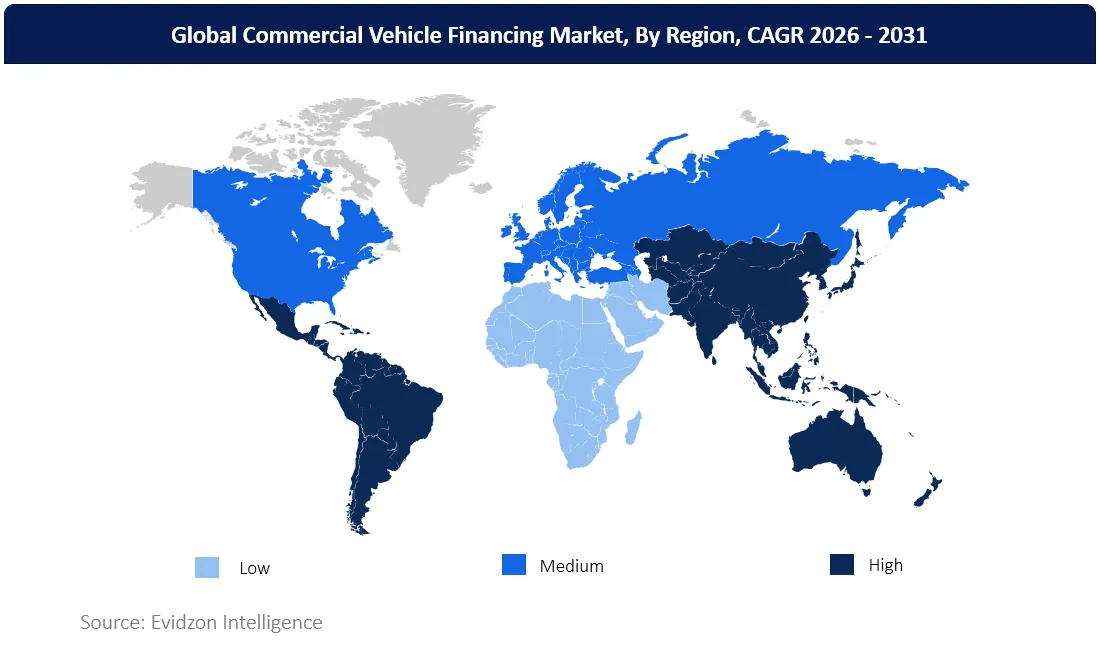
Fastest-Growing Region
Latin America commercial vehicle financing market is projected to be the fastest region in global commercial vehicle financing market by 2031 accounting for 11.4% CAGR. South America is expected to have the fastest-growing regional commercial vehicle financing market, driven by fleet modernization, growing logistics industry, agricultural transportation, infrastructure development and increasing formality of commercial-vehicle financing. Mexico and Brazil are the largest opportunity within the region, given its extensive road freight transport, large agricultural sector and consequential truck and LCV fleet. Financing is of particular importance for small and medium-sized operators given the significant capital intensity of vehicle acquisition relative to available cash resources. Increased bank and specialist finance participation help to monetize replacement and fleet expansion needs.
Electrification lags behind North America, Europe and China, but electric buses and urban commercial vehicles are helping to drive new financing opportunities. Latin America commercial vehicle financing market growth will not be limited to commercial-vehicle sales, but also credit penetration, replacement demand, freight activity, vehicle prices, availability of financing, interest rates and the formalization of small-fleet operators.
Competitive Landscape
- 1Bank of America
- 2JPMorgan Chase – Chase Auto
- 3Toyota Financial Services
- 4GM Financial
- 5Ford Credit
Market Concentration Level: Moderate
The commercial vehicle financing market is more concentrated around OEM captive finance companies. Competition is defined by business relationship with truck and bus manufacturers, dealer networks, fleet operators, residual-value expertise, funding costs and the ability to finance vehicles based on utilization and operating cash flows. OEM-linked financial-service companies have a strong competitive position due to the integrated nature of commercial-vehicle financing.
The competitive landscape includes banks, independent finance companies and regional commercial-vehicle lenders, which play an important role where OEM captives have limited geographic reach or where fleet customers operate multiple brands. Such players compete on credit availability, pricing, customized repayment schedules and large-fleet relationships. Additionally, commercial electric vehicle offers an additional competitive dimension, higher initial vehicle prices, battery economics, residual values, developing charging infrastructure is a point of concern, but key financing companies have started emphasizing on EVs financing.
Recent Development
Daimler Truck Financial Services Expands Integrated Fleet-Finance Model
At IAA Transportation 2026, Daimler Truck Financial Services introduced an integrated commercial vehicle financing concept that combines financing and leasing with insurance, service packages, digital payments and fleet-management solutions. In addition, Daimler Truck is using rental solutions to reduce the risk of entry into the electric truck market.
CNH Industrial Capital Europe GmbH and IVECO Austria partner
IVECO Austria and CNH Industrial Capital Europe have expanded their IVECO CAPITAL cooperation to include the financing and leasing of commercial vehicles for Austrian transport companies, fleet operators and small businesses.
Volvo Financial Services and Eicher Motors Announced Joint Venture
Volvo Financial Services and Eicher Motors have announced a 50:50 joint venture to provide financing, leasing and other financial services for Volvo and Eicher commercial vehicles in India. The cooperation is intended to bundle the expertise and capabilities of VFS in the field of financing with Eicher's commercial vehicle and dealer networks.
Table of Content
- 1.Introduction
- 1.1Scope and Objective of the Study
- 1.2Market Definition & Study Assumptions
- 2.Research Methodology
- 3.Executive Summary
- 4.Market Outlook
- 4.1Market Overview
- 4.2Market Drivers
- 4.2.1Fleet Replacement Cycles Sustain Recurring Financing Demand
- 4.2.2Higher Commercial Vehicle Prices Increase Financing Ticket Values
- 4.2.3Logistics Expansion Drives Fleet Financing Requirements
- 4.2.4Commercial EV Adoption Creates New Financing Opportunities
- 4.2.5OEM Captives Finance Offering With Fleet Lifecycle Services
- 4.2.6Digital Financing Improves Underwriting and Transaction Efficiency
- 4.3Market Restraint
- 4.3.1High Interest Rates Increase Commercial Fleet Acquisition Costs
- 4.3.2Small Fleet Operators Face Tighter Credit Access
- 4.3.3High EV Price Increase Initial Financing Requirements
- 4.3.4Commercial Vehicle Residual Values Increase Collateral Risk
- 4.4Regulatory Landscape
- 4.5Supply/Value Chain Analysis
- 4.6Porter's Five Forces Analysis
- 4.6.1Threat of New Entrants
- 4.6.2Bargaining Power of Buyers
- 4.6.3Bargaining Power of Suppliers
- 4.6.4Threat of Substitutes
- 4.6.5Competitive Rivalry
- 5.Market Segmentation (Includes market size in Value (USD), Forecast up to 2031, and market analysis with growth attributes)
- 5.1By Vehicle Type
- 5.1.1Light Commercial Vehicle
- 5.1.2Medium and Heavy-Duty Trucks
- 5.1.3Bus and Coach
- 5.2By Propulsion
- 5.2.1Internal Combustion Engine (ICE)
- 5.2.1.1Petrol / Gasoline
- 5.2.1.2Diesel
- 5.2.1.3CNG/LPG
- 5.2.2Electric Vehicle (EV)
- 5.2.2.1Hybrid Electric Vehicle (HEV)
- 5.2.2.2Plug-in Hybrid Electric Vehicle (PHEV)
- 5.2.2.3Battery Electric Vehicle (BEV)
- 5.3By Finance Source
- 5.3.1Bank
- 5.3.2NBFCs
- 5.3.3OEM Captive Finance
- 5.3.4Credit Unions
- 5.3.5Others
- 5.4By Customer Type
- 5.4.1Individual
- 5.4.2Fleet Operator
- 5.4.3Enterprise/Corporate
- 5.4.4Government/Public Sector
- 5.5By Loan Tenure
- 5.5.1Less than 3 Years
- 5.5.23-5 Years
- 5.5.3More than 5 Years
- 5.6By Region
- 5.6.1North America
- 5.6.1.1United States
- 5.6.1.2Canada
- 5.6.2Latin America
- 5.6.2.1Brazil
- 5.6.2.2Argentina
- 5.6.2.3Mexico
- 5.6.2.4Rest of Latin America
- 5.6.3Europe
- 5.6.3.1Germany
- 5.6.3.2Italy
- 5.6.3.3France
- 5.6.3.4Spain
- 5.6.3.5United Kingdom
- 5.6.3.6Russia
- 5.6.3.7Rest of Europe
- 5.6.4Asia Pacific
- 5.6.4.1China
- 5.6.4.2India
- 5.6.4.3Japan
- 5.6.4.4South Korea
- 5.6.4.5Indonesia
- 5.6.4.6Australia
- 5.6.4.7Rest of Asia-Pacific
- 5.6.5Middle East & Africa
- 5.6.5.1Saudi Arabia
- 5.6.5.2United Arab Emirates (UAE)
- 5.6.5.3South Africa
- 5.6.5.4Egypt
- 5.6.5.5Rest of the Middle East & Africa
- 6.Competitive Landscape
- 6.1Market Concentration Overview
- 6.2Market Share Analysis
- 6.3Company Profiles
- 6.3.1Bank of America
- 6.3.2JPMorgan Chase – Chase Auto
- 6.3.3Toyota Financial Services
- 6.3.4GM Financial
- 6.3.5Ford Credit
- 6.3.6Volkswagen Financial Services
- 6.3.7Hyundai Capital
- 6.3.8Santander Consumer Finance
- 6.3.9Ally Financial
- 6.3.10Capital One Auto Finance
- 6.3.11Mercedes-Benz Financial Services
- 6.3.12BMW Financial Services
- 6.3.13Mahindra Finance
- 6.3.14Navy Federal Credit Union
- 6.3.15PenFed Credit Union
- 7.Future Outlook
- 7.1Growth Opportunities & White-Space Analysis
- 7.2Analyst Recommendations
Market Size Methodology
The market value is calculated by new commercial vehicles sales multiplied by the applicable average vehicle transaction value, financing penetration rate, and average financed-value share (loan-to-value). The number of new vehicle sales is estimated using vehicle registrations, OEM sales disclosures, government statistics, industry associations, financing-company disclosures and regional automotive databases.
The market size is segmented by vehicle type, propulsion, finance source, customer type, loan tenure and country/region to reflect the different vehicle prices, financing penetration, LTV, credit availability, customer mix, and financing structures. Government statistics, central-bank data, vehicle registrations, OEM annual reports, financing-company disclosures, regulatory filings and industry associations are used as a basis to benchmark historical values.
The forecast considers new-vehicle sales, vehicle prices, EV adoption, financing penetration, average financed value, LTV, interest rates, credit availability, loan tenure, customer and fleet mix, OEM captive-finance penetration, bank/NBFC lending capacity, credit conditions, residual values and regional financing regulations.
FAQ
What is the global commercial vehicle financing market size and its growth forecast?
The global commercial vehicle financing market was valued at USD 1,093.56 billion in 2025 and is projected to reach USD 1,872.69 billion by 2031, growing at a CAGR of 9.67% during 2026–2031.
Which vehicle type dominates the global commercial vehicle financing market?
Light commercial vehicle (LCV) financing accounts for the largest market share, at 49.6% in 2025.
Which propulsion segment is expected to grow fastest in the commercial vehicle financing market?
Electric vehicle (EV) financing is projected to be the fastest-growing propulsion segment, with a CAGR of 21% during 2026–2031.
Which finance source and customer type hold the largest market shares?
Banks accounted for the largest share among finance sources, at 42% in 2025, while fleet operators represented the largest customer type, with 52.3% of the market.
Which region dominates the global commercial vehicle financing market, and who are the key players?
North America accounted for the largest regional share, at 59.7% in 2025. Bank of America, JPMorgan Chase – Chase Auto, Toyota Financial Services, GM Financial, and Ford Credit are the key players.
Have a question about this report?
Talk to the analyst behind this research, or browse the full report catalogue.
Contact Us