
Global Passenger Car Financing Market
The global passenger car financing market report is segmented by vehicle type (Hatchback, Sedan, SUV/MUV, and Others), by propulsion (Internal Combustion Engine (ICE) and Electric Vehicle (EV)), by finance source (Bank, NBFCs, OEM Captive Finance, and Credit Unions), by customer type (Individual, Fleet Operator, Enterprise/Corporate, and Government/Public Sector), by loan tenure (Less than 3 Years, 3-5 Years, and More than 5 Years), and by region (North America, Latin America, Europe, Asia-Pacific, and Middle-East and Africa). The global passenger car financing market report includes market size in Value (USD), and forecast up to 2031.
Global Passenger Car Financing Market
Market Size in USD Billion
Market Size Overview
USD Billion
Market Snapshot
- Study Period
- 2019-2031
- Forecast Period
- 2026-2031
- Base Year Market Size (2025)
- USD 1,093.56 Billion
- Market Size (2026)
- USD 1,180.51 Billion
- Market Size (2031)
- USD 1,872.69 Billion
- Growth Rate (2026-2031)
- 9.67% CAGR
- Market Concentration
- Fragmented
Major Players*





*Disclaimer: Major Players sorted in no particular order
Market Overview
The global passenger car financing market value is anticipated to grow from USD 1,093.56 billion in 2025 to 1,180.51 billion in 2026 and expected to reach USD 1,872.69 billion in 2031 with a CAGR (2026-2031) of 9.67%.
Increasing vehicle prices, SUV-led vehicle mix, electrification, lengthening loan tenures and growing vehicle sales with financial services integration are collectively driving the global passenger car financing market. Financing services are broadening beyond a conventional vehicle loan; banks, NBFCs, OEM captive finance companies and credit unions are competing on interest rates, down-payment requirements, loan-to-value ratios, leasing, insurance and bundled ownership products. OEM captive-finance operations play an increasingly crucial role in vehicle purchase process by offering product financing integrated into the purchase experience. For instance, Volkswagen Group reported 11.5 million new financing, leasing, service and insurance contracts globally in 2025, with leased and financed vehicles representing 37.2% of Group deliveries in its financial-services markets.
Depleting vehicle affordability is a key growth driver in the value of passenger-car financing. Increasing prices of passenger cars across the globe has reduced the purchasing power of mass customer segment leading to higher dependency on financing services with a dynamic shift towards increased loan tenure. The average transaction value of a new car in USA has reached approximately USD 42,000 - USD 43,000, while the average loan maturity lengthened to an average of 60 months. This results in a structural increase in the value of passenger-car financing even in relatively mature unit-sales markets. SUV/MUV adoption and electrification are modifying the mix of passenger vehicles secured through financing. Electrification is providing an additional growth pool for passenger-car financing: global electric-car sales exceeded 20 million units in 2025, representing approximately 25% of new-car sales, with EV penetration of nearly 55% in China and 28% in Europe.
OEM captive finance companies are expanding aggressively with manufacturer relationships, dealer networks leasing and after-sales services while banks are leading with broad customer base and balance sheet advantage. Vehicle affordability, SUV penetration, EV adoption, interest-rate conditions, credit availability, financing penetration, residual values, loan tenure and OEM integration of financial services are expected to shape the global passenger car financing market during the forecast period.
Key Takeaways
- By vehicle type, SUV/MUV passenger car financing accounts for 52.3% market share of the global passenger car financing market in 2025 and expected to grow at a 11.5% CAGR during 2026–2031.
- By propulsion, internal combustion engine (ICE) vehicle financing accounts for 62.1% market share in 2025, while electric vehicle (EV) financing is expected to grow at a 10.7% CAGR during 2026–2031.
- By finance source, banks accounts for 43.1% market share in 2025, while OEM captive finance is expected to grow at a 10.7% CAGR during 2026–2031.
- By customer type, individual customer accounts for 83.8% market share in 2025, while fleet operators is expected to grow at a 11.1% CAGR during 2026–2031.
- By loan tenure, 3-5 years segment accounts for 55.2% market share in 2025, while more than 5 years is expected to grow at 12.2% CAGR during 2026–2031.
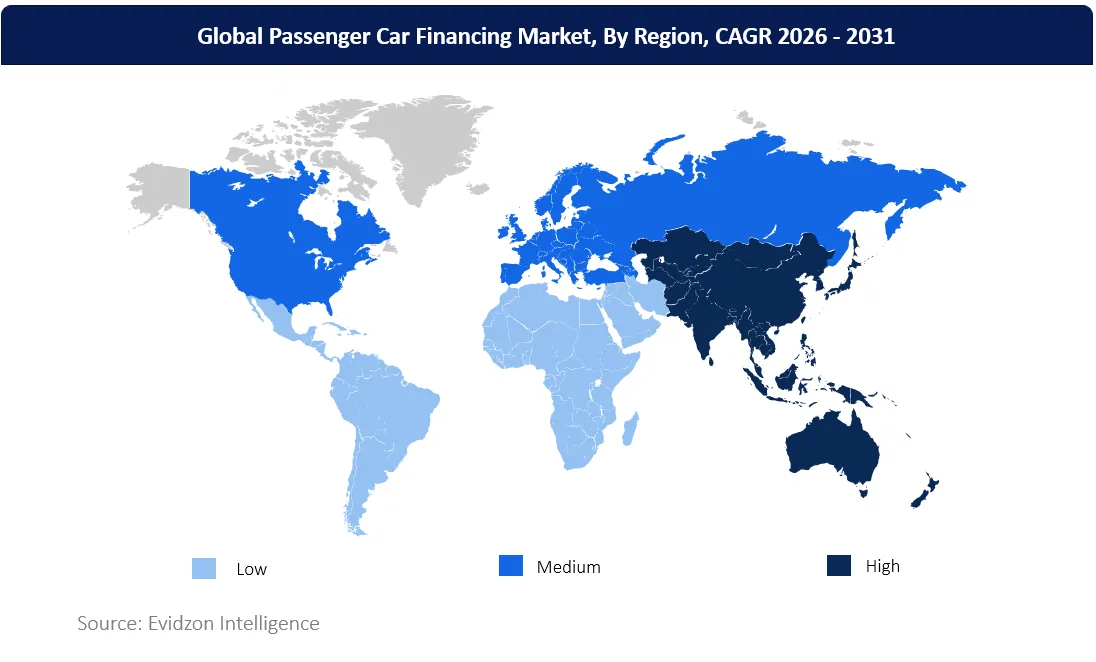
- By region, Asia-pacific accounts for 47.8% of the global passenger car financing market and anticipated to grow at 12.3% CAGR through 2031.
About the Study
The global passenger car financing market study covers financing for new passenger cars across ICE and EV powertrains, finance sources, customer types, loan tenures, and major global regions. The study analyzes financing provided by banks, NBFCs, OEM captive finance companies, credit unions and other providers, covering individuals, fleet operators, enterprises/corporates and government/public-sector customers with key regions and countries around the world. The study excludes used vehicle financing, along with two-wheelers, three-wheelers, commercial vehicle, dealer floor-plan financing, non-vehicle asset financing, insurance, maintenance and aftermarket services, charging infrastructure, and other mobility or financial services not directly associated with financing the acquisition of new vehicles.
Market Dynamics Analysis
Drivers
Higher transaction values increase average loan amounts and financed vehicle value.
Larger vehicles carry higher prices, increasing financing value per transaction.
Rapid electrification expands the addressable base for vehicle financing providers.
Extended maturities reduce monthly payments as vehicle prices increase.
Manufacturer-linked financing combines vehicle incentives, loans, leasing and insurance products.
Online applications and automated underwriting shorten approval cycles and reduce transaction friction.
Restraints
Higher borrowing costs increase monthly payments and discourage marginal buyers.
Rising delinquencies encourage lenders to tighten approval and risk thresholds.
Uncertain depreciation increases collateral risk and complicates future-value assumptions.
Extended repayment periods increase sensitivity to defaults and collateral depreciation.
Higher vehicle prices, SUV penetration, EV adoption, longer loan tenures, OEM captive-finance integration and digital financing are collectively fuelling the global passenger car financing market. Globally, electric-car sales exceeded 20 million units in 2025, or 25% of new-car sales, contributing to a growing financing pool. SUV adoption drives financing value due to higher transaction prices for larger vehicles, while longer maturities support affordability new-vehicle loans in the U.S. carried up to 73-84-month terms in recent years. OEM captives are gaining more importance as they consolidate financing with vehicle sales, leasing and post-sale services. At the same time, digital applications and automated credit evaluation reduce friction during the origination process, particularly for standard passenger-car and commercial fleet transactions.
Increasing borrowing costs, household credit quality, EV residual-value uncertainty and longer maturities led to increase the lender exposure and constraint the growth potential of global passenger car financing market. As higher priced vehicle require larger loan and customer prefer long tenures to moderate the monthly installments, it reflects the affordability pressure on customer and expose lenders to high credit risk. An additional collateral uncertainty is arising from the increasing penetration of electric vehicles, as the residual value and depreciation is highly volatile in EVs and varies by technology, model cycle and battery characteristics, increases the risk potential for lenders. Despite of increasing EV affordability, the price gap is likely to remain significant across major global markets.
Segment Analysis
By Vehicle Type
SUV/MUV financing constitutes the largest vehicle-type category in the passenger car financing market accounts for 52.3% of the market share in 2025 and anticipated to be the fastest vehicle-financing segment with 11.5% CAGR by 2031. SUV/MUV financing is driven by the shifting preference toward larger vehicles and subsequently increased transaction values. SUVs account nearly 50% of the global sales volume of passenger cars and benefits from higher pricing of SUVs and MUVs, which directly increases the value of the loan per unit. SUVs see strong adoption in China, the U.S. and other major automotive markets, and compact SUVs are penetrating emerging markets.
Lenders benefit from the consumer shift from hatchbacks and sedans toward SUVs, with higher average loan values. SUV/MUV financing is also forecast to be the fastest growing vehicle-type category as SUV sales continue to climb, along with broader premiumization trends, rising vehicle transaction values and growing availability of manufacturer-linked financing and leasing products.
Global Passenger Car Financing Market, By Vehicle Type, Market Share, 2025
By Propulsion
Internal combustion engine (ICE) represents the largest propulsion segment of passenger car financing accounting 74.8% market share while, electric vehicle (EV) is anticipated to foresee a CAGR of 10.7% through 2031. ICE passenger-car financing is driven by the majority representation in vehicle sales volume accounting significant new passenger-car transactions value. ICE vehicles established automotive ecosystem with wide model availability, dealer networks, consistent resale values, and extensive lender experience collectively drive demand.
However, the EV passenger car financing market is anticipated to be the fastest growing propulsion category, with increasing market acceptance as battery-electric cars gain greater and financing products become further integrated into overall EV sales. Global electric-car sales surpassed 20 million units in 2025, representing ~25% of global new car sales with China accounting for more than 50% of global BEV sales. The opportunity for financing is also growing as lenders are beginning to take into account the value of batteries, warranty, residual values, cost of ownership and technology depreciation when financing these vehicles. OEM captives are also providing promotional rates, leasing and additional products to help offset the up-front cost of battery-electric vehicles.
Global Passenger Car Financing Market, By Propulsion, Market Share, 2025
Geographic Analysis
Largest Region
Asia-pacific passenger car financing market registered the highest market share of 47.8% in 2025 of the global passenger car financing market. Passenger car sales volume, expanding vehicle ownership, large consumer population and increasingly developed automotive-finance infrastructure is collectively supporting the APAC passenger car financing market dominance. Due to the largest passenger car sales volume, extensive banking and finance-company network, and rapid transition toward EVs, China leads the Asia-pacific region in passenger car financing market. In addition to this, expanding vehicle ownership, rising household incomes and increasing penetration of organized vehicle finance beyond urban cities, India passenger car financing market is contributing significantly in Asia-pacific.
Whereas, mature banking and captive-finance ecosystems allows Japan and South Korea to grow, while Southeast Asian countries are expanding through consumer credit availability and vehicle ownership increase. Further increasing automobile electrification strengthens the region's financing opportunity, creating a rapidly expanding pool of EV financing demand.
Global Passenger Car Financing Market, By Region, Market Share, 2025
Fastest-Growing Region
Asia-pacific passenger car financing market is projected to be the fastest region in global passenger car financing market by 2031 accounting for 12.3% CAGR. Rising vehicle ownership, growing formal credit penetration, increasing average vehicle price, expanding EV adoption and digitalization of loan origination is collectively driving Asia-pacific passenger car financing market. China is fueling the region's growth through its rapid EV adoption and deepening financing-channel integration with manufacturer and dealer networks, while India presents considerable incremental opportunity as banks, NBFCs and OEM captives extend financing reach to tier-2 and tier-3 cities.
Southeast Asia is also establishing to capture financing opportunity, as rising disposable incomes drive higher passenger-car ownership and formal credit utilization. Financing penetration, average financed value, SUV mix, EV adoption, loan tenure and lender participation are the determination attributes converting vehicle demand into financing value. The combination of mature automotive markets and rapidly growing economies provides a significant growth base to Asia-pacific.
Competitive Landscape
- 1Bank of America
- 2JPMorgan Chase – Chase Auto
- 3Toyota Financial Services
- 4GM Financial
- 5Ford Credit
Market Concentration Level: Fragmented
The global passenger car financing market is fragmented with OEM captive finance companies, commercial banks, independent consumer-finance providers, NBFCs and credit unions. The competition is intensifying as a result of the increased importance of OEM and dealer network penetration, funding costs, credit underwriting capabilities, digital origination, and residual-value management, as well as the ability to bundle financing with insurance, maintenance and other vehicle-related services.
North America boasts a mature ecosystem of OEM captives, banks, credit unions and specialist auto lenders, where the competition focuses on the financing rate, loan terms, dealer relationships and credit segmentation capabilities. European financing is characterized by a stronger leasing component and an increasingly integrated set of financial services offerings. In Asia Pacific, competition is intensifying from banks and digital financing channels as electric vehicle (EV) penetration increases and domestic OEMs increasingly bundle financing with vehicle sales. The financing market competition is shaped by the captive OEM distribution networks, bank funding capabilities, specialized underwriting capabilities and increasingly digitized vehicle financing offerings.
Recent Development
Honda Cars India partnered with CSB Bank
Honda Cars India and CSB Bank have joined forces to offer new-car financing through select dealerships and bank locations. The partnership, covering Honda models such as the City, Amaze, Elevate and ZR-V (plus potential future EVs), seeks to increase the availability of financing in semi-urban and rural areas, where Honda sees heightened demand during the festive season – a critical channel for bank–OEM partnerships to finance new passenger cars.
Chase Auto Evaluates Agentic AI For Vehicle-Financing Journeys
Chase Auto is exploring use cases for agentic-AI applications, which could create a new channel for vehicle shopping and financing. Passenger-car lenders are differentiating on channels as much as on pricing and underwriting, with greater automation enabling lenders to participate in the vehicle-selection process at an earlier stage and better integrate financing with the digital customer journey.
Truist Exits Near-Prime Auto Lending Through Portfolio Sale
Truist has sold a USD 5.5 billion auto-loan portfolio and exited the near-prime auto lending market, following other banks in optimizing their portfolios. The move reflects a sector-wide reassessment of risk-adjusted returns across credit segments, and will create opportunities for specialists and nonprime lenders to acquire relationships and borrowers from larger competitors seeking to reduce exposure to higher-risk segments of the auto lending market.
Table of Content
- 1.Introduction
- 1.1Scope and Objective of the Study
- 1.2Market Definition & Study Assumptions
- 2.Research Methodology
- 3.Executive Summary
- 4.Market Outlook
- 4.1Market Overview
- 4.2Market Drivers
- 4.2.1Rising Passenger Car Prices Increase Financing Ticket Sizes
- 4.2.2SUV Adoption Raises Average Financed Vehicle Value
- 4.2.3EV Sales Expansion Creates New Financing Opportunities
- 4.2.4Longer Loan Terms Improve New-Car Payment Affordability
- 4.2.5OEM Captives Increase Financing Penetration by Integrated Offers
- 4.2.6Digital Lending Accelerates Passenger Car Financing Conversion Rates
- 4.3Market Restraint
- 4.3.1Elevated Interest Rates Suppress Passenger Car Affordability
- 4.3.2Household Credit Stress Tightens Automotive Loan Underwriting
- 4.3.3EV Residual Values Complicate Leasing and Financing Decisions
- 4.3.4Longer Loan Maturities Increase Lender Exposure Periods
- 4.4Regulatory Landscape
- 4.5Supply/Value Chain Analysis
- 4.6Porter's Five Forces Analysis
- 4.6.1Threat of New Entrants
- 4.6.2Bargaining Power of Buyers
- 4.6.3Bargaining Power of Suppliers
- 4.6.4Threat of Substitutes
- 4.6.5Competitive Rivalry
- 5.Market Segmentation (Includes market size in Value (USD), Forecast up to 2031, and market analysis with growth attributes)
- 5.1By Vehicle Type
- 5.1.1Hatchback
- 5.1.2Sedan
- 5.1.3SUV/MUV
- 5.1.4Others (Crossover, Coupe, Convertible, Wagon)
- 5.2By Propulsion
- 5.2.1Internal Combustion Engine (ICE)
- 5.2.1.1Petrol / Gasoline
- 5.2.1.2Diesel
- 5.2.1.3CNG/LPG
- 5.2.2Electric Vehicle (EV)
- 5.2.2.1Hybrid Electric Vehicle (HEV)
- 5.2.2.2Plug-in Hybrid Electric Vehicle (PHEV)
- 5.2.2.3Battery Electric Vehicle (BEV)
- 5.3By Finance Source
- 5.3.1Bank
- 5.3.2NBFCs
- 5.3.3OEM Captive Finance
- 5.3.4Credit Unions
- 5.3.5Others
- 5.4By Customer Type
- 5.4.1Individual
- 5.4.2Fleet Operator
- 5.4.3Enterprise/Corporate
- 5.4.4Government/Public Sector
- 5.5By Loan Tenure
- 5.5.1Less than 3 Years
- 5.5.23-5 Years
- 5.5.3More than 5 Years
- 5.6By Region
- 5.6.1North America
- 5.6.1.1United States
- 5.6.1.2Canada
- 5.6.2Latin America
- 5.6.2.1Brazil
- 5.6.2.2Argentina
- 5.6.2.3Mexico
- 5.6.2.4Rest of Latin America
- 5.6.3Europe
- 5.6.3.1Germany
- 5.6.3.2Italy
- 5.6.3.3France
- 5.6.3.4Spain
- 5.6.3.5United Kingdom
- 5.6.3.6Russia
- 5.6.3.7Rest of Europe
- 5.6.4Asia Pacific
- 5.6.4.1China
- 5.6.4.2India
- 5.6.4.3Japan
- 5.6.4.4South Korea
- 5.6.4.5Indonesia
- 5.6.4.6Australia
- 5.6.4.7Rest of Asia-Pacific
- 5.6.5Middle East & Africa
- 5.6.5.1Saudi Arabia
- 5.6.5.2United Arab Emirates (UAE)
- 5.6.5.3South Africa
- 5.6.5.4Egypt
- 5.6.5.5Rest of the Middle East & Africa
- 6.Competitive Landscape
- 6.1Market Concentration Overview
- 6.2Market Share Analysis
- 6.3Company Profiles
- 6.3.1Bank of America
- 6.3.2JPMorgan Chase – Chase Auto
- 6.3.3Toyota Financial Services
- 6.3.4GM Financial
- 6.3.5Ford Credit
- 6.3.6Volkswagen Financial Services
- 6.3.7Hyundai Capital
- 6.3.8Santander Consumer Finance
- 6.3.9Ally Financial
- 6.3.10Capital One Auto Finance
- 6.3.11Mercedes-Benz Financial Services
- 6.3.12BMW Financial Services
- 6.3.13Mahindra Finance
- 6.3.14Navy Federal Credit Union
- 6.3.15PenFed Credit Union
- 7.Future Outlook
- 7.1Growth Opportunities & White-Space Analysis
- 7.2Analyst Recommendations
Market Size Methodology
The market value is calculated by new passenger car sales multiplied by the applicable average vehicle transaction value, financing penetration rate, and average financed-value share (loan-to-value). The number of new vehicle sales is estimated using vehicle registrations, OEM sales disclosures, government statistics, industry associations, financing-company disclosures and regional automotive databases. The market size is segmented by vehicle type, propulsion, finance source, customer type, loan tenure and country/region to reflect the different vehicle prices, financing penetration, LTV, credit availability, customer mix, and financing structures.
Government statistics, central-bank data, vehicle registrations, OEM annual reports, financing-company disclosures, regulatory filings and industry associations are used as a basis to benchmark historical values.
The forecast considers new-vehicle sales, vehicle prices, EV adoption, financing penetration, average financed value, LTV, interest rates, credit availability, loan tenure, customer and fleet mix, OEM captive-finance penetration, bank/NBFC lending capacity, credit conditions, residual values and regional financing regulations.
FAQ
What is the global passenger car financing market size and its growth forecast?
The global passenger car financing market was valued at USD 1,093.56 billion in 2025 and is projected to reach USD 1,872.69 billion by 2031, growing at a CAGR of 9.67% during 2026–2031.
Which vehicle type dominates the global passenger car financing market?
SUV/MUV financing holds the largest share, accounting for 52.3% of the market in 2025.
Which propulsion segment is expected to grow fastest in the passenger car financing market?
Electric vehicle (EV) financing is projected to grow at a CAGR of 10.7% during 2026–2031.
Which finance source and customer type account for the largest market shares?
Banks accounted for the largest share among finance sources, at 43.1% in 2025.
Which region dominates the global passenger car financing market, and who are the key players?
Asia-Pacific accounted for the largest regional share, at 47.8% in 2025, and is projected to grow at a CAGR of 12.3% through 2031. Bank of America, JPMorgan Chase – Chase Auto, Toyota Financial Services, GM Financial, and Ford Credit are the key players.
Have a question about this report?
Talk to the analyst behind this research, or browse the full report catalogue.
Contact Us