
Global Automotive TPMS Market
The global automotive TPMS market report is segmented by system (Direct TPMS, Indirect TPMS, and Hybrid TPMS), by vehicle (Passenger car and Commercial vehicle), by sales channel (OEM and Aftermarket), by fitting method (Valve-stem Mounted, Band/Rim Mounted and Embedded-Tyre Module), by sensor technology (MEMS capacitive, Strain-Gauge, Piezoelectric, and Others), by frequency (315 MHz, 433 MHz, ≥2.4 GHz and UWB), by connectivity / technology integration (Stand-alone TPMS, Smart/connected TPMS, Bluetooth Low Energy, IoT/Telematics-Integrated TPMS), by propulsion (ICE vehicle, Hybrid Electric Vehicle, Plug-in-hybrid Vehicle and Battery Electric Vehicle), by region (North America, South America, Europe, Asia pacific and Middle East& Africa). The global automotive TPMS market report includes market size in value (USD) and volume (units), forecasts through 2031.
Global Automotive TPMS Market
Market Size in USD Billion
Market Size Overview
USD Billion
Market Snapshot
- Study Period
- 2019-2031
- Forecast Period
- 2026-2031
- Base Year Market Size (2025)
- USD 18.61 Billion
- Market Size (2026)
- USD 19.75 Billion
- Market Size (2031)
- USD 28.07 Billion
- Growth Rate (2026-2031)
- 7.28% CAGR
- Market Concentration
- Fragmented
Major Players*





*Disclaimer: Major Players sorted in no particular order
Market Overview
The global automotive (TPMS) tyre pressure monitoring system market value is anticipated to grow from USD 18.61 billion in 2025 to USD 19.75 billion in 2026 and is expected to reach USD 28.07 billion in 2031, with a CAGR (2026-2031) of 7.28%.
The global automotive (TPMS) tyre pressure monitoring system is driven by increasing vehicle production, mandatory TPMS installation regulations, rising vehicle electrification and growing demand for advanced vehicle safety technologies. TPMS continuously monitors type pressure and alerts driver when pressure falls below recommended levels, helps to improve road safety, vehicle stability, fuel efficiency and type lifespan. Global vehicle production increased from 92.7 million in 2024 to 96.4 million in 2025, registering 3.9% year-on-year growth [Source: OICA]. Meanwhile, electric cars sales surpassed 20 million units in 2025, recorded a 20% year-on-year growth in comparison to 2024. [Source: IEA]. Direct TPMS secured leading position due to its superior real-time tyre-pressure monitoring accuracy, and OEM fitment remains the primary sales channel. Passenger vehicles represent the core demand base where as commercial fleets, electric vehicles and aftermarket replacement are emerging as high-potential growth opportunities. Technological developments are focused in compact, low power, connected sensors and durable that support more efficient tyre monitoring and vehicle maintenance.
Competitive landscape is shaped by established global automotive (TPMS) component manufacturers and specialized sensor, suppliers. Key players are Continental AG, Denso Corporation, Sensata Technologies, ZF Friedrichshafen AG, Robert Bosch GmbH, Pacific Industrial Co., Ltd., and Huf Group. Competition is based on sensor accuracy, reliability, battery life, cost efficiency, regulatory compliance, and integration with vehicle electronics. Moreover, established suppliers benefit from long-term OEM relationships and extensive automotive technology portfolios, advancements in wireless communication, and connected vehicle systems are supporting product innovation. While, future opportunities are based on increasing TPMS penetration in electric vehicles, commercial fleets, and emerging automotive markets, with aftermarket replacement demand and the development of more connected tyre monitoring solutions.
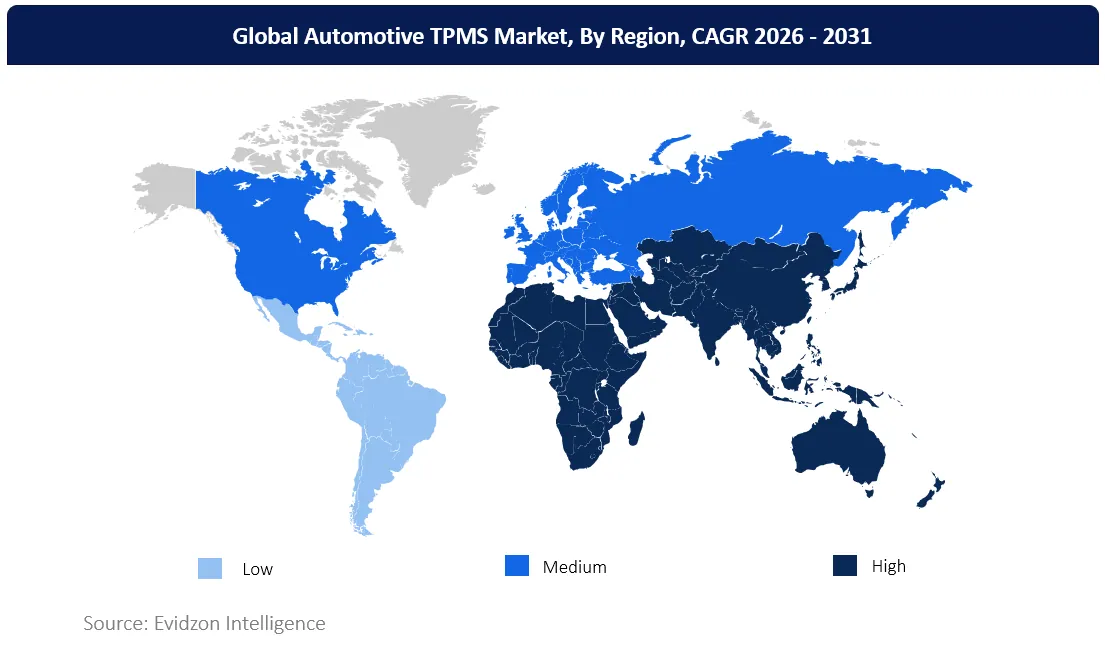
Asia-Pacific is positioned to experience the fastest growth, driven by expanding vehicle production, rapid EV adoption, and strengthening TPMS regulations across China, India, Japan, and South Korea. North America benefits from established TPMS regulations, advanced automotive technologies, and mature replacement market, while Europe demand is supported by vehicle safety standards, electrification, and premium vehicle production. Latin America and Middle East and Africa serve emerging opportunities through expanding vehicle fleets, increasing automotive production, and gradual adoption of electronic safety and tyre monitoring system.
Key Takeaways
- By system, direct TPMS led the largest segment market, accounting for 63.10% in 2025. Hybrid TPMS is expected to be the faster-growing segment, with a projected 8.20%CAGR through 2031 over the forecast period.
- By vehicle, passenger car remain the largest share accounts for 65.02% in 2025. However, commercial vehicles are expected to grow at the highest CAGR of 7.35% by 2031.
- By sales channel, OEM accounts the largest shares of 68.00% in 2025, while aftermarket are expected to be the fastest-growing category, registering an 8.30% CAGR through 2031.
- By fitting method, valve-stem mounted led the market with 67.30% in 2025, whereas embedded-tire module is expected to grow at 8.30% CAGR through 2031.
- By sensor technology, MEMS capacitive dominated with 51.60%in market share in 2025, while, piezoelectric is expected to grow at 8.20%CAGR by 2031.
- By frequency, 433 MHz dominated the market with a 53.30% share in 2025, while ≥2.4 GHz & UWB are the fastest growing segment at 8.30% CAGR through 2031.
- By connectivity/technology integration, stand-alone TPMS led the market, accounting for 73.00%, IoT/telematics-integrated TPMS is projected to grow at a CAGR of 14%by 2031.
- By propulsion, ICE vehicles led the market with 77.00% in 2025, whereas BEVs are the fastest-growing at a CAGR of 14% by 2031.
- By region, North America accounts for 74.22% in 2025, MEA is anticipated to be the fastest-growing at 14.18% CAGR by 2031.
About the Study
The global automotive TPMS market study covers the tyre pressure monitoring systems integrated into passenger cars and commercial vehicles. The analysis is segmented across systems, vehicles, sales channels, fitting methods, sensors, frequency, connectivity, propulsion, across major regions and countries. The study excludes complete vehicles, used vehicles, standalone tyre repair and maintenance services, general automotive sensors not related to TPMS, and other mobility services.
Market Dynamics Analysis
Drivers
Higher vehicle output increases original equipment system installations.
Safety regulations strengthen demand for pressure monitoring systems.
Drivers increasingly prioritize proper tire pressure and safety.
Better sensors enable reliable, responsive tire pressure detection.
Vehicle connectivity supports integrated monitoring and diagnostic functions.
Sensor failures and battery depletion generate replacement requirements.
Restraints
Component and integration costs can increase vehicle purchase prices.
Sealed sensor batteries eventually require complete sensor replacement.
Vehicle-specific requirements complicate fitment, programming, and sensor pairing.
Incorrect readings can reduce trust in system reliability.
The automotive TPMS demand is supported by vehicle production, safety requirements, technological development, and replacement needs. Higher vehicle output expands (OE) original equipment installation volumes, while regulatory requirements make monitoring systems essential to meet compliances across applicable vehicle categories and markets. Higher attention to tyre safety supports adoption in vehicle buyers and fleet operators seeking better pressure visibility. Meanwhile, improvements in sensor accuracy and strengthening system performance and support broader integration with connected vehicle electronics. Such attributes are shaping opportunities for suppliers offering reliable and compatible monitoring solutions. Battery depletion and component failure generate aftermarket replacement demand, providing a recurring revenue stream along with OEM sales.
Automotive TPMS systems require sensors, electronic components, control units, and vehicle integration, increasing costs for manufacturers and reducing adoption in price-sensitive vehicle segments. High prices led manufacturers cautious to integrate advanced monitoring features in entry-level models as it will subsequently increase the cost of replacement and might hinder the equilibrium in budget-conscious customer segment. Limiting lifespan of sensor battery is adding an additional layer of challenge, depleted batteries require complete sensor replacement even when other components remain functional. Aftermarket installation involves compatibility issues, as sensors must match vehicle specifications, operating frequencies, and programming requirements, Additionally, inaccurate readings and false alerts can reduce driver confidence, weakening trust in system reliability and discouraging adoption among potential buyers.
Segment Analysis
By System
Direct tyre monitoring systems account for 63.10% in 2025, supported by the ability to provide real-time, higher measurement accuracy and tyre-level pressure monitoring, with vehicle safety and electronic system adoption. Stringent vehicle safety regulations, increasing electronic content, and growing integration of TPMS with connected-vehicle and telematics platforms is further acting a growth catalyst factors. Rising consumer awareness of tyre safety is supporting demand for direct TPMS across commercial and passenger vehicles. Direct TPMS is gaining stronger penetration in premium vehicles, EVs, and connected fleets. The technology benefits from rising integration with vehicle diagnostics, telematics, connected-vehicle platforms, and predictive maintenance solutions. Direct TPMS is expected to maintain a leading market position in 2031, driven by increasing OEM adoption and the growing integration of connected and advanced vehicle technologies.
In contrast, hybrid TPMS are anticipated to be the fastest growing market segment accounting for 8.20% CAGR by 2031, driven by OEMs increasing integration to balance tyre monitoring performance with system costs. Hybrid systems combine direct tyre pressure sensors with indirect monitoring algorithms, allows manufacturer to reduce reliance on dedicated sensors maintain tyre pressure monitoring capabilities. While, integration with existing ABS and electronic control systems can support adoption across suitable vehicle platforms, particularly in cost sensitive passenger vehicle categories. Rising emphasis on vehicle safety, electronic monitoring and affordability technology solutions is creating opportunities for hybrid TPMS suppliers. However, adoption depended on system accuracy, vehicle compatibility, integration costs, and ability to deliver reliable tyre pressure monitoring under different driving conditions.
Global Automotive TPMS Market , By System, Market Share, 2025
By Vehicle
Passengers’ vehicles account for the highest market share of 65.02% in 2025, driven by high passenger car production, increasing fitment of vehicle safety technologies and growing integration of electronic monitoring systems in new vehicles. TPMS helps to identify underinflated or overinflated tyres, supports safer driving, tyre life, and fuel efficiency. Regulatory requirements for tyre pressure monitoring in major automotive markets have also strengthened adoption in passenger cars. While demand is extended beyond the high-end vehicles into broader passenger car categories with OEMs expanding safety features offering across economy, mid-range. However, replacement requirements for sensors and related components further support aftermarket demand as installed vehicles age.
Meanwhile, commercial vehicles are expected to grow at a CAGR of 7.35% by 2031, as fleet operators place greater emphasis on tyre performance, vehicle uptime, operating costs, and road safety. Trucks, buses, and light commercial vehicles often accumulate the high mileage than the passenger cars exposing tyres to sustained operating loads and increasing importance of regular pressure monitoring. Automotive TPMS market helps fleet manager to identify abnormal tyre pressure earlier, supporting timely maintenance and reducing the risk of unexpected breakdowns. Adoption of fleet telematics and connected vehicle systems shaping new opportunities to integrate tyre pressure data into fleet monitoring platforms across commercial vehicle fleets. Moreover, fleet operators increasingly prioritize preventive maintenance and reliable vehicle utilization, commercial vehicles offer opportunities for both factory-installed systems and aftermarket retrofits. Further growth is anticipated to shape on vehicle production, regulatory coverage, fleet investment, and the affordability of systems compatible with multi-axle configurations.
Global Automotive TPMS Market, By Vehicle, Market Share, 2025
Geographic Analysis
Largest Region
North America registered the highest market share of 74.22% in 2025 of global automotive TPMS market. North America's market dominance majorly supported by the United States, followed by Canada. While, U.S. remains the primary market, where mandatory TPMS fitment in new light vehicles has created a broad installed base and sustained demand for replacement sensors and related aftermarket services. OEM demand for TPMS components is further supported by growing automotive manufacturing and export ecosystem, while Canada's large vehicle parc and seasonal tire usage contribute to the need for frequent sensor servicing and replacement requirements.
Overall, North America's mature regulatory environment, high vehicle ownership, expanding connected-vehicle technologies, and replacement demand from the ageing vehicle parc and strong aftermarket ecosystem has collectively led North America a key market for automotive TPMS market. Direct TPMS is positioned for continued adoption due to its accurate, tire-level monitoring capabilities.
Global Automotive TPMS Market, By Region, Market Share, 2025
Fastest-Growing Region
Middle East & Africa is projected to be the fastest region in global automotive TPMS by 2031, accounting for 14.18% CAGR. The Middle East driven by vehicle ownership, expanding commercial fleets, growing automotive aftermarket activity, and increasing awareness of vehicle safety. particularly Saudi Arabia and the UAE are key demand centers, supported by higher penetration of premium vehicles, modern automotive service infrastructure, and increasing adoption of connected vehicle technologies. In Middle East extreme temperatures, long-distance driving, and extensive highway usage increase the importance of tyre-pressure monitoring system. High ambient temperatures, extended driving distances, and heavy highway usage are increasing the focus on tire safety, preventive maintenance, and reliable vehicle operation. Africa offers longer-term growth potential, driven by urbanization, expanding road transportation, logistics activity, and a growing vehicle parc, although affordability and fragmented aftermarket infrastructure remain a growth constraint.
Rising emphasis on vehicle safety, increasing fleet digitalization, growing penetration of premium vehicles, and development of automotive aftermarket infrastructure are expected to drive regional TPMS adoption. Direct TPMS is likely to see stronger uptake across premium and commercial vehicles, while Indirect TPMS will continue to serve price-sensitive vehicle segments.
Competitive Landscape
- 1Continental AG
- 2DENSO Corporation
- 3Sensata Technologies (Schrader TPMS)
- 4ZF Friedrichshafen AG
- 5Huf Hülsbeck & Fürst GmbH & Co.KG
Market Concentration Level: Fragmented
The global automotive tyre pressure monitoring system market competitive landscape is fragmented, Continental AG, Sensata Technologies, DENSO Corporation, Robert Bosch GmbH, ZF Friedrichshafen AG, Huf Hülsbeck & Fürst, and Pacific Industrial Co., Ltd are the key players. Competition is extends to specialist manufacturers such as Shanghai Baolong Automotive Corporation and CUB Elecparts, along with aftermarket suppliers offering replacement sensors, diagnostic equipment, programmable universal sensors, and retrofit monitoring systems. Key players compete sensor accuracy and reliability, battery life and energy efficiency, technology, OEM relationships, and compliance with regional vehicle safety requirements. Direct TPMS suppliers focus on pressure sensors, temperature measurement, radio-frequency transmission, and electronic control units, while indirect TPMS use in wheel- speed data from existing anti-lock braking systems to identify pressure changes.
OEM relationships depend on product validation, consistent manufacturing quality, vehicle-platform compatibility, supply reliability, and competitive pricing as well as aftermarket demand for broad vehicle coverage, sensor relearning and programming capabilities, installation convenience, and replacement availability influence purchasing decisions. Moreover, manufacturer working on to improve battery life, reduce sensor size, simplify servicing, and expand wireless connectivity. On the other side, vehicle adopts more connected architectures, suppliers that combine dependable pressure measurement with straightforward integration and practical diagnostic support positioned to compete across both factory-fitted and replacement applications.
Recent Development
Triton Valves Secures ₹110 Crore TPMS Supply Agreement with Sensata Technologies
Triton Valves secured a INR 110 crore (USD 11.5 million) long-term supply agreement from Sensata Technologies, a US-based sensor manufacturer, for the supply of tyre pressure monitoring system (TPMS). The agreement is expected to strengthen Triton Valves' expanding global TPMS presence, driven by stringent safety regulations and rising connected-vehicle technology across international markets.
Schrader Expands OE Replacement TPMS Sensor Coverage Across Vehicle Brands
Schrader launches OE replacement TPMS sensors including Chrysler, Dodge, Ram, Jeep, Volkswagen, Subaru, Toyota, Infiniti and Acura applications. These OE replacement TPMS sensors is likely to expand the reach and strengthen Schrader's position in the replacement TPMS sensor market.
Autotech partners with Auto gem to launch IMI-certified TPMS programmes
Auto tech Training has partnered with Autogem to launch an IMI-certified TPMS training programme to support the growing technical demands placed on tyre technicians.
Table of Content
- 1.Introduction
- 1.1Scope and Objective of the Study
- 1.2Market Definition & Study Assumptions
- 2.Research Methodology
- 3.Executive Summary
- 4.Market Outlook
- 4.1Market Overview
- 4.2Market Drivers
- 4.2.1Increasing Vehicle Production Expands TPMS Installation Demand
- 4.2.2Vehicle Safety Requirements Encourage Wider TPMS Adoption
- 4.2.3Growing Tyre Safety Awareness Supports Adoption
- 4.2.4Advanced Sensor Technologies Improve Monitoring Accuracy
- 4.2.5Connected Vehicle Systems Expand TPMS Integration Opportunities
- 4.2.6Replacement Demand Sustains Automotive TPMS Aftermarket Sales
- 4.3Market Restraint
- 4.3.1High System Costs Limit Price Sensitive Adoption
- 4.3.2Sensor Battery Limitations Increase Replacement Burdens
- 4.3.3Compatibility Issues Complicate Aftermarket TPMS Installation
- 4.3.4False Alerts Undermine Consumer Confidence in Monitoring
- 4.4Supply/Value Chain Analysis
- 4.5Regulatory Landscape
- 4.6Porter's Five Forces Analysis
- 4.6.1Threat of New Entrants
- 4.6.2Bargaining Power of Buyers
- 4.6.3Bargaining Power of Suppliers
- 4.6.4Threat of Substitutes
- 4.6.5Competitive Rivalry
- 5.Market Segmentation (Includes market size in Value (USD) and Volume (Units), Forecast up to 2031, and market analysis with growth attributes)
- 5.1By System Type
- 5.1.1Direct TPMS
- 5.1.2Indirect TPMS
- 5.1.3Hybrid TPMS
- 5.2By Vehicle Type
- 5.2.1Passenger Cars
- 5.2.1.1Hatchback
- 5.2.1.2Sedan
- 5.2.1.3SUV/MUV
- 5.2.2Commercial Vehicles
- 5.2.2.1Light Commercial Vehicles (LCV)
- 5.2.2.2Medium & Heavy Duty Truck
- 5.2.2.3Buses & Coaches
- 5.3By Sales Channel
- 5.3.1OEM / Factory-Fit
- 5.3.2Aftermarket / Retrofit
- 5.4By Fitting Method
- 5.4.1Valve-Stem Mounted
- 5.4.1.1Snap-In
- 5.4.1.2Clamp-In
- 5.4.2Band/Rim-Mounted
- 5.4.3Embedded-Tire Module
- 5.5By Sensor Technology
- 5.5.1MEMS Capacitive
- 5.5.2Strain-Gauge
- 5.5.3Piezoelectric
- 5.5.4Others
- 5.6By Frequency
- 5.6.1315 MHz
- 5.6.2433 MHz
- 5.6.3≥2.4 GHz & UWB
- 5.7By Connectivity / Technology Integration
- 5.7.1Stand-alone TPMS
- 5.7.2Smart/Connected TPMS
- 5.7.3Bluetooth Low Energy (BLE)
- 5.7.4IoT/Telematics-Integrated TPMS
- 5.8By Propulsion
- 5.8.1ICE Vehicles
- 5.8.2Hybrid Electric Vehicles (HEV)
- 5.8.3Plug-in Hybrid Electric Vehicle (PHEV)
- 5.8.4Battery Electric Vehicles (BEV)
- 5.9By Region
- 5.9.1North America
- 5.9.1.1United States
- 5.9.1.2Canada
- 5.9.2Latin America
- 5.9.2.1Brazil
- 5.9.2.2Argentina
- 5.9.2.3Mexico
- 5.9.2.4Rest of Latin America
- 5.9.3Europe
- 5.9.3.1Germany
- 5.9.3.2Italy
- 5.9.3.3France
- 5.9.3.4Spain
- 5.9.3.5United Kingdom
- 5.9.3.6Russia
- 5.9.3.7Rest of Europe
- 5.9.4Asia Pacific
- 5.9.4.1China
- 5.9.4.2India
- 5.9.4.3Japan
- 5.9.4.4South Korea
- 5.9.4.5Indonesia
- 5.9.4.6Australia
- 5.9.4.7Rest of Asia-Pacific
- 5.9.5Middle East & Africa
- 5.9.5.1Saudi Arabia
- 5.9.5.2United Arab Emirates (UAE)
- 5.9.5.3South Africa
- 5.9.5.4Egypt
- 5.9.5.5Rest of the Middle East & Africa
- 6.Competitive Landscape
- 6.1Market Concentration Overview
- 6.2Market Share Analysis
- 6.3Company Profiles
- 6.3.1Continental AG
- 6.3.2DENSO Corporation
- 6.3.3Sensata Technologies Holding plc (Schrader TPMS)
- 6.3.4Pacific Industrial Co., Ltd.
- 6.3.5Huf Hülsbeck & Fürst GmbH & Co. KG
- 6.3.6ZF Friedrichshafen AG
- 6.3.7Hamaton Automotive Technology Co.,ltd
- 6.3.8Robert Bosch GmbH
- 6.3.9NIRA Dynamics AB
- 6.3.10Valeo S.A.
- 6.3.11Shanghai Baolong Automotive Corporation
- 6.3.12CUB Elecparts Inc.
- 6.3.13Bendix Commercial Vehicle Systems LLC
- 6.3.14HELLA GmbH & Co. KGaA
- 6.3.15ALPS ALPINE Co., Ltd.
- 7.Future Outlook
- 7.1Growth Opportunities & White-Space Analysis
- 7.2Analyst Recommendations
FAQ
What is the projected size of the global automotive TPMS market by 2031?
The global automotive TPMS market is projected to grow from USD 18.61 billion in 2025 to USD 28.07 billion by 2031, at a CAGR of 7.28% during 2026–2031.
Which system segment holds the largest share of the global automotive TPMS market?
Direct TPMS holds the largest share, accounting for 63.10% of the market in 2025, supported by real-time tyre pressure monitoring and measurement accuracy.
Which segment is expected to grow the fastest in the global automotive TPMS market?
Hybrid TPMS is expected to be the fastest-growing system segment, with a projected CAGR of 8.20% through 2031.
Which region dominates the global automotive TPMS market, and which is expected to grow fastest?
North America dominates the market, accounting for 74.22% of the market in 2025. The Middle East and Africa is projected to be the fastest-growing region, with a CAGR of 14.18% during 2026–2031.
What are the major factors driving the global automotive TPMS market?
The market is driven by increasing vehicle production, mandatory TPMS installation requirements, rising tyre safety awareness, advancements in sensor technology, connected-vehicle integration, and aftermarket demand for replacement sensors and related components.
Market Size Methodology
Market value is calculated based on the number of TPMS systems and sensors installed or replaced multiplied by the corresponding average selling price (ASPs) are estimated by TPMS technology, system type, sensor type, frequency, vehicle type, propulsion type, sales channel, fitting method, and region, capturing differences in product specifications, installation rates, sensor configurations, and pricing.
Historical market estimates are benchmarked against vehicle production and parc data, TPMS fitment rates, OEM and Tier-1 supplier disclosures, TPMS shipment volumes, government statistics, industry associations, trade data, and company financial filings.
Forecasts incorporate expected changes in vehicle production, vehicle parc, TPMS penetration, Direct and Indirect TPMS adoption, vehicle electrification, connected-vehicle technologies, component pricing, replacement cycles, aftermarket demand, regulatory requirements, and sensor technology development.
Have a question about this report?
Talk to the analyst behind this research, or browse the full report catalogue.
Contact Us