
Global Automotive Aftermarket Sensor Market
The global automotive aftermarket sensor market report is segmented by sensor type (Position Sensor, Temperature Sensor, Pressure Sensor, Inertial & Speed Sensors, Radar Sensors & Magnetic Sensors, LiDAR Sensors and others), by vehicle type (Passengers cars and commercial vehicles), by propulsion (Internal Combustion Engine (ICE) vehicle and Electric Vehicle (EV)), by application (Core System Sensors, Safety & Automation Sensors and Efficiency & Comfort Sensors), by regions (North America, Latin America, Europe, Asia Pacific and Middle East & Africa). The global automotive aftermarket sensor market report includes market size in value (USD) and forecasts through 2031.
Global Automotive Aftermarket Sensor Market
Market Size in USD Billion
Market Size Overview
USD Billion
Market Snapshot
- Study Period
- 2019-2031
- Forecast Period
- 2026-2031
- Base Year Market Size (2025)
- USD 4.87 Billion
- Market Size (2026)
- USD 5.33 Billion
- Market Size (2031)
- USD 9.02 Billion
- Growth Rate (2026-2031)
- 11.08 % CAGR
- Market Concentration
- Moderate
Major Players*





*Disclaimer: Major Players sorted in no particular order
Market Overview
The global automotive aftermarket sensor market is shaped by growing replacement demand due to increased electronic component integration, complexity of modern vehicle systems, and growing global vehicle parc. Vehicles are increasingly relied on sensors across multiple applications such as mileage reading, monitoring engine temperature, exhaust emissions, air pressure, wheel speed, oxygen levels, and vehicle position. Sensors employed in such applications are exposed to extensive wear, damage, and electrical failures, led to create recurring demand across independent repair shops, authorized service center, parts distributors, and online retailers. Light and heavy-duty trucks are the lucrative subsegments of commercial vehicles, as long-haul operations led to accumulate high mileage resulting to frequent replacement of sensors to minimize downtime impact on fleet utilization. By propulsion, internal combustion engine vehicles are anticipated to dominate the market share over the forecast period, driving demand for oxygen, airflow, temperature, and pressure sensors, while hybrid and battery electric vehicles will fuel battery monitoring, thermal management, current measurement, and vehicle safety application sensors demand.
The global automotive aftermarket sensor market competitive landscape is price driven, key players are emphasized their offering on competitive pricing along with senor compatibility, reliability, warranty coverage, and distribution network. Robert Bosch GmbH, Denso Corporation, Denso continental AG, Sensata Technologies and Niterra Co, Ltd. are the key players with an upper-hand of engineering capabilities, distribution network, robust supply chain, wide product portfolio, and competitive price. Key players have developed wide product coverage through catalogues with vehicle-specific part identification number to address product identification and compatibility concerns.
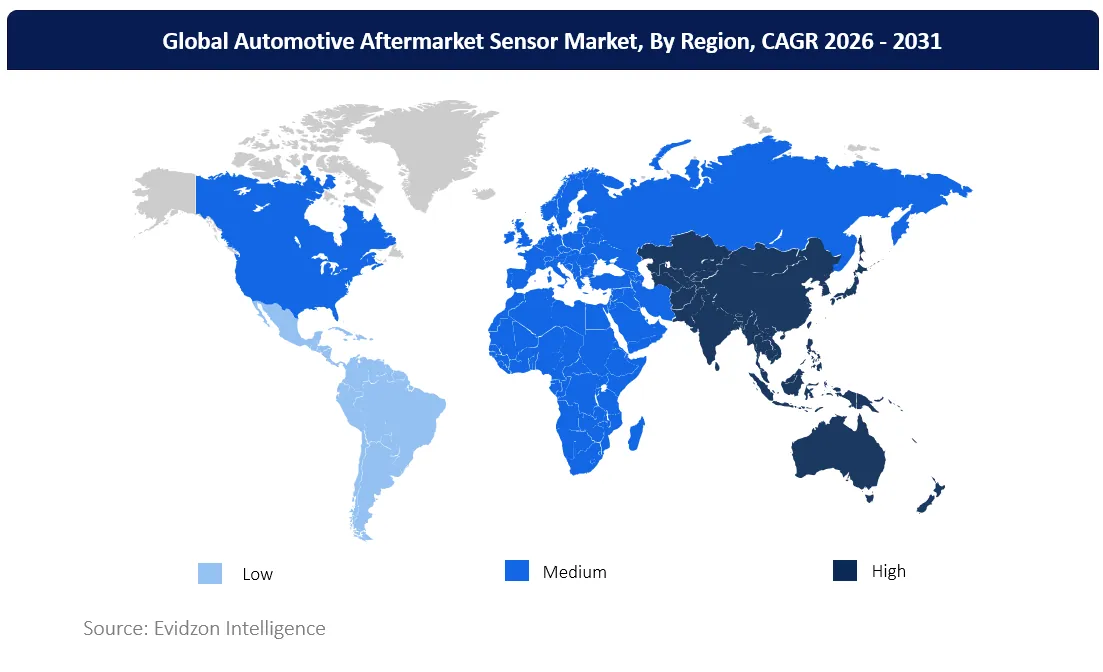
The market reflects regional differences owing to attributes like vehicle ownership, fleet aging, repair infrastructure and sensor replacement demand. North America have established auto parts distribution network and ageing vehicle fleet collectively led consistent replacement sensors demand across TPMS, oxygen, pressure, wheel-speed and other applications. Europe reflects steady demand curve on the back of vehicle safety regulations, emissions compliances and increasing adoption of advanced driver-assistance system (ADAS). Asia Pacific growth is driven by expanding vehicle ownership, growing independent workshops and wider access to affordable replacement components across China and India.
Key Takeaways
- By sensor type, pressure sensors account for 22.40% market share in 2025, while LiDAR sensors are expected to grow at a CAGR of 19.60% during 2026–2031.
- By vehicle type, passenger cars account for 74.60% market share in 2025, while commercial vehicles are expected to grow at a CAGR of 12.30% during 2026–2031.
- By propulsion type, internal combustion engine (ICE) vehicles account for 86.80% market share in 2025, whereas electric vehicles (EVs) are expected to grow at a CAGR of 18.20% during 2026–2031.
- By application type, core system sensors account for 48.70% market share in 2025, while safety and automation sensors are expected to grow at a CAGR of 14.80% during 2026–2031.
- By region, Asia Pacific accounts for 44.56% market share in 2025 and expected to grow at a CAGR of 13.20% during 2026–2031.
About the Study
The global automotive aftermarket sensor study covers replacement automotive sensor demand across sensor type, vehicle type, propulsion, application across major global regions and countries. The study analyzes demand through authorized distributors, independent aftermarket distributors, retailers, and evaluates sensor demand based on vehicle compatibility, sensing functions, electronic system integration, replacement needs, performance specifications, and pricing. The study excludes factory-fitted OEM sensor, sensors supplied to OEMs for new vehicle production, complete vehicles, standalone diagnostic equipment, vehicle repair and maintenance services, sensor testing and calibration services, and non-automotive sensors and applications.
Market Dynamics Analysis
Drivers
Older vehicles increasingly require sensor replacement during routine repairs.
Electronic systems add more monitored functions, increasing potential replacement frequency.
Safety system repairs require compatible, precision-sensitive sensor replacements.
Increasing ADAS adoption is creating replacement demand due to damage.
Digital catalogues help buyers identify suitable sensors for vehicles.
EV-specific systems create distinct aftermarket sensor replacement needs.
Restraints
Vehicle-specific specifications restrict universal aftermarket sensor substitution.
Cheap imitations produce inaccurate readings, premature failures, repeated repairs.
Advanced sensor often require diagnostic equipment and precise post-repair calibration.
Fault identification can complicate repairs and increase service expenses.
Increasing average vehicle parc age and electronics content across passenger cars and commercial vehicles is collectively driving the automotive aftermarket sensor demand. Ageing vehicle parc led faulty and worn out sensors replacement to restore the primary, safety, automated, power, and comfort functions. Failure in oxygen, pressure, temperature, speed, and position sensor led warning light and subsequently affect drivability, and emissions, resulting to encourage the replacement. .While, emerging vehicle electronic content increases the number of sensors replacement. ADAS features include parking sensors, radar-related sensors and wheel-speed sensing hardware face replacement after minor crashes or repeated faults. Whereas, electric vehicles require different sets of sensors to address the unique configurations of the powertrain. Increasing automobile electronic systems complexity is increasing difficulty to identify faults, necessitating the need of sensors replacement. Additionally, online sales channel offer digital catalogue to address compatibility concern across vehicle models, engines, and production years.
Sensors compatibility with specifications and intended application limit the aftermarket purchasing flexibility, leading to reduce the substitution scope and complicates sensor selection across vehicle models and applications. By by connector, operating range, mounting arrangement, software compatibility, and vehicle application, sensors are different, so visually similar component may not meet specifications. While, replacement of ADAS sensors including, radar, Lidar, and others, require high precision of calibration to compatible with vehicle’s safety and driving assistance systems.. Whereas, counterfeit sensor is an additional layer of challenge for tier-1 suppliers, led to impact the brand presence and revenue, while low grade products hinder the price equilibrium.
Segment Analysis
By Sensor Type
Pressure sensor is the largest sensor type segment accounts of the global automotive aftermarket sensor market, accounts 22.40% market share in 2025, driven by replacement demand across engine management, fuel delivery, tire pressure monitoring, transmission systems, and exhaust after-treatment. Vehicle mileage, manifold absolute pressure (MAP), failures in oil pressure, boost pressure, and differential pressure sensors lead poor engine performance, emission-control concerns and warning lights, driving demand for replacement sensors. Additionally, passengers’ cars accounts for substantial share of replacement sensors fueled by large installed base and regular servicing requirements, while commercial vehicles demand for sensor is fueled by engine management, braking systems, and exhaust after-treatment.
LiDAR sensor is anticipated to grow at CAGR of 19.60% by 2031, supported by increasing adoption of advanced driver-assistance systems (ADAS) and gradual expansion of automated driving capabilities. The aftermarket LiDAR sensor demand is fueled by sensor replacement including, hardware damage, electrical faults, collisions and failures in existing systems. However, market differs from conventional automotive sensor replacement as LiDAR units are expensive and often integrated with vehicle software, mounting structures, and calibration procedures. Over the forecast period, growth will depend on the expansion of the installed LiDAR-equipped vehicle parc, durability, and wider availability of compatible replacement LiDAR sensors.
Global Automotive Aftermarket Sensor Market, By Sensor Type, Market Share, 2025
By Vehicle Type
Passenger cars accounts 74.60% of global automotive aftermarket sensor market share in 2025, driven by overwhelming presence of passenger cars on road and frequent utilization for daily commuting. Large vehicle parc led recurring replacement demand for temperature, oxygen, pressure, position, speed, and tire-pressure monitoring sensors. Moreover, urban traffic congestion, frequent braking and prolonged vehicle use results sensor faults over time. Passenger cars are widely equipped with sensors across engine management, climate system, emission control, and driver assistance functions. After the vehicle service warranty periods owners tends to seek independent garages and aftermarket parts suppliers for affordable replacements, while growing number of sensor- in hybrid and electric passenger cars broadens future replacement opportunities.
Meanwhile, commercial vehicle is anticipated to be the fastest vehicle type segment of global automotive aftermarket sensor market with 12.30% CAGR by 2031. Emphasis on maximizing uptime across logistics, freight, construction, and delivery operations is likely to drive demand for sensors replacement. While heavy-duty trucks and buses undergo extensive use, accumulate substantial mileage, and operate under long-haul conditions, increases the need to replace default powertrain, temperature, pressure, exhaust, and wheel-speed sensors. Fault identification reduce unplanned downtime of fleet operators result direct financial incentive. Increasing last-mile activity and expansion of electronically monitored commercial fleets are expected to fueled the aftermarket sensor demand over the forecast period.
Global Automotive Aftermarket sensor market , By Vehicle Type, Market Share, 2025
Geographic Analysis
Largest Region
Asia-Pacific is the largest regional automotive aftermarket sensor market accounts for 44.56% market share in 2025. The Asia Pacific region dominates the automotive aftermarket sensor market due to the high number of vehicle parc across the region. China, Japan, India and South Korea's well established automotive manufacturing supply chains is supporting the aftermarket sensor demand curve. The high number of commercial vehicle parc across the region results in high replacement requirements due to heavy usage. Passenger vehicles also increase demand for replacement as parts age. Asia-Pacific has also multiple established automotive component manufacturers, results in a high availability of replacement sensors across price points. The variety of vehicles increases demand for sensors used for engine management, temperature sensing, pressure sensing and vehicle speed. This allows the replacement market to grow exponentially, combined with the large number of vehicles on roads across the region, reflecting a large market for replacement.
Oxygen, pressure, temperature, position, and speed sensors are in demand for conventional vehicles owing to engine performance issues, warning lights, and emissions-related faults. The Asia-Pacific region has broad independent repair market, while consumers compare aftermarket sensor prices with original replacement parts. The Asia-Pacific automotive aftermarket sensor demand is fueled by China’s manufacturing scale, India’s expanding vehicle parc, and Southeast Asia’s demand for affordable repairs sustain the region’s leading position.
Global Automotive Aftermarket Sensor Market, By Region, Market Share, 2025
Fastest- Growing Region
Asia-pacific automotive aftermarket sensor market is projected to grow at a CAGR of 13.20% CAGR during 2026-2031, evolving vehicle technology and changing repair requirements across the region is likely to drive the growth over the projection period. Increasing electric vehicle adoption is crafting a value pool for replacement sensor market across battery thermal management and electric propulsion system. In addition to this, growing development of autonomous vehicle and increasing SAE levels of ADAS system integration across vehicle type has introduced specialized sensors, including radar, Lidar, ultrasonic and other sensors. Increasing adoption of such technologies across mass-market vehicles is likely to create an opportunity pocket over the next decade.
Moreover, independent workshops and parts distributors are widening their product portfolio and technical capabilities to capitalize on such emerging trends. Increased access to vehicle diagnostic and calibration will make it easier for workshops to replace sensors across vehicle models. Suppliers focused on developing compatible product range, digital product catalogue, wide distribution network, will corner more complex automotive aftermarket sensor demand segments.
Competitive Landscape
- 1Robert Bosch GmbH
- 2Denso Corporation
- 3Denso Continental AG
- 4Sensata Technologies
- 5Niterra Co,Ltd
Market Concentration Level: Moderate
The global automotive aftermarket sensor competitive landscape is moderate, shaped by distribution network, technological product development capability, digital catalogues, and wide product portfolio. Key players operating in global automotive aftermarket sensor market includes Robert Bosch GmbH, Denso Corporation, Denso continental AG, Sensata Technologies and Niterra Co, Ltd., driven by established sensor engineering capabilities, and aftermarket distribution networks. Bosch offers a wide range of replacement sensors, including engine management, oxygen, pressure sensors and other automotive sensors. Meanwhile, Denso has strengths in powertrain and electronic component expertise, while Denso Continental AG and Sensata diversified operations, vehicle sensing, safety systems, and tyre-pressure monitoring. Niterra’s NKT brands specializes in oxygen and engine-management sensors.
Competition increasingly relies on product range, sensor accuracy and durability, compatibility, price and distribution network. Supplier who address servicing requirements of hybrid and electric vehicles, along with conventional engine-management applications are likely to capture wider opportunities. While, development of ADAS market is unfolding opportunities across radar, LiDAR, ultrasonic, diagnostic equipment, and post-repair calibrations. Thus, companies offering replacement sensors across applications are better positioned to retain large market share.
Recent Development
Hyundai Motor Group Partnered with NVIDIA to Develop Level 2+ and Level 2++ ADAS Systems
Hyundai Motor partnered with NVIDIA to develop Level 2+ and Level 2++ ADAS systems from 2028. The partnership is expected to improve sensor integration and expand ultrasonic sensors for advanced driving features across future assistance.
NXP Semiconductors Announced the SAF8444 Automotive Radar SoC
NXP semiconductors announced the SAF8444 automotive radar SoC is single-chip 77 GHz radar solution built on 28nm RFCMOS technology featuring on sensor to processing for L2 and L2+ADAS applications. The launch is expected to improve radar data processing efficiency on vehicle control and support wider adoption of advanced driver assistance features in future vehicles.
Bosch Expands Pressure Sensors Portfolio
Bosch expands European aftermarket portfolio with 60 air- conditioning pressure sensor part numbers, starting in Q1 2026, hybrid and electric vehicles to improve refrigerant-pressure monitoring and system protection.
Table of Content
- 1.Introduction
- 1.1Scope and Objective of the Study
- 1.2Market Definition & Study Assumptions
- 2.Research Methodology
- 3.Executive Summary
- 4.Market Outlook
- 4.1Market Overview
- 4.2Market Drivers
- 4.2.1Rising ADAS Adoption Across New Vehicle Programs
- 4.2.2Greater Electrification Raises Battery Sensing Requirements
- 4.2.3Connected Vehicle Functions Need Continuous Data Inputs
- 4.2.4Tighter Emission Rules Increase Monitoring Hardware
- 4.2.5Increasing Electronic Control Across Core Automotive Functions
- 4.2.6Automated Driving Development Demands Multimodal Perception
- 4.3Market Restraint
- 4.3.1High Integration Expenses Limit Advanced Sensor Deployment
- 4.3.2Complex Calibration Procedures Increase Engineering Workloads
- 4.3.3Semiconductor Shortages Disrupt Component Availability Worldwide
- 4.3.4Harsh Operating Conditions Reduce Sensor Reliability
- 4.4Supply/Value Chain Analysis
- 4.5Regulatory Landscape
- 4.6Porter's Five Forces Analysis
- 4.6.1Threat of New Entrants
- 4.6.2Bargaining Power of Buyers
- 4.6.3Bargaining Power of Suppliers
- 4.6.4Threat of Substitutes
- 4.6.5Competitive Rivalry
- 5.Market Segmentation (Includes market size in Value (USD) and Volume (Units), Forecast up to 2031, and market analysis with growth attributes)
- 5.1By Sensor type
- 5.1.1Position Sensors
- 5.1.2Temperature Sensors
- 5.1.3Pressure Sensors
- 5.1.4Inertial & Speed Sensors
- 5.1.5Radar Sensors & Magnetic sensors
- 5.1.6LiDAR Sensors
- 5.1.7Others (Oxygen (O₂) Sensors, NOx Sensors, Knock Sensors, Torque Sensors, Fuel Level & Ultrasonic etc.)
- 5.2By vehicle type
- 5.2.1Passenger Cars
- 5.2.1.1Hatchback
- 5.2.1.2Sedan
- 5.2.1.3SUV/MUV
- 5.2.2Commercial Vehicles
- 5.2.2.1Light Commercial Vehicles (LCV)
- 5.2.2.2Medium & Heavy Duty Truck
- 5.2.2.3Buses & Coaches
- 5.3By Propulsion Type
- 5.3.1Internal Combustion Engine (ICE) Vehicles
- 5.3.2Electric Vehicles (EVs)
- 5.4By Application Type
- 5.4.1Core System Sensors
- 5.4.1.1Powertrain
- 5.4.1.2Chassis
- 5.4.1.3Body Electronics
- 5.4.2Safety & Automation Sensors
- 5.4.2.1ADAS & Safety
- 5.4.2.2Telematics & Connectivity
- 5.4.3Efficiency & Comfort Sensors
- 5.4.3.1Battery Management
- 5.4.3.2Exhaust & Emission Control
- 5.4.3.3HVAC & Comfort
- 5.5By Region
- 5.5.1North America
- 5.5.1.1United States
- 5.5.1.2Canada
- 5.5.2Latin America
- 5.5.2.1Brazil
- 5.5.2.2Argentina
- 5.5.2.3Mexico
- 5.5.2.4Rest of Latin America
- 5.5.3Europe
- 5.5.3.1Germany
- 5.5.3.2Italy
- 5.5.3.3France
- 5.5.3.4Spain
- 5.5.3.5United Kingdom
- 5.5.3.6Russia
- 5.5.3.7Rest of Europe
- 5.5.4Asia Pacific
- 5.5.4.1China
- 5.5.4.2India
- 5.5.4.3Japan
- 5.5.4.4South Korea
- 5.5.4.5Indonesia
- 5.5.4.6Australia
- 5.5.4.7Rest of Asia-Pacific
- 5.5.5Middle East & Africa
- 5.5.5.1Saudi Arabia
- 5.5.5.2United Arab Emirates (UAE)
- 5.5.5.3South Africa
- 5.5.5.4Egypt
- 5.5.5.5Rest of the Middle East & Africa
- 6.Competitive Landscape
- 6.1Market Concentration Overview
- 6.2Market Share Analysis
- 6.3Company Profiles
- 6.3.1AGC Automotive
- 6.3.2Fuyao Glass Industry Group
- 6.3.3Saint-Gobain Sekurit
- 6.3.4Xinyi Glass (XYZ)
- 6.3.5Nippon Sheet Glass
- 6.3.6TAIWANGLASS GROUP
- 6.3.7Şişecam
- 6.3.8Guardian Industries
- 6.3.9Schott AG
- 6.3.10Vitro Automotive
- 6.3.11Carlex Glass America LLC
- 6.3.12Shanghai Yaohua Pilkington Glass
- 6.3.13Asahi India Glass Ltd.
- 6.3.14CSG Holding
- 6.3.15Corning Incorporated
- 7.Future Outlook
- 7.1Growth Opportunities & White-Space Analysis
- 7.2Analyst Recommendations
Market Size Methodology
Market value is calculated based on automotive aftermarket sensor sales volumes multiplied by corresponding average selling price (ASP), estimated by sensor type, vehicle type, propulsion, application, sales channel across major regions and countries to capture sensor specifications, vehicle compatibility, replacement requirements, pricing variations, and regional demand.
Historical market estimates are benchmarked against vehicle parc, vehicle age distribution, sensor replacement volumes, aftermarket component sales, repair and maintenance activity, distributor shipments, import-export data, replacement rates, and company disclosures.
Forecasts incorporate expected changes in vehicle parc, ageing vehicle fleets, vehicle electrification, ADAS adoption, emission regulations, electronic system complexity, sensor failure rates, replacement cycles, sensor prices, vehicle usage, aftermarket distribution networks, availability of compatible replacement parts, and regional automotive aftermarket growth.
FAQ
What is the projected size of the global automotive aftermarket sensor market by 2031?
The global automotive aftermarket sensor market value is USD 4.87 billion in 2025, increasing to USD 9.02 billion by 2031, with a CAGR of 11.08% during 2026–2031.
Which sensor type holds the largest share of the global automotive aftermarket sensor market?
Pressure sensors hold the largest share, accounting for 22.40% of the market in 2025.
Which sensor segment is expected to grow fastest during the forecast period?
LiDAR sensors are projected to grow at a CAGR of 19.60% during 2026–2031.
Which region dominates the global automotive aftermarket sensor market?
Asia Pacific leads the market with a 44.56% market share in 2025.
What are the key factors driving the global automotive aftermarket sensor market?
Ageing vehicle fleet, increasing electronic content, emission-control requirements, ADAS adoption, and wider availability of vehicle-specific parts through online channels are key growth drivers. However, compatibility issues, counterfeit products, calibration requirements, and shortages of trained technicians constrain market expansion.
Have a question about this report?
Talk to the analyst behind this research, or browse the full report catalogue.
Contact Us