
Global Automotive Sensor Market
The global automotive sensor report is segmented by sensor type (Position Sensor, Temperature Sensor, Pressure Sensor, Inertial & Speed Sensors, Radar Sensors & Magnetic Sensors, LiDAR Sensors and Others), by vehicle type (Passengers cars and commercial vehicles), by propulsion (Internal Combustion Engine (ICE) Vehicle and Electric Vehicle (EV)), by application (Core System Sensors, Safety & Automation Sensors and Efficiency and Comfort Sensors), by sales channel (OEM and Aftermarket), and by regions (North America, Latin America, Europe, Asia Pacific and Middle East & Africa). The global automotive sensor report includes market size in value and (USD) forecasts through 2031.
Global Automotive Sensor Market
Market Size in USD Billion
Market Size Overview
USD Billion
Market Snapshot
- Study Period
- 2019-2031
- Forecast Period
- 2026-2031
- Base Year Market Size (2025)
- USD 31.68 Billion
- Market Size (2026)
- USD 34.27 Billion
- Market Size (2031)
- USD 54.98 Billion
- Growth Rate (2026-2031)
- 9.91% CAGR
- Market Concentration
- Consolidated
Major Players*





*Disclaimer: Major Players sorted in no particular order
Market Overview
The global automotive sensor market value is anticipated to grow from USD 31.68 billion in 2025 to 34.27 billion in 2026 and is expected to reach USD 54.98 billion in 2031, with a CAGR (2026-2031) of 9.91%.
The global automotive sensor market is driven by increasing vehicle electrification, rising electronic content, and growing demand for advanced safety and driver-assistance systems. Automotive sensors measure parameters such as pressure, temperature, speed, position, acceleration, humidity, and distance, enabling vehicles to monitor operating conditions and support efficient control of critical systems. Such components are widely used across engine management, braking systems, tyre pressure monitoring, powertrain control, battery management, cabin comfort, and vehicle safety applications. The growing integration of advanced driver-assistance systems (ADAS) is expanding demand for radar, camera-based sensing, ultrasonic, and LiDAR sensors. Meanwhile, electric vehicles have an additional set of sensors to monitor battery temperature, voltage, current, motor performance, and thermal conditions.
The global automotive sensor market competitive landscape is consolidated, key players holding majority market share includes Robert Bosch GmbH, DENSO Corporation, Continental AG, Sensata Technologies, Infineon Technologies, and NXP Semiconductors. Competition is shaping on sensor accuracy, reliability, cost, automotive-grade qualification, and integration compatibility with vehicle electronics. Established suppliers benefit from long-term automaker relationships and extensive product portfolios, while semiconductor companies strengthen the market through advances in sensor interfaces, signal processing, radar, and power management. Future opportunities is centered on ADAS penetration, electrification, and sensor content per vehicle.
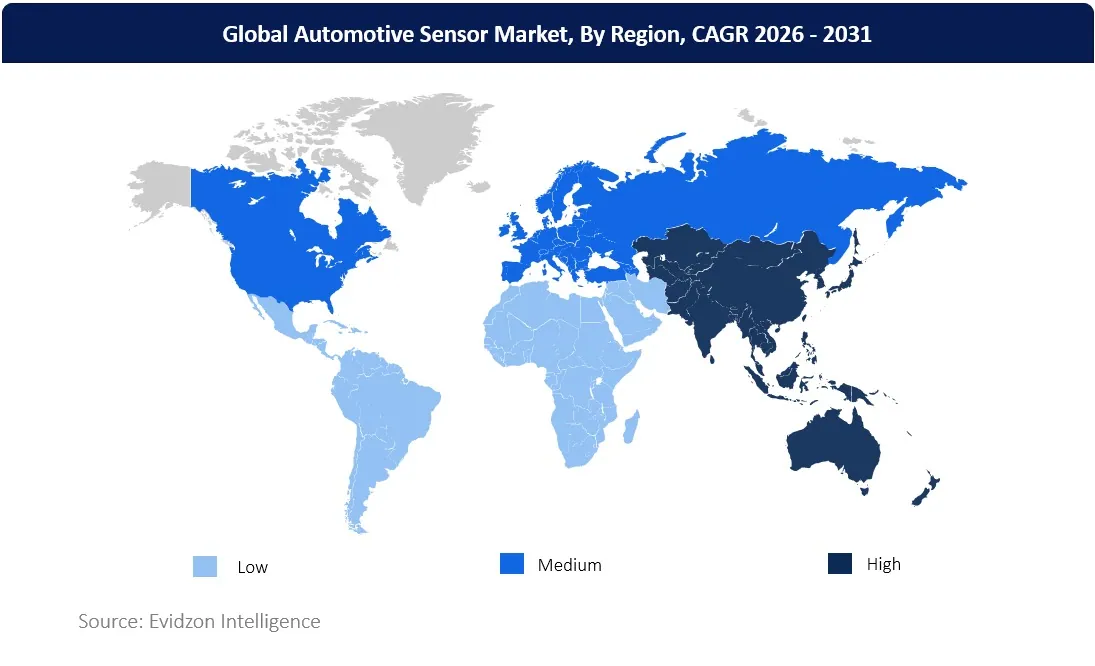
Asia Pacific is the largest and fastest growing automotive sensor market, driven by vehicle production and sensor technology development across China, Japan, South Korea, and India. North America benefits from ADAS development, electric vehicle technologies, and autonomous-driving programs. While, Europe’s demand is shaped by vehicle safety requirements, emissions control, premium automotive production, and electrification. Latin America and the Middle East and Africa offer opportunities through vehicle production, fleet expansion, and increasing adoption of electronic safety and monitoring systems.
Key Takeaways
- By sensor type, pressure sensors account for 21.60% of global automotive sensor market share in 2025, while LiDAR sensors are expected to grow at a CAGR of 18.70% during 2026–2031.
- By vehicle type, passenger cars account for 72.80% market share in 2025, while commercial vehicles are expected to grow at a CAGR of 10.20% during 2026–2031.
- By propulsion type, internal combustion engine (ICE) vehicles account for 64.70% of global automotive sensor market share in 2025, while electric vehicles (EVs) are expected to grow at a CAGR of 14.80% during 2026–2031.
- By application type, core system sensors account for 43.20% market share in 2025, while safety and automation sensors are expected to grow at a CAGR of 15.60% during 2026–2031.
- By sales channel, OEM sales account for 84.60% of global automotive sensor market share in 2025, while the aftermarket is expected to grow at a CAGR of 11.08% during 2026–2031.
- By region, Asia Pacific accounts for 43.80% market share in 2025 and is expected to grow at a CAGR of 11.20% during 2026–2031.
About the Study
The global automotive sensor market analysis covers sensor types, vehicle type, propulsion systems, application, sales channels, and regions. The study analyzes sensor demand across OEM and aftermarket channels and evaluates automotive sensor requirements based on vehicle design, sensing accuracy, operating conditions, electronic integration, safety standards, emissions monitoring, powertrain control, and driver-assistance applications. The study excludes complete vehicle value, standalone electronic systems, general industrial sensors, manufacturing equipment, repair services, and other activities outside the automotive sensors.
Market Dynamics Analysis
Drivers
Safety systems increasingly combine cameras, radar, ultrasonic and inertial sensors.
Electric platforms require precise readings across batteries and motors.
Connected architectures use sensor information for diagnostics, tracking and predictive services.
Powertrain monitoring needs accurate measurements to meet increasingly demanding regulatory limits.
Modern architectures replace mechanical functions with electronically measured inputs.
Automated vehicles need overlapping sensing methods for dependable road interpretation.
Restraints
Multiple sensing technologies increase hardware, software and validation costs.
Different mounting positions require repeated calibration across vehicle platforms.
Limited component supply can interrupt production schedules and vehicle programs.
Heat, vibration, moisture and contamination can gradually reduce accuracy.
Global automotive sensor market is driven by increasing electronic integration, vehicle electrification, and growing emphasis on vehicle safety and automated driving functions. Modern vehicle depends on pressure temperature, cameras radar, ultrasonic devices and inertial sensors enable features such as emergency braking, blind-spot detection or lane assistance. Moreover, electric powertrains shaping another layer of demand, with battery packs require continued monitoring of temperature, current, voltage and pressure. While stricter emission requirements sustain demand for oxygen, pressure, and temperature sensors in combustion-engine vehicles. In addition to this, Vehicle systems use sensor data for diagnostics, vehicle monitoring, and predictive maintenance. The development of ADAS and automated driving is increasing demand for multiple sensing technologies that help vehicles detect obstacles, monitor surroundings, and respond to changing road conditions. On the other side electronic architectures are spreading into braking, steering, suspension and thermal management.
Advanced sensing packages including spending on hardware integration, software development, calibration and validation includes a significant cost to integrate in vehicle programs. While, calibration demands the same sensor to perform consistently across vehicle platforms, mounting positions and operating conditions. Disruptions in supply chains may led bottleneck especially for manufacturers reliant on specialized semiconductor devices or limited component sources. Reliability is also a key parameter, as sensors are moving towards exposed locations and safety-critical applications including, heat, vibration, moisture, dust, and electromagnetic interference, it may affect measurement accuracy over the time. A unreliable data input from sensor create false warnings resulting automakers to undertake extensive testing before deployment in vehicles, resulting to extensive engineering requirements and slow down the adoption for new sensing technologies.
Segment Analysis
By Sensor Type
Pressure sensor accounts the largest market share of 21.60% in 2025 of the global automotive sensor market, fueled by widespread application across engine management, transmission systems, tyres pressure monitoring, and vehicle climate control. The relevance of pressure sensors is determined for both conventional powertrain (Petrol & Diesel engines), hybrid vehicles and electric vehicles. In internal combustion engine vehicles (ICE), pressure sensor helps to monitor the fuel delivery, intake manifold pressure, oil pressure, and exhaust conditions. Additionally, TPMS sensor support road safety by alerting drivers to underinflated tyres affects the braking, handling, and tyre wear. Pressure sensing is also relevant in electric vehicles for battery thermal management, braking systems, and refrigerant circuits. While the broad installation base for vehicle platforms sustains demand from both OE manufacturer and the replacement market.
LiDAR sensor is expected to be the fastest growing segment with a CAGR of 18.80% by 2031. LiDAR sensor increasingly growing on the back of need for advanced driver-assist systems and develop higher levels of automated driving, LiDAR sensors enable vehicles to form dynamic 3-D models of surroundings by laser beams. Unlike conventional cameras, LiDAR measures distance, allowing the vehicle to detect and avoid obstacles and estimate positions, and interpret road environments. Adoption is limited due to the cost of sensor technologies, integration requirements, and competition from camera-radar systems. While, falling component costs and improvements in solid-state design make the LiDAR practical for selected passenger vehicles and premium autonomous-driving applications. The growth is centered on automotive industry development beyond pilot programmes and isolated applications into production vehicles at greater scale.
Global Automotive Sensor Market, By Sensor Type, Market Share, 2025
By Vehicle Type
By vehicle type, passenger car is the largest segment of global automotive sensor market accounting 72.80% market share in 2025. The passenger car automotive sensor market is driven by increasing electronic systems content per vehicle integrated across mass-market and premium vehicles, engine management, exhaust monitoring, tyre pressure monitoring, parking assistance, airbag deployment, climate control and ADAS are the key application areas. The passenger car transition towards electric vehicle propulsion is shaping demand for battery temperature, voltage, current and position sensors. Key sensor manufacturers are expanding their presence across camera-based safety functions and radar-assisted driving features, while the price of sensor varies by application. The wide production base of passenger car and rising electronic content support the segment’s leading position. Strong demand for safety features and emission compliance extend beyond premium models into mid-range vehicles.
Whereas, commercial vehicles are expected to be the fastest growing vehicle segment with a CAGR of 12.20% by 2031. Medium and heavy-duty trucks, buses, and light commercial vehicles are propelling the integration of sensors to improve operating efficiency, meet emission standards and curb accidents risks. Fleet operators have strong persistent inclination to monitor engine performance, tyre pressure, brake condition and vehicle temperature, since unexpected downtime can impede deliveries and increase maintenance costs. Increasing electrification of delivery vans and urbans buses raises demand for battery and thermal management sensors. While, logistics companies are investing in connected vehicle technologies posed to generate demand for incremental sensor at faster rate in comparison to passenger cars.
Global Automotive Sensor Market, By Vehicle Type, Market Share, 2025
Geographic Analysis
Largest Region
Asia-Pacific is the largest regional automotive sensor market accounts for 43.80% market share in 2025, driven by extensive vehicle manufacturing and rising need for advanced electronics across passenger cars and commercial vehicles. China is the epicenter of Asia-Pacific automotive sensor market owing to China based OEMs and global manufacturer increasing integration of pressure, temperature, position, speed, and radar sensors across vehicle models.
Moreover, Japan and South Korea have well established automotive electronic and components supply chain. While, India is expanding vehicle production and safety requirements to encourage wider adoption of electronic monitoring systems. EV production adds another layer of demand for battery temperature monitoring, current sensing and powertrain control. However, cost remains a key consideration especially for entry level vehicles where manufacturer balance sensor content against selling price.
Global Automotive Sensor Market, By Region, Market Share, 2025
Fastest- Growing Region
Asia- pacific is the fastest growing regional automotive sensor market anticipated to account for 11.20% CAGR by 2031, driven by high vehicle production, expanding electric vehicle manufacturing, and increasing integration of advanced electronic systems sensor adoption spreads conventional powertrain and emissions applications. China is driving growth on the back of vertically integrated electric vehicle supply chain, extensive domestic automotive production and adoption of sophisticated advanced driver-assistance systems.
While, Japan and South Korea offer expertise in automotive electronics and India offers opportunity for increasing penetration, as safety features in wider range of lower-priced vehicles. The region’s shift towards electric vehicles shaping additional layer of sensing for battery temperature, voltage, current, and motor position, increasing demand per vehicle. ADAS is supporting demand for radar, camera-based sensing, and ultrasonic parking systems. Growth depends on manufacturers technology development across mass-market vehicle at affordable cost. Additionally, suppliers increasing ability to meet automotive regulations at competitive pricing is aiding sensor integration across new vehicle platforms.
Competitive Landscape
- 1Robert Bosch GmbH
- 2Denso Corporation
- 3NXP Semiconductor
- 4Infineon Technologies AG
- 5Sensata Technologies
Market Concentration Level: Consolidated
The global automotive sensor market competitive landscape is consolidated, key players in the market includes established automotive suppliers and semiconductor manufacturers such as Robert Bosch GmbH, DENSO Corporation, Continental AG, Infineon Technologies AG, NXP Semiconductors N.V., and Sensata Technologies. Key companies compete on sensor performance, reliability, pricing, manufacturing capacity, and ability to meet OEMs’ technical and regulatory requirements. Robert Bosch GmbH and DENSO Corporation supply sensors for powertrain control, vehicle safety, and electronic systems. Continental AG has strong presence in vehicle dynamics and driver-assistance technologies. Infineon Technologies AG developing semiconductor solutions for magnetic sensing and radar applications, while NXP Semiconductors supplies automotive radar chips and related processing technologies. Sensata Technologies primarily focuses on pressure, temperature, and other sensing solutions which is used to monitor vehicle operating conditions.
Competition is increasingly influenced by vehicle electrification, growing electronic system, and adoption of advanced safety functions. Suppliers are investing in product development to improve measurement accuracy, reduce component size, and control costs without compromising reliability. OEMs are increasingly identify suppliers based on production consistency, testing capabilities, and their ability to support different vehicle platforms. However, long-term supply relationships and compliance with automotive quality standards remain crucial.
Recent Development
Hyundai Motor Group Partnered with NVIDIA to Develop Level 2+ and Level 2++ ADAS Systems
Hyundai Motor partnered with NVIDIA to develop Level 2+ and Level 2++ ADAS systems from 2028.The partnership is expected to improve sensor integration and expand ultrasonic sensors for advanced driving features across future assistance.
NXP Semiconductors Announced the SAF8444 Automotive Radar SoC
NXP semiconductors announced the SAF8444 automotive radar SoC is single-chip 77 GHz radar solution built on 28nm RFCMOS technology featuring on sensor to processing for L2 and L2+ADAS applications. The launch is expected to improve radar data processing efficiency on vehicle control and support wider adoption of advanced driver assistance features in future vehicles
Bosch and Qualcomm Expand Partnership to Develop Next-Generation ADAS Platforms
Bosch and Qualcomm expand partnership to develop centralized advanced driver- assistance systems (ADAS) integrating camera and radar sensor data with Snapdragon Ride computing technology, the partnership targeting next-generation driver-assistance systems in vehicles planned for launch from 2028.
Table of Content
- 1.Introduction
- 1.1Scope and Objective of the Study
- 1.2Market Definition & Study Assumptions
- 2.Research Methodology
- 3.Executive Summary
- 4.Market Outlook
- 4.1Market Overview
- 4.2Market Drivers
- 4.2.1Rising ADAS Adoption Across New Vehicle Programs
- 4.2.2Greater Electrification Raises Battery Sensing Requirements
- 4.2.3Connected Vehicle Functions Need Continuous Data Inputs
- 4.2.4Tighter Emission Rules Increase Monitoring Hardware
- 4.2.5Increasing Electronic Control Across Core Automotive Functions
- 4.2.6Automated Driving Development Demands Multimodal Perception
- 4.3Market Restraint
- 4.3.1High Integration Expenses Limit Advanced Sensor Deployment
- 4.3.2Complex Calibration Procedures Increase Engineering Workloads
- 4.3.3Semiconductor Shortages Disrupt Component Availability Worldwide
- 4.3.4Harsh Operating Conditions Reduce Sensor Reliability
- 4.4Supply/Value Chain Analysis
- 4.5Regulatory Landscape
- 4.6Porter's Five Forces Analysis
- 4.6.1Threat of New Entrants
- 4.6.2Bargaining Power of Buyers
- 4.6.3Bargaining Power of Suppliers
- 4.6.4Threat of Substitutes
- 4.6.5Competitive Rivalry
- 5.Market Segmentation (Includes market size in Value (USD) and Volume (Units), Forecast up to 2031, and market analysis with growth attributes)
- 5.1By Sensor type
- 5.1.1Position Sensors
- 5.1.2Temperature Sensors
- 5.1.3Pressure Sensors
- 5.1.4Inertial & Speed Sensors
- 5.1.5Radar Sensors & Magnetic sensors
- 5.1.6LiDAR Sensors
- 5.1.7Others(Oxygen (O₂) Sensors,NOx Sensors,Knock Sensors,Torque Sensors,Fuel Level & Ultrasonic etc)
- 5.2By vehicle type
- 5.2.1Passenger Cars
- 5.2.1.1Hatchback
- 5.2.1.2Sedan
- 5.2.1.3SUV/MUV
- 5.2.2Commercial Vehicles
- 5.2.2.1Light Commercial Vehicles (LCV)
- 5.2.2.2Medium & Heavy Duty Truck
- 5.2.2.3Buses & Coaches
- 5.3By propulsion type
- 5.3.1Internal Combustion Engine (ICE) Vehicles
- 5.3.2Electric Vehicles (EVs)
- 5.4By Application type
- 5.4.1Core System Sensors
- 5.4.1.1Powertrain
- 5.4.1.2Chassis
- 5.4.1.3Body Electronics
- 5.4.2Safety & Automation Sensors
- 5.4.2.1ADAS & Safety
- 5.4.2.2Telematics & Connectivity
- 5.4.3Efficiency & Comfort Sensors
- 5.4.3.1Battery Management
- 5.4.3.2Exhaust & Emission Control
- 5.4.3.3HVAC & Comfort
- 5.5By Sales channels
- 5.5.1OEM
- 5.5.2After-Market
- 5.6By Region
- 5.6.1North America
- 5.6.1.1United States
- 5.6.1.2Canada
- 5.6.2Latin America
- 5.6.2.1Brazil
- 5.6.2.2Argentina
- 5.6.2.3Mexico
- 5.6.2.4Rest of Latin America
- 5.6.3Europe
- 5.6.3.1Germany
- 5.6.3.2Italy
- 5.6.3.3France
- 5.6.3.4Spain
- 5.6.3.5United Kingdom
- 5.6.3.6Russia
- 5.6.3.7Rest of Europe
- 5.6.4Asia Pacific
- 5.6.4.1China
- 5.6.4.2India
- 5.6.4.3Japan
- 5.6.4.4South Korea
- 5.6.4.5Indonesia
- 5.6.4.6Australia
- 5.6.4.7Rest of Asia-Pacific
- 5.6.5Middle East & Africa
- 5.6.5.1Saudi Arabia
- 5.6.5.2United Arab Emirates (UAE)
- 5.6.5.3South Africa
- 5.6.5.4Egypt
- 5.6.5.5Rest of the Middle East & Africa
- 6.Competitive Landscape
- 6.1Market Concentration Overview
- 6.2Market Share Analysis
- 6.3Company Profiles
- 6.3.1Robert Bosch GmbH
- 6.3.2Denso Corporation
- 6.3.3Infineon Technologies AG
- 6.3.4NXP Semiconductor
- 6.3.5Sensata Technologies
- 6.3.6TE Connectivity
- 6.3.7Valeo SA
- 6.3.8Hitachi Astemo
- 6.3.9Texas Instruments
- 6.3.10STMicroelectronics
- 6.3.11Hyundai Mobis
- 6.3.12Allegro MicroSystems
- 6.3.13CTS Corporation
- 6.3.14Aptiv PLC
- 6.3.15Hella GmbH
- 7.Future Outlook
- 7.1Growth Opportunities & White-Space Analysis
- 7.2Analyst Recommendations
Market Size Methodology
Global automotive sensor market value is calculated based on automotive sensor sales volumes multiplied by corresponding average selling price (ASP), estimated by sensor type, vehicle type, propulsion, application, sales channel and region to capture sensor specifications, vehicle integration levels, sensing requirements, pricing differences, OEM fitment, aftermarket replacement patterns, purchasing channels, and regional demand.
Historical market estimates are benchmarked against automotive sensor shipments, vehicle production, vehicle parc, new vehicle registrations, sensor content per vehicle, OEM fitment volumes, aftermarket replacement volumes, semiconductor and component shipments, import-export data, replacement rates, and company disclosures.
Forecasts incorporate expected vehicle production, electric vehicle penetration, ADAS adoption, automated driving development, connected vehicle penetration, electronic content per vehicle, battery monitoring requirements, sensor prices, calibration requirements, replacement cycles, OEM demand, aftermarket activity, semiconductor availability, and regional vehicle parc growth.
FAQ
What is the projected size of the global automotive sensor market by 2031?
The global automotive sensor market is valued at USD 31.68 billion in 2025 and is projected to reach USD 54.98 billion by 2031, growing at a CAGR of 9.31% during 2026–2031.
Which sensor type holds the largest share of the global automotive sensor market?
Pressure sensors hold the largest share, accounting for 21.60% of the global automotive sensor market in 2025.
Which sensor segment is expected to grow fastest in the global automotive sensor market?
LiDAR sensors are expected to be the fastest-growing sensor type, with a projected CAGR of 18.70% during 2026–2031.
Which region dominates the global automotive sensor market?
Asia Pacific dominates the global automotive sensor market, accounting for 43.80% of the market in 2025.
What are the major factors driving the global automotive sensor market?
The market is driven by vehicle electrification, stricter emission requirements, increasing adoption of ADAS, and growing integration of electronic control systems. Electric vehicles require sensors for battery monitoring, motor control, and thermal management, while conventional vehicles continue to use sensors for engine performance, emissions monitoring, and vehicle safety.
Have a question about this report?
Talk to the analyst behind this research, or browse the full report catalogue.
Contact Us