
Global Automotive Aluminum Wheel Market
The global automotive aluminum wheel market is segmented by vehicle type (Passenger Car and Commercial Vehicle), by propulsion (Internal Combustion Engine (ICE) and Electric Vehicle (EV)), by rim size (Below 13 Inch, 13-15 Inch, 16-18 Inch, 19-21 Inch, and Above 21 Inch), by manufacturing process (Casting, Forging, and Flow-Forming (Spinning)), by sales channel (OEM and Aftermarket), and by region (North America, Latin America, Europe, Asia-Pacific, and Middle-East and Africa). The global automotive aluminum wheel market report includes market size in Value (USD) and Volume (Units), forecast up to 2031.
Global Automotive Aluminum Wheel Market
Market Size in USD Billion
Market Size Overview
USD Billion
Market Snapshot
- Study Period
- 2019-2031
- Forecast Period
- 2026-2031
- Base Year Market Size (2025)
- USD 27.43 Billion
- Market Size (2026)
- USD 28.41 Billion
- Market Size (2031)
- USD 39.71 Billion
- Growth Rate (2026-2031)
- 6.93% CAGR
- Market Concentration
- Consolidated
Major Players*


*Disclaimer: Major Players sorted in no particular order
Market Overview
The global automotive aluminum wheel market value is anticipated to grow from USD 27.43 billion in 2025 to 28.41 million in 2026 and expected to reach USD 39.71 million in 2031 with a CAGR (2026-2031) of 6.93%.
Increasing lightweight vehicle components, evolving wheel designs, and continued adoption of alloy wheels across passenger cars and commercial vehicles is collectively supporting the global automotive aluminum wheel market. Aluminum wheels offers a widespread advantages over steel wheel counter parts such as visual appeal, corrosion resistance, and weight reduction compared with conventional steel alternatives making it lucrative across mid-range and premium vehicles. In electric vehicles, reduced weight is especially prominent, but wheels should also be able to withstand the load-carrying capacity. In manufacturing processes, casting is most suitable for large-volume production, while flow-forming and forging are used for high-strength parts and thus, may have higher costs. Wheels are also subject to replacement, and customization is yet another source of demand.
The key global automotive aluminum wheel market players includes Iochpe-Maxion (Maxion Wheels), CITIC Dicastal, Zhejiang Wanfeng Auto Wheel, Superior Industries International and Ronal Group competing on production scale, OEM relationships, engineering capabilities, product quality, and production costs. In order to compete within the industry, suppliers implement competitive capabilities like increase in production volume, optimization of regional supply chains, improvement of production processes, and design and engineering of wheels, meeting the demand for light-weight vehicles and alternative drive-trains. The competitiveness is based on the optimization of costs, material usage, product quality, and approval of technical specifications by the OEMs.
Asia-Pacific offers significant opportunities due to the extensive automotive manufacturing across China, India, and Japan, a wide range of suppliers, and the growing demand for alloy wheels. China is a major producer of automobiles, including electric vehicles, but it also has significant potential of aluminum wheel production. India will continue to see a rise in passenger cars and their fitment with alloy wheels across both OEM and aftermarket channels on the back of shifting customer preference. The regional variations in automotive production, the rise of electric vehicles, the power of consumer purchasing, and the range of vehicle sizes and price points are factors that will drive wheel demand. Localized production and partnerships with regional OEMs to shorten the supply chain and reduce costs are two areas of emphasis for suppliers.
Key Takeaways
- By vehicle type, passenger car accounts for nearly 78.4% market share in 2025 while commercial vehicle is expected to grow at a CAGR of 8.5% by 2031.
- By propulsion, internal combustion engine (ICE) remains the largest sub-segment accounting for nearly 76.1% of the global automotive aluminum wheel market in 2025. Whereas, electric vehicle (EV) is expected to be the fastest growing propulsion segment expanding at 15.4% CAGR by 2031.
- By rim size, 16–18 inch segment has registered the highest market value share of nearly 46.6% in 2025 of global automotive aluminum wheel market and above 21 inch is expected to ride at a 10.2% CAGR over the forecast period.
- By manufacturing process, casting remains the dominant demand base with nearly 76.1% market share in 2025, and flow-forming (spinning) is projected to grow at 9.1% CAGR by 2031.
- By sales channel, OEM accounts for 80.2% global automotive aluminum wheel market share in 2025. However, aftermarket is projected to witness a CAGR of 8.0% during 2026–2031.
- By region, Asia-Pacific accounts for 47.2% global automotive aluminum wheel market share in 2025 and is projected to witness a CAGR of 8.3% during 2026–2031.
About the Study
The study covers wheels for passenger cars, commercial vehicles and covers ICE and electric vehicle propulsion, with break-downs by rim size and manufacturing process, including casting, forging and flow-forming (spinning). Study includes OEM Wheels for original equipment manufacturer's fitted to new vehicles and aftermarket wheels for replacement or customization. The study scope excludes tires, wheel hubs, bearings, brakes and other chassis parts.
Market Dynamics Analysis
Drivers
Higher alloy-wheel fitment increases demand from original equipment channel.
Range efficiency encourages lightweight wheel engineering and adoption.
SUV popularity and premium styling support larger wheels.
Advanced forming reduces weight while maintaining structural performance.
Performance requirements support demand for high-strength forged wheels.
Styling upgrades and replacements support recurring aftermarket demand.
Restraints
Unstable metal prices complicate procurement and pricing decisions.
Premium pricing discourages adoption in cost-sensitive vehicle segments.
Fatigue and impact testing increase validation time and expense.
Specialized equipment and machining raise production investment requirements.
Passenger-car production and the growing fitment of aluminum wheels are the key drivers forming primary demand base, where alloy wheels are standard or available as factory upgrades. Aluminum wheels offer specific technical advantage of comparatively less weight, making it lucrative for electric vehicles, as reduced weight can improve efficiency, but with limited scope in terms of load capacity. Increasing market share of SUVs and premium vehicles is driving demand for large rim size wheels, carrying higher per unit value. Casting is likely to be used for large-volume programs, whereas flow-forming offers scope to offer weight, strength and cost benefits, while forging is used for more performance-critical, higher-cost applications. In addition to OEM demand channel, aftermarket is driven by replacement, damage and customization, unfolding revenue opportunities for wheel manufacturers beyond OEM.
The aluminum price fluctuations and OEM contracts risks create uncertainty for wheel manufacturers as the metal is a significant cost driver and the OEM contracts can limit the ability to increase prices. Moreover, aluminum wheels tend to be more expensive than their steel counterparts and are usually employed across entry-level automotive market segments, where the price difference has to be justified by higher benefits of the reduced weight and different styling options. Qualifying products under a number of different complex aluminum properties, including fatigue life, toughness, and size accuracy tests, required before any wheels can be released for production or included into a production schedule, add to costs and timing risks. The need for forging, as a process requiring equipment and additional machining, increases the capital investment and limits the options for capacity increases due to its lack of flexibility, unless there is a demand for a premium product with higher margins.
Segment Analysis
By Vehicle Type
Passenger car represent the largest vehicle type category with 78.4% market share in global automotive aluminum wheel market, while commercial vehicle is expected to foresee 8.5% CAGR through 2031. Broad range of OEM alloy-wheel fitment across passenger car segments and their appeal to customer’s preferences in terms of style and performance is primarily driving the passenger car automotive aluminum wheel market. Moreover, SUVs and high-end passenger cars has witnessed exponential sales growth leading to drive demand for large diameter wheels. Additionally, increasing adoption of electric vehicles across the globe has propelled the requirement of low weight automotive components including automotive wheels, aluminum alloys are much lighter than traditional steel wheels and also offer aerodynamic engineering specifications, leading to act as a tailwind factor.
Light-weight and aerodynamic engineering specifications is not limited to EVs application, in ICE vehicles, it assists to increase performance and fuel economy of passenger cars and are beneficial in terms of weight reduction allows OEMs to achieve carbon footprint regulations. It is also essential to stress that the choice of wheels depends on vehicle price segment, since entry-level cars are more sensitive to cost and have less potential for wheel weight reduction.
Global Automotive Aluminum Wheel Market, By Vehicle Type, Market Share, 2025
By Propulsion
Internal combustion engine (ICE) accounts for the highest automotive aluminum wheel market share of 76.1% in 2025, meanwhile electric vehicle (EV) is projected to grow at 15.4% CAGR by 2031. The existing production base, significant number of vehicles in circulation, and ICE vehicles availability across price categories are the key attributes allowing internal combustion engine (ICE) Vehicles to account for the largest demand base in automotive aluminum wheel market. Lightweight aluminum alloys are majorly employed across middle to higher trims and premium cars, while entry-level vehicles primarily have steel wheels and aluminum wheels are fitted as an upgrade option driving the aftermarket sales channel.
In addition, the demand depends on the volume of production of vehicles, the inclusion of wheels in the factory equipment, and the degree of replacement of steel wheels. At the same time, electric cars provide an opportunity to reduce the weight of transportation and, hence, the energy consumption of the motor vehicle. However, electric vehicles wheels have specific requirements related to the weight of batteries, increased weight, and the need for higher performance, as well as aerodynamics.
Global Automotive Aluminum Wheel Market, By Propulsion, Market Share, 2025
Geographic Analysis
Largest Region
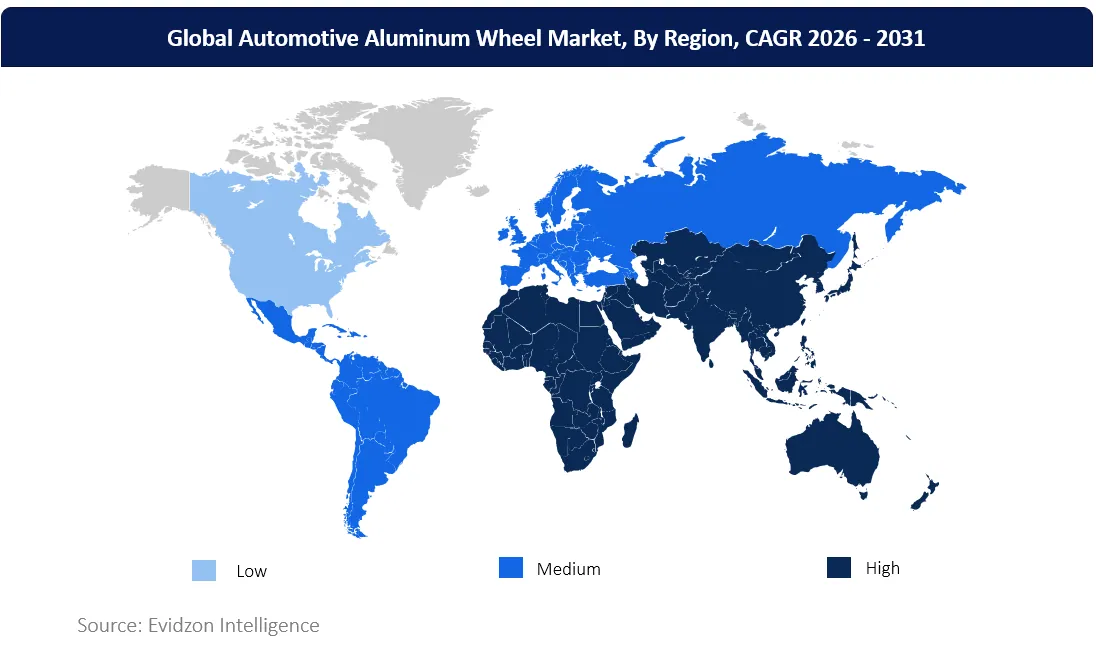
Asia-Pacific registered the highest market share of 47.2% in 2025 of global automotive aluminum wheel market. Extensive automotive production, broad component manufacturing facilities, and sales demand across vehicle categories has collectively led Asia-Pacific to account for the largest share in global automotive aluminum wheel market. China provides vast vehicle manufacturing industry and growing electric vehicle production, India unfolds opportunities as vehicle output and alloy-wheel adoption develop, Japan established automotive manufacturers and advanced component engineering.
The demand in the region is highly dependent on local price ranges, which allows considering both entry-level cast aluminum wheels and high-end solutions for luxury cars. Suppliers are expected to be closer to the automotive manufacturers in terms of proximity to assembly plants, production capabilities, and OEM relationships. Customer preferences for SUVs, larger wheel diameters, and vehicle customization reflected the shifting demand base on the back of increasing purchasing power, vehicle specifications, and alloy-wheel fitment rate.
Global Automotive Aluminum Wheel Market, By Region, Market Share, 2025
Fastest-Growing Region
Asia-Pacific is projected to be the fastest region in global automotive aluminum wheel market by 2031 accounting for 8.3% CAGR. Expanding automotive manufacturing, rising alloy-wheel adoption, and continued investment in electric vehicle production underpinned the growth outlook of Asia-Pacific automotive aluminum wheel market. Dynamically shifting customer preferences towards SUVs and premium vehicles are driving larger-diameter wheels, while EV manufacturers are emphasizing on lightweight wheel designs for the sake of gaining efficiency and range. Asia-Pacific automotive manufacturing capabilities coupled with established aluminum processing capabilities and extensive supplier networks will continue to support production scale at competitive cost.
However, growth across the region varies based on affordability, aluminum prices, OEM sourcing strategies, domestic production trends, and EV adoption rate. Aluminum wheel suppliers are spotlighting structural performance, quality, and cost requirements and invest heavily in research and development (R&D) to build their technical expertise and capitalize on regional market specifics.
Competitive Landscape
- 1Zhejiang Wanfeng Auto Wheel
- 2CITIC Dicastal
- 3Iochpe-Maxion (Maxion Wheels)
- 4Superior Industries International
- 5Ronal Group
Market Concentration Level: Consolidated
The global automotive aluminum wheel market competitive landscape is concentrated by small group of players accounting significant market share with established OEM supply relationships, along with regional manufacturers competing on cost, manufacturing capacity and customer proximity. Iochpe-Maxion (Maxion Wheels), CITIC Dicastal, Zhejiang Wanfeng Auto Wheel, Superior Industries International and Ronal Group are the key players owing to their manufacturing scale and established presence in the automotive aluminum wheel supply. The competition is increasingly characterized by manufacturing technology, weight, structural strength, design flexibility, surface finish, cost and compliance with OEM quality requirements.
The competitive landscape is particularly more intense in passenger car segment, as OEMs are focused to optimize wheel weight along with visual appeal and durability at low price. Wheel manufacturers are also exposed to meet the regional regulations ends including fatigue strength, impact resistance, dimensional accuracy and surface finish increasing research and development cost. Key companies are investing in production efficiency, enhanced process control, surface treatments and advanced forming methods allow manufacturers to meet OEM specs without extending wheel's cost beyond the car program budget.
Recent Development
Maxion Launches Forged Truck Wheels
Maxion Wheels, an wheel manufacturers has launched forged aluminum truck wheel portfolio, including commercial vehicle steel and forged aluminum wheels, forging continued emphasis on expansion of commercial vehicle wheel.
CITIC Dicastal Raises Wheel Supply Commitments
CITIC Dicastal Co., Ltd., one of the largest global manufacturer of aluminum alloy wheels has revised its aluminum alloy wheel purchasing agreement with affiliated companies, increasing annual transaction caps to RMB 11 billion for 2026, RMB 12 billion for 2027 and RMB 13 billion for 2028.
RONAL Expands Aftermarket Wheel Design Portfolio
RONAL Group has announced the launch of the R75 Y-spoke aluminum wheel, designed for the aftermarket to fit compact cars up to higher-class vehicles. The 18-, 19-, and 20-inch wheels, which come in multiple finishes, are aimed at satisfying the growing demand for sportier designs in both economy and premium-class automobiles.
Table of Content
- 1.Introduction
- 1.1Scope and Objective of the Study
- 1.2Market Definition & Study Assumptions
- 2.Research Methodology
- 3.Executive Summary
- 4.Market Outlook
- 4.1Market Overview
- 4.2Market Drivers
- 4.2.1Rising Passenger Vehicle Aluminum Wheel Fitment
- 4.2.2Electric Vehicles Driving Lightweight Wheel Designs
- 4.2.3Growing Demand For Larger Diameter Wheels
- 4.2.4Flow Forming Improves Wheel Strength and Weight
- 4.2.5Forged Wheels Gain Premium Vehicle Applications
- 4.2.6Aftermarket Customization Expands Aluminum Wheel Purchases
- 4.3Market Restraint
- 4.3.1Aluminum Price Volatility Pressures Wheel Manufacturer Margins
- 4.3.2Higher Alloy Wheel Costs Limit Price Sensitive Adoption
- 4.3.3Wheel Safety Validation Lengthens Product Development Cycles
- 4.3.4Forging Requires Capital Intensive Manufacturing Infrastructure
- 4.4Regulatory Landscape
- 4.5Supply/Value Chain Analysis
- 4.6Porter's Five Forces Analysis
- 4.6.1Threat of New Entrants
- 4.6.2Bargaining Power of Buyers
- 4.6.3Bargaining Power of Suppliers
- 4.6.4Threat of Substitutes
- 4.6.5Competitive Rivalry
- 5.Market Segmentation (Includes market size in Value (USD), Forecast up to 2031, and market analysis with growth attributes)
- 5.1By Vehicle Type
- 5.1.1Passenger Car
- 5.1.1.1Hatchback
- 5.1.1.2Sedan
- 5.1.1.3SUV/MUV
- 5.1.1.4Others (Crossover, Coupe, Convertible, Wagon)
- 5.1.2Commercial Vehicle
- 5.1.2.1Light Commercial Vehicle
- 5.1.2.2Medium and Heavy-Duty Trucks
- 5.1.2.3Bus and Coach
- 5.2By Propulsion
- 5.2.1Internal Combustion Engine (ICE)
- 5.2.1.1Petrol / Gasoline
- 5.2.1.2Diesel
- 5.2.1.3CNG/LPG
- 5.2.2Electric Vehicle (EV)
- 5.2.2.1Hybrid Electric Vehicle (HEV)
- 5.2.2.2Plug-in Hybrid Electric Vehicle (PHEV)
- 5.2.2.3Battery Electric Vehicle (BEV)
- 5.2.2.4Fuel Cell Electric Vehicle (FCEV)
- 5.3By Rim Size
- 5.3.1Below 13 Inch
- 5.3.213-15 Inch
- 5.3.316-18 Inch
- 5.3.419-21 Inch
- 5.3.5Above 21 Inch
- 5.4By Manufacturing Process
- 5.4.1Casting
- 5.4.1.1Gravity Casting
- 5.4.1.2Low-Pressure Die Casting (LPDC)
- 5.4.1.3High-Pressure Die Casting (HPDC)
- 5.4.1.4Squeeze Casting (Liquid Forging)
- 5.4.2Forging
- 5.4.3Flow-Forming (Spinning)
- 5.5By Sales Channel
- 5.5.1OEM
- 5.5.2Aftermarket
- 5.6By Region
- 5.6.1North America
- 5.6.1.1United States
- 5.6.1.2Canada
- 5.6.2Latin America
- 5.6.2.1Brazil
- 5.6.2.2Argentina
- 5.6.2.3Mexico
- 5.6.2.4Rest of Latin America
- 5.6.3Europe
- 5.6.3.1Germany
- 5.6.3.2Italy
- 5.6.3.3France
- 5.6.3.4Spain
- 5.6.3.5United Kingdom
- 5.6.3.6Russia
- 5.6.3.7Rest of Europe
- 5.6.4Asia Pacific
- 5.6.4.1China
- 5.6.4.2India
- 5.6.4.3Japan
- 5.6.4.4South Korea
- 5.6.4.5Indonesia
- 5.6.4.6Australia
- 5.6.4.7Rest of Asia-Pacific
- 5.6.5Middle East & Africa
- 5.6.5.1Saudi Arabia
- 5.6.5.2United Arab Emirates (UAE)
- 5.6.5.3South Africa
- 5.6.5.4Egypt
- 5.6.5.5Rest of the Middle East & Africa
- 6.Competitive Landscape
- 6.1Market Concentration Overview
- 6.2Market Share Analysis
- 6.3Company Profiles
- 6.3.1Iochpe-Maxion (Maxion Wheels)
- 6.3.2CITIC Dicastal
- 6.3.3Zhejiang Wanfeng Auto Wheel
- 6.3.4Superior Industries International
- 6.3.5RONAL GROUP
- 6.3.6Steel Strips Wheels Limited (SSWL)
- 6.3.7Wheels India Limited
- 6.3.8ENKEI Corporation
- 6.3.9BORBET
- 6.3.10CMS Jant ve Makina Sanayi
- 6.3.11ALCAR Group
- 6.3.12PAKO Group / Pakoakuina
- 6.3.13Kosei Aluminum Co., Ltd. (KOSEI)
- 6.3.14BBS Japan Co., Ltd.
- 6.3.15Alcoa Wheels
- 7.Future Outlook
- 7.1Growth Opportunities & White-Space Analysis
- 7.2Analyst Recommendations
Market Size Methodology
The global automotive aluminum wheel market is calculated by multiplying new vehicle production by the average value of aluminum wheels fitted per vehicle, with aftermarket demand estimated separately using the installed vehicle parc and replacement requirements.
The calculation accounts for the number of aluminum wheels fitted to each vehicle, wheel diameter, manufacturing process and average selling price. Vehicle production and registration data, OEM specifications, supplier disclosures, company reports, government databases and industry sources are the key sources on which historical data has drawn.
While, vehicle production growth, the ratio of passenger cars and commercial vehicles, transition to electric vehicles, wheel diameters preferences, aluminum wheels evolution, forged and flow-formed wheels, OEM sourcing strategies, wheels prices, the size of the parc, replacement after damage and normal replacement cycles are the key factors considered in market forecast. The analysis takes into account factory-fitted wheels and aftermarket wheels which are bought by the car owner. Demand for aftermarket wheels is driven by replacement needs, personalization and customization, and cost of upgrade from steel wheels to aluminum alloy wheels.
FAQ
What is the projected size of the global automotive aluminum wheel market by 2031?
The global automotive aluminum wheel market is projected to reach USD 39.71 billion by 2031, compared with USD 27.43 billion in 2025, representing a CAGR of 6.93% during 2026–2031.
Which vehicle type accounts for the largest share of the global automotive aluminum wheel market?
Passenger cars account for the largest share, representing 78.4% of the global automotive aluminum wheel market in 2025.
Which propulsion segment is expected to grow fastest in the global automotive aluminum wheel market?
The electric vehicle (EV) segment is projected to grow at a CAGR of 15.4% through 2031.
Which manufacturing process dominates the global automotive aluminum wheel market?
Casting is the dominant manufacturing process, accounting for 76.1% of the market in 2025.
Who are the major players in the global automotive aluminum wheel market?
The five major players identified in the report are Iochpe-Maxion (Maxion Wheels), CITIC Dicastal, Zhejiang Wanfeng Auto Wheel, Superior Industries International, and Ronal Group.
Have a question about this report?
Talk to the analyst behind this research, or browse the full report catalogue.
Contact Us