
Global Automotive Sunroof Market
The global automotive sunroof market report is segmented by sunroof type (Panoramic Sunroof, Built-in Sunroof, Spoiler Sunroof and Pop-up Sunroof), by component (Glass Panel, Motors and Actuators, Drive Mechanisms, Frames and Structural Components, Control Units and Electrical Components, Seals and Drainage Systems, Sunshades and Other),by operation (Electric, Automatic, and Manual), by vehicle (Passenger Vehicle and Commercial Vehicle), by propulsion (ICE, BEV, HEV and PHEV), by vehicle class (Economy, Mid-range, Premium and Luxury), by sales channel (OEM and Aftermarket), by region (North America, South America, Europe, Asia Pacific, and Middle east & Africa). The global automotive Sunroof market report includes market size in value (USD) and forecasts through 2031.
Global Automotive Sunroof Market
Market Size in USD Billion
Market Size Overview
USD Billion
Market Snapshot
- Study Period
- 2019-2031
- Forecast Period
- 2026-2031
- Base Year Market Size (2025)
- USD 12.03 Billion
- Market Size (2026)
- USD 13.02 Billion
- Market Size (2031)
- USD 19.31 Billion
- Growth Rate (2026-2031)
- 8.21% CAGR
- Market Concentration
- Moderate
Major Players*





*Disclaimer: Major Players sorted in no particular order
Market Overview
The global sunroof market value is anticipated to grow from USD 12.30 billion in 2025 to 13.02 billion in 2026 and is expected to reach USD 19.31 billion in 2031, with a CAGR (2026-2031) of 8.21%.
The global automotive sunroof market is driven by increasing the demand of premium vehicle, accelerating popularity of SUVs and crossovers, adoption of panoramic roofs and growing integration of electronic functions in sunroof. Global automotive sunroof market shifting from luxury vehicles to mid-range and mass-market vehicles in emerging markets. OEMs are increasingly offering sunroofs as product differentiation in entry-segment passenger cars, leading significant volume growth. Technological developments, lightweight structures, smart glass, electrochromic glazing, solar control technologies and integrated sunshades are the key attributes anticipated to fuel growth curve over the coming years.
The global automotive sunroof market competitive landscape is moderate, key players includes Webasto, Inalfa Roof Systems, Aisin Corporation, Magna International, Inteva Products, and CIE Automotive competing across OEM and aftermarket channels. The automotive sunroof demand is shifting towards integrated roof systems featuring power operation, anti-pinch protection, rain sensing, solar-control glazing, ultraviolet protection, and improved thermal insulation. Established suppliers with strong OEM supply contracts, high manufacturing scale, and global reach will continue to dominate the market.
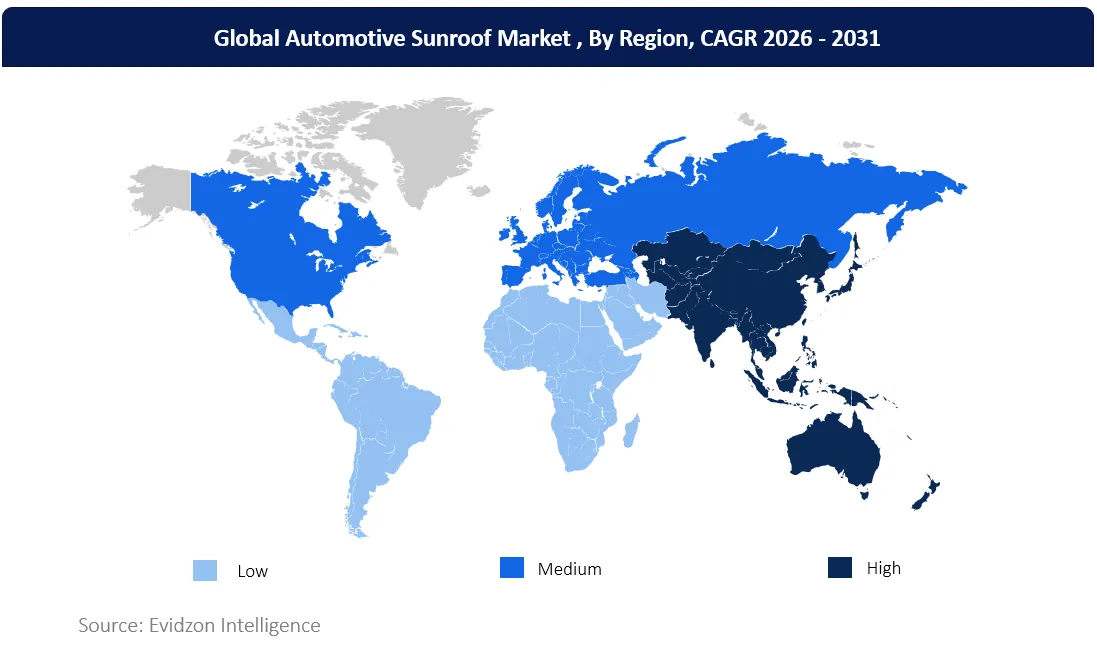
Asia-Pacific is largest and fastest growing automotive sunroof market, driven by vehicle production, rising purchasing power, and rapid EV adoption across China, India and Japan. South Korea's large vehicle production capability with increasing penetration of luxury and premium vehicles across powertrains is driving sunroof demand. Moreover, increasing vehicle ownership per household in Southeast Asia will act as a growth catalyst factor for APAC automotive sunroof market. Europe benefits from development premium vehicle production, while North America offers opportunities through its strong SUV and large-vehicle market.
Key Takeaways
- By sunroof type, panoramic sunroof led the largest segment market, accounting for 55.0% of global automotive sunroof market in 2025. panoramic sunroof is expected to be the fastest-growing segment, with a projected 9.8%CAGR through 2031.
- By component, glass remains the largest segment with 94.0% of the market in 2025. However, control Units and electrical components is expected to grow at a CAGR of 16.8% by 2031.
- By operation, electric / automatic is the largest growing segment, accounting for 88.0%, whereas electric / automatic is expected to grow at a CAGR of 8.0% through 2031.
- By vehicle, passenger cars remain the largest shares accounts for 97.0% of the market in 2025, while commercial vehicles are expected to be the fastest-growing category, registering an 11.5% CAGR through 2031.
- By propulsion, internal combustion engine (ICE) led the market with 68.0% in 2025, whereas battery electric vehicle (BEV) is expected to grow at 14.5% CAGR through 2031.
- By vehicle class, mid-range remains the largest segment, accounting for 39.0%in 2025, and is expected to be fastest- growing category, registering an 9.0% CAGR of through 2031.
- By sales channel, OEM led the largest market, accounting for 91.0% in 2025. while, OEM is expected to grow at a CAGR of 7.9%through 2031.
- By region, Asia Pacific dominated with a 48.0% market share in 2025, and is expected to grow at 9.4% CAGR by 2031.
About the Study
The global automotive sunroof market study covers the automotive components integrated across passenger cars and commercial vehicles segmented by sunroof types, materials, operation, vehicle types, propulsion, vehicle class, sales channel and regions and countries. The study excludes complete vehicles, unrelated vehicle glazing systems, standalone roofs that are not related to sunroof applications, aftermarket repair services, complete automotive parts and components market and other non-sunroof automotive components.
Market Dynamics Analysis
Drivers
Panoramic roofs improve openness, natural light, and perceived luxury.
Automakers differentiate premium models through advanced sunroof configurations.
Falling component costs support broader installation beyond luxury vehicles.
Improved glazing and motors enable lighter, quieter roof systems.
Larger glass areas create distinctive interiors and exterior styling.
Automated controls improve convenience, positioning, and user functionality.
Restraints
Glass panels, mechanisms, motors, and assembly add vehicle costs.
Roof assemblies increase mass and may influence energy consumption.
Seal deterioration and drainage faults can trigger costly repairs.
Roof openings require careful reinforcement, packaging, and crash validation.
Automotive sunroof demand is driven by increasing consumer preference for premium cabin experiences and growing the use of panoramic roofs across passenger vehicles Expanding SUV and crossover production is supporting OEM demand, with automakers increasingly using sunroofs to differentiate vehicle trims and enhance perceived value. Panoramic configurations are gaining traction as larger glass areas improve natural lighting and create a more spacious cabin feel. Meanwhile, sunroof availability is extending beyond luxury vehicles into selected mid-range models, supported by manufacturing scale and wider product offerings. Advances in electric operating mechanisms, lightweight structures, improved sealing and solar-control glazing are helping suppliers address weight, noise, heat ingress and operating reliability. Moreover, one-touch controls, anti-pinch protection and automated functions are becoming important as manufacturers to integrate more convenient roof systems. While, adoption of electric vehicle, suppliers are focusing on balancing expensive glass surfaces with thermal comfort, energy efficiency, safety and vehicle-specific integration.
Economics of automotive sunroof production increasingly getting challenging as manufacturers integrate the larger glass panels, panoramic designs, electric motors, operating tracks, seals, drainage channels, and electronic controls that require adding to component and assembly costs compared with conventional roofs. Another challenge is integrating sunroof structure to maintain strength, headroom and passenger safety, airbag packaging, and rollover protection which can increase engineering and validation expenses. Moreover, roof assembly weight affects the vehicle efficiency, particularly in electric vehicles where it influences energy consumption and driving range. Long-term reliability is another constraint, as damaged seals, motor faults, blocked drainage channels and wind noise increase warranty claims and ownership costs. Such factors increases complexity for automakers to meet customer demand for sunroof features with affordable pricing, safety requirements and maintenance costs.
Segment Analysis
By Sunroof Type
Panoramic sunroof is the largest segment of global automotive sunroof market represents 55.0% market share in 2025. Panoramic sunroof dominance reflects growing adoption across SUVs, crossovers, premium sedans, and electric vehicles, where larger glass panels improve natural lighting and create a more spacious cabin environment. SUVs represent the primary demand engine their higher rooflines provide greater flexibility for integrating panoramic roof structures while maintaining acceptable headroom. Automakers also use panoramic sunroofs to differentiate higher vehicle trims and strengthen the appeal of mid-size and premium models. Wider factory-fitted availability is gradually extending this feature beyond luxury vehicles into selected mid-range passenger cars.
Meanwhile, panoramic sunroof is forecast to record a CAGR of 9.8% by 2031, driven the expansion of electric vehicles and changing consumer preferences for technology-focused cabin designs. Electric vehicle manufacturer is integrating a large fixed and panoramic glass roofs to enhance interior ambience and reinforce vehicle appearence. Localized manufacturing of roof mechanisms, including expansion in India helps to reduce component costs and improve OEM sourcing. However, higher system cost, thermal management requirements, and installation complexity may limit adoption in price-sensitive vehicle segments. Whereas, SUV production, EV adoption, wider availability across mid-range models, vehicle premiumization and advances in solar-control glazing are supporting to continued demand for panoramic sunroofs.
Global Automotive Sunroof Market, By Sunroof Types, Market Share, 2025
By Component
Glass panel is the largest component segment of the global automotive sunroof market, accounting for 43.0% of market share in 2025, driven by the widespread use of glass panels in conventional and panoramic sunroof systems, where natural light, exterior styling, visibility, and cabin openness influence vehicle design. As automakers expand panoramic roof fitment across SUVs, premium passenger cars, and selected mid-range vehicles, the amount of glass used per vehicle increases. Manufacturers are focusing on laminated glazing, lightweight structures, acoustic performance, and improved thermal insulation to address occupant comfort and vehicle efficiency requirements. Larger glass surfaces in electric vehicles, increase exposure to solar heat and glare, making solar-control coatings and heat-reflective glazing increasingly important. These developments are encouraging suppliers to improve glass performance while balancing weight, durability, safety, and manufacturing costs.
Control units and electrical components projected to be the fastest-growing segment accounts for 10.5% CAGR of global automotive sunroof due to increasing integration of electronic features in powered sunroof systems. Components manage opening and closing operations, anti-pinch protection, position sensing, remote activation, and coordination with electrical vehicle architectures. Rising adoption of panoramic sunroofs and premium comfort features shaping need for reliable control systems across passenger vehicles. Automakers integrating sunroof controls into centralized switch panels, touchscreen interfaces, and connected vehicle features. Adoption of EV supports demand for compact and electronical controlled sunroof mechanisms. Moreover, improvement in safety functions, control precision and system integration strengthening the growth segment.
Global Automotive Sunroof Market, By Component, Market Share, 2025
Geographic Analysis
Largest Region
Asia-Pacific is the largest regional automotive sunroof market, accounting for 48.0% of the global market in 2025, supported by high vehicle production and sales across China, India, Japan, and South Korea. China is key growth driver, with its large automotive industry and growing use of panoramic sunroofs in passenger vehicles. In India, Increasing vehicle sales and wider availability of sunroofs in mid-range and premium models are helping to expand adoption. Meanwhile, Japan and South Korea contribute through established automakers and continued development of advanced vehicle technologies.
Automotive manufacturers across Asia-Pacific are increasingly offering panoramic roofs, larger glass panels, integrated sunshades, improved sealing systems, and solar-control glazing in new vehicle models. Chinese OEMs are strengthening demand for larger fixed panoramic roofs, while suppliers are developing lightweight structures and improved thermal insulation to address cabin comfort and vehicle efficiency requirements. Electronically controlled and dimmable glazing presents opportunities for technology adoption, although higher costs continue to limit broader penetration. Additionally, rising consumer preference for premium interior features and the expansion of electric vehicle production are supporting the adoption of advanced sunroof systems across the region.
Global Automotive Sunroof Market, By Region, Market Share, 2025
Fastest Growing Region
Asia-Pacific is the fastest-growing regional automotive sunroof market, with a projected CAGR of 9.40% by 2031, supported by rising SUV production, increasing EV penetration, and wider adoption of panoramic sunroofs across vehicle categories. Increasing integration of panoramic fixed sunroofs, dimmable glazing, solar-control glass, lightweight roof structures, and electronic controls across vehicle types is shaping future growth curve in China. Such features increases product value while improving cabin comfort and thermal management. Meanwhile, India offers additional growth opportunities through rising demand for SUVs, expanding availability of panoramic sunroofs in compact and mid-size vehicles, and growing consumer preference for premium cabin features. This trend is extending sunroof adoption beyond luxury vehicles into broader passenger vehicle segments.
Japan and South Korea support regional demand through established automotive manufacturing bases, advanced component suppliers, and continued development of electronically controlled roof systems. However, market growth varies by country, vehicle category, and price segment. Wider adoption depends on balancing roof-system costs, structural weight, sealing performance, durability, and thermal efficiency. Suppliers deliver reliable panoramic systems, advanced glazing options, and cost-effective solutions are better positioned to benefit from Asia-Pacific's expanding automotive sunroof market.
Competitive Landscape
- 1Webasto Group
- 2INALFA Roof System
- 3Motherson Yachiyo
- 4Aisin Seiki
- 5Fuyao Glass Industry Group
Market Concentration Level: Moderate
The global automotive sunroof market competitive landscape is shaped by roof-system engineering capabilities, panoramic roof technology, product reliability, vehicle integration, manufacturing efficiency, and long-term relationship with automotive manufacturers. Key players operating in global automotive sunroof market includes Webasto, Inalfa Roof Systems, Magna International, Aisin Corporation, and Fuyao Glass Industry Group. The companies compete through product design, system performance, customization, and their ability to meet manufacturer requirement across different vehicle categories. Webasto and Inalfa Roof Systems developing roof technology and advanced features, while Magna competes through broader automotive engineering and modular system capabilities. CIE focuses on roof-system manufacturing and assembly expertise. Aisin Corporation have better positioning in development of specific sunroof technology, while Fuyao is particularly strong in automotive glazing.
Competition increasingly depends on combining larger glass areas with thermal comfort, reliable opening mechanisms, lower system weight, and efficient vehicle integration. As panoramic roofs become more prominent in passenger cars and electric vehicles, suppliers balancing appearance, functionality, headroom, durability, and manufacturing cost are positioned to secure long-term OEM programmes.
Recent Development
Fuyao Group Advances Solar Sunroof Glass Toward Mass Production
Mass production of solar sunroof glass that incorporates photovoltaic cells directly laminated to glass has been confirmed by Fuyao Group. Auxiliary load management in EVs is potentially impacted by this advancement, as it reduces the burden on the primary battery pack, marking the shift of vehicle-integrated PV (VIPV) from experimental R&D to commercial automotive supply chains.
Webasto signed an agreement with Zhejiang Fujia Technology (FJT)
Webasto and Zhejiang Fujia Technology, a Chinese glass maker, established an agreement for Webasto to acquire a 30% share in a recently formed joint venture. The goal of this collaboration is to jointly design and manufacture Fixed Transparent Modules (FTMs), a type of fixed glass roof system, for the quickly growing Chinese market. The agreement requires China's regulatory clearance.
Webasto Plans Third India Sunroof Manufacturing Plant for Q4
Webasto Group has announced plans to establish a third production facility in India as demand for sunroof systems continues to grow in the country’s automotive market. The new manufacturing plant will be located in the Delhi region between Manesar and Kharkhoda and is set to be operational by Q4 2026.
Table of Content
- 1.Introduction
- 1.1Scope and Objective of the Study
- 1.2Market Definition & Study Assumptions
- 2.Research Methodology
- 3.Executive Summary
- 4.Market Outlook
- 4.1Market Overview
- 4.2Market Drivers
- 4.2.1Rising Consumer Preference for Enhanced Cabin Experiences
- 4.2.2Increasing Integration in Premium Vehicle Models
- 4.2.3Expanding Adoption Across Mid-Range Passenger Vehicles
- 4.2.4Advancements in Sunroof Glass and Operating Mechanisms
- 4.2.5Growing Demand for Panoramic Roof Configurations
- 4.2.6Development of Electrically Controlled Smart Roof Systems
- 4.3Market Restraint
- 4.3.1High System Costs Limit Wider Vehicle Adoption
- 4.3.2Additional Vehicle Weight Can Affect Efficiency
- 4.3.3Water Leakage and Sealing Reliability Concerns
- 4.3.4Structural Integration Creates Engineering and Safety Challenges
- 4.4Supply/Value Chain Analysis
- 4.5Regulatory Landscape
- 4.6Porter's Five Forces Analysis
- 4.6.1Threat of New Entrants
- 4.6.2Bargaining Power of Buyers
- 4.6.3Bargaining Power of Suppliers
- 4.6.4Threat of Substitutes
- 4.6.5Competitive Rivalry
- 5.Market Segmentation (Includes market size in Value (USD) and Volume (Units), Forecast up to 2031, and market analysis with growth attributes)
- 5.1By Sunroof Type
- 5.1.1Panoramic Sunroof
- 5.1.1.1Fixed Panoramic
- 5.1.1.2Sliding Panoramic
- 5.1.2Built-in Sunroof
- 5.1.2.1Tilt & Slide
- 5.1.2.2Sliding
- 5.1.3Spoiler Sunroof
- 5.1.4Pop-up Sunroof
- 5.2By Component
- 5.2.1Glass panel
- 5.2.2Motors and Actuators
- 5.2.3Drive Mechanisms
- 5.2.4Frames and Structural Components
- 5.2.5Control Units and Electrical Components
- 5.2.6Seals and Drainage Systems
- 5.2.7Sunshades and Other Components
- 5.3By Operation
- 5.3.1Electric / Automatic
- 5.3.2Manual
- 5.4By Vehicle Type
- 5.4.1Passenger Vehicles
- 5.4.1.1Sedans
- 5.4.1.2Hatchbacks
- 5.4.1.3SUVs
- 5.4.1.4MPVs / MUVs
- 5.4.1.5Coupes / Convertibles
- 5.4.2Commercial Vehicles
- 5.4.2.1Light Commercial Vehicles
- 5.5By Propulsion
- 5.5.1Internal Combustion Engine (ICE)
- 5.5.2Battery Electric Vehicle (BEV)
- 5.5.3Hybrid Electric Vehicle (HEV)
- 5.5.4Plug-in Hybrid Electric Vehicle (PHEV)
- 5.6By Vehicle Class
- 5.6.1Economy
- 5.6.2Mid-range
- 5.6.3Premium
- 5.6.4Luxury
- 5.7By Sales Channel
- 5.7.1OEM
- 5.7.2Aftermarket
- 5.8By Regions
- 5.8.1North America
- 5.8.1.1United States
- 5.8.1.2Canada
- 5.8.2Latin America
- 5.8.2.1Brazil
- 5.8.2.2Argentina
- 5.8.2.3Mexico
- 5.8.2.4Rest of Latin America
- 5.8.3Europe
- 5.8.3.1Germany
- 5.8.3.2Italy
- 5.8.3.3France
- 5.8.3.4Spain
- 5.8.3.5United Kingdom
- 5.8.3.6Russia
- 5.8.3.7Rest of Europe
- 5.8.4Asia Pacific
- 5.8.4.1China
- 5.8.4.2India
- 5.8.4.3Japan
- 5.8.4.4South Korea
- 5.8.4.5Indonesia
- 5.8.4.6Australia
- 5.8.4.7Rest of Asia-Pacific
- 5.8.5Middle East & Africa
- 5.8.5.1Saudi Arabia
- 5.8.5.2United Arab Emirates (UAE)
- 5.8.5.3South Africa
- 5.8.5.4Egypt
- 5.8.5.5Rest of the Middle East & Africa
- 6.Competitive Landscape
- 6.1Market Concentration Overview
- 6.2Market Share Analysis
- 6.3Company Profiles
- 6.3.1Webasto Group
- 6.3.2Inalfa Roof System
- 6.3.3Motherson Yachiyo
- 6.3.4Aisin Seiki
- 6.3.5CIE Automotive S.A.
- 6.3.6Saint-Gobain Sekurit
- 6.3.7Fuyao Glass Industry Group Co., Ltd.
- 6.3.8Inteva Products
- 6.3.9Magna International Inc.
- 6.3.10Johnan Manufacturing Inc.
- 6.3.11Signature Automotive Products
- 6.3.12Shanghai Wanchao Car Sunroof
- 6.3.13Minda-HCMF
- 6.3.14Houming Industry(HM Auto parts)
- 6.3.15Uno Minda
- 7.Future Outlook
- 7.1Growth Opportunities & White-Space Analysis
- 7.2Analyst Recommendations
Market Size Methodology
Market value is calculated based on the number of vehicles equipped with sunroof systems multiplied by corresponding average selling prices (ASP), estimated by Sunroof type, Material, operation, vehicle type, propulsion, Vehicle class, Sales channel and regional market capture differences in product mix, specifications, component installation rates, replacement cycles, and average component prices. OEM demand is assessed based on global vehicle production by vehicle model and variant levels, and sunroof penetration, while aftermarket demand is assessed based on vehicle age, replacement cycles, retrofit installations, and aftermarket.
Historical market estimates are benchmarked against global vehicle production and parc data. OEM supplier disclosures, sunroof system shipment volumes, industry associations, and company financial filings. Forecasts incorporate expected changes in global vehicle production, SUV and premium vehicle penetration, sunroof fitment rates, and adoption of panoramic and electric sunroof systems. OEM model launches, technology advancements, system pricing, aftermarket demand, replacement cycles, raw-material costs, and regulatory requirements.
FAQ
What is the global automotive sunroof market size?
he global automotive sunroof market was valued at USD 12.30 billion in 2025 and is projected to reach USD 19.31 billion by 2031, growing at a reported CAGR of 7.87% during 2026–2031.
Which sunroof type dominates the global automotive sunroof market?
Panoramic sunroofs dominated the market in 2025, accounting for 55.0% of the market. Their adoption is supported by growing SUV production, demand for larger glass roof areas, premium cabin features, and increasing availability across mid-range vehicles.
Which region leads the global automotive sunroof market?
Asia Pacific led the market in 2025, accounting for 48.0% of global revenue. Strong vehicle production in China, India, Japan, and South Korea, alongside increasing sunroof penetration and EV adoption, supports regional demand.
What are the key factors driving the automotive sunroof market?
Key growth drivers include rising demand for SUVs and electric vehicles, increasing consumer preference for premium cabin features, wider sunroof availability in mass-market models, and technological developments in panoramic roofs, smart glass, solar-control glazing, and electric operating mechanisms.
Who are the major players in the global automotive sunroof market?
Major companies include Webasto Group, Inalfa Roof Systems, Magna International, Aisin Corporation, and Fuyao Glass Industry Group. These companies compete through roof-system design, panoramic glazing, product reliability, vehicle integration, manufacturing efficiency, and relationships with automotive manufacturers.
Have a question about this report?
Talk to the analyst behind this research, or browse the full report catalogue.
Contact Us