
Global Automotive Infotainment Market
The global automotive infotainment market report is segmented by component (Software& Hardware), by vehicle (Passenger Cars and Commercial Vehicles), by propulsion (ICE, BEV, HEV, and PHEV), by operating system (QNX, Linux, Android Automotive OS and Others), by connectivity (Bluetooth, Wi-Fi, 4G and 5G), by Installation (In-Dash and Rear Seat), by technology (embedded, integrated and tethered), by sales channel(OEM and Aftermarket), and by region (North America, South America, Europe, Asia Pacific, and Middle east & Africa). The global automotive infotainment market report includes market size in value (USD) and forecasts through 2031.
Global Automotive Infotainment Market
Market Size in USD Billion
Market Size Overview
USD Billion
Market Snapshot
- Study Period
- 2019-2031
- Forecast Period
- 2026-2031
- Base Year Market Size (2025)
- USD 29.22 Billion
- Market Size (2026)
- USD 31.2 Billion
- Market Size (2031)
- USD 44.76 Billion
- Growth Rate (2026-2031)
- 7.48% CAGR
- Market Concentration
- Fragmented
Major Players*




*Disclaimer: Major Players sorted in no particular order
Market Overview
The global automotive infotainment market value is anticipated to grow from USD 29.22 billion in 2025 to 31.30 billion in 2026 and is expected to reach USD 44.76 billion in 2031, with a CAGR (2026-2031) of 7.62%.
The global Infotainment market is evolving, automakers are increasingly integrating digital connectivity, entertainment, navigation, and communication functions across vehicle types. Modern infotainment systems combine touchscreen displays, audio units, GPS navigation, Bluetooth, smartphone mirroring, voice assistants, and internet-based services. The premium features in no more limited to luxury segment vehicles, the penetration is increasing across economy and mid-range vehicles, extending beyond traditional concentration in premium models. Passenger cars represent the largest automotive infotainment systems market, supported by high production volumes and consumer demand for convenient, connected driving experiences. OEM-installed infotainment systems dominate the market, while aftermarket provides upgrade options for older vehicles.
The global automotive Infotainment market market moving towards centralized computing platforms to include systems such as digital instruments, telematics etc. Infotainment is evolving across large screens, wireless phone connections, over the air software updates and personalization features. Key market players includes Bosch, DENSO, Harman International, Panasonic, Visteon and Continental, competing on hardware and software integration, reliability and long-term supply contracts with OEMs. However, the market faces headwinds due to increasing cost of electronic components, risk of cyberattacks, software compatibility and regular upgrades. Future demand is likely to driven by the increasing adoption of automotive digital cockpit, software defined vehicles, electric vehicles, and connected car technologies.
Asia Pacific is demand epicenter owing to extensive vehicle production, strong demand for feature filled vehicles and the development of technology across APAC countries such as China, Japan, South Korea and India. High adoption of advanced infotainment systems, smartphone integration and premium in-car technologies are driving the North America automotive Infotainment market. Presence of established automakers and demand for integrated digital cockpits, navigation and connected services is shaping demand across Europe. South America shows gradual adoption as vehicle owners seek improved connectivity and entertainment features. The Middle East and Africa market is supported by rising vehicle ownership and increasing customer preference towards advanced infotainment, although affordability and infrastructure influence adoption.
Key Takeaways
- By Component, hardware led the largest segment market, accounting for 67.0% in 2025. software is expected to be the faster-growing segment, with a projected 11.9%CAGR through 2031.
- By Vehicle, passenger cars remain the largest shares accounts for 87.0% of the market in 2025, while medium and heavy commercial vehicles are expected to be the fastest-growing category, registering a 9.6%CAGR by 2031.
- By propulsion, ICE led the market with 68.0% in 2025, whereas BEV is expected to grow at a 13.4%CAGR by 2031.
- By operating system, QNX dominate the largest share accounts 38.0% in 2025. While android automotive OS are expected to be the fastest-growing category, registering a 15.8% CAGR through 2031.
- By connectivity, 4G remains the largest segment, accounting for 55.0% in 2025. While 5G is the faster-growing segment with a projected 17.0%CAGR through 2031
- By installation, in-dash led the largest segment market, accounting for 78.0%in 2025, while rear-Seat is expected to grow at a CAGR of 10.8% by 2031.
- By technology, embedded remains the largest segment, accounting for 63.0%in 2025, while Integrated is expected to grow at 12.8% CAGR by 2031.
- By sales channel, OEMs dominate the disruption with 91.0% of the largest market in 2025. However, the aftermarket expected to grow at a CAGR of 9.3% by 2031.
- By region, Asia pacific dominated with a 41.0% market share in 2025. The Middle East & Africa region is expected to grow at 8.6% CAGR by 2031.
About the Study
The global Infotainment market study covers infotainment integrated systems in passenger cars and commercial vehicles across components, vehicle types, operating systems, connectivity type, installation type, propulsion, sales channels, and regions and countries. The study excludes standalone consumer electronics products of aftermarket designed for vehicle repair, automotive applications and maintenance services, telecommunications infrastructure, total automotive parts and components and other non-automotive digital entertainment and connectivity services.
Market Dynamics Analysis
Drivers
Integrated navigation, communication, and entertainment features hold significant weightage in vehicle purchasing decision.
Affordable systems extend adoption beyond premium vehicle categories.
Combined displays simplify controls and improve cabin functionality.
Smartphone mirroring strengthens everyday infotainment system usefulness.
Voice commands provide convenient access to vehicle functions.
Updatable software supports evolving features after vehicle delivery.
Restraints
Premium displays and processors increase system installation costs.
Network vulnerabilities expose vehicles to unauthorized digital access.
Platform differences complicate integration, testing, and ongoing support.
Rapid changes shorten product lifecycles and complicate planning.
Growing demand for connected driving experiences is encouraging automakers to make infotainment a core part of vehicle design. Navigation, hands-free communication, music streaming, and smartphone integration increasingly influence buyers purchasing decision across vehicle categories. As component and platform costs are is getting more affordable, manufacturers introduce large displays and connected functions in mid-range and economy vehicle models, widening the potential customer base. Digital cockpit integration system allows infotainment screens to work along with instrument clusters and vehicle information systems, improving access to controls while reducing fragmented interfaces. Voice interfaces shaping another way to operate functions with less manual interaction. Meanwhile, software-defined architectures allow features to be improved after purchase, creating opportunities for continued software development and differentiation among suppliers.
Advanced infotainment systems require displays, processors, connectivity modules, and supporting electronics, increasing costs for automakers and complexity to target price-sensitive segments. Such costs can reduce the inclusion of high-end features in entry-level models or force manufacturers to limit specifications to protect vehicle affordability. Connected functions introduce cybersecurity risks, requiring suppliers and automakers investing in secure software, testing, and ongoing vulnerability management. Integration presents another challenge, as infotainment platforms must work with different vehicle architectures, operating systems, hardware configurations, and communication protocols. This adds engineering and validation work across vehicle programs. Additionally, frequent changes in processors, software platforms, and display technologies can shorten product lifecycles, complicate component sourcing, and increase development costs for suppliers serving multiple automakers.
Segment Analysis
By Component
Hardware led the global infotainment market, accounts for 67.0% in 2025. driven by a larger touchscreen displays, advanced audio systems, integrated connectivity technologies, high-performance processors, and multi-display digital cockpit displays and other electronic components. Manufacturers are shifting towards advanced or centralized computing systems to supports infotainment, connectivity, navigation, and the growing penetration of EVs and connected vehicle. Moreover, increasing electronic system per vehicle and supporting the demand. Hardware represents the larger portion of the automotive infotainment system, but software is expected to expand rapidly. The automotive infotainment industry is shifting from hardware-centric infotainment towards integrated hardware to software platforms.
Software is projected to be the fastest-growing segment accounts for 11.9% CAGR by 2031 of the global automotive infotainments due to increasing focus on connected features, personalized interfaces, and software-based vehicle functions. Infotainment software manages navigation, multimedia playback, smartphone integration, voice recognition, and connectivity with cloud-based services, cloud connectivity, cybersecurity, and over-the-air (OTA) updates, to improve system performance, introduce new features, and address software issues without requiring a workshop visit. Rising adoption of android automotive OS, Linux-based platforms, and proprietary operating systems is expanding software development opportunities across vehicle categories.
Global Automotive Infotainment Market, By Component, Market Share, 2025
By Vehicle
Passenger cars dominate the global infotainment market, accounts for 87.0% in 2025, supported by high vehicle production, increasing the high demand of consumer for connected vehicles and premium features in vehicles, and higher infotainment installation rates. Passenger vehicles are equipped with larger touchscreens, smartphone integration, connected navigation, AI-enabled interfaces, voice control, and advanced audio systems. Expansion of infotainment systems across mid-range and mass-range passengers’ cars are driving high volume. Whereas EV adoption has increased the demand for integrated digital interfaces. The growing integration of infotainment systems with digital instrument clusters and other cockpit electronics further strengthens their role in passenger car design.
In contrast, commercial vehicles are anticipated to be fastest growing market segment account for 9.6% CAGR by 2031. Commercial vehicles are strategically crucial segment with the adoption of telematics, as fleet operators and vehicle manufacturers increasingly adopt connected in-cabin technologies. Infotainment systems in buses, trucks and light commercial are increasingly integrated with vehicle status monitoring and driver assistance information, enabling real-time route information. Expanding the logistics activity fleet digitalization and adoption of connected and electric commercial vehicles have created additional opportunities for the infotainment suppliers. However, adoption will depend on system costs, vehicle operating requirements, and the value these technologies provide to fleet operators.
Global Automotive Infotainment Market, By Vehicle, Market Share, 2025
Geographic Analysis
Largest Region
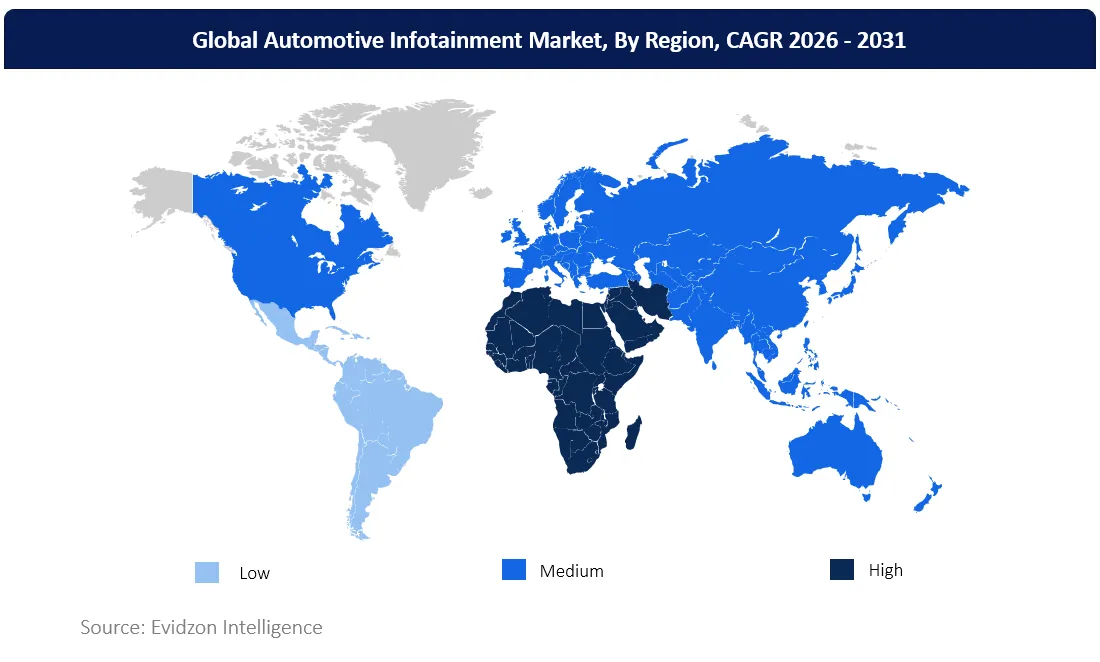
Asia Pacific registered the largest market share of 41.0% in 2025 in the global automotive infotainment market, supported by strong vehicle manufacturing base and substantial demand for passenger cars. China, Japan, South Korea, and India play crucial roles in regional production, supplying vehicles across different price categories. Manufacturers are increasingly integrating touchscreen displays, smartphone connectivity, navigation, voice control, and connected entertainment features into new models to meet changing consumer expectations.
The increasing adoption of infotainment systems across economy and mid-range vehicles further supports regional demand, particularly in price-sensitive markets. The presence of established automotive electronics suppliers and technology manufacturers also strengthens local production and system integration. Continued growth in vehicle production, rising consumer preference in connected features, and the expansion of digital cockpit technologies support Asia Pacific's leading position in the global automotive infotainment systems market.
Global Automotive Infotainment Market, By Region, Market Share,2025
Fastest Growing Region
Middle East & Africa is projected to be the fastest-growing region accounting CAGR of 8.6% by 2031. Middle East & Africa automotive Infotainment market expansion is poised to increasing premium vehicle adoption, connected-vehicle initiatives, and rising consumer demand for advanced digital features in vehicles. Increasing consumer interest in smartphone connectivity, touchscreen displays, navigation, and in-car entertainment is encouraging automakers to offer more exclusive models across the region. Growth in premium and mid-range vehicle sales across Gulf countries, is shaping additional opportunities for infotainment suppliers. While, the expansion of automotive distribution networks and digital infrastructure is improving access to connected vehicle technologies. However, adoption will vary across countries, depending on vehicle affordability, connectivity availability, and consumer purchasing power.
Competitive Landscape
- 1Continental AG
- 2HARMAN International (Samsung)
- 3Marelli
- 4Panasonic Automotive Systems Co., Ltd.
- 5Robert Bosch GmbH
Market Concentration Level: Fragmented
The global automotive infotainment market is concentrated around a group of established infotainment manufacturer with strong OEM and supplier relationships, technology, capabilities, software integration, cost efficiency and geographic manufacturing capabilities. Harman International, Continental AG, Marelli, Panasonic Automotive Systems Co., Ltd., and Robert Bosch GmbH, are key companies compete on infotainment performance, product reliability, pricing manufacturing capacity and ability to meet vehicle programs throughout their production cycles. Bosch, DENSO Corporation supply infotainment units, connected cockpit, technologies, electronic control systems, and integrated solutions. Harman International developing infotainment software and connected-car technology.
OEMs are driving demand for infotainment system with ADAS, vehicle connectivity, and other electronic system integration. Moreover, suppliers investing in software development AI-enabled voice control, advanced display technology, centralized cockpit computing, connected services and cybersecurity for improve the car user experience, support software updates, limits electronic system complexity and meet manufacturer requirements for scalable, cost-effective infotainment platforms. The aftermarket is significant competitive demand channel, with suppliers competing through product variety, pricing, smartphone connectivity, vehicle compatibility, installation support, warranty coverage, and after-sales support.
Recent Development
Chery Jaguar Land Rover (CJLR) revealed a cinema-like infotainment system
The Chery Jaguar Land Rover (CJLR) has revealed a cinematic-style Human-Machine Interface (HMI) infotainment system, powered by the Qualcomm Snapdragon 8397 automotive-grade chip of the Freelander 8 SUV.
HCLTech Partners with e.solutions to Advance AI-Enabled Automotive Infotainment
HCL Technologies entered into a multi-year strategic partnership with Volkswagen Group’s e.solutions to advance next-generation automotive infotainment technologies. This Partnership focused on scaling AI-enabled platform development on Android Automotive. This partnership focused on the development of integration, and validation of software-defined infotainment and connectivity solutions.
Volkswagen Group and Qualcomm Sign Infotainment Technology Supply Agreement
Volkswagen Group and Qualcomm announced a long-term supply agreement for delivery of the infotainment and connectivity capabilities based on Snapdragon Digital Chassis solutions. Powered by Qualcomm technology for Volkswagen's software-defined vehicle architecture in 2027.
Table of Content
- 1.Introduction
- 1.1Scope and Objective of the Study
- 1.2Market Definition & Study Assumptions
- 2.Research Methodology
- 3.Executive Summary
- 4.Market Outlook
- 4.1Market Overview
- 4.2Market Drivers
- 4.2.1Growing Demand for Connected Driving Experiences
- 4.2.2Expansion of Infotainment Across Vehicle Price Segments
- 4.2.3Rising Integration of Digital Cockpit Technologies
- 4.2.4Increasing Adoption of Smartphone Connectivity Features
- 4.2.5Demand for Advanced In-Vehicle Voice Interfaces
- 4.2.6Growing Use of Software-Defined Vehicle Architectures
- 4.3Market Restraint
- 4.3.1High Costs of Advanced Infotainment Hardware
- 4.3.2Cybersecurity Risks in Connected Vehicle Systems
- 4.3.3Software Compatibility Across Diverse Vehicle Platforms
- 4.3.4Short Technology Cycles Increase Replacement Pressure
- 4.4Supply/Value Chain Analysis
- 4.5Regulatory Landscape
- 4.6Porter's Five Forces Analysis
- 4.6.1Threat of New Entrants
- 4.6.2Bargaining Power of Buyers
- 4.6.3Bargaining Power of Suppliers
- 4.6.4Threat of Substitutes
- 4.6.5Competitive Rivalry
- 5.Market Segmentation (Includes market size in Value (USD) and Volume (Units), Forecast up to 2031, and market analysis with growth attributes)
- 5.1By Component
- 5.1.1software
- 5.1.2Hardware
- 5.2By Vehicle Type
- 5.2.1Passenger Cars
- 5.2.1.1Sedans
- 5.2.1.2Hatchbacks
- 5.2.1.3SUVs
- 5.2.1.4MPVs / MUVs
- 5.2.1.5Coupes / Convertibles
- 5.2.2Commercial Vehicles
- 5.2.2.1Light Commercial Vehicles
- 5.2.2.2Medium & Heavy Commercial Vehicle
- 5.2.2.3Buses & Coaches
- 5.3By Propulsion
- 5.3.1Internal Combustion Engine (ICE)
- 5.3.2Battery Electric vehicle (BEV)
- 5.3.3Hybrid Electric Vehicle (HEV)
- 5.3.4Plug-in Hybrid Electric Vehicle (PHEV)
- 5.4By Operating system
- 5.4.1QNX
- 5.4.2Linux
- 5.4.3Android Automotive OS
- 5.4.4Others (Proprietary/OEM OS, MeeGo/Tizen-based automotive systems, etc.)
- 5.5By Connectivity
- 5.5.1Bluetooth
- 5.5.2Wi-Fi
- 5.5.34G
- 5.5.45G
- 5.6By Installation
- 5.6.1In-Dash
- 5.6.2Rear-Seat
- 5.7By Technology
- 5.7.1Embedded
- 5.7.2Integrated
- 5.7.3Tethered
- 5.8By sales channel
- 5.8.1OEM
- 5.8.2Aftermarket
- 5.9By Regions
- 5.9.1North America
- 5.9.2United States
- 5.9.3Canada
- 5.9.4Latin America
- 5.9.5Brazil
- 5.9.6Argentina
- 5.9.7Mexico
- 5.9.8Rest of Latin America
- 5.9.9Europe
- 5.9.10Germany
- 5.9.11Italy
- 5.9.12France
- 5.9.13Spain
- 5.9.14United Kingdom
- 5.9.15Russia
- 5.9.16Rest of Europe
- 5.9.17Asia Pacific
- 5.9.18China
- 5.9.19India
- 5.9.20Japan
- 5.9.21South Korea
- 5.9.22Indonesia
- 5.9.23Australia
- 5.9.24Rest of Asia-Pacific
- 5.9.25Middle East & Africa
- 5.9.26Saudi Arabia
- 5.9.27United Arab Emirates (UAE)
- 5.9.28South Africa
- 5.9.29Egypt
- 5.9.30Rest of the Middle East & Africa
- 6.Competitive Landscape
- 6.1Market Concentration Overview
- 6.2Market Share Analysis
- 6.3Company Profiles
- 6.3.1Continental AG
- 6.3.2HARMAN International (Samsung)
- 6.3.3Marelli
- 6.3.4Panasonic Automotive Systems Co., Ltd.
- 6.3.5Robert Bosch GmbH
- 6.3.6Saint-Gobain Sekurit
- 6.3.7visteon Corporation
- 6.3.8DENSO Corporation
- 6.3.9LG Electronics
- 6.3.10Hyundai Mobis
- 6.3.11Sony Corporation
- 6.3.12Garmin Ltd.
- 6.3.13AISIN Corporation
- 6.3.14Faurecia Clarion Electronics
- 6.3.15Alpine Electronics
- 7.Future Outlook
- 7.1Growth Opportunities & White-Space Analysis
- 7.2Analyst Recommendations
Market Size Methodology
Market value is calculated based on infotainment system installation volumes multiplied by corresponding average selling prices (ASP), estimated by component type, vehicle category, Propulsion, operating system, connectivity, installation, Technology, sales and region. The market capture differences in system specifications, screen size, connectivity features, software functionality, installation rates, OEM fitment, replacement cycles, and regional product mix and pricing. OEM demand is assessed based on infotainment system installation per vehicle across new vehicle production.
Historical market estimates are benchmarked against vehicle production and parc data, OEM and Tier-1 supplier disclosures, infotainment shipment volumes, connected-vehicle penetration, automotive electronics data, government statistics, industry associations, trade data and company financial filings.
Forecasts incorporate expected changes in global vehicle production, vehicle parc, EV and hybrid penetration, software-defined vehicle adoption, connected-car penetration, automotive electronic content, digital cockpit adoption, display technology, AI-enabled infotainment, smartphone connectivity, semiconductor pricing and availability, technology adoption, replacement and upgrade cycles and regulatory requirements.
FAQ
What is the global automotive infotainment market size and projected growth?
The global automotive infotainment market was valued at USD 29.22 billion in 2025 and is projected to reach USD 44.76 billion by 2031, growing at a CAGR of 7.62% from 2026 to 2031.
Which component dominates the global automotive infotainment market?
Hardware dominates the market, accounting for 67.0% of the market share in 2025. Demand is supported by touchscreen displays, head units, processors, audio systems, and connectivity modules, while software is expected to grow faster at a CAGR of 11.9% through 2031.
Which region holds the largest share of the automotive infotainment market?
Asia Pacific hold the largest regional share at 41.0% in 2025, supported by strong vehicle production, demand for connected passenger cars, and automotive electronics manufacturing across China, Japan, South Korea, and India.
Which segment is expected to grow fastest in the automotive infotainment market?
The android automotive OS segment is expected to grow at the fastest rate among operating systems, with a projected CAGR of 15.8% through 2031, driven by demand for connected services, software integration, and advanced in-vehicle digital experiences.
Who are the major players in the global automotive infotainment market?
Major players include Continental AG, HARMAN International (Samsung), Marelli, Panasonic Automotive Systems Co., Ltd., and Robert Bosch GmbH. These companies compete through infotainment hardware, software integration, display technologies, connectivity features, system reliability, and OEM partnerships.
Have a question about this report?
Talk to the analyst behind this research, or browse the full report catalogue.
Contact Us