
Global Automotive Gravity Die Casting Market
The global automotive parts gravity mold die casting market is segmented by vehicle type (Passenger Car and Commercial Vehicle), by propulsion (Internal Combustion Engine (ICE) and Electric Vehicle (EV)), by component (Powertrain & transmission, EV & e-powertrain, Structural components, Chassis & suspension, Electronics & housings, Body components, and Other), by die casting process (Gravity die casting, Permanent-mold casting, Tilt casting, and Semi-permanent mold casting), by sales channel (OEM and Aftermarket), by material (Aluminum, Zinc, Magnesium, and Others), and by region (North America, Latin America, Europe, Asia-Pacific, and Middle-East and Africa). The global automotive parts gravity mold die casting market report includes market size in Value (USD) and forecast up to 2031.
Global Automotive Gravity Die Casting Market
Market Size in USD Billion
Market Size Overview
USD Billion
Market Snapshot
- Study Period
- 2019-2031
- Forecast Period
- 2026-2031
- Base Year Market Size (2025)
- USD 5.5 Billion
- Market Size (2026)
- USD 5.6 Billion
- Market Size (2031)
- USD 6.8 Billion
- Growth Rate (2026-2031)
- 4.05 CAGR
- Market Concentration
- Fragmented
Major Players*




*Disclaimer: Major Players sorted in no particular order
Market Overview
The global automotive parts gravity mold die casting market value is anticipated to grow from USD 5.5 billion in 2025 to 5.6 billion in 2026 and expected to reach USD 6.8 billion in 2031 with a CAGR (2026-2031) of 4.05%.
The gravity/permanent-mold die casting market serves applications requiring quality, dimensional stability, and solidification control of the casting outweigh the extreme cycle speeds achievable in HPDC. Automotive transportation continues to be the core demand driver, aluminum alloys are intensively utilized across housings, suspension parts, brackets, wheels, covers, and selected powertrain components. Internal combustion engines (ICEs) dominate gravity/permanent-mold die casting, and electric vehicle (EV) are slowly introducing motor housings, reduction gear cases, thermal management components, and structural parts. Permanent-mold processes provide greater repeatability than sand casting and support longer production runs than HPDC at reduced pressure and tooling intensity.
Competition landscape formed around process flexibility, alloy capability and the components production ability of consistent mechanical properties across multiple production cycles. Suppliers are combining gravity and permanent-mold casting with machining, heat-treatment, finishing and inspection to add value per component rather than simply competing on foundry capacity. The process is still viable for components where thickness of walls, fatigue resistance and control of the solidification profile dictate performance, such as suspension parts, housings, and some chassis applications. EV programs represent additional opportunities, while the shift is more selective than in HPDC due to very large integrated structures typically favor higher pressure processes. Companies are therefore concentrating on applications where permanent-mold casting offers a sensible balance between tooling cost, production volumes, size tolerances and component performance.
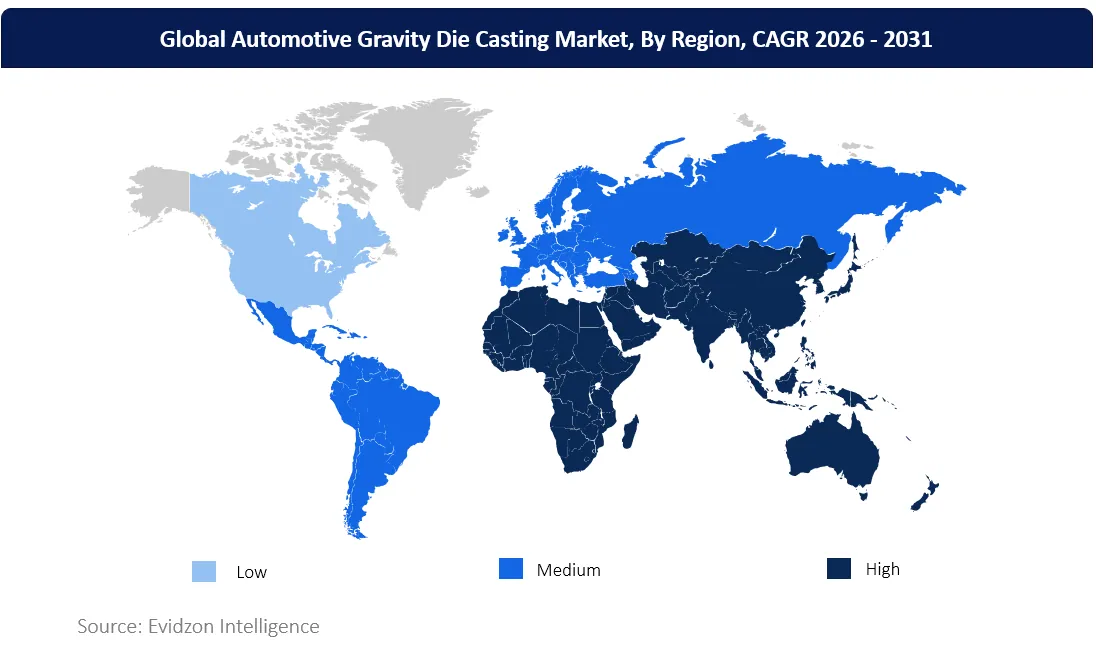
Asia-Pacific offers the most attractive manufacturing base for gravity/permanent mold casting due to China, Japan, India, South Korea and Southeast Asia's combination of strong vehicle production with established aluminum foundries and component supply chains. Europe continues to be strategically important for lightweight components, high-end vehicle applications and more stringent material efficiency requirements where recyclability and emission regulations drive aluminum choice. Middle East & Africa represents emerging opportunities as local vehicle assembly, industrialization and supplier localization efforts gain momentum, though with less developed casting ecosystems compared to Asia-Pacific.
Key Takeaways
- By vehicle type, passenger car accounts for nearly 69.1% market share in 2025 and expected to grow at a CAGR of 4.8% by 2031.
- By propulsion, internal combustion engine (ICE) remains the largest sub-segment accounting for nearly 81.1% of the automotive parts gravity/permanent-mold die casting market in 2025. Whereas, electric vehicle (EV) is expected to be the fastest growing propulsion segment expanding at 7.9% CAGR by 2031.
- By component, powertrain & transmission segment has registered the highest market value share of nearly 30.0% in 2025 of global automotive parts gravity/permanent-mold die casting market and EV & E-powertrain is expected to ride at a 8.6% CAGR over the forecast period.
- By die casting process, permanent-mold casting remain the dominant demand base with more than 43.1% market share in 2025, and projected to grow at 5.2% CAGR by 2031.
- By sales channel, OEM accounts for 89.1% global automotive parts gravity/permanent-mold die casting market share in 2025. However, aftermarket is projected to witness a CAGR of 4.7% during 2026–2031.
- By material, aluminum segment accounts for nearly 86.1% market share in 2025. However, magnesium is expected to grow at a CAGR of 5.8% by 2031.
- By region, Asia Pacific accounts for 45.1% global automotive parts gravity/permanent-mold die casting market share in 2025. However, Middle East & Africa is projected to witness a CAGR of 5.1% during 2026–2031.
About the Study
The global automotive parts gravity/permanent-mold die casting market study covers die-cast components for new passenger cars and commercial vehicles, with segmentation by vehicle type, propulsion, component, casting process, sales channel and material, with analysis by region and country. This study only covers automotive parts produced by gravity/mold die casting, and does not include complete automotive parts die casting, automotive parts HPDC die casting, automotive parts LPDC die casting, production of raw metals, die casting of non-automotive parts, complete vehicle production, machining and assembly processes not directly related to die-cast components, and downstream recycling and secondary materials markets.
Market Dynamics Analysis
Drivers
High-volume engine programs retain established gravity-cast applications.
Metal dies deliver tighter tolerances than conventional sand molds.
Controlled solidification enables strong automotive aluminum alloy castings.
Expendable cores create passages and enclosed cavities economically.
Capital requirements remain below LPDC and HPDC alternatives.
Secondary alloys reduce cost and carbon intensity of castings.
Restraints
Low filling pressure restricts sections below roughly 4–5 mm.
Typical castings can require several minutes before removal.
Solidification contraction can create internal casting defects.
Permanent dies need sufficient volumes to recover investment.
Automotive parts gravity/permanent-mold die casting retains relevance where the core aim is to manufacture repeatable aluminum components with reduced cost compared to pressure casting. Permanent-mold die-castings have established applications across moderate complexity and consistent wall thickness components including cylinder heads, pistons, wheels, and other powertrain parts. Better dimensional accuracy and surface quality is achieved from metal molds along with refine the microstructure of aluminum alloys through rapid heat extraction, along with design flexibility trough expendable cores for internal passages and cavities. From economic perspective, the permanent molds is relatively lower than low- and high-pressure die casting, making it appropriate in the production of specific automotive details. Further, the developing new cast aluminum alloys, including recycled aluminum casting alloy (AlSi7Mg0.3) helping to reduce carbon footprint of the manufacturing process.
Relatively simple equipment and controlled solidification restricts geometric freedom and production yield, acting as major headwind for the Automotive parts gravity/permanent-mold die casting market. As permanent mold aluminum alloy casting require sections of at least 4-5 mm in thickness due to the impossibility of filling narrow gaps under the action of gravity, making it unsuitable for applications which high-pressure casting would allow reducing the wall thicknesses to increase performance. The production rate is low as permanent mold casting cycles are usually between 4-10 minutes before the cast part extracted from the mold, resulting in a necessity of using several machines to increase the productivity. In addition, shrinkage and feeding defects require special consideration during gating design since gravity casting has low pressure during solidification. The tooling complexity in the form of dies made for gravity casting imposes additional economic constraints due to their significantly higher cost compared to sand patterns, thus rendering such technology inappropriate for low-volume production due to the inability to amortize high costs over a sufficient number of parts.
Segment Analysis
By Vehicle
Passenger cars represent the largest vehicle type category with 69.1% market share in global automotive parts gravity/permanent-mold die casting market and expected to grow at a CAGR of 4.8% by 2031. Passenger cars growth is supported through the widespread application of gravity and permanent-mold castings across wheels, brake components, housings, engine-related parts and other moderately complex components. The process is suitable for passenger-vehicle applications where dimensional consistency, surface quality, heat treatment and controlled solidification is required without the high intensity of tooling and equipment associated with pressure die casting.
However, a distinct demand profile is shaped by commercial vehicles across powertrain, chassis, suspension, braking and other load-bearing application cast components. Additionally gradual electrific powertrain penetration in commercial vehicle is driving the demand for motor-related housings, reduction-gear components and thermal-management parts and reducing the dependency on conventional engine castings. The underlying vehicle production cycle, component complexity, durability requirements and aluminum intensity therefore determine the demand for gravity mold casting across vehicle categories.
Global Automotive Parts Gravity Mold Die Casting Market, By Vehicle, Market Share, 2025
By Propulsion
Internal combustion engine (ICE) accounts for the highest market share of 81.1% in 2025 while, electric vehicles (EVs) are expected to grow at 7.9% CAGR by 2031. ICE vehicles continue to drive significant demand in the gravity mold casting by applications including cylinder heads, engine covers, transmission housings, brackets, and other powertrain components. Gravity /permanent-mold casting processes are suitable where controlled filling and solidification are required for heat-treatable aluminum alloys.
However, as EVs begin to penetrate, this dynamic has started to shift the application mix. Powertrains in EVs eliminate a number of ICE components while adding motor housings, reduction-gear housings, inverter-related components, cooling components, and a subset of structural applications. However, it is not a one-to-one substitution of ICE casting demand, the geometry, thermal requirements, material selection, production volumes of the replacement components are different. With continued increase in EV penetration the manufacturing capabilities will shift from existing casting capacity and tooling toward components with different dimensional, thermal, and mechanical requirements.
Global Automotive Parts Gravity Mold Die Casting Market, By Propulsion, Market Share, 2025
Geographic Analysis
Largest Region
Asia Pacific registered the highest market share of 45.1% in 2025 of global automotive parts gravity/permanent-mold die casting market. Extensive automotive manufacturing footprint and aluminum-component supply base are the core driving factor of Asia-Pacific automotive parts gravity/permanent-mold die casting market. China has reached 34.53 million vehicles production in 2025, including 16.63 million new-energy vehicles, while India has recorded 5.54 million passenger vehicles and 1.17 million commercial vehicles produced in FY2025-26.
South Korea, Thailand, and Indonesia is growing form a diverse supply base of integrated automotive manufacturing and aluminum-component production capabilities. The automotive production of Asia Pacific region allows application of gravity/permanent-mold die casting across wheels, housings, powertrain components, and chassis parts of passenger cars and commercial vehicles. Electric vehicle production is incrementally shifting requirements toward electric-drive and thermal-management applications.
Global Automotive Parts Gravity Mold Die Casting Market, By Region, Market Share, 2025
Fastest-Growing Region
Middle East & Africa is projected to be the fastest region in global automotive parts gravity/permanent-mold die casting market by 2031 accounting for 5.1% CAGR. Middle East & Africa features a developing automotive manufacturing industry, with casting demand driven by automotive assembly activity and localized component production. South Africa and Morocco feature established automotive production ecosystems, with Moroccan manufacturing increasingly focused on export-oriented automotive production.
The opportunity for gravity mold casting in the region is applicable to components produced at a lower equipment investment than large-scale high-pressure die casting (HPDC) but at higher volume than sand casting. Wheels, housings, brackets, brake components, and certain powertrain parts are therefore applicable to localized casting operations as automotive production increases in the region. Further electric-drive housing and thermal-management component are likely to drive the incremental growth with increasing electric vehicle production, alongside ICE vehicles.
Competitive Landscape
- 1Nemak, S.A.B. de C.V.
- 2Ryobi Limited
- 3Linamar Corporation
- 4Sundaram-Clayton Limited
- 5Rockman Industries Limited
Market Concentration Level: Fragmented
The global automotive parts gravity/permanent-mold die casting market is fragmented, the competition is driven by the casting quality, the know-how of specific alloys, mold design, heat-treatment capabilities, dimensional control, and the ability to produce medium and high volume components. Nemak, S.A.B. de C.V., Ryobi Limited, Linamar Corporation, Sundaram-Clayton Limited, and Rockman Industries Limited possess significant expertise in gravity/permanent-mold casting process.
The automotive parts gravity/permanent-mold die casting market competition is driven by the need for high-quality aluminum parts require higher mechanical properties, less porosity, higher degree of heat-treatment resistance, which may be achieved through various aluminum casting technologies. The production of cylinder heads, housings, chassis and suspension components, intake and valve parts, and other products using gravity/permanent-mold casting remains in high demand. The key competitive trends in the global automotive parts gravity/permanent-mold die casting market include metallurgical improvements, innovative and lightweight design, permanent-mold re-use, heat-treated castings, machining, and process automation.
Recent Development
Alicon Castalloy Announced to Set-up New LPDC and GDC Plant
Alicon Castalloy’s Board of Director has announced an capital of INR 125.5 crore (USD 13 million) to set-up a new plant for GDC (Gravity Die Castings), LPDC (Low-Pressure Die Castings) and machining operations in Shikrapur, Pune, Maharashtra.
Uno Minda Approves LPDC Alloy-wheel Manufacturing Investment
Uno Minda approved an amount of INR 764 crore (~USD 79 Million) for setting up a new greenfield four-wheeler alloy-wheel facility in Maharashtra. The plant will be employing a combination of LPDC and gravity die casting processes and is expected to have an annual capacity of around 1.8 million wheels.
Horse Powertrain Invests in Tilting Gravity Casting
Horse Powertrain has invested 45 million Euro (USD 50 million) in the development of a new 3,500-m² tilting gravity die-casting facility in Valladolid, Spain, to be employed in the production of cylinder-heads and to increase the production capacity of the plant by 20% (360,000 units/year).
Table of Content
- 1.Introduction
- 1.1Scope and Objective of the Study
- 1.2Market Definition & Study Assumptions
- 2.Research Methodology
- 3.Executive Summary
- 4.Market Outlook
- 4.1Market Overview
- 4.2Market Drivers
- 4.2.1Automotive Cylinder Head Production Sustains Gravity Casting
- 4.2.2Permanent Molds Improve Dimensional Repeatability
- 4.2.3Heat-Treatable Alloys Support Performance-Critical Components
- 4.2.4Core Integration Enables Internal Component Geometries
- 4.2.5Lower Equipment Investment Supports Supplier Adoption
- 4.2.6Recycled Aluminum Development Improves Material Economics
- 4.3Market Restraint
- 4.3.1Gravity Filling Limits Thin-Wall Component Capability
- 4.3.2Long Solidification Cycles Constrain Production Throughput
- 4.3.3Shrinkage Porosity Requires Careful Feeding Design
- 4.3.4Tooling Economics Penalize Short Production Runs
- 4.4Regulatory Landscape
- 4.5Supply/Value Chain Analysis
- 4.6Porter's Five Forces Analysis
- 4.6.1Threat of New Entrants
- 4.6.2Bargaining Power of Buyers
- 4.6.3Bargaining Power of Suppliers
- 4.6.4Threat of Substitutes
- 4.6.5Competitive Rivalry
- 5.Market Segmentation (Includes market size in Value (USD), Forecast up to 2031, and market analysis with growth attributes)
- 5.1By Vehicle Type
- 5.1.1Passenger Car
- 5.1.1.1Hatchback
- 5.1.1.2Sedan
- 5.1.1.3SUV/MUV
- 5.1.1.4Others (Crossover, Coupe, Convertible, Wagon)
- 5.1.2Commercial Vehicle
- 5.1.2.1Light Commercial Vehicle
- 5.1.2.2Medium and Heavy-Duty Trucks
- 5.1.2.3Bus and Coach
- 5.2By Propulsion
- 5.2.1Internal Combustion Engine (ICE)
- 5.2.1.1Petrol / Gasoline
- 5.2.1.2Diesel
- 5.2.1.3CNG/LPG
- 5.2.2Electric Vehicle (EV)
- 5.2.2.1Hybrid Electric Vehicle (HEV)
- 5.2.2.2Plug-in Hybrid Electric Vehicle (PHEV)
- 5.2.2.3Battery Electric Vehicle (BEV)
- 5.3By Component
- 5.3.1Powertrain & transmission
- 5.3.2EV & e-powertrain
- 5.3.3Structural components
- 5.3.4Chassis & suspension
- 5.3.5Electronics & housings
- 5.3.6Body components
- 5.3.7Other
- 5.4By Die Casting process
- 5.4.1Gravity die casting
- 5.4.2Permanent-mold casting
- 5.4.3Tilt casting
- 5.4.4Semi-permanent mold casting
- 5.5By Sales Channel
- 5.5.1OEM
- 5.5.2Aftermarket
- 5.6By Material
- 5.6.1Aluminum
- 5.6.2Zinc
- 5.6.3Magnesium
- 5.6.4Others
- 5.7By Region
- 5.7.1North America
- 5.7.1.1United States
- 5.7.1.2Canada
- 5.7.2Latin America
- 5.7.2.1Brazil
- 5.7.2.2Argentina
- 5.7.2.3Mexico
- 5.7.2.4Rest of Latin America
- 5.7.3Europe
- 5.7.3.1Germany
- 5.7.3.2Italy
- 5.7.3.3France
- 5.7.3.4Spain
- 5.7.3.5United Kingdom
- 5.7.3.6Russia
- 5.7.3.7Rest of Europe
- 5.7.4Asia Pacific
- 5.7.4.1China
- 5.7.4.2India
- 5.7.4.3Japan
- 5.7.4.4South Korea
- 5.7.4.5Indonesia
- 5.7.4.6Australia
- 5.7.4.7Rest of Asia-Pacific
- 5.7.5Middle East & Africa
- 5.7.5.1Saudi Arabia
- 5.7.5.2United Arab Emirates (UAE)
- 5.7.5.3South Africa
- 5.7.5.4Egypt
- 5.7.5.5Rest of the Middle East & Africa
- 6.Competitive Landscape
- 6.1Market Concentration Overview
- 6.2Market Share Analysis
- 6.3Company Profiles
- 6.3.1Nemak, S.A.B. de C.V.
- 6.3.2Ryobi Limited
- 6.3.3Linamar Corporation
- 6.3.4Sundaram-Clayton Limited
- 6.3.5Rockman Industries Limited
- 6.3.6Endurance Technologies Limited
- 6.3.7Rheinmetall AG / KS AluTech
- 6.3.8Wencan Group Co., Ltd.
- 6.3.9Alphacraft
- 6.3.10Jaya Hind Industries Private Limited
- 6.3.11Sunbeam Lightweighting Solutions
- 6.3.12Spark Minda
- 6.3.13SOM Autotech
- 6.3.14Roots Cast Private Limited
- 6.3.15Impression Auto Components Private Limited
- 7.Future Outlook
- 7.1Growth Opportunities & White-Space Analysis
- 7.2Analyst Recommendations
FAQ
What is the global automotive parts gravity mold die casting market size and its growth forecast?
The global automotive parts gravity mold die casting market was valued at USD 5.5 billion in 2025 and is projected to reach USD 6.8 billion by 2031, growing at a CAGR of 4.05% from 2026 to 2031.
Which vehicle type dominates the automotive parts gravity mold die casting market?
Passenger cars dominate the market, accounting for 69.1% of the market share in 2025, and expected to grow at a CAGR of 4.8% through 2031, supported by applications across wheels, brake components, housings, engine-related parts, and other moderately complex components.
Which propulsion segment holds the largest share, and which is expected to grow fastest?
Internal combustion engine (ICE) vehicles accounted for the largest share, at 81.1% in 2025. Electric vehicles (EVs) are projected to be the fastest-growing propulsion segment, with a CAGR of 7.9% through 2031.
Which component and region account for the largest market shares?
Powertrain and transmission components held the largest component share, at 30.0% in 2025. Asia-Pacific was the largest regional market, accounting for 45.1% of the global market in the same year.
Who are the key players in the global automotive parts gravity mold die casting market?
Nemak, S.A.B. de C.V., Ryobi Limited, Linamar Corporation, Sundaram-Clayton Limited, and Rockman Industries Limited are the key players in the global automotive parts gravity mold die casting market.
Market Size Methodology
To arrive at the market size, new production of vehicles multiplied by a corresponding average sales value of selected automotive parts gravity/permanent-mold die cast components per vehicle. The calculation includes adjustments by component type, considering differences in penetration and material intensity. This approach is applied to respective segments including propulsion type, vehicle type, component type, casting process, material type, and sales channel. The difference between the die-cast content of an ICE and EV in both light and commercial vehicle segments is accounted in the calculation. New vehicle production and circulation data, including OEM production reports, supplier data, government statistics, industry reports, technical publications, and company reports, has used for historical context and to establish production and penetration benchmarks.
Forecast is based on vehicle production, with consideration given to the balance between passenger car and commercial vehicles, ICEs and EVs, and the choice of powertrain architecture for EVs, the inclusion of die-cast components, penetration rates for passenger car and commercial vehicles in relation to component type, material, sales channel, structural casting requirements, consolidation rates per component type, manufacturing processes, component value, metal prices, manufacturing technology, OEM sourcing preferences, capacity expansions, and shifts in regional manufacturing. Aftermarket sales of die-cast components is calculated on the basis of the circulatory stock of vehicles, with consideration given to component replacements, vehicle ages, and replacement intervals, as well as the proportion of components sold via independent and OEM service channels.
Have a question about this report?
Talk to the analyst behind this research, or browse the full report catalogue.
Contact Us