
Global Automotive Wheel Market
The global automotive wheel market is segmented by vehicle type (Passenger Car and Commercial Vehicle), by propulsion (Internal Combustion Engine (ICE) and Electric Vehicle (EV)), by rim size (Below 13 Inch, 13-15 Inch, 16-18 Inch, 19-21 Inch, and Above 21 Inch), by manufacturing process (Casting, Forging, and Flow-Forming (Spinning)), by material (Steel (Carbon Steel), Aluminum Alloy, Magnesium Alloy, Others (Titanium, Carbon Fiber Composite, etc.)), by sales channel (OEM and Aftermarket), and by region (North America, Latin America, Europe, Asia-Pacific, and Middle-East and Africa). The global automotive wheel market report includes market size in Value (USD) and Volume (Units), forecast up to 2031.
Global Automotive Wheel Market
Market Size in USD Billion
Market Size Overview
USD Billion
Market Snapshot
- Study Period
- 2019-2031
- Forecast Period
- 2026-2031
- Base Year Market Size (2025)
- USD 52.66 Billion
- Market Size (2026)
- USD 54.45 Billion
- Market Size (2031)
- USD 75.94 Billion
- Growth Rate (2026-2031)
- 6.88% CAGR
- Market Concentration
- Moderate
Major Players*



*Disclaimer: Major Players sorted in no particular order
Market Overview
The global automotive wheel market value is anticipated to grow from USD 52.66 billion in 2025 to 54.45 million in 2026 and expected to reach USD 75.94 million in 2031 with a CAGR (2026-2031) of 6.88%.
Vehicle production, changing vehicle designs and demand for durable, lightweight automotive components is collectively shaping the global automotive wheel market. Cost sensitive markets with majorly driven by low price or entry-level vehicle trims are fueling the steel wheel demand while, markets with preference of vehicle is determined by visual appeal, and weight reduction are fueling the aluminum alloy wheels. Based on propulsion type and vehicle class the demand varies by rim diameter and wheel type, countries with high SUV and premium vehicle penetration is driving large diameter wheels demand, whereas, light weigh wheels is driven by increasing electric vehicle adoption owing to aerodynamic efficiency and driving range.
Global suppliers, regional manufacturers and specialists serving premium and aftermarket applications shaped the automotive wheel competitive landscape. OEM supply agreements, manufacturing scale, localized production and investments in lighter wheel designs are the key areas where global suppliers are capitalizing. While, through regional expansion and technical partnerships regional manufacturers are increasing their service base. Through such strategies, key players in the market are reducing production cost and gaining advanced wheel engineering capabilities.
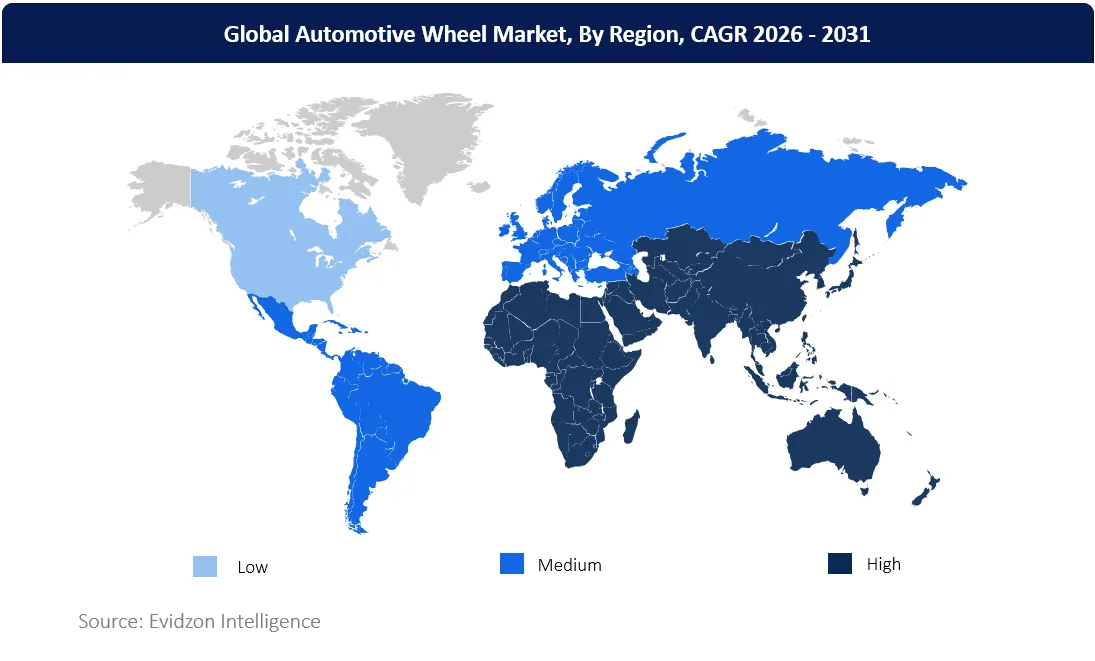
North America has established automotive manufacturing hubs, a thriving SUV and light truck market, and a strong replacement market for premium and standard wheels. In Asia-Pacific, opportunities for growth exist through the production of vehicles in China, Japan and India, as well as an increase in the number of vehicles across the region and the rising production of electric vehicles. Premium vehicle fitments, OEM lightweight requirements, and stringent regulations is shaping the Europe automotive wheel market. Therefore, local manufacturing and a wide product portfolio are needed to meet the demand of original equipment manufacturers (OEMs) and aftermarket customers.
Key Takeaways
- By vehicle type, commercial vehicle accounts for nearly 61% market share of the global automotive wheel market in 2025 and passenger car is expected to grow at a CAGR of 7.97% by 2031.
- By propulsion, internal combustion engine (ICE) remains the largest sub-segment accounting for nearly 74.5% of the global automotive wheel market in 2025. Whereas, electric vehicle (EV) is expected to be the fastest growing segment expanding at 14.5% CAGR by 2031.
- By rim size, 16–18 inch segment has registered the highest market value share of nearly 45.5% in 2025 of global automotive wheel market and above 21 inch is expected to grow at a 9.8% CAGR over the forecast period.
- By manufacturing process, casting remains the dominant demand base with nearly 63.2% market share in 2025, and flow-forming (spinning) is projected to grow at 8.7% CAGR by 2031.
- By material, aluminum alloy segment accounts for nearly 49.5% market share in 2025. However, magnesium alloy is expected to grow at a CAGR of 8.9% by 2031.
- By sales channel, OEM accounts for 81.2% global automotive wheel market share in 2025. However, aftermarket is projected to witness a CAGR of 7.9% during 2026–2031.
- By region, North America accounts for 42.5% global automotive wheel market share in 2025. However, Asia-Pacific is projected to witness a CAGR of 8.1% during 2026–2031.
About the Study
The study covers wheels for passenger cars, commercial vehicles and across ICE and electric vehicle propulsion, including steel, aluminum alloy, magnesium alloy and other materials, further segmented by rim size and manufacturing process, including casting, forging and flow-forming (spinning). Study includes OEM wheels fitted to new vehicles and aftermarket wheels for replacement or customization. The study scope excludes tires, wheel hubs, bearings, brakes and other automotive parts.
Market Dynamics Analysis
Drivers
Higher vehicle production increases original equipment wheel requirements.
EV weight and efficiency requirements encourage specialized wheel designs.
SUV popularity and premium styling support larger rim demand.
Lightweight alloys improve efficiency, handling and corrosion resistance.
Forging and flow-forming deliver strength with reduced wheel weight.
Replacement needs and customization purchases support recurring wheel sales.
Restraints
Aluminum and steel price fluctuations complicate procurement and pricing.
Capital-intensive production and machining increase premium wheel costs.
Potholes and impacts increase repair expenses and replacement frequency.
Load, fatigue and impact testing extend product development cycles.
The demand curve of automotive wheel is influenced by the vehicle production and parc, each additional vehicle produced subsequently creates factory-fitted wheels demand and while increasing parc drives the replacement demand. As overall weight and driving efficiency influence material selection and design in electric vehicles across passenger car and commercial vehicles, wheel-engineering priorities are dynamically evolving with the increasing penetration of EVs. Increasing market share of SUVs and premium vehicles is driving demand for large rim size wheels, carrying higher per unit value. OEMs emphasis on reducing weight, enhancing durability and styling is fueling the adoption of aluminum alloys, while forging and flow-forming is making space in application where strength and weight reduction justify higher manufacturing costs. Additionally, replacement, damage and customization creates aftermarket demand, unfolding revenue opportunities for wheel manufacturers beyond OEM.
Steel and aluminum are the key materials in automotive wheel manufacturing, volatile raw material prices erodes the predictability of long-term production cost led to impact the manufacturing cost and subsequently shrinks profit margin. In addition to this, passing the increased cost to OEMs is difficult owing to long-term supply agreements. Specialized equipment, machining requirements and higher production costs resulting to complex the competitiveness of forge wheel segment across price-sensitive and high-volume vehicle segments. The aftermarket wheels market experience the difficulty of customer loyalty attrition due to the high cost of damage repair and the implied price mismatch between the replaced wheels and the vehicle’s class or performance needs. The costs of vehicle safety validation, including verifying the wheels’ capacity to withstand loads and impacts and meet fatigue resistance requirements, add significantly to the research and development costs for new products or alternative material solutions.
Segment Analysis
By Vehicle Type
Commercial vehicle represent the largest vehicle type category with 61% market share in global automotive wheel market and expected to foresee 7.97% CAGR through 2031. The demand for commercial vehicle wheel is driven by vehicle sales and replacement on the back of applications across freight transportation, construction, and infrastructure development requiring truck, bus and other commercial vehicles. Such vehicles require wheels capable of withstanding extreme conditions including heavy axle loads, frequent breaking and other stressful conditions, making the purchase decision a matter of fatigue and weight capacity.
The demand is segmented by the size and power of the vehicle, the operating environment, overall mileage and maintenance schedule. The commercial vehicle wheel market is further shaping by the operators seeking reliability and manufacturers emphasis to achieve an optimal balance between strength and cost of production.
Global Automotive Wheel Market, By Vehicle Type, Market Share, 2025
By Propulsion
Internal combustion engine (ICE) accounts for the highest automotive wheel market share of 74.5% in 2025, meanwhile electric vehicle (EV) is projected to grow at 14.5% CAGR by 2031. Internal combustion engine (ICE) vehicles drive automotive wheel demand through established supply chains and comparatively large global vehicles parc. Wheels vary by category, trim, rim diameter and the choice between steel and aluminum alloy materials. Steels wheels dominate in the entry level vehicle trims due to low cost and high durability while aluminum wheels are increasingly adopted for its weight reducing potential and appearance.
Meanwhile, electric vehicle adoption is unlocking opportunity for wheels that carry higher vehicle mass, improve aerodynamic performance and reduce rolling resistance. Such attribute is driving manufacturers to optimize wheel geometry, material selection and structural performance.
Global Automotive Wheel Market, By Propulsion, Market Share, 2025
Geographic Analysis
Largest Region
North America registered the highest market share of 42.5% in 2025 of global automotive wheel market. North America automotive wheels dominance is driven by light-truck and sport utility vehicle (SUV), and mature replacement market. Consumer preference for large vehicles influences the rim diameters, wheel styling and material specifications, while commercial transportation sustains the demand for the durable wheels for the harsh operating conditions. The aftermarket also contributes to the demand due to collision damage, road hazards, and replacement, and customization.
Wheel suppliers in North America compete on the product quality, manufacturing efficiency, delivery reliability and established relationships with automakers. Electric vehicle production opens up opportunities for the lightweight and aerodynamic wheel designs however, the adoption depends on the vehicle requirements and cost-consciousness. The regional demand also reflects the differences in the passenger vehicle production, commercial fleet activity and the consumer spending on the replacement wheels.
Global Automotive Wheel Market, By Region, Market Share, 2025
Fastest-Growing Region
Asia-Pacific is projected to be the fastest region in global automotive wheel market by 2031 accounting for 8.1% CAGR. The demand for automotive wheels in the Asia-Pacific region is determined by vehicle production and sales across China, India, Japan, and Southeast Asian countries. The diversity of vehicle types in the region is expected to drive the demand for cost-effective steel wheels, as well as wheels made of aluminum alloy. Moreover, the types of wheels are projected to be differentiated based on the category of vehicles, as well as the purchasing power of local populations and the requirements of original equipment manufacturers.
The rising production of electric vehicles will create new demand for wheels made of light materials with optimized designs and energy performance characteristics. The local production of wheels, network relations with auto manufacturers, and low-cost production capabilities are also expected to impact wheel manufacturing in the Asia-Pacific region. Variations in infrastructure development, road conditions, and the level of vehicle affordability in different countries will differentiate the types of wheels in demand.
Competitive Landscape
- 1Iochpe-Maxion (Maxion Wheels)
- 2CITIC Dicastal
- 3Zhejiang Wanfeng Auto Wheel
- 4Superior Industries International
- 5Ronal Group
Market Concentration Level: Moderate
The global automotive wheel market competitive landscape is moderately concentrated , formed by large-scale wheel manufacturers with established OEM relationships, global production capabilities and specialized regional suppliers. Iochpe-Maxion (Maxion Wheels), CITIC Dicastal, Zhejiang Wanfeng Auto Wheel, Superior Industries International and RONAL GROUP are the key players owing to their manufacturing scale and established presence in the automotive wheel supply. The competition is increasingly characterized by wheel material, manufacturing technology, weight, structural strength, design flexibility, surface finish, cost and compliance with OEM quality requirements.
Aluminum alloy wheel suppliers are competing on distinct attributes including lightweight designs, styling options and advanced casting or forming capabilities, while steel wheel manufacturers remain competitive on cost and suitability for mass-market vehicles and commercial applications. Long-term OEM relationships, expanding manufacturing capacity, improving production efficiency and developing wheels suited to evolving vehicle platforms are critical competitive priorities.
Recent Development
Maxion Launches Forged Truck Wheels
Maxion Wheels, an wheel manufacturers has launched forged aluminum truck wheel portfolio, including commercial vehicle steel and forged aluminum wheels, forging continued emphasis on expansion of commercial vehicle wheel.
CITIC Dicastal Raises Wheel Supply Commitments
CITIC Dicastal Co., Ltd., one of the largest global manufacturer of aluminum alloy wheels has revised its aluminum alloy wheel purchasing agreement with affiliated companies, increasing annual transaction caps to RMB 11 billion for 2026, RMB 12 billion for 2027 and RMB 13 billion for 2028.
Steel Strips Wheels Expands Manufacturing Capacity
Steel Strips Wheels Limited (SSWL) has announced to invest INR 500 – 600 crore (~USD 52-63 million) at its Bhuj, Gujarat, facility to add 1.2 million units of alloy wheel production capacity, reaching a total capacity of nearly 5 million.
Table of Content
- 1.Introduction
- 1.1Scope and Objective of the Study
- 1.2Market Definition & Study Assumptions
- 2.Research Methodology
- 3.Executive Summary
- 4.Market Outlook
- 4.1Market Overview
- 4.2Market Drivers
- 4.2.1Rising Vehicle Production Expands Wheel Demand
- 4.2.2Growing Electric Vehicle Adoption Changes Wheel Specifications
- 4.2.3Increasing Preference For Larger Diameter Wheels
- 4.2.4Aluminum Alloy Adoption Supports Lightweight Wheel Manufacturing
- 4.2.5Advanced Manufacturing Processes Improve Wheel Performance
- 4.2.6Expanding Vehicle Parc Sustains Aftermarket Replacement Demand
- 4.3Market Restraint
- 4.3.1Volatile Raw Material Prices Pressure Wheel Margins
- 4.3.2High Forging Costs Limit Wider Adoption
- 4.3.3Wheel Damage Raises Ownership and Replacement Costs
- 4.3.4Strict Wheel Safety Requirements Increase Validation Costs
- 4.4Regulatory Landscape
- 4.5Supply/Value Chain Analysis
- 4.6Porter's Five Forces Analysis
- 4.6.1Threat of New Entrants
- 4.6.2Bargaining Power of Buyers
- 4.6.3Bargaining Power of Suppliers
- 4.6.4Threat of Substitutes
- 4.6.5Competitive Rivalry
- 5.Market Segmentation (Includes market size in Value (USD), Forecast up to 2031, and market analysis with growth attributes)
- 5.1By Vehicle Type
- 5.1.1Passenger Car
- 5.1.1.1Hatchback
- 5.1.1.2Sedan
- 5.1.1.3SUV/MUV
- 5.1.1.4Others (Crossover, Coupe, Convertible, Wagon)
- 5.1.2Commercial Vehicle
- 5.1.2.1Light Commercial Vehicle
- 5.1.2.2Medium and Heavy-Duty Trucks
- 5.1.2.3Bus and Coach
- 5.2By Propulsion
- 5.2.1Internal Combustion Engine (ICE)
- 5.2.1.1Petrol / Gasoline
- 5.2.1.2Diesel
- 5.2.1.3CNG/LPG
- 5.2.2Electric Vehicle (EV)
- 5.2.2.1Hybrid Electric Vehicle (HEV)
- 5.2.2.2Plug-in Hybrid Electric Vehicle (PHEV)
- 5.2.2.3Battery Electric Vehicle (BEV)
- 5.2.2.4Fuel Cell Electric Vehicle (FCEV)
- 5.3By Rim Size
- 5.3.1Below 13 Inch
- 5.3.213-15 Inch
- 5.3.316-18 Inch
- 5.3.419-21 Inch
- 5.3.5Above 21 Inch
- 5.4By Manufacturing Process
- 5.4.1Casting
- 5.4.1.1Gravity Casting
- 5.4.1.2Low-Pressure Die Casting (LPDC)
- 5.4.1.3High-Pressure Die Casting (HPDC)
- 5.4.1.4Squeeze Casting (Liquid Forging)
- 5.4.2Forging
- 5.4.3Flow-Forming (Spinning)
- 5.5By Material
- 5.5.1Steel (Carbon Steel)
- 5.5.2Aluminum Alloy
- 5.5.3Magnesium Alloy
- 5.5.4Others (Titanium, Carbon Fiber Composite, etc.)
- 5.6By Sales Channel
- 5.6.1OEM
- 5.6.2Aftermarket
- 5.7By Region
- 5.7.1North America
- 5.7.1.1United States
- 5.7.1.2Canada
- 5.7.2Latin America
- 5.7.2.1Brazil
- 5.7.2.2Argentina
- 5.7.2.3Mexico
- 5.7.2.4Rest of Latin America
- 5.7.3Europe
- 5.7.3.1Germany
- 5.7.3.2Italy
- 5.7.3.3France
- 5.7.3.4Spain
- 5.7.3.5United Kingdom
- 5.7.3.6Russia
- 5.7.3.7Rest of Europe
- 5.7.4Asia Pacific
- 5.7.4.1China
- 5.7.4.2India
- 5.7.4.3Japan
- 5.7.4.4South Korea
- 5.7.4.5Indonesia
- 5.7.4.6Australia
- 5.7.4.7Rest of Asia-Pacific
- 5.7.5Middle East & Africa
- 5.7.5.1Saudi Arabia
- 5.7.5.2United Arab Emirates (UAE)
- 5.7.5.3South Africa
- 5.7.5.4Egypt
- 5.7.5.5Rest of the Middle East & Africa
- 6.Competitive Landscape
- 6.1Market Concentration Overview
- 6.2Market Share Analysis
- 6.3Company Profiles
- 6.3.1Iochpe-Maxion (Maxion Wheels)
- 6.3.2CITIC Dicastal
- 6.3.3Zhejiang Wanfeng Auto Wheel
- 6.3.4Superior Industries International
- 6.3.5RONAL GROUP
- 6.3.6Steel Strips Wheels Limited (SSWL)
- 6.3.7Dongfeng Automotive Wheel
- 6.3.8Wheels India Limited
- 6.3.9ENKEI Corporation
- 6.3.10BORBET
- 6.3.11CMS Jant ve Makina Sanayi
- 6.3.12TOPY Industries
- 6.3.13ALCAR Group
- 6.3.14PAKO Group / Pakoakuina
- 6.3.15Klassic Wheels Limited
- 7.Future Outlook
- 7.1Growth Opportunities & White-Space Analysis
- 7.2Analyst Recommendations
FAQ
What is the global automotive wheel market size and projected growth?
The global automotive wheel market was valued at USD 52.66 billion in 2025 and is projected to reach USD 75.94 billion by 2031, growing at a CAGR of 6.88% from 2026 to 2031.
Which vehicle type dominates the global automotive wheel market?
Commercial vehicles dominates the global automotive wheel market, account for approximately 61% of market share in 2025.
Which propulsion segment holds the largest market share, and which is expected to grow fastest?
Internal combustion engine (ICE) vehicles account for approximately 74.5% of the global automotive wheel market in 2025. Electric vehicle (EV) wheels are projected to be the fastest-growing propulsion segment, with a CAGR of 14.5% through 2031.
Which region dominates the global automotive wheel market, and which is expected to grow fastest?
North America holds the largest regional share, accounting for 42.5% of the global automotive wheel market in 2025. Asia-Pacific is projected to be the fastest-growing region, with a CAGR of 8.1% from 2026 to 2031.
What are the key factors driving the global automotive wheel market?
Key growth drivers include rising vehicle production, increasing EV adoption, demand for larger-diameter wheels, greater use of aluminum alloys, advancements in forging and flow-forming, and aftermarket replacement demand.
Market Size Methodology
The value of the global automotive wheel market is calculated by multiplying the number of new vehicles produced by the average wheel value fitted per vehicle, with aftermarket demand separately assessed based on the installed vehicle parc and requirements for replacement.
Wheel value is estimated by vehicle type, propulsion, rim size, manufacturing process, material, sales channel and region/country to account for variances in wheel specifications, vehicle position and sourcing costs. Vehicle production and registration data, OEM specifications, supplier disclosures, company reports, government databases and industry sources are the key sources on which historical data has drawn.
While, vehicle production growth, the ratio of passenger cars and commercial vehicles, transition to electric vehicles, wheel diameters preferences, aluminum wheels evolution, forged and flow-formed wheels, OEM sourcing strategies, wheels prices, the size of the parc, replacement after damage and normal replacement cycles are the key factors considered in market forecast. The analysis takes into account factory-fitted wheels and aftermarket wheels. Demand for aftermarket wheels is driven by replacement needs, personalization and customization, and cost of upgrade from steel wheels to light alloys.
Have a question about this report?
Talk to the analyst behind this research, or browse the full report catalogue.
Contact Us