
Global ADAS Market
The global advanced driver assistance systems (ADAS) market report is segmented by automation level (Level 1, Level 2/2+, Level 3, Level 4, and Level 5), by component (Hardware and Software), by sales channel (OEM and Aftermarket), by application (Personal Ownership and Commercial Applications), by vehicle type (Passenger Car and Commercial Vehicle), by propulsion (ICE, HEV, PHEV, and BEV), and by region (North America, South America, Europe, Asia-Pacific, and Middle-East and Africa). The global advanced driver assistance systems (ADAS) market report includes market size in value (USD), and forecast up to 2031.
Global ADAS Market
Market Size in USD Billion
Market Size Overview
USD Billion
Market Snapshot
- Study Period
- 2019-2031
- Forecast Period
- 2026-2031
- Base Year Market Size (2025)
- USD 35.11 Billion
- Market Size (2026)
- USD 41.04 Billion
- Market Size (2031)
- USD 72.24 Billion
- Growth Rate (2026-2031)
- 11.97% CAGR
- Market Concentration
- Consolidated
Major Players*





*Disclaimer: Major Players sorted in no particular order
Market Overview
The global advanced driver assistance systems (ADAS) market value is anticipated to grow from USD 35.1 billion in 2025 to 41.04 billion in 2026 and expected to reach USD 72.24 billion in 2031 with a CAGR (2026-2031) of 11.97%.
The global advance driver assistance system industry is witnessing a transition towards being mores standardized in mass vehicle segment instead of concentrated as optional safety feature in premium vehicles. According to International Energy Agency (IEA), More than 50% of vehicles sold across the globe in 2025 has been equipped with SAE Level 1 or above, L2/L2+ automation system are accounting more than one-third of market and projected to grow by 1.5X over the next five years. This trend reflects the increasing incorporation of driver assistance into mainstream car specs: driven by safety requirements, consumer demands and cost-optimized sensing and computing technologies. Adaptive cruise control, lane-centering assistance and automatic emergency braking are increasingly integrated into coordinated systems rather than available as standalone features.
OEMs are strategically moving beyond isolated functions of L2 like adaptive cruise control or lane-departure warning towards integrated architecture or sensor fusion combining cameras, radar, LiDAR, ultrasonic sensing, ECUs, high-performance computing, steering and braking actuation, driver monitoring and software. This architecture allows multiple sensors and vehicle-control functions operate simultaneously and enable to shift towards L2+ automation level. The competitive focus is shifting from performance of individual sensors to system-level integration, software capabilities, validation, functional safety and scalability of technologies across different car platforms at commercially viable costs.
Over the coming years the automated driver assistance systems market will register continued technological advancement driving towards higher level of automation. Level 4 ADAS is likely to shape the sphere of driverless vehicles and deployment of robotaxi will continue to increase beyond United States and China. However regional regulations and compliance along with infrastructural development will remain a challenge and restricting the growth potential during the forecast period. Hence, the market growth is not technology driven, but reliability of ADAS, regional regulations, cost-effectiveness across the regions will outline the future growth trajectory.
Key Takeaways
- By automation level, Level 2 segment has registered the highest market value share of nearly 68% in 2025 of global advanced driver assistance systems (ADAS) market and Level 4 is expected to ride at a 36% CAGR over the forecast period.
- By component, hardware accounts for 80% market share in 2025. However, software is likely to witness a CAGR 0f 18% through 2031.
- By sales channel, OEM accounts for more than 95% of ADAS market share in 2025. Whereas, continued availability of aftermarket ADAS and increasing customer preferences towards advance features will drive the ADAS aftermarket segment at 21% CAGR by 2031.
- By application, personal ownership will remain the dominant demand base with more than 75% market share in 2025, while commercial application of advanced driver assistance systems (ADAS) is projected to grow at 24% CAGR by 2031.
- By vehicle type, passenger accounts for nearly 76% market share in 2025. However, commercial vehicle ADAS is expected to grow at a CAGR of 19% by 2031.
- By propulsion, internal combustion engine (ICE) remains the largest sub-segment accounting for nearly 60% of the advanced driver assistance systems (ADAS) segment in 2025 and battery electric vehicle (BEV) is expected to grow at 18% CAGR by 2031.
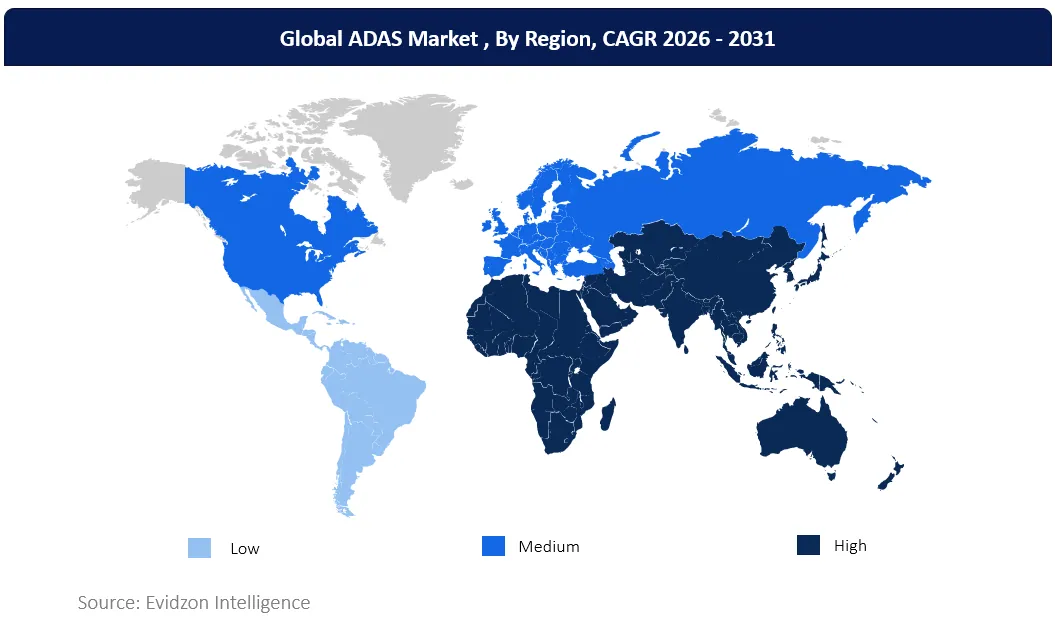
- By region, Asia-pacific accounts for 60.17% of the global advanced driver assistance systems (ADAS) market and Middle East and Africa is expected to grow at a CAGR of 18.86% through 2031.
About the Study
The global advanced driver assistance systems (ADAS) market study covers hardware and software installed in passenger and commercial vehicles to provide driver assistance across SAE Level 1, Level 2/2+, Level 3, Level 4, and Level 5 with analysis by automation level, components, sales channel, application, vehicle type, propulsion across major global regions and countries. The study excludes autonomous mobility service revenue, robotaxi, mapping services, autonomous-driving infrastructure and the full vehicle value attributed to the autonomous vehicle market.
Market Dynamics Analysis
Drivers
The move from single-function ADAS to integrated Level 2/2+ systems is the most significant demand driver.
ADAS adoption is increasingly being influenced by regulations rather than consumer desire to pay.
The costs of ADAS are improving as sensors, computers, and electrical designs advance.
ADAS is increasingly utilized to differentiate automobiles in segments where mechanical features have grown less distinguishable.
The underlying safety issue remains significant, providing a compelling incentive for ADAS investment.
BEVs offer an advantageous electronic architecture for autonomous driving, especially in situations requiring high electrical power availability and centralized computation.
Restraints
Sensors, compute, software, steering, brakes, powertrain, and HMI must all work together to provide advanced ADAS functionality.
The physical limits of sensors impede ADAS performance.
Sensor replacement and recalibration can add complexity to collision repairs.
Regulation is becoming more harmonized but still geographically scattered.
The key forces accelerating the pedal of ADAS industry are the regulatory penetration, mainstream Level 2 adoption and the shift toward software-defined vehicle architectures. Regional like EU's General Safety Regulation has required a broad range of assistance technologies on new vehicles since July 2024 is setting the ADAS market floor. As European Commission estimating that the measures could save more than 25,000 lives and prevent at least 140,000 serious injuries by 2038. Similarly, United States, NHTSA is estimating to prevent 24,000 injuries and save at least 360 lives annually by implementing mandatory automatic emergency braking (AEB) and pedestrian AEB on new passenger cars and light trucks from September 2029. Additionally, substantial commercial significance has led OEMs to view ADAS technology as potential product differentiator and a potential software revenue stream.
The increasing technical, regulatory and economic complexity and gap between new-vehicle fitment and total vehicle-fleet penetration are the key factors restricting the growth potential of ADAS market over the forecast period. Higher SAE automation level requires capable computing, redundancy and vehicle-control architectures, which in turn increase the cost of integration. Similar challenge has been seen by Mercedes Benz and BMW in the integration of L3 automation, later OEMs has decided to emphasize on sophisticated L2+ systems that provide broader functionality while retaining driver responsibility rather than attempting immediate mass deployment of L3. Additionally, environmental limitations, driver-supervision requirements and fragmented regulatory frameworks constrain the reliability and scalability of higher-level systems.
Segment Analysis
By Automation Level
Level 2/2+ automation level accounts for the highest market share of nearly 68% in 2025. Increasing adoption of L2+ ADAS reflects the dynamic transition towards integrated systems capable of simultaneously controlling steering, acceleration, and braking instead of basic driver-assistance function. Features line blind spot monitoring, lane-keep assist, emergency braking, adaptive cruise control, automated parking has increased the level of road and ease of driving leading mainstream passenger vehicles. China had roughly 10% L2+ penetration in new-car sales in 2025, compared to 6% in the United States, showing the growing deployment of higher-capability assistance systems.
Level 4 is anticipated to be the fastest automation level with 36% CAGR by 2031, owing to the continued development in commercial domains like robotaxis. Services like robotaxi and driverless are well suited for application under controlled environments such as highways, industrial areas, parking facilities, and other geofenced applications. However, Level 4 adoption is projected to be more limited than Level 2/2+ due to the technology's substantially higher perception, computing, redundancy, validation, and operational-domain capabilities. As a result, Level 2 will continue to contribute the most income, while Level 4 represents the faster-growing emerging market.
Global Advanced Driver Assistance Systems (ADAS) Market, By Automation Level, Market Share, 2025
By Component
Hardware represents the largest component category with 80% market share in global Advanced Driver Assistance Systems (ADAS) market. The high market share of hardware reflects that the high value is embedded in cameras, radar, LiDAR, ultrasonic sensors, electronic control units, braking and steering actuators, and human-machine interfaces required to implement ADAS functions. Increasing trend of sensor fusion by combining multiple sensing technologies for more powerful processing and vehicle-control systems is further adding up to the hardware content per vehicle. With increasing level of automation dependency on hardware like sensors, computing technology, actuators and others will continue to grow.
However, ADAS software is anticipated to foresee a CAGR of 18% through 2031. Software plays a crucial role in integrating higher level of automation due to the importance of perception, sensor-fusion, object classification, path planning, decision-making, driver monitoring, system control, and over-the-air software updates. A higher value proposition is projected to transition towards algorithms and software rather than incremental hardware alone with continued integration of L2+ and higher level of ADAS.
Global Advanced Driver Assistance Systems (ADAS) Market, By Component, Market Share, 2025
Geographic Analysis
Largest Region
Asia Pacific registered the highest market share of 60.17% in 2025 of global advanced driver assistance systems (ADAS) market. Exceptionally large vehicle production base, rapid adoption of advanced vehicle electronics, growing penetration of electric and software-defined vehicles, and increasing integration of Level 2 and Level 2+ functions by Asia based OEMs is primarily supporting the region’s dominance. With higher adoption of L2 and above driver assistance technology, large production base, and technological development, China is leading the Asia-Pacific market.
Since the beginning of 2026, the penetration rate of new passenger vehicles equipped with combined driver assistance features in China has reached 70%, while that of models having navigation-assisted driving, or NOA, has surpassed 30%. In contrast, China's Ministry of Industry and Information Technology has developed an obligatory national standard outlining the safety standards for combining driver assistance systems in intelligent and connected vehicles. In the long run, it will improve market access management for intelligent and connected vehicle goods while holding companies more accountable for safety.
Global Advanced Driver Assistance Systems (ADAS) Market, By Country, Market Share, 2025
Fastest-Growing Region
Middle East and Africa is projected to be the fastest region in global advanced driver assistance systems (ADAS) by 2031 accounting for 18.86% CAGR. Unlike Asia-pacific, the growth levers of MEA ADAS market is primarily driven by increasing road-safety requirements, premium-vehicle penetration, smart-mobility investments, fleet modernization and the gradual incorporation of advanced safety technologies into new vehicles. The Gulf countries like Saudi Arabia and UAE are at the forefront of this transition towards ADAS technology on the back of high purchasing power, large premium-vehicle presence and government-led transportation modernization programs.
In MEA, United Arab Emirates ADAS market is accounting for driving the major region’s growth. Dubai's smart-mobility agenda, increasing deployment of connected-vehicle infrastructure and the country's ambition to integrate autonomous and intelligent transportation technologies are overall complimenting the UAE ADAS market. Additionally, Dubai has created an own regulatory structure. The emirate published Law No. 9 of 2023 in April 2023 to regulate Advanced Driver Assistance Systems (ADAS) operations. This law supports the emirate's 25% autonomous-transport goal and offers a legal framework for Advanced Driver Assistance Systems (ADAS) testing and deployment.
Competitive Landscape
- 1Robert Bosch GmbH
- 2AUMOVIO SE
- 3ZF Friedrichshafen AG
- 4Denso Corporation
- 5Aptiv PLC
Market Concentration Level: Consolidated
The global advanced driver assistance systems market is concentrated and increasingly technology-intensive with continuous hardware and software development required to remain competitive in the market. The ADAS competitive landscape is majorly driven by Tier-1 players including Bosch, ZF, Continental/Aumovio, Denso, Valeo, Aptiv, Magna, Autoliv, Hyundai Mobis and Forvia, competing with global footprint, established OEM relationships, broad ADAS portfolio, and continuous technology development.
Players are emphasizing on integrated platforms combining cameras, radar, LiDAR, electronic control units, high-performance computing, sensor-fusion software and vehicle-control technologies beyond individual cameras, radar and ultrasonic sensors. Suppliers/manufacturers integrating these technologies are able to reduce the cost and offer higher level of ADAS at competitive pricing, strengthening their position across higher-value ADAS programs. The major pressure is arising from China based suppliers as they primarily compete on cost, rapid algorithm iteration, vertical integration and shorter development cycles. BYD, Freetech, Huawei Technologies, and other China based suppliers are expanding their presence across the globe, and reshaping the competitive structure.
As the competition is moving from individual components to centralized computing, domain controllers, perception software and integrated ADAS platforms the cruciality of software scalability, OTA capability, cybersecurity, functional safety has increased exponentially. ADAS technology, OEM penetration, cost, and software development capability are the key factors shaping the competitive landscape of global ADAS market.
Recent Development
Hyundai Motor Group is Taking Leap in Autonomous Driving with AI
Hyundai Motor Group announced two separate strategies for autonomous driving, including utilization of technology from NVIDIA and its own Atria AI platform. The group plans to launch vehicles with NVIDIA-based Level 2+ driving functions in the first half of 2028 and Level 2++ in the second half of 2028, and introduce Level 2++ vehicles equipped with Atria AI in the second half of 2029.
Bendix Selected Aeva to Develop the Commercial-Vehicle ADAS
Bendix Commercial Vehicle Systems has chosen Aeva to co-develop a next-generation Level 2+ active safety and collision prevention system for Class 8 commercial vehicles. Bendix's flagship driver assistance platform for mass production will be equipped with Aeva's 4D LiDAR sensors and perception software.
Volkswagen's CARIZON and Horizon Robotics Deepen ADAS/Autonomous-Driving Collaboration
Volkswagen's China intelligent driving joint venture, CARIZON (created by CARIAD and Horizon Robotics), has expanded its collaboration. The agreement grants CARIZON white-box access to Horizon's AI foundation model in order to expedite in-house Level 3 and Level 4 autonomous driving systems, with an L3 rollout in China targeted for the second half of 2027.
Table of Content
- 1.Introduction
- 1.1Scope and Objective of the Study
- 1.2Market Definition & Study Assumptions
- 2.Research Methodology
- 3.Executive Summary
- 4.Market Outlook
- 4.1Market Overview
- 4.2Market Drivers
- 4.2.1Growing Adoption of Advanced Driver Assistance Systems
- 4.2.2Increasing OEM Competition
- 4.2.3Increasing Customer Demand for Safety
- 4.2.4Development of Level 4 Vehicles
- 4.2.5Growing Adoption of Software-Defined cars
- 4.2.6Increasing Electrification
- 4.3Market Restraint
- 4.3.1High Vehicle Cost
- 4.3.2Regulatory Restrictions
- 4.3.3Consumer Trust and Driver Monitoring
- 4.3.4Complex Driving Environments
- 4.4Regulatory Landscape
- 4.5Supply/Value Chain Analysis
- 4.6Porter's Five Forces Analysis
- 4.6.1Threat of New Entrants
- 4.6.2Bargaining Power of Buyers
- 4.6.3Bargaining Power of Suppliers
- 4.6.4Threat of Substitutes
- 4.6.5Competitive Rivalry
- 5.Market Segmentation (Includes market size in Value (USD) and Forecast up to 2031, and market analysis with growth attributes)
- 5.1By Automation Level
- 5.1.1Level 1(Driver Assistance)
- 5.1.2Level 2 (Partial Automation)
- 5.1.3Level 3 (Conditional Automation)
- 5.1.4Level 4 (High Automation)
- 5.1.5Level 5 (Full Automation)
- 5.2By Application
- 5.2.1Personal Ownership
- 5.2.2Commercial Applications (Shuttle services, Robo-taxi, etc.)
- 5.3By Vehicle Type
- 5.3.1Passenger Car
- 5.3.1.1Hatchback
- 5.3.1.2Sedan
- 5.3.1.3SUV
- 5.3.1.4Multi-Purpose Vehicle (MPV)
- 5.3.1.5Others (Crossover, Coupe, Convertible, Wagon)
- 5.3.2Commercial Vehicle
- 5.3.2.1Light Commercial Vehicle
- 5.3.2.2Medium and Heavy-Duty Trucks
- 5.3.2.3Bus and Coach
- 5.4By Propulsion
- 5.4.1Internal Combustion Engine (ICE)
- 5.4.1.1Petrol / Gasoline
- 5.4.1.2Diesel
- 5.4.1.3CNG/LPG
- 5.4.2Hybrid Electric Vehicle (HEV)
- 5.4.3Plug-in Hybrid Electric Vehicle (PHEV)
- 5.4.4Battery Electric Vehicle (BEV)
- 5.5By Region
- 5.5.1North America
- 5.5.1.1United States
- 5.5.1.2Canada
- 5.5.2Latin America
- 5.5.2.1Brazil
- 5.5.2.2Argentina
- 5.5.2.3Mexico
- 5.5.2.4Rest of Latin America
- 5.5.3Europe
- 5.5.3.1Germany
- 5.5.3.2Italy
- 5.5.3.3France
- 5.5.3.4Spain
- 5.5.3.5United Kingdom
- 5.5.3.6Russia
- 5.5.3.7Rest of Europe
- 5.5.4Asia Pacific
- 5.5.4.1China
- 5.5.4.2India
- 5.5.4.3Japan
- 5.5.4.4South Korea
- 5.5.4.5Indonesia
- 5.5.4.6Australia
- 5.5.4.7Rest of Asia-Pacific
- 5.5.5Middle East & Africa
- 5.5.5.1Saudi Arabia
- 5.5.5.2United Arab Emirates (UAE)
- 5.5.5.3South Africa
- 5.5.5.4Egypt
- 5.5.5.5Rest of the Middle East & Africa
- 6.Competitive Landscape
- 6.1Market Concentration Overview
- 6.2Market Share Analysis
- 6.3Company Profiles
- 6.3.1Robert Bosch GmbH
- 6.3.2AUMOVIO SE
- 6.3.3ZF Friedrichshafen AG
- 6.3.4Denso Corporation
- 6.3.5Aptiv PLC
- 6.3.6Valeo SE
- 6.3.7Mobileye Global Inc.
- 6.3.8Magna International Inc.
- 6.3.9Hyundai Mobis
- 6.3.10FORVIA HELLA
- 6.3.11Autoliv Inc.
- 6.3.12Hitachi Astemo
- 6.3.13HARMAN International
- 6.3.14Aisin Corporation
- 6.3.15NVIDIA Corporation
- 7.Future Outlook
- 7.1Growth Opportunities & White-Space Analysis
- 7.2Analyst Recommendations
Market Size Methodology
The market value is calculated by multiplying the sales volume of vehicles equipped with qualifying ADAS functionality by the corresponding ADAS system price. New-vehicle sales are used as the primary demand indicator, with vehicles classified across Level 1, Level 2/2+, Level 3, Level 4 and Level 5 automation level. Market sizing is further segmented by automation level, component, sales channel, application, vehicle type, propulsion, and country/region to capture differences in technology adoption and vehicle configuration.
OEM model specifications, vehicle registrations, autonomous-driving deployment data, government statistics, industry associations, company disclosures and regulatory filings are used to benchmark historical values.
Forecasts consider vehicle sales, ADAS penetration, migration across automation levels, vehicle and propulsion mix, average vehicle prices, sensor and computing content, software integration, OEM deployment plans, technology maturity, regulatory approvals, infrastructure readiness and regional driving conditions.
FAQ
What is the size of the global ADAS market, and how is it expected to grow through 2031?
The global ADAS market was valued at USD 35.11 billion in 2025. It is projected to increase to USD 41.04 billion in 2026 and reach USD 72.24 billion by 2031, registering a CAGR of 11.97% during 2026–2031.
Which automation level accounts for the largest share of the global ADAS market?
Level 2/2+ accounted for the largest share, at nearly 68% in 2025. Its adoption is supported by the integration of functions such as adaptive cruise control, lane-keeping assistance, blind-spot monitoring and automatic emergency braking.
Which component category dominates the global ADAS market?
Hardware represented approximately 80% of the global ADAS market in 2025, supported by the value of cameras, radar, LiDAR, ultrasonic sensors, electronic control units and vehicle-control components.
Which sales channel and application account for the largest shares of the ADAS market?
OEM sales accounted for more than 95% of the market in 2025, while personal ownership represented more than 75%.
Which region dominates the global ADAS market, and which is expected to grow fastest?
Asia-Pacific held the largest regional share, accounting for 60.17% of the global ADAS market in 2025. Middle East and Africa is projected to be the fastest-growing region, with a CAGR of 18.86% during 2026–2031.
Have a question about this report?
Talk to the analyst behind this research, or browse the full report catalogue.
Contact Us