
Global Robotaxi Market
The global robotaxi market report is segmented by vehicle type (Purpose-built Robotaxi and Autonomous Shuttle and Vans), by autonomous level (Level 4 and Level 5), by propulsion (Battery Electric Vehicles (BEV), Plug-in Hybrid Electric Vehicle (PHEV), Fuel Cell Electric Vehicles (FCEVs)), by applications (Urban Transportation, Sub-urban Transportation, Airport Transportation, Corporate and Campus Transportation), and by region (North America, Latin America , Asia Pacific ,and Middle East& Africa). The global robotaxi market report includes market size in value (USD) and forecasts through 2031.
Global Robotaxi Market
Market Size in USD Billion
Market Size Overview
USD Billion
Market Snapshot
- Study Period
- 2019-2031
- Forecast Period
- 2026-2031
- Base Year Market Size (2025)
- USD 0.57 Billion
- Market Size (2026)
- USD 1.12 Billion
- Market Size (2031)
- USD 19.16 Billion
- Growth Rate (2026-2031)
- 76.55% CAGR
- Market Concentration
- Consolidated
Major Players*





*Disclaimer: Major Players sorted in no particular order
Market Overview
The global robotaxi market value is anticipated to grow from USD 0.57 billion in 2025 to 1.12 billion in 2026 and is expected to reach USD 19.16 billion in 2031, with a CAGR (2026-2031) of 76.55%
The global robotaxi market is dynamically shifting from controlled autonomous driving to commercialized services of autonomous taxi driven by advances in artificial intelligence, sensor technology, high-performance computing, and vehicle connectivity. Robotaxis leverage cameras, radar, LiDAR, onboard computing, and autonomous driving software to transport passengers’, limits or no human intervention depending on approved conditions. While, China leads commercial deployment, with key players including Baidu, Pony.Ai, Waymo, Tesla and We Ride are expanding services across selected cities, expands driverless ride-hailing operations, and companies also pursuing own robotaxi.
The market growth is reliant on technological advancements, regulatory approval, reliable mapping, charging infrastructure, insurance requirements, and public confidence; influence operators to launch services. High-density urban areas offers attractive conditions for robotaxis with strong demand of conventional ride-hailing and high parking costs. However, vehicle and sensor costs, remote fleet supervision, and maintenance are the crucial factor considered before deployment. Over the coming years, converting pilot programmes into repeatable commercial operations will led by improving fleet economics, and meeting regional regulations to operate across cities.
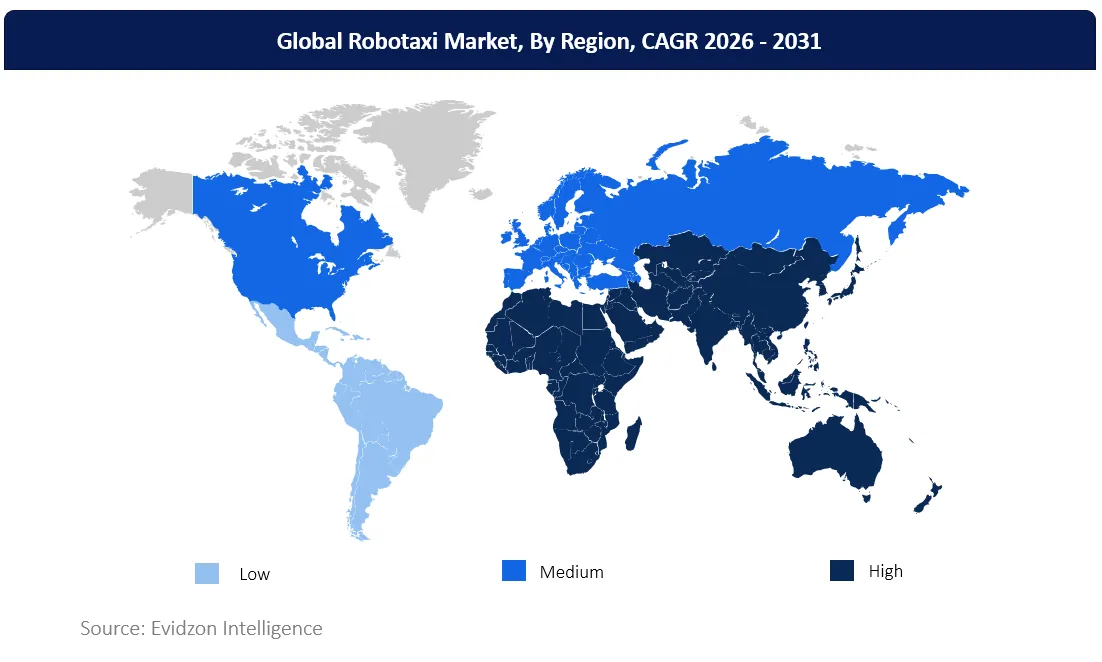
Regional market development varies with regulatory readiness, mobility demand, and investment in autonomous transport. Asia Pacific benefits from China’s expanding commercial robotaxi programmes and support from domestic technology and automotive companies. North America remains a major deployment centre, supported by established autonomous-driving developers and ongoing driverless ride-hailing operations in selected US cities. Europe robotaxi deployment is shaped by stringent vehicle-safety regulations, data requirements, and country-level approvals. The Middle East is attracting investment in smart mobility and autonomous transport, particularly in technology-focused urban centers across GCC countries.
Key Takeaways
- By vehicle type, purpose-built robotaxis account for 64.30% market share in 2025, while autonomous shuttles and vans are expected to grow at a CAGR of 82.20% during 2026–2031.
- By autonomous level, Level 4 autonomous vehicles account for 100.00% of global robotaxi market share in 2025 and are expected to grow at a CAGR of 76.55% during 2026–2031.
- By propulsion, battery electric vehicles (BEVs) account for 100.00% market share in 2025 and are expected to grow at a CAGR of 76.55% during 2026–2031.
- By application, urban transportation accounts for 68.40% of global robotaxi market share in 2025, while airport transportation is expected to grow at a CAGR of 86.40% during 2026–2031.
- By region, Asia Pacific accounts for 78.70% of global robotaxi market share in 2025, while the Middle East and Africa region is expected to grow at a CAGR of 90.30% during 2026–2031.
About the Study
The global robotaxi market study covers robotaxi services across major vehicle types, autonomous levels, applications, and propulsion across major global regions and countries. The study analyzes purpose-built robotaxis and qualifying autonomous shuttles and vans used for commercial passenger transportation. The study excludes conventional ride-hailing vehicles with human drivers, fixed-route public transit, delivery vehicles, testing fleets not engaged in commercial services, autonomous driving systems supplied independently, and activities outside the commercial robotaxi service market.
Market Dynamics Analysis
Drivers
Passengers seek convenient, app-based autonomous urban transportation.
Driverless operations may reduce recurring human-driver expenses.
Improved perception and decision-making support wider commercial deployment.
Dedicated designs can improve passenger capacity and fleet utilization.
Operating permits enable paid rides across additional jurisdictions.
Key companies are investing on vehicle & software development, and service launches.
Restraints
Sensors, computing hardware, and specialized vehicles require substantial capital.
Rare edge cases can disrupt service and undermine customer's confidence.
Different approval processes slow launches across national markets.
Charging access and maintenance capacity constrain fleet availability.
Demand for convenient, app-based mobility concepts provides operators reasons to introduce driverless passenger services in selected suitable cities. While the rational behind robotaxi operation is based on potential of autonomous driving to reduce recurring driver expenses and improves vehicle utilization owing to remote assistance and low fleet management costs. The technical feasibility is driven by progress in advanced sensing, perception and domain control are essential to extending service coverage and handling more complex traffic conditions. The development of purpose-built platforms supports standardized repeatable vehicle production and vehicle designed around passenger transport and potential to expand fleet economics as deployments scale. However, commercial deployment depends on regulatory approval, safety requirements, and permission to locate in specific locations. Strategic investment from automotive companies’, technology developers, and mobility providers will remain crucial for developing robotaxis, improving autonomous systems, and expanding services into new markets.
Robotaxi operators facing high initial cost, sensors, computing hardware, software integration, and fleet management costs limit the development while demand is uncertain and fare revenue fails to cover operating costs. Safety is also a barrier to deployment due to unusual road layouts, unpredictable road users, severe weather, and difficult situations can expose system limitations, requiring further testing or service restrictions or additional validation. Regulatory framework is adding another layer of barrier with regional approvals, operating conditions, and reporting obligations differ between jurisdictions and operators adapt systems and processes before entering new markets. Variations in charging infrastructure, maintenance facilities, remote fleet support, and vehicle recovery affect the proportion of vehicles availability for robotaxi services and delay expansion.
Segment Analysis
By Vehicle Type
Purpose-built robotaxis hold the largest global robotaxis market share of 64.30% in 2025. The purpose-built robotaxis market is primarily supported by vehicle designs developed specifically for driverless passenger transport. Unlike conventional vehicles retrofitted with autonomous driving technology, purpose-built robotaxis models integrate sensors, computing systems, passenger seating, and safety features around the needs of autonomous operation. Additionally, removing traditional driving controls can free up cabin space and support practical layouts for commercial ride-hailing. While, standardized vehicle platforms can simplify maintenance, software updates, and monitoring more efficiently across multiple geographic regions.
Autonomous shuttles and vans segment are expected to grow at CAGR of 82.20% by 2031. The autonomous shuttles and vans market growth is anticipated to fueled by transport authorities, airports, business parks, residential communities, and commercial campuses explore driverless passenger mobility. While, higher passenger capacity and suitability for fixed routes within geofenced operating zones increase practicality for first- and last-mile transportation, campus connectivity, and supporting demand from local transit services. Future growth of autonomous shuttles and vans market is depended on regulatory approval, route conditions, passenger demand, and the ability to operate services reliably at competitive costs.
Global Robotaxi Market, By Vehicle Type, Market Share, 2025
By Autonomous Level
Level 4 autonomous vehicles account for 100% of global robotaxi market share in 2025, designed for commercial driverless transportation within defined operating areas. Key companies such as, Waymo, Baidu, and Pony.ai are advancing Level 4 technology through sensor integration autonomous driving software, fleet management, and continuous validation, strengthening Level 4’s position in robotaxi market. Adoption is supported by operating models built around app-based bookings, centralized fleet monitoring, and driverless passenger services. Compared to Level 2, and Level 3 autonomous systems, Level 4 technology automation allows passengers to use robotaxi services without supervising driving within the permitted operating conditions. In contrast, Level 4 autonomous vehicle is also anticipated to be the fastest growing segment accounting for CAGR of 76.55% by 2031.
While, the market is driven by commercial service areas and increasing investment in autonomous mobility. Growth depends on new city launches, regulatory approvals, improvements in autonomous driving technology, and shifting towards pilot programmes to larger commercial fleets. While, advances in artificial intelligence, sensor fusion, high-performance computing, and simulation are helping developers improve driving performance across complex urban conditions. Additionally, partnership between vehicle manufacturers, software developers, and mobility operators are supporting faster deployment, as operators enter markets and increase fleet sizes, demand for Level 4-enabled vehicles, sensors, computing hardware, and supporting infrastructure is likely to rise.
Moreover, Level 5 autonomous vehicle aim to enable fully driverless vehicles across all road and environmental conditions without any operational restrictions associated with Level 4 systems. Level 5 eventually expand robotaxi services beyond geofenced areas, however widespread commercial deployment remains uncertain owing to regional regulation and technology development. In near term, Level 4 technology remains more practical and feasible solution for commercial robotaxi operations.
Global Robotaxi Market, By Autonomous Level, Market Share, 2025
Geographic Analysis
Largest Region
Asia Pacific is the largest robotaxi market accounting 78.70% of market share in 2025. The Asia Pacific robotaxi market dominance is led by China’s established autonomous driving ecosystem, expanding driverless ride-hailing operations and strong investment in mobility technology. China is the primary growth engine of Asia Pacific robotaxi market, with presence of key companies such as Baidu, Pony.ai, and We Ride advancing driverless ride-hailing services across selected cities. Moreover, regional regulatory bodies supports the intelligent connected vehicles, dedicated testing zones, and smart-city infrastructure, helping companies in testing and deployment of autonomous vehicles.
While, Japan and South Korea offers extensive automotive manufacturing capabilities and investments in automated mobility technologies. However, robotaxi deployment varies by countries across Asia-Pacific depending on regulatory approval, road conditions, safety requirements and public acceptance. Meanwhile, high urban population and strong demand for app -based transport provide further opportunities for robotaxi services in major metropolitan areas. The combination of technology development, vehicle production capacity and rising demand for urban transportation supports global robotaxi market growth curve.
Global Robotaxi Market, By Region, Market Share, 2025
Fastest-Growing Region
The Middle East and Africa robotaxi market is projected to grow at 90.30% CAGR by 2031. The MEA robotaxi market is driven by new autonomous mobility projects, government-backed smart-city initiatives and investment in next-generation transportation. The UAE and Saudi Arabia are emerging as key markets with investments in digital infrastructure, urban transport modernization, and advanced mobility services creating opportunities for robotaxi operators, while Dubai, Abu Dhabi, and major Saudi development projects shaping opportunities for autonomous ride-hailing services.
Partnership between local transport authorities and international autonomous driving company’s authorities are helping to establish pilot programmes and commercial deployments. However, extreme temperatures, regulatory requirements, limited operating zones, and need for local testing affect deployment timelines. In Middle East & Africa robotaxi market is emerging as pilot operations transition into broader commercial services.
Competitive Landscape
- 1Waymo
- 2Tesla
- 3Baidu Apollo Go
- 4Pony ai
- 5We ride
Market Concentration Level: Consolidated
The global robotaxi market is shaped by competition among autonomous driving technology developers, ride-hailing service providers and automakers developing vehicles for driverless passenger transport. Companies such as Waymo, Tesla, Baidu Apollo Go, Pony.ai, and We Ride are major key players following different commercial approach. Waymo focuses on providing more paid driverless rides service in U.S. cities, supported by autonomous driving technology and operational experience, while Tesla is pursuing a purpose-built robotaxi model through its cyber cab autonomous driving strategy. Baidu’s Apollo Go has launched its commercial robotaxi operations in China and exploring international market, Pony.ai and We Ride are developing robotaxi services and emphasizing on strategic partnerships to expand deployment across selected countries.
The competition across companies extends beyond autonomous driving software towards safety demonstration and secure regulatory approvals, low operating costs, and maintain sufficient fleet availability to serve passengers reliably. While, partnership with automakers, mobility platforms, and fleet operators help companies access vehicles, operating infrastructure, and new markets. In addition, manufacturer is also looking for vehicle designs that fit for purpose-built robotaxis aiming to reduce reliance on conventional driver controls and support more standardized robotaxi operations. The robotaxi market future competitive outlook is anticipated to shaped by local regulations, road conditions, passenger demand, and infrastructure readiness. While companies translate technical capability into safe, consistent, and commercially viable rides and expand their presence in the global robotaxi market.
Recent Development
Baidu Apollo Go Launched First International Robotaxi Pilot in Jakarta
Baidu’s Apollo Go launched its first international robotaxi pilot service in Jakarta, Indonesia, deploying initial fleet of 50 autonomous vehicles in selected areas. The pilot marks Apollo Go’s expansion beyond China and into Southeast Asia, allowing the company to assess driverless ride-hailing services in Jakarta and evaluate opportunities for wider regional expansion.
Tesla launched public robotaxi in Austin
Tesla launched public robotaxi service in Austin, Texas. The two-seat vehicle has no steering wheel in all electric Cyber cab and is bookable through Tesla’s Robotaxi app. The launch advances Tesla plans for autonomous ride-hailing although fleet expansion and regulatory scrutiny are major challenges.
Waymo Expands Driverless Robotaxi Services Across New U.S. Cities
Waymo expands its driverless robotaxi services into additional U.S. markets, includes Denver, San Diego, and Tampa. The expansion supports its target to reach one million weekly rides by the end of 2026, and strengthening its commercial footprint and fleet utilization
Table of Content
- 1.Introduction
- 1.1Scope and Objective of the Study
- 1.2Market Definition & Study Assumptions
- 2.Research Methodology
- 3.Executive Summary
- 4.Market Outlook
- 4.1Market Overview
- 4.2Market Drivers
- 4.2.1Rising Demand for on-Demand Driverless Rides
- 4.2.2Lower Long-Term Commercial Fleet Operating Costs
- 4.2.3Advances in Autonomous Driving System Reliability
- 4.2.4Expansion of Purpose-Built Robotaxi Vehicle Platforms
- 4.2.5Regulatory Approvals for Commercial Driverless Passenger Services
- 4.2.6Strategic Investment in Robotaxi Fleet Expansion
- 4.3Market Restraint
- 4.3.1High Vehicle and Autonomous System Deployment Costs
- 4.3.2Unresolved Safety Risks in Complex Traffic Conditions
- 4.3.3Fragmented Rules for Driverless Commercial Passenger Operations
- 4.3.4Limited Charging and Fleet Support Infrastructure
- 4.4Supply/Value Chain Analysis
- 4.5Regulatory Landscape
- 4.6Porter's Five Forces Analysis
- 4.6.1Threat of New Entrants
- 4.6.2Bargaining Power of Buyers
- 4.6.3Bargaining Power of Suppliers
- 4.6.4Threat of Substitutes
- 4.6.5Competitive Rivalry
- 5.Market Segmentation (Includes market size in Value (USD) and Forecast up to 2031, and market analysis with growth attributes)
- 5.1By Vehicle Type
- 5.1.1Purpose-built Robotaxi
- 5.1.2Autonomous Shuttle and Vans
- 5.2By Autonomous Level
- 5.2.1Level 4
- 5.2.2Level 5
- 5.3By Propulsion Type
- 5.3.1Battery Electric Vehicles (BEV)
- 5.3.2Plug-in Hybrid Electric Vehicle (PHEV)
- 5.3.3Fuel Cell Electric Vehicles (FCEVs)
- 5.4By Application
- 5.4.1Urban Transportation
- 5.4.2Sub-urban Transportation
- 5.4.3Airport Transportation
- 5.4.4Corporate and Campus Transportation
- 5.5By Region
- 5.5.1North America
- 5.5.1.1United States
- 5.5.1.2Canada
- 5.5.2Latin America
- 5.5.2.1Brazil
- 5.5.2.2Argentina
- 5.5.2.3Mexico
- 5.5.2.4Rest of Latin America
- 5.5.3Europe
- 5.5.3.1Germany
- 5.5.3.2Italy
- 5.5.3.3France
- 5.5.3.4Spain
- 5.5.3.5United Kingdom
- 5.5.3.6Russia
- 5.5.3.7Rest of Europe
- 5.5.4Asia Pacific
- 5.5.4.1China
- 5.5.4.2India
- 5.5.4.3Japan
- 5.5.4.4South Korea
- 5.5.4.5Indonesia
- 5.5.4.6Australia
- 5.5.4.7Rest of Asia-Pacific
- 5.5.5Middle East & Africa
- 5.5.5.1Saudi Arabia
- 5.5.5.2United Arab Emirates (UAE)
- 5.5.5.3South Africa
- 5.5.5.4Egypt
- 5.5.5.5Rest of the Middle East & Africa
- 6.Competitive Landscape
- 6.1Market Concentration Overview
- 6.2Market Share Analysis
- 6.3Company Profiles
- 6.3.1waymo
- 6.3.2Tesla
- 6.3.3Baidu Apollo Go
- 6.3.4Pony ai
- 6.3.5We ride
- 6.3.6Cruise
- 6.3.7Zoox
- 6.3.8AutoX
- 6.3.9Avride
- 6.3.10Nuro
- 6.3.11Momenta
- 6.3.12Verna
- 6.3.13Motional
- 6.3.14Mobileye
- 6.3.15Wayve
- 7.Future Outlook
- 7.1Growth Opportunities & White-Space Analysis
- 7.2Analyst Recommendations
FAQ
What is the projected size of the global robotaxi market by 2031?
The global robotaxi market is projected to grow from USD 0.57 billion in 2025 to USD 1.12 billion in 2026 and reach USD 19.16 billion by 2031, registering a CAGR of 76.55% during 2026–2031.
Which vehicle type dominates the global robotaxi market, and which is expected to grow fastest?
The Purpose-built robotaxis dominated the market with a 64.30% share in 2025. Autonomous shuttles and vans are expected to be the fastest-growing vehicle type, with a projected CAGR of 82.20% during 2026–2031.
Which autonomous driving level and propulsion type lead the global robotaxi market?
Level 4 autonomous vehicles and battery electric vehicles (BEVs) each accounted for 100.00% of the global robotaxi market in 2025.
Which region dominates the global robotaxi market, and which is expected to grow fastest?
Asia Pacific dominated the market with a 78.70% share in 2025, supported by China’s autonomous driving ecosystem and expanding driverless ride-hailing operations. The Middle East and Africa region is expected to grow fastest, with a projected CAGR of 90.30% during 2026–2031.
Who are the major players in the global robotaxi market?
The major players in robotaxi market are Waymo, Tesla, Baidu Apollo Go, Pony.ai, and WeRide. Major players pursue different commercial approaches involving autonomous driving technology, purpose-built robotaxi vehicles, driverless ride-hailing services, and strategic partnerships to expand deployment across selected markets.
Have a question about this report?
Talk to the analyst behind this research, or browse the full report catalogue.
Contact Us