
Global Autonomous Vehicle Market
The global autonomous vehicle market report is segmented by automation level (Level 1, Level 2/2+, Level 3, Level 4, and Level 5), by application (Personal Ownership and Commercial Applications), by vehicle type (Passenger Car and Commercial Vehicle), by propulsion (ICE, HEV, PHEV, and BEV), and by region (North America, South America, Europe, Asia-Pacific, and Middle-East and Africa). The global autonomous vehicle market report includes market size in Value (USD) and Volume (Units), and Forecast up to 2031.
Global Autonomous Vehicle Market
Market Size in USD Billion
Market Size Overview
USD Billion
Market Snapshot
- Study Period
- 2019-2031
- Forecast Period
- 2026-2031
- Base Year Market Size (2025)
- USD 1,461.8 Billion
- Market Size (2026)
- USD 1,720.3 Billion
- Market Size (2031)
- USD 3,829.5 Billion
- Growth Rate (2026-2031)
- 17.4% CAGR
- Market Concentration
- Consolidated
Major Players*



*Disclaimer: Major Players sorted in no particular order
Market Overview
The global autonomous vehicle market value is anticipated to grow from USD 1,461.8 billion in 2025 to 1,720.3 billion in 2026 and expected to reach USD 3,829.5 billion in 2031 with a CAGR (2026-2031) of 17.4%.
Autonomous driving has transitioned from a premium-vehicle differentiator to a broader vehicle-market technology, with Level 1 and above now present across more than half of global passenger-car sales. Adoption is being driven less by fully autonomous operation and more by the rapid standardization of practical driver-assistance functions, including adaptive cruise control, automatic emergency braking, blind-spot monitoring, lane keeping and automated parking. The autonomous feature in passenger cars is no more limited to high end models, increasing concern over road safety and ease of driving has led the integration of features like cruise control/adaptive cruise control, emergency braking, blind spot monitoring, lane assist and others.
Integration of autonomous features is one of the key feature OEMs are strategically prioritizing on to differentiate product and unlock new high potential revenue streams. Hands-free navigation feature of level 2+ automation is gaining significant traction in United States and China, and registered a penetration of 6% and 10% respectively across the passenger car sales.
At the higher end of the autonomy spectrum, Level 4 is developing through controlled commercial applications rather than mass-market private ownership. Geofenced robotaxi programs in the United States and China are providing real-world operating experience, while China has emerged as a particularly important market for urban navigation-assisted driving and higher-level autonomous development. The resulting market structure is increasingly bifurcated: L1/L2 drive near-term volume through widespread passenger-vehicle integration, L2+ represents the principal technology-upgrade battleground, and L4 provides the strongest long-term commercial autonomy opportunity.
Key Takeaways
- By automation level, Level 2 segment has registered the highest market value share of nearly 36% in 2025 of global autonomous vehicle market and Level 4 is expected to ride at a 38% CAGR over the forecast period.
- By application, personal ownership will remain the dominant demand base with more than 75% market share in 2025, while commercial application of autonomous vehicle is projected to grow at 32% CAGR by 2031.
- By vehicle type, passenger accounts for nearly 67.7% market share in 2025 and commercial vehicle is expected to grow at a CAGR of 18.7% by 2031.
- By propulsion, internal combustion engine (ICE) vehicle remains the largest sub-segment accounting for nearly 63% of the autonomous vehicle segment in 2025 and battery electric vehicle (BEV) is expected to grow at 16% CAGR by 2031.
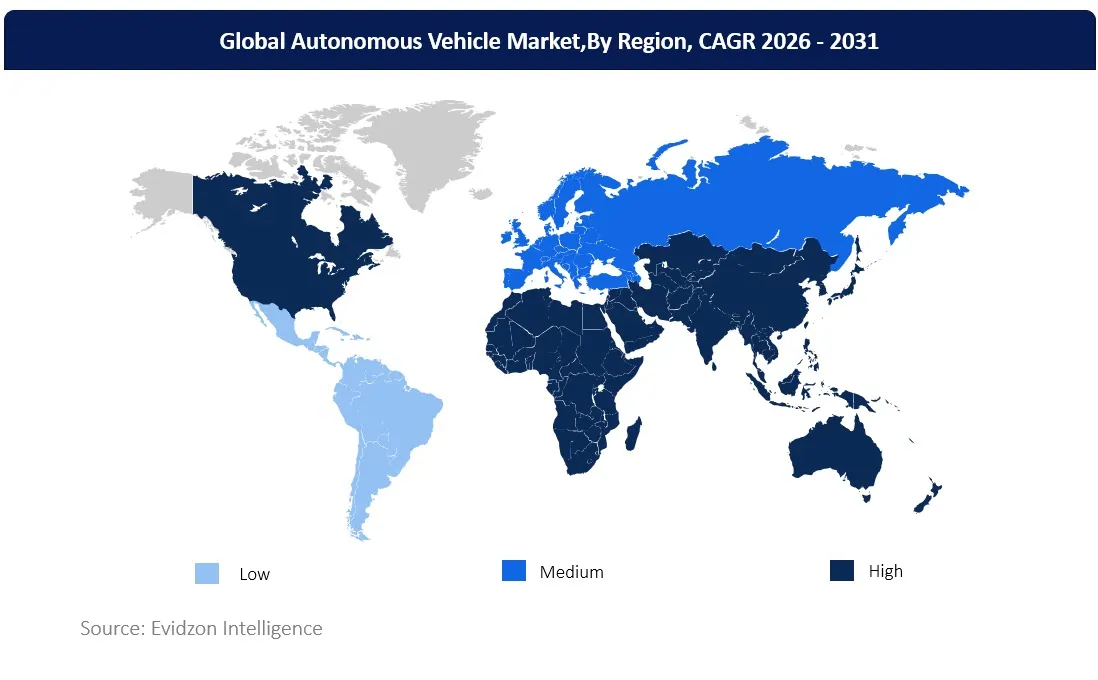
- By region, Asia-pacific accounts for 52.5% of the global autonomous vehicle market and Middle East and Africa is expected to grow at a CAGR of 24.9% through 2031.
About the Study
The global autonomous vehicle market study covers the factory-produced and OEM-sold vehicles equipped with SAE Level 1, Level 2/2+, Level 3, Level 4, and Level 5 driving-automation capabilities with analysis by automation level, application, vehicle type, propulsion across major global regions and countries. The study excludes standalone retrofitted aftermarket autonomous systems, autonomous-driving software suppliers, mapping providers, autonomous-driving technology companies selling systems independently, robo-taxi operators' service revenue, autonomous-driving infrastructure and standalone ADAS components.
Market Dynamics Analysis
Drivers
The market for autonomous vehicles is primarily driven in the near future by the growing use of ADAS.
As a differentiator, OEMs are using more advanced ADAS.
Reducing driver workload and offering collision avoidance capabilities, autonomous features offers cutting-edge safety features.
Level 4 vehicles take over driving duties from the driver, marking a major shift in commercial applications.
OEMs are implementing increasingly complex autonomous features through software updates and new vehicle designs.
EVs offer electronic architecture for autonomous driving, especially in situations requiring high electrical power availability and centralized computation.
Restraints
Advanced automation raises the cost of vehicles by requiring more sensors, processors, redundant systems, software development, and validation.
Compared to Level 1-2 systems, Level 3-5 deployment is subject to stricter regulations.
Driver attentiveness is still necessary for Level 2 systems. For OEMs, improper or excessive dependence on automation is still a problem.
Higher automation is technically challenging due to urban traffic, bad weather, construction zones, poor road markings, and erratic road users.
From driving assistance to increasingly automated OEM vehicle platforms the global autonomous vehicle market is transitioning dominantly, with a greater near-term business economics around Level 1, Level 2 and Level 2+ automation levels. Level 1 will witness an increase adoption across emerging markets like Middle East and Africa and South America with limited infrastructure readiness and serves as a transitional technology. Whereas, regions like Asia-Pacific, Europe and North America will witness an aggressive transition towards Level 2+ automation over the next decade. Increasing electric vehicle adoption across the globe is an added advantage for the autonomous vehicle market, as EVs have better integration of automation systems due to less mechanical complexity.
Regulatory uncertainty, high vehicle and system costs, limitations in real-world operating conditions, consumer trust, and the complexity of deploying higher levels of automation at scale are some of the major roadblocks of autonomous market growth. Level 3 and above automation level requires significant reliability and safety demonstration as it replace the human intervention. Additionally regulatory requirements across countries furthers adds up to the complexity of vehicle development and commercialization.
Segment Analysis
By Automation Level
Level 2/2+ automation level accounts for the highest market share of nearly 36% in 2025. The ability to be deployed across broader vehicle type at affordable price point with minimal compliance requirements led the growth of L2/L2+ ADAS vehicles. Over the next half decade the market share of L2/L2+ ADAS vehicles are expected to grow by 1.5X. OEMs are increasingly competing on L2/L2+ ADAS vehicles with multiple features creating major volume and revenue opportunity from this segment over the forecast period.
Level 4 is anticipated to be the fastest automation level with 38% CAGR by 2031, owing to the increasing adoption and continuous technology advancement for the applications like robotaxi. Robotaxis offering commercial services across 11 China cities and 10 United States cities in H12026. The commercial services in number of cities across United States has been doubled over the last calendar year. L2/L2+ is emerging as the commercial center of gravity of vehicle automation, combining substantially broader addressable volumes than L3–L5 with a lower regulatory and liability burden.
Global Autonomous Vehicle Market, By Automation Level, Market Share, 2025
By Application
Personal ownership represents the largest application category with 75% market share in global autonomous vehicle market, whereas commercial vehicles are anticipated to expand at 32% CAGR through 2031. The increasing customer acceptance of automated driving capabilities in passenger cars has led OEM to integrate ADAS beyond premium models into higher-volume vehicle platforms and represent it as a vehicle differentiator. A major transition on L1 automation has been already done, which created an adoption pathway to shift towards L2/L2+ automation.
However, commercial application is taking pace as the cost of robo taxis has decreased by nearly 30% since inception. For instance, Waymo’s Jaguar I-Pace initially costed around USD 100,000 but by reducing number of sensors the cost has come down to USD 70,000. Similarly, Apollo RT6 self-driving car cost has reduced to under USD 30,000. Such cost reduction will reduce the upfront cost of autonomous vehicle making it economically viable in applications like robotaxis.
Global Autonomous Vehicle Market, By Application, Market Share, 2025
Geographic Analysis
Largest Region
Asia Pacific registered the highest market share of 52.5% in 2025 of global autonomous vehicle market. Asia Pacific is primarily leading by China's enormous automotive production base, rapid penetration of intelligent-driving features, strong domestic OEM competition and increasing commercialization of higher-level autonomous vehicles. Chinese OEMs include BYD Auto, Changan, Chery, Geely, GWM, Leapmotor, Li Auto, NIO, SAIC and XPeng are increasingly focus on L1 and L2/L2+ ADAS functions for mass-market deployment.
More than half of the growth in electric car sales worldwide in 2025 came from China, and 60% of the world's electric car sales came from Chinese automakers, offering a sizable vehicle base for the integration of software-defined and autonomous driving technologies. China is anticipated to be Asia Pacific's main growth engine, especially for Level 2+, Level 3, and eventually Level 4 OEM automobiles. Compared to most other countries, China's sizable domestic car industry offers manufacturers a far broader testing and commercialization base.
Global Autonomous Vehicle Market, By Region, Market Share, 2025
Fastest-Growing Region
Middle East and Africa is projected to be the fastest region in global autonomous vehicle by 2031 accounting for 24.9% CAGR. In MEA, adoption is still concentrated in a small number of technologically advanced markets, like Saudi Arabia and the United Arab Emirates (UAE). Government-led smart-mobility programs, autonomous taxis, shuttle services, connected infrastructure, and extensive urban mobility efforts are driving the region's development more than traditional private-vehicle adoption of Level 3–5 technology.
The UAE, particularly Dubai and Abu Dhabi, is now the most advanced market for autonomous vehicles in the Middle East and North Africa. Baidu Apollo Go, WeRide, and Pony.ai reportedly started testing more than 60 self-driving cars in Jumeirah and Umm Suqeim, according to Dubai. Additionally, Dubai has created an own regulatory structure. The emirate published Law No. 9 of 2023 in April 2023 to regulate autonomous vehicle operations. This law supports the emirate's 25% autonomous-transport goal and offers a legal framework for autonomous vehicle testing and deployment.
Competitive Landscape
- 1Tesla, Inc.
- 2Mercedes-Benz Group AG
- 3BMW Group
- 4General Motors Company
- 5Ford Motor Company
Market Concentration Level: Consolidated
The global autonomous vehicle market is concentrated with key players including Tesla, Inc., Mercedes-Benz Group AG, BMW Group, General Motors Company, and Ford Motor Company. Key automotive companies are working along with component and sensor manufacturers to reduce the upfront cost of autonomous vehicles. Companies like Waymo and Baidu are working around reducing the number of sensors and alternative technologies to minimize the integration cost. Whereas, Tesla is working on autonomous technology solely reliable on cameras to achieve a drastic cost reduction. As autonomous-driving functionality shifts from luxury distinction to general car acceptance, OEMs with robust software expertise, centralized vehicle architectures, large-scale production, and access to vehicle data are expected to have an advantage.
Recent Development
Waymo Enters Singapore Autonomous Mobility Market
Singapore’s Land Transport Authority named Waymo as the country’s newest autonomous vehicle operator, alongside ComfortDelGro and Grab. Waymo’s vehicles are expected to arrive in the coming months, with initial manual driving planned for 2027 and commercial ride-hailing services targeted for 2028, subject to safety and regulatory requirements.
China approved first mandatory national standard for L3 and L4 autonomous vehicles
Jointly the Ministry of Industry and Information Technology (MIIT), with the State Administration for Market Regulation has approved the China’s first mandatory national standards (GB 44721-2026) for L3 and L4 autonomous driving systems for M-category passenger vehicles and N-category commercial vehicles, with effect from July 1, 2027 onwards.
India Waived-off licensing requirements of Short-Range Automotive Radar
The Department of Telecommunications has removed licensing requirements for short-range automotive radar systems operating in the 77–81 GHz frequency band, aligned with the international regulatory frameworks European Union, United States, Japan, and South Korea, allowing smoother deployment of advanced vehicle safety technologies in India.
Table of Content
- 1.Introduction
- 1.1Scope and Objective of the Study
- 1.2Market Definition & Study Assumptions
- 2.Research Methodology
- 3.Executive Summary
- 4.Market Outlook
- 4.1Market Overview
- 4.2Market Drivers
- 4.2.1Growing Adoption of Advanced Driver Assistance Systems
- 4.2.2Increasing OEM Competition
- 4.2.3Increasing Customer Demand for Safety
- 4.2.4Development of Level 4 Vehicles
- 4.2.5Growing Adoption of Software-Defined cars
- 4.2.6Increasing Electric Vehicle Adoption
- 4.3Market Restraint
- 4.3.1High Vehicle Cost
- 4.3.2Regulatory Restrictions
- 4.3.3Consumer Trust and Driver Monitoring
- 4.3.4Complex Driving Environments
- 4.4Regulatory Landscape
- 4.5Supply/Value Chain Analysis
- 4.6Porter's Five Forces Analysis
- 4.6.1Threat of New Entrants
- 4.6.2Bargaining Power of Buyers
- 4.6.3Bargaining Power of Suppliers
- 4.6.4Threat of Substitutes
- 4.6.5Competitive Rivalry
- 5.Market Segmentation (Includes market size in Value (USD) and Volume (Units), Forecast up to 2031, and market analysis with growth attributes)
- 5.1By Automation Level
- 5.1.1Level 1(Driver Assistance)
- 5.1.2Level 2 (Partial Automation)
- 5.1.3Level 3 (Conditional Automation)
- 5.1.4Level 4 (High Automation)
- 5.1.5Level 5 (Full Automation)
- 5.2By Application
- 5.2.1Personal Ownership
- 5.2.2Commercial Applications (Shuttle services, Robo-taxi, etc.)
- 5.3By Vehicle Type
- 5.3.1Passenger Car
- 5.3.1.1Hatchback
- 5.3.1.2Sedan
- 5.3.1.3SUV
- 5.3.1.4Multi-Purpose Vehicle (MPV)
- 5.3.1.5Others (Crossover, Coupe, Convertible, Wagon)
- 5.3.2Commercial Vehicle
- 5.3.2.1Light Commercial Vehicle
- 5.3.2.2Medium and Heavy-Duty Trucks
- 5.3.2.3Bus and Coach
- 5.4By Propulsion
- 5.4.1Internal Combustion Engine (ICE)
- 5.4.1.1Petrol / Gasoline
- 5.4.1.2Diesel
- 5.4.1.3CNG/LPG
- 5.4.2Hybrid Electric Vehicle (HEV)
- 5.4.3Plug-in Hybrid Electric Vehicle (PHEV)
- 5.4.4Battery Electric Vehicle (BEV)
- 5.5By Region
- 5.5.1North America
- 5.5.1.1United States
- 5.5.1.2Canada
- 5.5.2Latin America
- 5.5.2.1Brazil
- 5.5.2.2Argentina
- 5.5.2.3Mexico
- 5.5.2.4Rest of Latin America
- 5.5.3Europe
- 5.5.3.1Germany
- 5.5.3.2Italy
- 5.5.3.3France
- 5.5.3.4Spain
- 5.5.3.5United Kingdom
- 5.5.3.6Russia
- 5.5.3.7Rest of Europe
- 5.5.4Asia Pacific
- 5.5.4.1China
- 5.5.4.2India
- 5.5.4.3Japan
- 5.5.4.4South Korea
- 5.5.4.5Indonesia
- 5.5.4.6Australia
- 5.5.4.7Rest of Asia-Pacific
- 5.5.5Middle East & Africa
- 5.5.5.1Saudi Arabia
- 5.5.5.2United Arab Emirates (UAE)
- 5.5.5.3South Africa
- 5.5.5.4Egypt
- 5.5.5.5Rest of the Middle East & Africa
- 6.Competitive Landscape
- 6.1Market Concentration Overview
- 6.2Market Share Analysis
- 6.3Company Profiles
- 6.3.1Tesla, Inc.
- 6.3.2Mercedes-Benz Group AG
- 6.3.3BMW Group
- 6.3.4General Motors Company
- 6.3.5Ford Motor Company
- 6.3.6Toyota Motor Corporation
- 6.3.7Volkswagen Group
- 6.3.8Hyundai Motor Group
- 6.3.9Honda Motor Co., Ltd.
- 6.3.10Nissan Motor Co., Ltd.
- 6.3.11Stellantis N.V.
- 6.3.12Volvo Cars
- 6.3.13BYD Company Limited
- 6.3.14Geely
- 6.3.15SAIC Motor
- 7.Future Outlook
- 7.1Growth Opportunities & White-Space Analysis
- 7.2Analyst Recommendations
Market Size Methodology
The market value is calculated by multiplying the sales volume of vehicles equipped with qualifying autonomous-driving functionality by the corresponding average vehicle price. New-vehicle sales are used as the primary demand indicator, with vehicles classified across Level 1, Level 2/2+, Level 3, Level 4 and Level 5 automation. Market sizing is further segmented by automation level, application, vehicle type, propulsion, price segment and country/region to capture differences in technology adoption and vehicle configuration.
OEM model specifications, vehicle registrations, autonomous-driving deployment data, government statistics, industry associations, company disclosures and regulatory filings are used to benchmark historical values.
Forecasts consider vehicle sales, autonomous-functionality penetration, migration across automation levels, vehicle and propulsion mix, average vehicle prices, sensor and computing content, software integration, OEM deployment plans, technology maturity, regulatory approvals, infrastructure readiness and regional driving conditions.
FAQ
What is the global autonomous vehicle market size and its expected growth through 2031?
The global autonomous vehicle market was valued at USD 1,461.8 billion in 2025 and is projected to reach USD 1,720.3 billion in 2026 and USD 3,829.5 billion by 2031, growing at a CAGR of 17.4% during 2026–2031.
Which automation level holds the largest share of the global autonomous vehicle market?
Level 2/2+ accounts for the largest share of the global autonomous vehicle market, representing nearly 36% in 2025.
Which application segment dominates the global autonomous vehicle market?
Personal ownership dominates the global autonomous vehicle market, accounting for more than 75% of the market in 2025.
Which region leads the global autonomous vehicle market, and which is expected to grow fastest?
Asia-Pacific leads the global autonomous vehicle market, accounting for 52.5% of the market in 2025, driven primarily by China's automotive production base and adoption of intelligent-driving technologies. Middle East and Africa is projected to be the fastest-growing region, with a CAGR of 24.9% during 2026–2031.
Who are the major players in the global autonomous vehicle market?
Tesla, Inc., Mercedes-Benz Group AG, BMW Group, General Motors Company, and Ford Motor Company are the major players in the global autonomous vehicle market.
Have a question about this report?
Talk to the analyst behind this research, or browse the full report catalogue.
Contact Us