
Global Vehicle Recycling market
The global vehicle recycling market report is segmented by vehicle type (Passenger Car and Commercial Vehicle), by propulsion (ICE, HEV, PHEV, BEV), by component (Engine & Powertrain, Transmission, Electric Motor, Battery, Catalytic Converter, Alternator & Starter, ECUs & Electronics, Wheels & Tyres, Body Panels, Interior Components, Glass, and Other Components), by recovered material (Metal, Plastics, Rubber, Glass, Fluids, and Other Materials), by recycling channel (Organized and Unorganized), and by region (North America, South America, Europe, Asia-Pacific, and Middle-East and Africa). The global vehicle recycling market report includes market size in value (USD) and forecast up to 2031.
Global Vehicle Recycling market
Market Size in USD Billion
Market Size Overview
USD Billion
Market Snapshot
- Study Period
- 2019-2031
- Forecast Period
- 2026-2031
- Base Year Market Size (2025)
- USD 175.78 Billion
- Market Size (2026)
- USD 188.37 Billion
- Market Size (2031)
- USD 245.34 Billion
- Growth Rate (2026-2031)
- 5.43 CAGR
- Market Concentration
- Fragmented
Major Players*





*Disclaimer: Major Players sorted in no particular order
Market Overview
The global vehicle recycling market value is anticipated to grow from USD 175.78 billion in 2025 to 188.37 billion in 2026 and expected to reach USD 245.34 billion in 2031 with a CAGR (2026-2031) of 5.43%.
Increasing end-of-life vehicles (ELVs), value of recyclable components, compliance on mandatory usage of recycled materials, and depleting cost of collection and processing are collectively shaping the global vehicle recycling market. The growing supply of vehicles reaching the end of their service life creates a perpetual supply of recyclable material, but the value of this output is determined by the ability to extract useful and valuable components during the dismantling process. Ferrous and non-ferrous metals dominates the value chain owing to high value, however, the processing cost, condition of ELVs, and availability of ELVs acquisition channels substantially impact the yield, while increasing electronic architectures in vehicles increase the complexity of recycling and increase the cost.
Key players operating in vehicle recycling market are broadening their operations from traditional salvaging of vehicles and scrap sales towards parts refurbishment. Recycling companies are emphasizing on vehicle-grading systems, digital parts inventories, automated material sorting, and establishing strong network with repair networks and secondary-material buyers. Whereas, OEMs are developing circular economy through recycling facilities and partnership with regional channels to improve ELV sourcing for recovering material, primarily fueled by regional government regulations on ELVs.
North America accounts for the highest value of recyclable material due to the significant vehicle parc, density of salvage and dismantling operations, and capability of multiple revenue streams from vehicle scrap. The region dominates the global vehicle recycling market in terms of size, but it is also seeing an increase in competition as the operations of OEMs and independent recyclers interact. Asia-Pacific is the second most significant region for the global vehicle recycling market, with many countries at various stages of adopting policies and practices for end-of-life vehicle management. China’s significant contribution to the overall number of vehicles, while India’s challenges in transitioning to a formalized system, where unorganized recyclers continue to dominate the market.
Key Takeaways
- By vehicle type, commercial vehicle recycling accounts for nearly 63.4% market share of the global vehicle recycling market in 2025 and expected to grow at a CAGR of 6.2% by 2031.
- By propulsion, internal combustion engine (ICE) remains the largest sub-segment accounting for nearly 91.2% of the global vehicle recycling market segment in 2025 and battery electric vehicle (BEV) is expected to grow at 18.5% CAGR by 2031.
- By component, engine & powertrain will remain accounting for the dominant market share with more than 24% in 2025, while battery is anticipated to foresee a CAGR of 21% during 2026-2031.
- By recovered material, metals will account for nearly 66% market value in 2025, however, other materials is anticipated to grow at 19.5% CAGR by 2031.
- By recycling channel, Unorganized channel accounts for more than 88% market share, and organized recycling channels is likely to register 22% CAGR during 2026-2031.
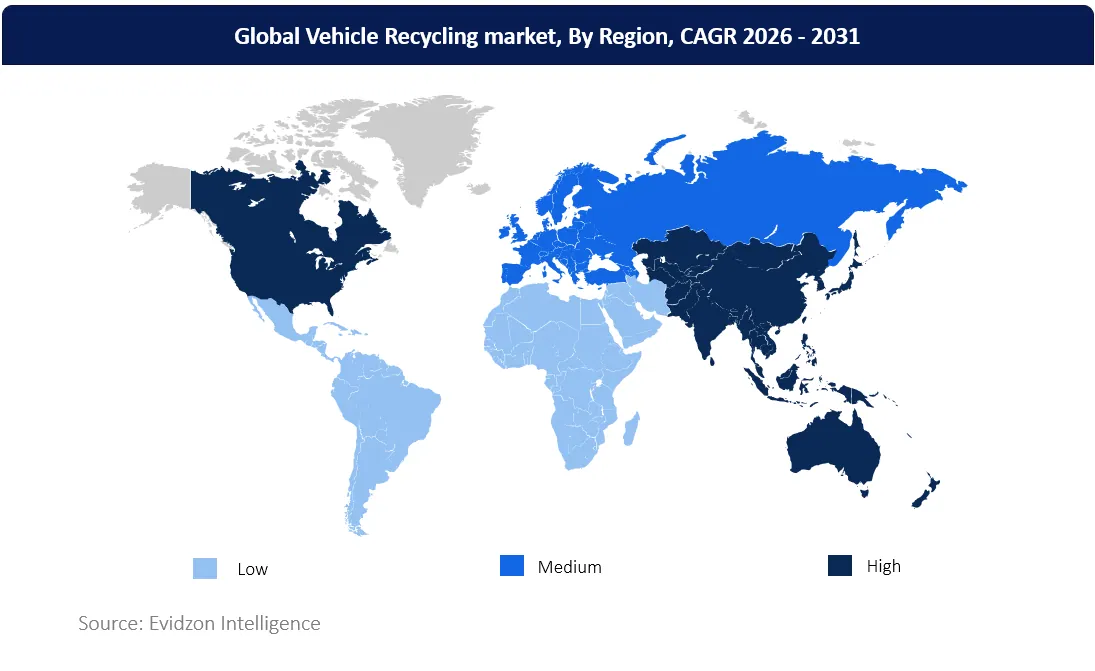
- By region, North America accounts for 47.4% of the global vehicle recycling market and Asia-pacific is expected to grow at a CAGR of 7.65% through 2031.
About the Study
The global vehicle recycling market study covers the end-of-life passenger and commercial vehicles, with analysis by vehicle type, powertrain, component, recovered material, recycling channel and major global regions and countries. The study covers ICE, HEV, PHEV and BEV vehicles to capture differences in vehicle composition, recoverable materials and battery content. The study excludes the original vehicle purchase or resale value, vehicles sold as used vehicles before reaching end-of-life, and downstream transactions involving recycled materials beyond the defined recycling market boundary.
Market Dynamics Analysis
Drivers
Automotive recycled-plastic mandates create demand for recovered end-of-life vehicle materials.
OEMs obligations promotes ELV collection and treatment beyond scrap-value economics.
Growing EV fleets will generate retired vehicles with batteries, motors and power electronics.
Retiring trucks and buses yield substantial recoverable metals and reusable assemblies.
Automated depollution, dismantling and sorting improve recovery quality and processing productivity.
Refurbished engines, transmissions and components generate value beyond bulk material recovery.
Restraints
Export demand extends vehicle lifetimes and diverts potential domestic recycling feedstock.
Unregulated operators capture valuable parts while leaving costly residues and compliance burdens.
Mixed plastics, foams and contaminated fines require costly separation or disposal.
High-voltage systems and damaged batteries require specialized procedures, equipment and storage.
Regulatory requirements, fleet electrification and the economics of recovering reusable components and materials from ELVs are collectively shaping the global vehicle recycling market landscape. The new EU Union ELV framework contains recycled-plastic requirements of 15% in 2032 and 25% in 2036 [Source: European Commission], including a requirement for ELV-derived plastics, thus creating a defined market for recovered automotive materials. Electrification is building a future stream of end-of-life vehicles containing traction batteries, electric motors, power electronics and conventional vehicle materials. With the aging and retirement of EVs, recyclers will recover both the structures of the vehicles as well as more valuable electrified components. Commercial fleet turnover provides additional source of heavier vehicles containing considerable metal content and re-usable components. OEMs responsibility compliances may help to reinforce the economics of collection, but enhanced dismantling technologies and stream of re-usable parts also allow recycling companies to raise the value recovery per vehicle.
Vehicle recycling is constrained by the difficulty of securing a reliable supply of vehicles for formal treatment and recovering sufficient value from each unit. Used-vehicle exports and extended use of second-hand vehicles delay the generation of ELVs, and allow informal dismantlers to extract engines, transmissions and other valuable components before vehicles reach the authorized recycling facilities. According to the European Commission, approximately 3.5 million vehicles are exported or illegally dumped from the EU every year, representing a considerable number of vehicles that are not subjected to traceability. Processing of such streams is also hampered by the fact that according to the EU, only 19% of plastics from ELVs are recycled, with the majority of the material being unrecoverable shredded metals, with limited sorting and valorization. Electrified vehicles involve additional complexity in terms of handling high voltages and batteries, which can add to the operational complexity.
Segment Analysis
By Vehicle Type
Commercial vehicle recycling accounts for the highest market share of nearly 63.4% in 2025 and anticipated to be the fastest recycling vehicle type with 6.2% CAGR by 2031. High material intensity, larger component assemblies and concentrated fleet replacement cycles resulting commercial vehicles to be the largest vehicle-type category in terms of value in the global vehicle recycling market. Substantially higher content of steel, aluminum, copper, powertrain components, tyres and other recoverable materials in commercial vehicles compared to passenger cars, increased the per commercial end-of-life-vehicle recovered value.
Additionally, commercial-vehicle recycling is moving from traditional metal recovery towards component refurbishing, remanufacturing, and higher-value parts recycling. Engines, transmissions, axles, wheels, catalytic converters, and other elements can be resold at significant value during the recycling process before the vehicle’s other materials are recovered. Key countries vehicle-scrapping infrastructure is similarly skewed towards commercial vehicles, with buses and medium and heavy-duty trucks figuring as one of the priority vehicle categories for scrapping.
Global Vehicle Recycling Market, By Vehicle Type, Market Share, 2025
Internal combustion engine (ICE) represents the largest propulsion category with 91.2% market share in global vehicle recycling market. However, battery electric vehicle (BEV) is anticipated to foresee a CAGR of 18.5% through 2031. Internal combustion engine (ICE) vehicles comprise the largest segment of propulsion, reflecting the age profile of the global ELV pool. The vehicles entering recycling facilities are overwhelmingly manufactured prior to the recent growth in BEV and PHEV adoption; thus, recycling volumes are currently driven by conventional engines, transmissions, exhaust systems and catalytic converters, lead-acid batteries and ferrous and non-ferrous metals. The economic structure of ICE recycling is well established, with maturity in dismantling networks and markets for used engines, transmissions, catalytic converters and metal scrap.
EV recycling is an emerging segment and is growing the fastest as a propulsion stream as a result of the growing fleet of electric vehicles and the eventual retirement of the early electric vehicles. Unlike ICE vehicles, BEVs introduce high value battery packs, electric motors, power electronics and further electronic control systems into the dismantling process. Thus, the economics of recyclers are shifting from metal recovery to diagnostics of batteries, safe high voltage dismantling, component reuse and critical material recovery. However, the transition will be gradual as the majority of recently deployed EV batteries have not yet reached end of life. By 2035, European Commission's new ELV framework expects to recover or reuse 5.4 million tones of materials, including 350 tons of rare earth materials collected for reuse and recycling.
Global Vehicle Recycling Market, By Propulsion, Market Share, 2025
Geographic Analysis
Largest Region
North America registered the highest market share of 47.4% in 2025 of global vehicle recycling market. North America remains the most developed vehicle recycling market, supported by the established dismantling ecosystem, high vehicle ownership, extensive salvage networks, and well-established secondary markets for used automotive components and recovered metals. The United States provides the market base, with large volumes of end-of-life vehicles supplied to dismantlers, salvage yards, parts-reuse businesses, shredders, and metal processors. The region’s relatively high average vehicle size and material intensity also increases the recoverable value per vehicle, particularly across steel, aluminum, copper, powertrain assemblies, catalytic converters, wheels, and reusable components.
The North America vehicle recycling market is transitioning from traditional conventional vehicle dismantling and metal recovery to high-value parts harvesting. The rise of hybrid and battery-electric vehicles is generating new demands for high-voltage deactivation, battery processing, electric-motor disassembly and electronics recovery, fundamentally altering capital requirements for recyclers, beyond just increases in vehicle volumes. Recycling companies with established parts-distribution channels are anticipated to capture highest value.
Global Vehicle Recycling Market, By Region, Market Share, 2025
Fastest-Growing Region
Asia-pacific is projected to be the fastest region in global vehicle recycling market by 2031 accounting for 7.65% CAGR. Asia-Pacific is the region with the fastest-growing market due to the increase in vehicle ownership and stricter government regulations regarding end-of-life vehicle collection, dismantling, and recovery. China is the biggest contributor to the region due to the high number of cars, growing new-energy vehicle market, and the need to dismantle old vehicles. The countries in the region have different levels of development in this area – Japan and South Korea have well-established networks, whereas Indian and several other Southeast Asian states are moving from informal scrapping to formalization.
The growth of China towards fully electric vehicles is especially crucial for the composition of future recycling feeds. While, India recycling market is shaping on the back of formalized regulations, according to the Environment Protection (End-of-Life Vehicles) Rules, 2025, the OEMs will be responsible for scrapping vehicles. The rules set that the number of vehicles for dismantling should be counted from those put on the market 15 years before for transport and 12 years before for non-transport vehicles. Therefore, the region will continue to develop due to the increasing number of vehicles, growing ELV stock, and developing electrified transport.
Competitive Landscape
- 1Guangdong Brunp Recycling Technology Co., Ltd.
- 2Shanghai Xinzhuang Auto Dismantling Co., Ltd.,
- 3Chongqing Renewable Resources Group Co., Ltd.
- 4Toyota Tsusho Corporation (Radius Recycling)
- 5GEM Co., Ltd.
Market Concentration Level: Fragmented
The global vehicle recycling market is fragmented, with a large amount of competitors concentrated around unorganized channels including independent dismantlers, scrap dealers, and informal recyclers. Compared to other regions, Europe is leading in terms of key players, as well as the most extensive end-of-life-vehicle (ELV) management system backed by the regulations established by the regional governments. In contrast, China is also growing rapidly with thousands of dismantlers registered by the government with appropriate equipment for processing vehicles.
The key organized vehicle recycling companies include GEM Co., Ltd., Stena Recycling AB, INDRA Automobile Recycling, Galloo Group, Derichebourg Group, Toyota Tsusho Corporation, European Metal Recycling Limited, LKQ Corporation, Fenix Parts, Inc., Pull-A-Part, LLC, Kuusakoski Group Oy, and others. The automobile recycling industry is characterized by a tendency to increase the amount of processed vehicles and focus on more efficient methods of recycling. Thus, the key players are improving their capacities by emphasizing the amount of vehicle parts that may be reused, using standardized equipment for automating the dismantling process, and ensuring traceability and compliance with regulations for recycled materials or components. Moreover, the companies are developing their networks of collection and incorporating multiple stages of recycling to make the most use of each vehicle brought to their facilities.
Recent Development
Porsche Manufactured EV Cells with Recycled Cathode Materials
Porsche and Cylib, a Germany based battery recycling company has jointly developed a battery cell consisting cathode material made up of recycled lithium, nickel, cobalt and manganese from end-of-life EV packs, in wake of passport rules, stricter European battery recovery, and traceability.
U.S. Department of Commerce Ban Export of Lithium-Ion Black Mass
The U.S. Department of Commerce's BIS prohibited the export of black mass from lithium-ion battery recycling and tungsten waste and scrap for one year, centralizing trade controls, critical minerals policy, and environmental regulation. Materials which were treated as waste management streams subjected to Resource Conservation and Recovery and Toxic Substances Control Act by battery recycling industry will now also subjected to defense production allocation requirements.
EU Council adopted new End-of-Life Vehicles (ELV) regulation
The new EU end-of-life vehicles (ELV) regulation mandates the circularity and recycled content targets for passenger cars and light commercial vans. The regulation states to achieve the usage of at least 15% of recycled plastic in manufacturing of new vehicles in 6 years with an increase to 25% recycled plastic within 10 years of the regulation enforced, with a minimum of 20% of recycled plastic recovered from end-of-life vehicles.
Table of Content
- 1.Introduction
- 1.1Scope and Objective of the Study
- 1.2Market Definition & Study Assumptions
- 2.Research Methodology
- 3.Executive Summary
- 4.Market Outlook
- 4.1Market Overview
- 4.2Market Drivers
- 4.2.1Mandatory Recycled-Content Requirements Create ELV Material Demand
- 4.2.2Extended OEM Responsibility Shifts ELV Collection Economics
- 4.2.3Electrification Expands Future End-of-Life Vehicle Feedstock
- 4.2.4Commercial Fleet Renewal Generates Heavy-Vehicle Recycling Feedstock
- 4.2.5Vehicle Dismantling Technology Improves Material Separation Yields
- 4.2.6Reusable Parts Markets Increase Revenue per Scrapped Vehicle
- 4.3Market Restraint
- 4.3.1Used-Vehicle Exports Delay Domestic ELV Availability
- 4.3.2Unorganized Dismantling Undercuts Authorized Treatment Economics
- 4.3.3Shredder Residue Disposal Constrains Material Recovery Margins
- 4.3.4Electrified Vehicle Architectures Complicate Safe Dismantling
- 4.4Regulatory Landscape
- 4.5Supply/Value Chain Analysis
- 4.6Porter's Five Forces Analysis
- 4.6.1Threat of New Entrants
- 4.6.2Bargaining Power of Buyers
- 4.6.3Bargaining Power of Suppliers
- 4.6.4Threat of Substitutes
- 4.6.5Competitive Rivalry
- 5.Market Segmentation (Includes market size in Value (USD), Forecast up to 2031, and market analysis with growth attributes)
- 5.1By Vehicle Type
- 5.1.1Passenger Car
- 5.1.2Commercial Vehicle
- 5.1.2.1Light Commercial Vehicle
- 5.1.2.2Medium and Heavy-Duty Trucks
- 5.1.2.3Bus and Coach
- 5.2By Propulsion
- 5.2.1Internal Combustion Engine (ICE)
- 5.2.1.1Petrol / Gasoline
- 5.2.1.2Diesel
- 5.2.1.3CNG/LPG
- 5.2.2Hybrid Electric Vehicle (HEV)
- 5.2.3Plug-in Hybrid Electric Vehicle (PHEV)
- 5.2.4Battery Electric Vehicle (BEV)
- 5.3By Component
- 5.3.1Engine & Powertrain
- 5.3.2Transmission
- 5.3.3Electric Motor
- 5.3.4Battery
- 5.3.5Catalytic Converter
- 5.3.6Alternator & Starter
- 5.3.7ECUs & Electronics
- 5.3.8Wheels & Tyres
- 5.3.9Body Panels
- 5.3.10Interior Components
- 5.3.11Glass
- 5.3.12Other Components
- 5.4By Recovered Material
- 5.4.1Metal
- 5.4.1.1Steel
- 5.4.1.2Iron
- 5.4.1.3Aluminium
- 5.4.1.4Copper
- 5.4.1.5Zinc
- 5.4.1.6Magnesium
- 5.4.1.7Nickel
- 5.4.1.8Lithium
- 5.4.1.9Palladium
- 5.4.1.10Rhodium
- 5.4.1.11Other metals
- 5.4.2Plastics
- 5.4.3Rubber
- 5.4.4Glass
- 5.4.5Fluids
- 5.4.6Other Materials
- 5.5By Recycling Channel
- 5.5.1Organized (RVSFs, OEM-linked Recycling Networks, Specialized EV Recyclers)
- 5.5.2Unorganized (Independent Dismantlers / Scrap Dealers / Informal Recyclers)
- 5.6By Region
- 5.6.1North America
- 5.6.1.1United States
- 5.6.1.2Canada
- 5.6.2Latin America
- 5.6.2.1Brazil
- 5.6.2.2Argentina
- 5.6.2.3Mexico
- 5.6.2.4Rest of Latin America
- 5.6.3Europe
- 5.6.3.1Germany
- 5.6.3.2Italy
- 5.6.3.3France
- 5.6.3.4Spain
- 5.6.3.5United Kingdom
- 5.6.3.6Russia
- 5.6.3.7Rest of Europe
- 5.6.4Asia Pacific
- 5.6.4.1China
- 5.6.4.2India
- 5.6.4.3Japan
- 5.6.4.4South Korea
- 5.6.4.5Indonesia
- 5.6.4.6Australia
- 5.6.4.7Rest of Asia-Pacific
- 5.6.5Middle East & Africa
- 5.6.5.1Saudi Arabia
- 5.6.5.2United Arab Emirates (UAE)
- 5.6.5.3South Africa
- 5.6.5.4Egypt
- 5.6.5.5Rest of the Middle East & Africa
- 6.Competitive Landscape
- 6.1Market Concentration Overview
- 6.2Market Share Analysis
- 6.3Company Profiles
- 6.3.1GEM Co., Ltd.
- 6.3.2Guangdong Brunp Recycling Technology Co., Ltd.
- 6.3.3Shanghai Xinzhuang Auto Dismantling Co., Ltd.,
- 6.3.4Chongqing Auto Scrap (Group) Co., Ltd.
- 6.3.5Toyota Tsusho Corporation (Radius Recycling)
- 6.3.6Fenix Parts, Inc.
- 6.3.7LKQ Corporation
- 6.3.8Stena Recycling AB
- 6.3.9INDRA Automobile Recycling
- 6.3.10Galloo Group
- 6.3.11Derichebourg Group
- 6.3.12European Metal Recycling Limited
- 6.3.13Sims Limited
- 6.3.14EMR Metal Recycling
- 6.3.15Kuusakoski Group Oy
- 7.Future Outlook
- 7.1Growth Opportunities & White-Space Analysis
- 7.2Analyst Recommendations
Market Size Methodology
The market value is calculated by multiplying the number of end-of-life vehicles entering the recycling stream by the corresponding average recoverable value per vehicle. EOL vehicle volumes are estimated using vehicle parc, new-vehicle registrations, vehicle survival rates, average vehicle lifespan and scrappage patterns.
Market sizing is further segmented by vehicle type, powertrain, component, recovered material, recycling channel and country/region to capture differences in vehicle mix, vehicle weight, material composition and recycling economics. Government statistics, vehicle registrations, industry associations, recycling authorities, company disclosures, regulatory filings and industry studies are used to benchmark historical values.
Forecasts consider vehicle parc, vehicle sales, average vehicle age, vehicle retirement rates, recycling penetration, vehicle and powertrain mix, EV adoption, battery retirement, recovery rates, recycled-material prices, reusable-parts value, recycling infrastructure, regulatory requirements and regional ELV policies.
FAQ
What is the projected size of the global vehicle recycling market by 2031?
The global vehicle recycling market is projected to grow from USD 175.78 billion in 2025 to USD 245.34 billion by 2031, registering a CAGR of 5.43% during 2026–2031.
Which vehicle type dominates the global vehicle recycling market?
Commercial vehicle recycling dominates the market, accounting for 63.4% of the market share in 2025.
Which propulsion segment holds the largest market share, and which is expected to grow fastest?
Internal combustion engine (ICE) vehicles account for the largest share, at 91.2% in 2025. Battery electric vehicle (BEV) recycling is projected to be the fastest-growing propulsion segment, with a CAGR of 18.5% through 2031.
Which region dominates the global vehicle recycling market, and which is expected to grow fastest?
North America leads the market, accounting for 47.4% of the global market in 2025. Asia-Pacific is projected to be the fastest-growing region, with a CAGR of 7.65% during 2026–2031.
Who are the key players in the global vehicle recycling market?
Guangdong Brunp Recycling Technology Co., Ltd., Shanghai Xinzhuang Auto Dismantling Co., Ltd., Chongqing Renewable Resources Group Co., Ltd., Toyota Tsusho Corporation (Radius Recycling), and GEM Co., Ltd. are the key players in the global vehicle recycling market.
Have a question about this report?
Talk to the analyst behind this research, or browse the full report catalogue.
Contact Us