
Global Passenger Car Market
The global passenger car market report is segmented by propulsion (ICE, HEV, PHEV, BEV, and FCEV), by vehicle type (Hatchback, Sedan, SUV, Multi-Purpose Vehicle (MPV), and Others), by price segment (Economy, Mid-range, Premium, and Luxury), by sales channel (Dealer/Distributor and Online Sales), by end user (Individual and Fleet Owners), and by region (North America, South America, Europe, Asia-Pacific, and Middle-East and Africa). The global passenger car market report includes market size in value (USD) and volume (Units), and forecast up to 2031.
Global Passenger Car Market
Market Size in USD Billion
Market Size Overview
USD Billion
Market Snapshot
- Study Period
- 2019-2031
- Forecast Period
- 2026-2031
- Base Year Market Size (2025)
- USD 1,889 Billion
- Market Size (2026)
- USD 2,019 Billion
- Market Size (2031)
- USD 3,022 Billion
- Growth Rate (2026-2031)
- 8.40% CAGR
- Market Concentration
- Consolidated
Major Players*




*Disclaimer: Major Players sorted in no particular order
Market Overview
The global passenger car market value is anticipated to grow from USD 1,889 billion in 2025 to 2,019 billion in 2026 and expected to reach USD 3,022 billion in 2031 with a CAGR (2026-2031) of 8.4%.
The global passenger car market is witnessing a dynamic shift in customer buying preferences towards electric propulsion, SUV body type, higher safety standards, and new-age technologies like connected features and ADAS. This significant structural transformation is coupled with consumer preferences, technological advancement, electrification, stricter emissions requirements, and evolving vehicle ownership patterns. Technologically integrated mobility platforms, with connected features, advanced driver-assistance systems, digital interfaces, and electric powertrains are the key attributes of product differentiation.
Electric vehicles are the strongest structural force shaping the demand of passenger car market. Electric and hybrid cars accounts for more than 30% market share in global car sales volume. Asia is expected to remain center of the global passenger car demand driven by large automotive ecosystem and demand lever countries including China, Japan, India, Indonesia, and South Korea. China has the largest influence across global supply and produced nearly 16 million electric cars, equivalent to nearly three-quarters of global electric-car production [Source: IEA].
However, evolving electrification policies, fleet renewal and emissions regulations are influencing purchasing decisions of customers across European markets. Whereas, aggressive expansion strategies of China based players in electric and hybrid powertrain is increasing competitiveness level across the globe. Affordability, electrification, SUV adoption, technological integration, regional regulations, and regional economic development are expected to shape the demand curve of passenger cars over the forecast period.
Key Takeaways
- By propulsion, internal combustion engine (ICE) remains the largest sub-segment accounting for nearly 75% passenger car segment in 2025. Whereas, BEVs are expected to be the fastest, growing at 17% CAGR by 2031.
- By vehicle type, SUVs accounts for nearly 50% market share in 2025 and expected to grow at a CAGR of 14.5% by 2031.
- By price segment, economy segment has registered the highest market value share of nearly 60%, whereas the luxury segment of global passenger car market is expected to ride at the highest CAGR rate of 14% over the forecast period.
- By sales channel, dealer / distributor accounts for more than 92% market share in 2025, meanwhile, online sales are projected to grow at 16% CAGR through 2031.
- By end user, individual users will remain the dominant demand base with more than 75% market share. However, increasing mobility-as-a-services segment will drive the demand from fleet owners at 12% CAGR by 2031.
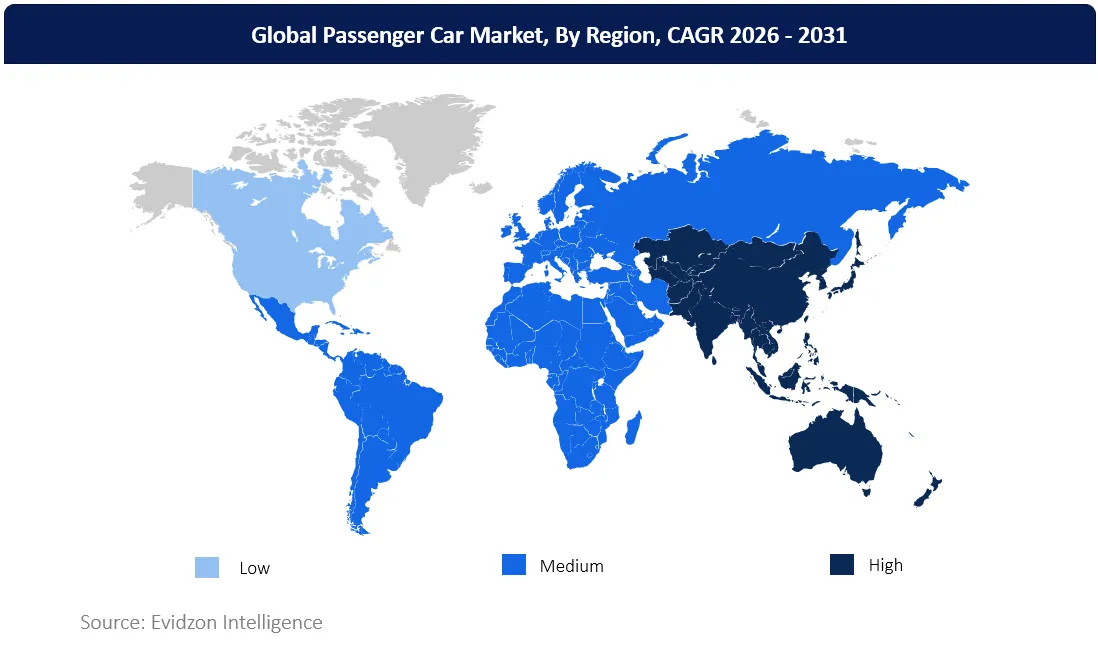
- By region, Asia-pacific accounts for more than 50% of the global passenger car market on the back of automobile demand centers like China, Japan, India, Indonesia, and South Korea and anticipated to be fastest growing market at 10.5% CAGR by 2031.
About the Study
The global passenger car market study covers the new passenger vehicles across different propulsion technologies, vehicle body types, price categories, sales channels and end-user groups, with analysis across major global regions and countries. The study excludes commercial vehicles, buses, trucks, two-wheelers, used vehicles, standalone aftermarket services, vehicle components, batteries, charging infrastructure and any other mobility services.
Market Dynamics Analysis
Drivers
Expanding middle-class populations increase first-time vehicle purchases across emerging markets.
Customer preference for space, visibility and versatility continues shifting demand toward SUVs.
BEV, HEV and PHEV adoption expands addressable demand and accelerates model replacement cycles.
ADAS, connectivity and digital cockpits increase perceived vehicle value and replacement appeal.
Urban expansion creates demand for convenient private transportation and smaller efficient vehicles.
Incentives and emissions standards accelerate technology transitions and stimulate new-model investment.
Restraints
Elevated vehicle prices and borrowing costs can delay purchases and extend replacement cycles.
Semiconductor shortages, raw-material constraints and logistics disruptions can restrict production and increase vehicle costs.
Stricter emissions, safety and efficiency requirements increase development and manufacturing expenses for automakers.
Aggressive pricing and expanding Chinese OEM presence are increasing competitive pressure and reducing industry margins.
Rising household mobility requirements, urbanization and increasing purchasing power across emerging economies are anticipated to fuel the demand for passenger cars. However, increasing SUVs adoption is the key attribute due to increasingly customer preferences towards higher seating positions, cabin space, perceived safety and multifunctional use. Whereas, electric propulsion vehicles are creating a new automotive ecosystem and a new product cycle, with BEVs, hybrids and plug-in hybrids. A strong transition on BEVs over the past half-decade across the major countries has shown the growth potential and continued increasing penetration on the back of favorable regional government policies and initiatives.
Affordability, financing costs, supply-chain volatility and increasingly intense competition are some of the key market restraints of global passenger car market. In addition to this, Tariffs, localization requirements and geopolitical uncertainty can further increase production costs leading to impact the price dynamics. Further, OEMs' ability to balance electrification investment, pricing competitiveness, supply-chain resilience and profitability is the attributes which will craft the growth trajectory over the long-run.
Segment Analysis
By Propulsion
In 2025, internal combustion engine (ICE) accounts for nearly 75% market share in global passenger car market. Extensive installed base, mature refueling infrastructure, broad model availability and comparatively established ownership economics is supporting the internal combustion engine segment resulting to remain the dominant propulsion category in the global passenger car market. In internal combustion engine (ICE) petrol/gasoline vehicles has a broader customer acceptance due to its availability and suitability across passenger-car applications, while diesels has relevant in selected category across specific regions.
In contrast to this, battery electric vehicle (BEV) is anticipated to grow at a CAGR of 17% by 2031, gaining traction on the back of favorable regional policies, incentives and a positive advantage in total cost of ownership (TCO). In addition to this, expanding charging infrastructure, increasing model availability and improving battery technology are the growth catalyst factors. Hybrid electric vehicle (HEV) and plug-in hybrid electric vehicle (PHEV) are gaining relevance as transitional technology from conventional ICE vehicles to BEVs.
Global Passenger Car Market, By Propulsion, Market Share, 2025
By Vehicle Type
SUVs (Sports Utility vehicle) accounts for 50% of global passenger car sales in 2025, insulated by strong consumer preference for spacious interiors, higher seating positions, perceived safety, versatility and lifestyle-oriented designs.
Customers seeking compact dimensions, affordability and urban maneuverability, particularly in densely populated markets will continue to prefer hatchbacks. However, sedans will make their space when customer purchasing decision is influenced by comfort, efficiency and traditional body styling remain important purchasing considerations. In others (crossovers, coupes, convertibles and wagons), benefits from increasing product diversification and the crossoverization of traditional vehicle formats.
Global Passenger Car Market, By Vehicle Type, Market Share, 2025
Geographic Analysis
Largest Region
Asia Pacific accounts for 50% of the global passenger car market in 2025. China's vast vehicle ecosystem, Japan's mature replacement market, India's expanding ownership base, Indonesia’s emerging automobile landscape, and South Korea's globally integrated OEM industry is majorly driving the Asia pacific passenger car market. The combination of large consumer populations, expanding urbanization, increasing household mobility requirements and strong localize manufacturing capabilities is complimenting the growth curve.
China’s dominance in electric vehicle supply chain and expertise in localized manufacturing allows to remain the principal demand and production center. Increasing motorization rate, rising income levels, urban infrastructure development, ease in financing, and supportive government policies for automotive production is creating a long-term opportunity. Strong battery manufacturing capabilities, expanding EV model availability and significant investment across the automotive value chain enables region to be in a center role of automobile electrification.
Global Passenger Car Market, By Region, Market Share, 2025
Fastest-Growing Region
Increasing vehicle sales volume of key countries including China, India, Japan, and South Korea is the principal factor which anticipates Asia Pacific growth at 10.5% CAGR through 2031. South East Asian markets including Indonesia, Malaysia, Philippines, and Vietnam is transitioning from earlier stage of vehicle ownership expansion, creating greater headroom for incremental passenger vehicle sales compared with mature markets in North America and Europe.
Sales volume of passenger cars across China, India, Japan, and South Korea has registered an increase of 9.2%, 5%, 3%, 4.2% respectively in 2025 in comparison to 2024 [Source: OICA]. Whereas, mature market like Europe and United States has registered a Y-o-Y sales growth of 1.2% and -8.3% [Source: OICA]. OEMs based in Asia pacific with established market presence are investing heavily in electric vehicles development and new-age digital technologies to make their product portfolio resilient against the increasing. Transition towards low-emission coupled with replacement demand and increasing availability of electric and hybrid models vehicles will continue to fuel the Asia Pacific passenger car market over the next decade.
Competitive Landscape
- 1Toyota Motor Corporation
- 2Renault-Nissan Alliance
- 3Hyundai Motor Group
- 4Volkswagen Group
- 5General Motors
Market Concentration Level: Consolidated
Japanese, European, American and Korean automakers alongside rapidly expanding Chinese manufacturers are shaping the competitive landscape of global passenger car market. Key OEMs are competing by differentiating their product portfolio, brand strength, manufacturing scale, dealer networks, technological capabilities and geographic reach. Chinese passenger car manufacturers are increasingly reshaping competitive dynamics through aggressive EV expansion, vertical integration and international market entry. The global passenger car market competitive landscape is aggressively centered on the electrification, software, ADAS, pricing, product localization and supply-chain efficiency.
Recent Development
Toyota Announces USD 1.34 Billion Investment in Argentina’s Electrified-Vehicle Manufacturing
Toyota announced plans to invest USD 1.34 billion in a new manufacturing facility in Argentina for electric vehicle manufacturing. However, the plant’s location, production capacity or vehicle model is not yet disclosed.
Kia India Plans to Expand India Plant Capacity
Kia Corporation, a South Korea based company has announced to expand the India plant capacity with a vision of multi-powertrain approach across ICE, EVs, strong hybrids and CNG and targets annual domestic sales of 4.10 lakh units by 2030.
GM and SAIC Renew China JV Till 2047
General Motors announced an extension of 20 years China joint venture partnership with SAIC Motor to 2047. GM-SAIC will increase focus on the Buick and Cadillac brands in China along with a plan to launch 30 new energy vehicle by 2030.
Table of Content
- 1.Introduction
- 1.1Scope and Objective of the Study
- 1.2Market Definition & Study Assumptions
- 2.Research Methodology
- 3.Executive Summary
- 4.Market Outlook
- 4.1Market Overview
- 4.2Market Drivers
- 4.2.1Rising vehicle ownership in emerging economies
- 4.2.2Increasing customer preferences for SUVs
- 4.2.3Electrification and powertrain diversification
- 4.2.4Advanced safety and connected technologies
- 4.2.5Urbanization and mobility requirements
- 4.2.6Government incentives and emissions regulation
- 4.3Market Restraint
- 4.3.1High vehicle purchase and financing costs
- 4.3.2Supply-chain disruptions
- 4.3.3Increasing regulatory compliance costs
- 4.3.4Intensifying price competition
- 4.4Regulatory Landscape
- 4.5Supply/Value Chain Analysis
- 4.6Porter's Five Forces Analysis
- 4.6.1Threat of New Entrants
- 4.6.2Bargaining Power of Buyers
- 4.6.3Bargaining Power of Suppliers
- 4.6.4Threat of Substitutes
- 4.6.5Competitive Rivalry
- 5.Market Segmentation (Includes market size in Value (USD) and Volume (Units), Forecast up to 2031, and market analysis with growth attributes)
- 5.1By Propulsion
- 5.1.1Internal Combustion Engine (ICE)
- 5.1.1.1Petrol / Gasoline
- 5.1.1.2Diesel
- 5.1.1.3CNG/LPG
- 5.1.2Hybrid Electric Vehicle (HEV)
- 5.1.3Plug-in Hybrid Electric Vehicle (PHEV)
- 5.1.4Battery Electric Vehicle (BEV)
- 5.1.5Fuel Cell Electric Vehicle (FCEV)
- 5.2By Vehicle Type
- 5.2.1Hatchback
- 5.2.2Sedan
- 5.2.3SUV
- 5.2.4Multi-Purpose Vehicle (MPV)
- 5.2.5Others (Crossover, Coupe, Convertible, Wagon)
- 5.3By Price Segment
- 5.3.1Economy
- 5.3.2Mid-range
- 5.3.3Premium
- 5.3.4Luxury
- 5.4By Sales Channel
- 5.4.1Dealer / Distributor
- 5.4.2Online Sales
- 5.5By End User
- 5.5.1Individual
- 5.5.2Fleet
- 5.6By Region
- 5.6.1North America
- 5.6.1.1United States
- 5.6.1.2Canada
- 5.6.2Latin America
- 5.6.2.1Brazil
- 5.6.2.2Argentina
- 5.6.2.3Mexico
- 5.6.2.4Rest of Latin America
- 5.6.3Europe
- 5.6.3.1Germany
- 5.6.3.2Italy
- 5.6.3.3France
- 5.6.3.4Spain
- 5.6.3.5United Kingdom
- 5.6.3.6Russia
- 5.6.3.7Rest of Europe
- 5.6.4Asia Pacific
- 5.6.4.1China
- 5.6.4.2India
- 5.6.4.3Japan
- 5.6.4.4South Korea
- 5.6.4.5Indonesia
- 5.6.4.6Australia
- 5.6.4.7Rest of Asia-Pacific
- 5.6.5Middle East & Africa
- 5.6.5.1Saudi Arabia
- 5.6.5.2United Arab Emirates (UAE)
- 5.6.5.3South Africa
- 5.6.5.4Egypt
- 5.6.5.5Rest of the Middle East & Africa
- 6.Competitive Landscape
- 6.1Market Concentration Overview
- 6.2Market Share Analysis
- 6.3Company Profiles
- 6.3.1Toyota Group
- 6.3.2Volkswagen Group
- 6.3.3Hyundai-Kia
- 6.3.4Renault-Nissan Alliance
- 6.3.5General Motors
- 6.3.6Stellantis
- 6.3.7Honda Motor
- 6.3.8Ford Group
- 6.3.9BYD
- 6.3.10Suzuki
- 6.3.11Geely Group
- 6.3.12BMW Group
- 6.3.13Mercedes-Benz Group
- 6.3.14Chery Group
- 6.3.15SAIC Motor
- 7.Future Outlook
- 7.1Growth Opportunities & White-Space Analysis
- 7.2Analyst Recommendations
Market Size Methodology
Market value is calculated using new passenger vehicle sales volume multiplied by the corresponding average selling price (ASP). ASP is estimated by vehicle type, propulsion, price segment and country to capture differences in product mix and pricing. Historical estimates are benchmarked against vehicle registrations, OEM sales disclosures, government statistics, industry associations and company filings. Forecasts incorporate expected changes in vehicle volume, powertrain mix, vehicle pricing, technology content, consumer demand and regulatory conditions.
FAQ
What is the projected size of the global passenger car market by 2031?
The global passenger car market is valued at USD 1,889 billion in 2025 and is projected to reach USD 3,022 billion by 2031, growing at a CAGR of 8.4% during 2026–2031.
Which propulsion segment dominates the global passenger car market, and which is expected to grow fastest?
Internal combustion engine (ICE) vehicles account for approximately 75% of the market in 2025, while battery electric vehicles (BEVs) are projected to grow at a CAGR of 17% through 2031.
Which vehicle type holds the largest share of the global passenger car market?
SUVs account for approximately 50% of the market in 2025 and are projected to grow at a CAGR of 14.5% through 2031.
Which price segment and sales channel lead the global passenger car market?
The economy price segment accounts for nearly 60% of market value in 2025, while dealer/distributor sales represent more than 92% of the market.
Which region dominates the global passenger car market, and which is expected to grow fastest?
Asia-Pacific accounts for more than 50% of the market in 2025 and is projected to be the fastest-growing region, with a CAGR of 10.5% through 2031.
Have a question about this report?
Talk to the analyst behind this research, or browse the full report catalogue.
Contact Us