
Global Golf Cart Market
The global golf cart Market report is segmented by vehicle type (Utility Golf Carts, Personal Transportation Golf Carts, Street-Legal Golf Carts and Specialty Golf Carts), by propulsion type (Electric Golf Carts, Gasoline Golf Carts and Solar-Assisted Electric Golf Carts), by seating capacity (2-seater,4-seater,5-Seater and Above 5-Seater), by application (Golf Courses, Residential Communities, Resorts & Hospitality, Commercial & Industrial Facilities, Airports & Transportation and Others), by ownership (Individual Ownership and Commercial/Fleet Ownership), by distribution channel (OEM/Direct Sales and Dealer/Distributor Sales), and by region (North America, Latin America, Europe, Asia Pacific, Middle East & Africa). The global golf cart market report includes market size in value and (USD) and volume (units), forecasts through 2031.
Global Golf Cart Market
Market Size in USD Billion
Market Size Overview
USD Billion
Market Snapshot
- Study Period
- 2019-2031
- Forecast Period
- 2026-2031
- Base Year Market Size (2025)
- USD 2.21 Billion
- Market Size (2026)
- USD 2.38 Billion
- Market Size (2031)
- USD 3.19 Billion
- Growth Rate (2026-2031)
- 6.02% CAGR
- Market Concentration
- Highly Fragmented
Major Players*




*Disclaimer: Major Players sorted in no particular order
Market Overview
The global golf cart market value is anticipated to grow from USD 2.21 billion in 2025 to 2.38 billion in 2026 and is expected to reach USD 3.19 billion in 2031, with a CAGR (2026-2031) of 6.02%.
The global golf cart market is driven by rising demand for low-speed transportation, expansion of golf-cart courses, growth in tourism and hospitality infrastructure and increasing the adoption across residential, commercial and industrial facilities. Golf cart is increasingly used for passenger transportation, luggage movement, maintenance activities and material handling across golf resorts, hotels, airports, gated communities, educational institutions and industrial campuses. Moreover, growing preference for electric golf cart is supported by lower noise levels, reduced local emissions and lower maintenance requirements. Additionally, advancements in lithium-ion battery technology, improved driving range, faster charging systems and availability of two-seater, four-seater, and above 5-seater and utility configurations are supporting wider applications across different end users.
Competitive landscape is shaped by established golf cart manufacturers, electric vehicle producer and specialized low-speed vehicle supplier. Meanwhile, competition is based on vehicle pricing, battery performance, driving range, build quality, seating capacity, customization, product reliability and after sales service. Manufacturers offering diversified vehicle configurations, efficient battery systems, fleet management solutions and established dealer networks are better positioned to serve golf courses, hospitality operators, residential communities and commercial fleet customers. Rising adoption of lithium-ion batteries, GPS tracking, digital displays and fleet monitoring systems is influencing product differentiation across the market.
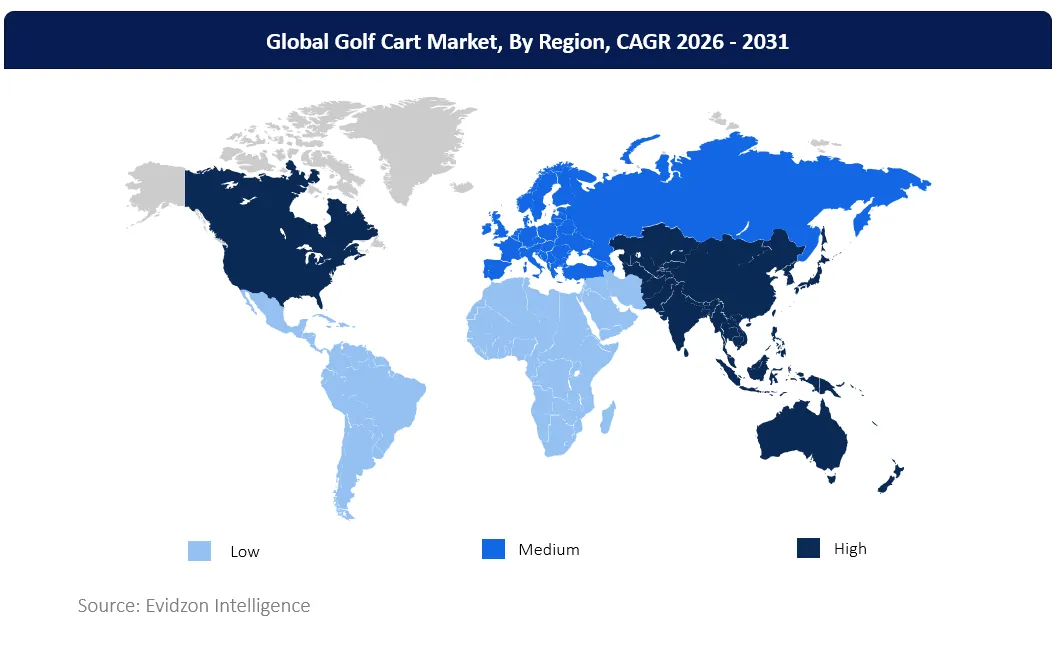
North America represents established demand center, fueled by golf course network, strong recreational vehicle culture, retirement communities, and widespread use of low-speed vehicles in residential and commercial environments. Europe presents opportunities through golf tourism, hospitality applications, and demand for quieter, lower-emission transport within private facilities. Asia Pacific is emerging as important growth market, driven by investments in golf infrastructure, luxury resorts, tourism developments, residential townships, and industrial facilities across China, India, Japan, South Korea, Thailand, and Australia. The Middle East is also creating opportunities through large-scale tourism, hospitality, leisure, and integrated real estate projects, particularly in Saudi Arabia and the UAE.
Key Takeaways
- By vehicle type, utility golf carts account for nearly 36.8% market share in 2025, Whereas street-legal golf carts are expected to grow at a CAGR of 9.4% during 2026–2031.
- By propulsion, electric golf carts remain the largest sub-segment, accounting for nearly 68.4% of the global golf cart market in 2025. Whereas, solar-assisted electric golf carts are expected to be the fastest-growing propulsion segment, expanding at a 10.2% CAGR during 2026–2031.
- By seating capacity, 2-seater accounts for nearly 43.7% market share in 2025. However, above 5-seater is expected to grow at a CAGR of 8.6% during 2026–2031.
- By application, golf courses account for nearly 31.6% market share in 2025. However, airports & transportation are projected to witness a CAGR of 9.8% during 2026–2031.
- By ownership, commercial/fleet ownership accounts for nearly 66.3% market share in 2025. However, individual ownership is expected to grow at a CAGR of 7.8% during 2026–2031.
- By distribution channel, dealer/distributor sales account for nearly 64.7% market share in 2025. However, OEM/direct sales are projected to witness a CAGR of 7.4% during 2026–2031.
- By region, North America accounts for nearly 42.8% of the global golf cart market share in 2025. However, Asia Pacific is projected to witness a CAGR of 8.9% during 2026–2031.
About the Study
The global golf cart market study covers golf carts across major vehicle types, propulsion types, battery types, seating capacities, applications, end users, and major global regions and countries. The study analyzes demand across electric, gasoline, diesel and solar-assisted electric golf carts, including passenger transportation and utility configurations used in golf courses, resorts and hospitality facilities, residential communities, commercial establishments, industrial facilities, airports and other institutional environments. The study excludes conventional passenger car, low-speed vehicles outside golf cart applications, standalone battery and component sales, golf course equipment, vehicle repair and maintenance services, and other activities outside the golf cart manufacturing and sales industry.
Market Dynamics Analysis
Drivers
New course openings and added capacity generate procurement.
Hotels and attractions deploy carts for guest mobility.
Gated communities use carts for convenient local transportation.
Large properties use carts for staff transport.
Lower energy and maintenance needs improve ownership economics.
Operators replace ageing vehicles with safer, efficient models.
Restraints
Purchase costs limit adoption among smaller operators.
Inadequate charging access complicates continuous fleet deployment.
Low-speed designs restrict longer routes and heavier loads.
Local rules limit public-road access and operating areas.
Global golf cart is supported by expanding applications, increasing investments in hospitality infrastructure, and rising demand for compact, low-speed transportation across residential, commercial and institutional facilities. The growth of new golf course development and fleet replacement is generating recurring vehicle procurement, while resorts and hotels are deploying passenger carts to transport guests across large properties. Residential areas, educational campuses, airports and industrial facilities are shaping additional demand for passenger and utility configurations used in short-distance transportation and light material handling. The shift towards electric golf cart is gaining traction, supported by lower operating costs, reduced noise levels and simpler maintenance compared with conventional fuel-powered models. While improvements in battery technology, including lithium-ion systems are supporting fleet adoption through better driving range, faster charging capacity and reduced vehicle weight. These developments are broadening the customer base and creating demand across applications beyond golf course operations.
Market is constrained by high vehicle acquisition costs, charging infrastructure limitations, restricted vehicle capabilities and varying regulatory requirements. Initial investments in vehicles, battery systems, chargers and customized configurations increase purchasing costs for smaller golf courses, resorts and residential communities operating with limited fleet budgets. Electric golf carts require appropriate charging facilities and adequate electrical capacity at operating locations, adding infrastructure expenses and potentially affecting fleet utilization where charging access is limited. Additionally, low operating speeds and restricted payload capacities make golf carts less suitable for longer-distance transportation and heavy-duty applications, reducing their ability to replace conventional utility vehicles. Regulatory differences across countries and local jurisdictions regarding vehicle registration, road access, speed limits and permitted operating areas, restrict their deployment beyond private properties and designated facilities. Such factors extended purchasing decisions, increase ownership costs and moderate adoption across potential end-use applications.
Segment Analysis
By Vehicle Type
The global golf cart market was dominated by, utility golf carts which accounted for the largest share of 36.8% in 2025, driven by wider application beyond traditional golf course transportation across resorts, hotels, residential communities, industrial facilities, airports and institutional campuses. While these vehicles are designed to handle passenger movement, luggage transportation, maintenance activities and light materials handling, make them suitable for both commercial and operational requirements. Moreover, golf course also uses utility configurations for grounds keeping, equipment transportation and routine maintenance operations. Commercial fleet operators prefer these vehicles for practical design, flexible cargo arrangements and suitability for frequent short-distance movement. Additionally, availability of electric and gasoline-powered configurations allows buyers to select vehicles based on operating conditions, payload requirements and charging infrastructure. While, combination of diverse applications, fleet procurement and replacement demand continues to supporting the utility golf cart market across globe.
Meanwhile street-legal golf carts expected to register the fastest growth at CAGR of 9.4% during the forecast period 2031, driven by increasing demand for short-distance transportation across the residential communities, retirement villages, tourism destinations and planned urban developments. While these vehicles offer greater flexibility than conventional golf carts through road-complaint safety equipment, including headlights, turn indicators, mirrors, seat belts and other required features depends on local regulations. Moreover, growing adoption across gated communities and private residential developments is supporting their use for neighborhood transportation, shopping trips and local commuting. Expansion of resorts and tourism operators are incorporating street-legal carts for guest mobility and transportation between accommodation facilities, recreational areas and commercial zones, the availability of electric configurations, lower operating costs and compact vehicle dimensions is strengthening their appeal for short-distance mobility. As well as communities and private developments establish infrastructure for low-speed vehicles, demand for street-legal golf carts is expected to expand across both individual and commercial ownership categories.
Global Golf Cart Market, By Vehicle Type, Market Share,2025
By Propulsion
Electric golf account for 68.4% of largest share in 2025 of global golf cart market, driven by lower operating costs, quieter operation, reduced maintenance requirements and suitability for short-distance transportation across golf courses, resorts, residential communities and commercial facilities, while Golf courses operators and hospitality businesses that require regular passenger movement across designated routes. Additionally, improvements in battery technology, particularly lithium-ion-batteries, are supporting longer driving ranges, faster charging, reduced battery weight, and improved service life. Commercial fleet operators increasingly prefer electric configurations for their simple maintenance requirements and lower energy consumption. Moreover, growing emphasis on reducing local emissions across tourism facilities, residential developments and institutional properties is encouraging the transition from gasoline-powered carts to electric alternatives. As well as availability of different seating capacity, utility configurations and customized models continue to support the adoption of electric golf carts across expanding their applications beyond traditional golf course transportation.
Meanwhile, solar-assisted electric golf cart is expected to grow at CAGR of 10.2% by 2031, supported by increasing interest in supplementary renewable energy charging, lower electricity consumption and improved vehicle operating efficiency. Integration of rooftop solar panels allows these vehicles to generate additional power during outdoor operation and parking, potential to extend the battery availability and reducing the dependency on conventional charging infrastructure. Golf Courses, resorts, residential communities, and large commercial properties provide suitable operating environments due to open spaces and predictable vehicle movement patterns. While growing the investment in sustainable hospitality infrastructure and energy efficient transportation is shaping additional opportunities for solar-assisted configurations. Moreover, improvements in lightweight solar panels, battery management systems and photovoltaic integration are supporting the product development. However, solar assistance supplements rather than replaces grid charging, make battery capacity and conventional charging access important considerations for fleet operators.
Global Golf Cart Market, By Propulsion Type, Market Share,2025
Geographic Analysis
Largest Region
North America accounted for the largest share of the global golf cart market, representing 40.60% in 2025, with the United state and Canada represents the key demand areas. The United States serves the principal demand centre, driven by extensive golf course network country clubs, retirement communities, gated residential developments and developed recreational vehicle culture. While demand is concentrated across Florida, California, Arizona and Texas, where golf facilities, resort developments, residential communities and the commercial establishments generate requirements for passenger and utility golf carts.
Florida, California and Arizona form the principal golf cart demand clusters, supporting the golf course operations, residential mobility and hospitality-related transportation. Meanwhile, Texas shaping additional demand through expanding residential communities, commercial facilities, industrial properties and recreational developments. Additionally, the presence of established manufacturers such as Club Car, E-Z-GO and Yamaha Golf-Car along with other extensive dealer networks and aftermarket service facilities, supports the regional adoption. Resorts, airports, educational institutions and industrial campuses also shaping demand through internal passenger transportation, luggage movement and routine operational activities. Moreover, combination of established golf infrastructure, recurring fleet replacement, residential adoption and expanding the commercial applications makes North America the leading market for golf cart manufacturers seeking to strengthen vehicle sales, fleet contracts and regional distribution coverage.
Global Golf Cart Market, By Region, Market Share, 2025
Fastest-Growing Region
Asia Pacific is projected to be the fastest-growing region accounts for CAGR of 8.9% by 2031 in the global golf cart market, driven by rising investments in golf infrastructure, expanding tourism, luxury hospitality developments and integrated residential communities. China witnessing increasing demand for golf cart across golf courses, resorts, commercial properties and large residential developments, supported by expanding electric vehicle manufacturing capabilities and availability of cost-competitive models. In India, investments in luxury resorts, golf courses, hotels and large residential townships are shaping demand for passenger and utility golf carts across hospitality and private facilities. While, Japan, South Korea, Thailand and Australia are supporting regional demand through established golf tourism, recreational facilities and commercial applications. Changes in end-user requirements are influencing vehicle configurations, increasing adoption of electric golf carts and improvements in lithium-ion battery technology are supporting longer driving ranges, faster charging and lower operating costs. While, Manufacturers are expanding product portfolios through customized seating capacities, utility configurations and connected fleet management solutions to address the different application requirements. Additionally, the market growth depends on tourism investments, golf course development, charging infrastructure availability and manufacturers ability to provide reliable, cost-competitive vehicles across diverse regional markets.
Competitive Landscape
- 1Yamaha Golf Company
- 2E-Z-GO (Textron)
- 3Polaris Inc. (GEM)
- 4Club Car
- 5LOBO EV Technologies
Market Concentration Level: Highly Fragmented
The global golf cart market is moderately consolidated, with manufacturers competing on the basis of vehicle quality, battery performance, pricing, product configurations, technological capabilities and ability to supply golf courses, hospitality operators and commercial fleet customers with reliable vehicles. Key players operating in the global golf cart market include Club Car, E-Z-GO, Yamaha Golf-Car, Garia, Polaris, and LOBO EV Technologies. These companies compete through driving range, battery efficiency, seating capacity, vehicle durability, customization options, passenger comfort and after-sales service. Their product portfolios span electric, gasoline-powered, utility, personal transportation and street-legal golf carts used across golf courses, resorts, residential communities, airports and industrial facilities.
Meanwhile, product engineering and battery technology are essential elements in the purchasing decisions of golf cart operators. Golf courses, resorts and commercial fleet owners require vehicles that provide consistent operating performance, low maintenance requirements and reliable battery life under frequent daily usage. Increasing the adoption of electric golf carts is shaping demand for improved lithium-ion battery systems, faster charging capabilities, efficient motor technologies and advanced battery management systems. Additionally, expanding applications across residential communities and commercial properties are influencing the demand for larger seating configurations, enclosed cabins, utility cargo beds and street-legal vehicles. Manufacturers are incorporating GPS tracking, digital displays, remote diagnostics and fleet monitoring technologies to improve vehicle management and differentiate their offerings.
Customer relationships and manufacturing reach two significant factors influencing competitive advantages among golf cart manufacturers. Commercial fleet operators, golf course developers, hospitality groups and institutional buyers prefer suppliers that can provide customized vehicles, bulk procurement capabilities, consistent product quality and accessible maintenance support. While, established manufacturers gaining benefits from recognized brands, extensive dealer networks, replacement parts availability and long-term relationships with commercial customers. Meanwhile, the regional manufacturers from China, compete through cost-effective production, flexible configurations, shorter delivery timelines and the expanding international distribution networks. Additionally, the competitive landscape is shaped by investments in lithium-ion battery technology, electric vehicle platforms, manufacturing efficiency and product diversification. Manufacturers continue to balance vehicle development costs, battery prices, distribution expenses and pricing pressure while meeting the changing requirements of golf course operators, hospitality businesses and emerging commercial applications.
Recent Development
Eco Battery Expands Partnership with Lani EV for Advanced Electric Golf Cart Batteries
Eco Battery expanded its partnership with Lani EV by supplying 51.2V lithium iron phosphate (LiFePO4) battery systems for its ZROX vehicle lineup. The collaboration also supports the ZROX Adventure LSV, a four-passenger electric vehicle featuring a 580W solar roof and an estimated driving range of more than 55 miles. The partnership strengthens Lani EV's electric vehicle portfolio while expanding Eco Battery's presence in the golf cart and low-speed electric vehicle battery segment.
Yamaha Introduces UMAX4 and UMAX4 Rally Sport to Expand Utility Golf Cart Portfolio
Yamaha Golf-Cart Company introduced two new four-passenger golf cart models, the UMAX4 and UMAX4 Rally sports, designed for commercial and personal transportation applications. The launch expands Yamaha's utility vehicle portfolio and strengthens its presence in the growing multi-passenger golf cart segment.
Golf Carts Modified Introduces 76V Lithium Battery
The company introduced a 76V lithium battery option, expanding its aftermarket portfolio and targeting golf cart owners seeking higher performance, battery upgrades and customized electric vehicle configurations.
Table of Content
- 1.Introduction
- 1.1Scope and Objective of the Study
- 1.2Market Definition & Study Assumptions
- 2.Research Methodology
- 3.Executive Summary
- 4.Market Outlook
- 4.1Market Overview
- 4.2Market Drivers
- 4.2.1Expanding Golf Course Fleets Sustain Vehicle Demand
- 4.2.2Resorts and Tourism Increase Cart Utilization
- 4.2.3Residential Communities Adopt Carts for Short Trips
- 4.2.4Campuses and Industrial Sites Need Internal Mobility
- 4.2.5Electric Drivetrains Improve Operating Cost Appeal
- 4.2.6Fleet Modernization Supports Replacement Cart Purchases
- 4.3Market Restraint
- 4.3.1High Upfront Prices Constrain Buyer Affordability
- 4.3.2Charging Infrastructure Gaps Complicate Electric Fleet Operations
- 4.3.3Speed And Payload Limits Narrow Utility Applications
- 4.3.4Road-Use Regulations Restrict Wider Public Mobility Deployment
- 4.4Supply/Value Chain Analysis
- 4.5Regulatory Landscape
- 4.6Porter's Five Forces Analysis
- 4.6.1Threat of New Entrants
- 4.6.2Bargaining Power of Buyers
- 4.6.3Bargaining Power of Suppliers
- 4.6.4Threat of Substitutes
- 4.6.5Competitive Rivalry
- 5.Market Segmentation (Includes market size in Value (USD) and Volume (Units), Forecast up to 2031, and market analysis with growth attributes)
- 5.1By Vehicle Type
- 5.1.1Utility Golf Carts
- 5.1.2Personal Transportation Golf Carts
- 5.1.3Street-Legal Golf Carts
- 5.1.4Specialty Golf Carts
- 5.2By Propulsion Type
- 5.2.1Electric Golf Carts
- 5.2.2Gasoline Golf Carts
- 5.2.3Solar-Assisted Electric Golf Carts
- 5.3By Seating Capacity
- 5.3.12 seater
- 5.3.24 seater
- 5.3.35-Seater
- 5.3.4Above 5-Seater
- 5.4By Application
- 5.4.1Golf Courses
- 5.4.2Residential Communities
- 5.4.3Resorts & Hospitality
- 5.4.4Commercial & Industrial Facilities
- 5.4.5Airports & Transportation
- 5.4.6Others
- 5.5By ownership
- 5.5.1Individual Ownership
- 5.5.2Commercial/Fleet Ownership
- 5.6By Distribution Channel
- 5.6.1OEM/Direct Sales
- 5.6.2Dealer/Distributor Sales
- 5.7By Region
- 5.7.1North America
- 5.7.1.1United States
- 5.7.1.2Canada
- 5.7.2Latin America
- 5.7.2.1Brazil
- 5.7.2.2Argentina
- 5.7.2.3Mexico
- 5.7.2.4Rest of Latin America
- 5.7.3Europe
- 5.7.3.1Germany
- 5.7.3.2Italy
- 5.7.3.3France
- 5.7.3.4Spain
- 5.7.3.5United Kingdom
- 5.7.3.6Russia
- 5.7.3.7Rest of Europe
- 5.7.4Asia Pacific
- 5.7.4.1China
- 5.7.4.2India
- 5.7.4.3Japan
- 5.7.4.4South Korea
- 5.7.4.5Indonesia
- 5.7.4.6Australia
- 5.7.4.7Rest of Asia-Pacific
- 5.7.5Middle East & Africa
- 5.7.5.1Saudi Arabia
- 5.7.5.2United Arab Emirates (UAE)
- 5.7.5.3South Africa
- 5.7.5.4Egypt
- 5.7.5.5Rest of the Middle East & Africa
- 6.Competitive Landscape
- 6.1Market Concentration Overview
- 6.2Market Share Analysis
- 6.3Company Profiles
- 6.3.1Yamaha Golf-Car Company
- 6.3.2E-Z-GO (Textron)
- 6.3.3Polaris Inc. (GEM)
- 6.3.4Club Car
- 6.3.5LOBO EV Technologies
- 6.3.6Columbia Vehicle Group Inc.
- 6.3.7HDK Electric Vehicles
- 6.3.8Cushman (Textron)
- 6.3.9ICON EV
- 6.3.10Bintelli Electric Vehicles
- 6.3.11Kandi Technologies Group
- 6.3.12Melex
- 6.3.13Marshell Green Power
- 6.3.14Solargolfer
- 6.3.15LANI
- 6.3.16Shining Vehicle
- 6.3.17EAYS Electrics
- 7.Future Outlook
- 7.1Growth Opportunities & White-Space Analysis
- 7.2Analyst Recommendations
Market Size Methodology
Market value is calculated based on on car wash service volumes multiplied by the corresponding average selling price (ASP), estimated by vehicle type, powertrain, seating capacity, end-use and region to capture vehicle configurations, propulsion technologies, customer applications, pricing variations, purchasing patterns and regional demand.
Historical market estimates are benchmarked against manufacturer sales volumes, production capacity, golf course counts, golf cart fleet sizes, vehicle replacement demand, dealer shipments, import-export statistics, battery installations, company disclosures and regional industry data.
Forecasts incorporate expected changes in golf course development, tourism infrastructure, residential community expansion, commercial fleet procurement, electric golf cart adoption, lithium-ion battery technology, vehicle customization, charging infrastructure, fuel prices, regulatory requirements, manufacturing costs, vehicle pricing and regional demand growth.
FAQ
What is the projected size of the global golf cart market by 2031?
The global golf cart market is valued at USD 2.21 billion in 2025 and is projected to reach USD 3.19 billion by 2031, growing at a CAGR of 6.02% during 2026–2031.
Which vehicle type dominates the global golf cart market?
Utility golf carts dominate the market, accounting for 36.8% of the market share in 2025.
Which propulsion segment holds the largest share of the global golf cart market?
Electric golf carts hold the largest share, accounting for 68.4% of the market in 2025.
Which region is expected to record the fastest growth in the global golf cart market?
Asia Pacific is expected to be the fastest-growing region, registering a CAGR of 8.9% during 2026–2031.
What are the key factors driving the global golf cart market?
Rising demand for low-speed transportation, expansion of golf-cart courses, growth in tourism and hospitality infrastructure and increasing the adoption across residential, commercial and industrial facilities are the key factors driving the global golf cart market.
Have a question about this report?
Talk to the analyst behind this research, or browse the full report catalogue.
Contact Us