
Global Agricultural Tractor Market
The global agricultural tractor market is segmented by horsepower (Less than 40 HP, 40-100 HP, 101-200 HP, and More than 200 HP), by drive type (Two-Wheel Drive and Four-Wheel Drive), by propulsion (Diesel, Electric, and Hybrid), by tractor type (Utility Tractor, Row Crop Tractor, Orchard and Vineyard Tractor, and Compact and Sub-Compact Tractor), and by region (North America, Latin America, Europe, Asia-Pacific, and Middle-East and Africa). The global automotive aluminum components market report includes market size in value (USD) and volume (Units), forecast up to 2031.
Global Agricultural Tractor Market
Market Size in USD Billion
Market Size Overview
USD Billion
Market Snapshot
- Study Period
- 2019-2031
- Forecast Period
- 2026-2031
- Base Year Market Size (2025)
- USD 58.1 Billion
- Market Size (2026)
- USD 60.1 Billion
- Market Size (2031)
- USD 71.1 Billion
- Growth Rate (2026-2031)
- 3.4% CAGR
- Market Concentration
- Highly Concentrated
Major Players*




*Disclaimer: Major Players sorted in no particular order
Market Overview
The global agricultural tractor market value is anticipated to grow from USD 58.1 billion in 2025 to 60.1 billion in 2026 and expected to reach USD 71.1 billion in 2031 with a CAGR (2026-2031) of 3.4%.
The tractor market is evolving from horsepower-led purchase toward productivity per machine, operating cost and equipment integration. The buyers evaluates tractor in relation to implements, hydraulics, transmission, guidance systems and service support. This is particularly visible at the higher end of the market where European registrations of tractors above 250 HP has seen increase in recent years even as overall agricultural tractor registrations have declined. At the other end, compact and utility tractors are relevant where farms are smaller, field access is restricted or where one machine has to handle several non-field tasks. Emission requirements are also changing the economics of the products as manufacturers face higher costs of engineering and components as India, China and other markets tighten standards. Precision agriculture is becoming part of the specification rather than a purchase of a separate technology as automated steering, telematics and machine-to-implement communication are built around the tractor.
Competition is intense between global full-line manufacturers and companies with strong regional specialization. Key agricultural tractor players including Deere & Company, CNH Industrial, AGCO Corporation, Kubota Corporation, CLAAS KGaA GmbH, Mahindra & Mahindra Limited, SDF Group and Argo Tractors S.p.A. compete across different combinations of horsepower, crop application, geography and technology. Dealer reach is a competitive asset as tractor purchases depend heavily on parts availability, diagnostics and seasonal service response. Manufacturers also compete with precision agriculture, autonomy, connected-machine platforms and financing while local production allows them to configure tractors to regional crops, regulations and price points.
Regional demand differs significantly, as the farm structure determines the tractor specification. Asia Pacific combines a highly fragmented farming with increasingly mechanized commercial agriculture, creating demand ranging from compact utility tractors to higher horsepower machines. China and India remain epicenter of the global agricultural mechanization although different landholding structures and government programs guide buying patterns. North America is focused on high-capacity equipment, precision guidance and utilization of machinery across large farms. Europe has a diverse mix of applications that span arable, dairy, vineyard and orchard. Latin America, particularly Brazil has strong requirements for tractors suited to large-scale row crops and to challenging soil conditions.
Key Takeaways
- By horsepower, 40–100 HP remains the largest sub-segment accounting for nearly 48.5% of the global agricultural tractor market in 2025. Whereas, tractors above 200 HP are expected to be the fastest growing horsepower segment at 7.5% CAGR by 2031.
- By drive type, two-wheel drive accounts for nearly 61.5% market share in 2025. However, four-wheel drive agricultural tractors are expected to grow at a CAGR of 4.4% by 2031.
- By propulsion, diesel segment has registered the highest market value share of nearly 97.8% in 2025 of global agricultural tractor market and is expected to grow at a 3.25% CAGR over the forecast period.
- By tractor type, utility tractors will remain the dominant demand base with more than 51% market share in 2025, and projected to grow at 2.95% CAGR by 2031.
- By region, Asia-pacific accounts for 60% of the global electric vehicle market and Latin America expected to grow at a CAGR of 4.3% through 2031.
About the Study
The global agricultural tractor market study covers new tractors designed for agricultural and farming applications, segmented by horsepower, drive type, propulsion, and tractor types, covering the main producing regions and countries. The market comprises new agricultural tractors sold or registered as new through OEMs, franchised dealers, distributors, and other commercial outlets. The study excludes construction, industrial, forestry, road/highway tractors, garden tractors designed for primary domestic use, used tractor sales, rental revenue from tractors, agricultural implements sold separately, parts and service, and downstream financing revenues.
Market Dynamics Analysis
Drivers
Larger operating areas justify higher-capacity tractors and wider implements.
Rental operators spread tractor costs across multiple farm customers.
Replacement demand rises as maintenance costs and downtime accumulate.
Crop-specific operations increasingly dictate horsepower, hydraulics and PTO specifications.
Higher drawbar performance supports tillage, planting and difficult field conditions.
Guidance, automation and telematics increasingly influence new-machine specifications.
Restraints
Affordable second-hand machines postpone purchases among price-sensitive farmers.
Stricter standards add hardware complexity and increase acquisition expenses.
Limited operating hours can weaken returns on expensive tractor assets.
Low technical support increases downtime concerns after equipment purchases.
The buying decisions are increasingly determined by the number of operations that one tractor can perform on a farmland during the short agricultural season. Farm consolidation allows meeting the challenge of higher field capacity by employing bigger and faster machines since the single operator manages more acres. USDA indicate that the tendency to adopt larger, faster, and more precise tractors is explained by farmers’ ability to manage larger land areas. Chinese authorities, explicitly prioritize the development of agricultural machinery, including slope-specific equipment and technologies for replacing outdated machinery, which suggests that the China tractor market will continue to grow. At the same time, customized hiring practices promote the most efficient use of equipment, which is especially important for small-scale farms, as in the India tractor market. The approach is optimized according to the crop, season, and area cultivated, which makes the custom use of machinery as valuable as owning the equipment. Multiple factors affect the choice of a tractor, including power, PTIO rating, hydraulics, 4×4 capability, and the level of guidance, which speak of farmers’ preference for multifunctional machines that fit into the broader system of field operations.
The biggest limitation is often utilization of assets rather than tractor availability. A tractor is essential for planting, tillage or harvesting, but sits idle at other times and a new machine is hard to justify when an older unit can still perform such core tasks. Availability of used-equipment broadens the decision, as smaller players involved – India’s government machinery platform explicitly covers hiring services as well as sale and purchase of old agricultural machinery. The financing structures can also turn mechanization into an ownership decision or a rental decision – hence India’s Custom Hiring Centre framework provides credit-linked assistance for eligible equipment-service businesses. Compatible implements, trained operators, diagnostics and dependable service support is required in precision-enabled tractor, where surrounding capabilities are not suitable, farmers have less incentive to pay for sophisticated specifications due to low utilization rate. Emission requirement further adds up to the engineering and maintenance complexity with stringent regulations.
Segment Analysis
By Horsepower
40–100 HP accounts for the highest market share of nearly 48.5% in 2025 while, above 200 HP are expected to grow at 7.5% CAGR by 2031. The 40–100 HP agricultural tractors matches the work profile of mainstream farms since a single tractor in this range can cover cultivation, seedbed preparation, sowing, spraying, transport and PTO-driven operations without the heavier driveline and larger implements associated with high-horsepower equipment. 40–100 HP agricultural tractors offers flexibility, which allows customer to switch between field and utility making it a crucial segment where utilization rate depends on several crops or seasonal tasks.
In above 200 HP agricultural tractors, the economics change since it make sense when the operation can keep them working with wide tillage and planting equipment, heavy trailers or demanding soil conditions. Horsepower is therefore increasingly evaluated alongside hydraulic flow, PTO output, transmission type, ballast requirements and implement width. Larger agricultural tractors can reduce the number of passes and the time required in the field, but their value depends on the annual utilization. Buyers are considering guidance, automatic steering and implement communication when specifying higher-capacity tractors due to the productivity gain from the whole tractor-implement combination rather than engine output.
Global Agricultural Tractor Market, By Horespower, Market Share, 2025
By Drive Type
Two-wheel drive agricultural tractors represent the largest vehicle type category with 61.5% market share in global agricultural tractors market, whereas four-wheel drive agricultural tractors are expected to grow at a CAGR of 4.4% by 2031. Two-wheel-drive tractors are practical option in transport, light tillage, spraying, orchard work or operations conducted on relatively firm and level ground. Simpler drivetrain help to cut costs on both purchase and maintenance and be less weight helps in situations where minimizing the impact on the ground is important.
Four-wheel agricultural tractors are gaining attraction where traction becomes the limiting factor. Heavy tillage, wet ground, slopes, large tools and great drawbar loads led 2WD more prone to wheel slip, and fuel wastage. Four-wheel drive means more wheels are being used to haul the load and can cling better to the ground in challenging ground conditions. Farmers also factor in tire options, axle ratings, ground clearance, turning circles and ballast in addition to the drive system. For use on loads or transportation, pull capabilities in the front matter as much as ground grip. As specifications are getting more tailored, four-wheel drive is being embraced more and more due to the conditions in which four-wheel agricultural tractors are used instead of the engine size alone.
Global Agricultural Tractor Market, By Drive Type, Market Share, 2025
Geographic Analysis
Largest Region
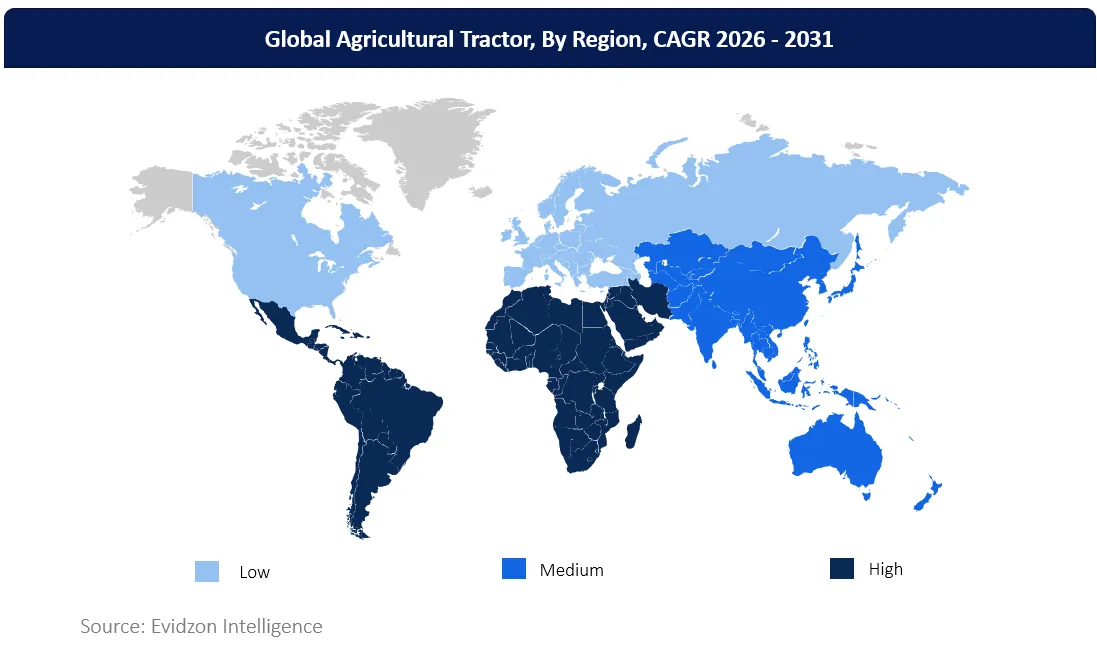
Asia Pacific registered the highest market share of 60% in 2025 of global agricultural tractors market. Asia Pacific is a region with diverse agricultural tractor markets as evidenced by the different development paths of China and India. The former has been trending towards more powerful machinery as farm activities becoming mechanized and official authorities encourages the purchase of larger, more powerful equipment. India’s farm structure comparatively more fragmented, explains the emphasis on smaller, utility agricultural tractors as well as high-horsepower agricultural tractors for commercial hire companies.
Finances and government incentives play an important role as a major difference between the needs of small-scale farmers and large-scale commercial operations. India’s agricultural mechanization policy offers a wide range of support services and Custom Hiring Centres for small-farm ownership in order for them to acquire the best machinery without having to bear the costs associated with ownership. China is also encouraging the purchase of higher-horsepower agricultural tractors and the replacement of existing agricultural machinery. In general, buyers in the region are looking at horsepower alongside the equipment’s ability to utilize various implements, hydraulic capabilities, fuel economy, and overall accessibility to service and support.
Global Agricultural Tractor Market, By Region, Market Share, 2025
Fastest-Growing Region
Latin America is projected to be the fastest region in global agricultural tractors by 2031 accounting for 16.3% CAGR. Latin America’s tractor market is closely linked to commercial farming, including mechanized crop and livestock production, such as soybean, corn, sugarcane, and other essential products. Brazil remains one of the regions with the most substantial variation in the availability of equipment, with the overall number of tractors owned by farmers being relatively low, this result in the formation of two distinct groups of buyers. Larger farms require more powerful equipment that can operate constantly during the crop season while also being able to accommodate the large implements used on these facilities. In contrast, small farmers are highly dependent on either contract farming services or underpowered cost-efficient agricultural tractors.
Additionally, the characteristics of the local environment, including soil structure and relief, as well as specific conditions associated with crop cycles, affect the demand for four-wheel drive agricultural tractors and the required level of hydraulic systems’ performance. Brazilian credit policies promote the development and modernization of commercial farming, and manufacturers are constantly working to improve their presence in local markets in order to meet the growing demand for agricultural tractors in remote areas.
Competitive Landscape
- 1Mahindra & Mahindra Limited
- 2International Tractors Limited
- 3Tractors and Farm Equipment Limited (TAFE)
- 4Escorts Kubota Limited
- 5Deere & Company
Market Concentration Level: Highly Concentrated
The global agricultural tractor market is highly competitive, with manufacturers differentiating on horsepower coverage, product reliability, fuel efficiency, dealer networks, financing availability, localization and increasingly precision-agriculture capabilities. The competitive structure is characterized by a combination of multinational original equipment manufacturers (OEMs) and high-volume regional manufacturers, including Indian companies with established considerable scale across the world’s largest tractor markets. Mahindra & Mahindra Limited (Mahindra, Swaraj and Trakstar), International Tractors Limited (Sonalika and Solis), Tractors and Farm Equipment Limited (TAFE) (Massey Ferguson and Eicher), Escorts Kubota Limited (Farmtrac and Powertrac) and Deere & Company are the key player in market collectively accounts for over 50% of the market share.
The next tier includes CNH Industrial N.V., AGCO Corporation, Kubota Corporation, CLAAS KGaA mbH, SDF S.p.A. and Yanmar Holdings Co., Ltd. competing across developed agricultural markets. The differentiation increasingly extends beyond the tractor itself to precision agriculture, telematics, autonomous functions, implements, aftermarket services and integrated farm-management platforms. Chinese manufacturers including YTO Group Corporation, Weichai Lovol Intelligent Agricultural Technology Co., Ltd. and Zoomlion Heavy Industry Science & Technology Co., Ltd. add another competitive layer, particularly across China, Asia, Africa and selected emerging markets.
Recent Development
Kubota Expands Indian Tractor Manufacturing Capacity
Kubota Corporation and Escorts Kubota Limited started preparations for a new manufacturing plant in the state of Uttar Pradesh. The plant is anticipated to scale up tractor production for the Indian market and exports, whereas the manufacture of tractors in Haryana will continue. The 623,000-square-meter site reflects Kubota’s long-term strategy of localizing agricultural machinery.
Mahindra Launches New Multi-Purpose Agricultural Tractor
Mahindra Tractors unveiled the YuvoTech+ 585 DI V1 across India, available in both 2WD and 4WD variants. The tractor is equipped with Mahindra’s mBULL engine and is designed for multipurpose farming operations emphasizing on the pull performance, fuel-efficiency, and comfort.
TAFE Inaugurated New DEUTZ Engine Production Facility
TAFE Motors inaugurated new DEUTZ engine manufacturing facility at its Alwar manufacturing plant in Rajasthan, India. The production facility is a collaboration of TAFE Motors and DEUTZ AG focused on the production of engines for diverse applications including agricultural machinery. For tractors, the collaboration will support localized manufacturing of high-end diesel engine technology to reduce the dependency on imports.
Table of Content
- 1.Introduction
- 1.1Scope and Objective of the Study
- 1.2Market Definition & Study Assumptions
- 2.Research Methodology
- 3.Executive Summary
- 4.Market Outlook
- 4.1Market Overview
- 4.2Market Drivers
- 4.2.1Farm Consolidation Shifts Demand Toward Higher Horsepower
- 4.2.2Custom Hiring Expands Tractor Utilization Beyond Individual Ownership
- 4.2.3Aging Tractor Fleets Accelerate Replacement
- 4.2.4Implement Specialization Drives Demand For Matched Tractor Configurations
- 4.2.5Four-Wheel-Drive Adoption Improves Traction for Intensive Operations
- 4.2.6Precision-Ready Platforms Increase Demand for Connected Tractor Technology
- 4.3Market Restraint
- 4.3.1Used Tractor Availability Extends New-Equipment Replacement Intervals
- 4.3.2Emission Compliance Raises Engine and Aftertreatment System Costs
- 4.3.3Seasonal Utilization Creates Weak Annual Asset Economics
- 4.3.4Dealer Service Gaps Discourage Complex Tractor Technology Adoption
- 4.4Regulatory Landscape
- 4.5Supply/Value Chain Analysis
- 4.6Porter's Five Forces Analysis
- 4.6.1Threat of New Entrants
- 4.6.2Bargaining Power of Buyers
- 4.6.3Bargaining Power of Suppliers
- 4.6.4Threat of Substitutes
- 4.6.5Competitive Rivalry
- 5.Market Segmentation (Includes market size in Value (USD), Forecast up to 2031, and market analysis with growth attributes)
- 5.1By Horsepower
- 5.1.1Less than 40 HP
- 5.1.240-100 HP
- 5.1.3101-200 HP
- 5.1.4More than 200 HP
- 5.2By Drive Type
- 5.2.1Two-Wheel Drive
- 5.2.2Four-Wheel Drive
- 5.3By Propulsion
- 5.3.1Diesel
- 5.3.2Electric
- 5.3.3Hybrid
- 5.4By Tractor Type
- 5.4.1Utility Tractor
- 5.4.2Row Crop Tractor
- 5.4.3Orchard and Vineyard Tractor
- 5.4.4Compact and Sub-Compact Tractor
- 5.5By Region
- 5.5.1North America
- 5.5.1.1United States
- 5.5.1.2Canada
- 5.5.2Latin America
- 5.5.2.1Brazil
- 5.5.2.2Argentina
- 5.5.2.3Mexico
- 5.5.2.4Rest of Latin America
- 5.5.3Europe
- 5.5.3.1Germany
- 5.5.3.2Italy
- 5.5.3.3France
- 5.5.3.4Spain
- 5.5.3.5United Kingdom
- 5.5.3.6Russia
- 5.5.3.7Rest of Europe
- 5.5.4Asia Pacific
- 5.5.4.1China
- 5.5.4.2India
- 5.5.4.3Japan
- 5.5.4.4South Korea
- 5.5.4.5Indonesia
- 5.5.4.6Australia
- 5.5.4.7Rest of Asia-Pacific
- 5.5.5Middle East & Africa
- 5.5.5.1Saudi Arabia
- 5.5.5.2United Arab Emirates (UAE)
- 5.5.5.3South Africa
- 5.5.5.4Egypt
- 5.5.5.5Rest of the Middle East & Africa
- 6.Competitive Landscape
- 6.1Market Concentration Overview
- 6.2Market Share Analysis
- 6.3Company Profiles
- 6.3.1Mahindra & Mahindra Limited
- 6.3.2Deere & Company
- 6.3.3CNH Industrial N.V.
- 6.3.4AGCO Corporation
- 6.3.5Tractors and Farm Equipment Limited
- 6.3.6International Tractors Limited
- 6.3.7Kubota Corporation
- 6.3.8Escorts Kubota Limited
- 6.3.9SDF S.p.A.
- 6.3.10Yanmar Holdings Co., Ltd.
- 6.3.11CLAAS KGaA mbH
- 6.3.12YTO Group Corporation
- 6.3.13Weichai Lovol Intelligent Agricultural Technology Co., Ltd.
- 6.3.14Zoomlion Heavy Industry Science & Technology Co., Ltd.
- 6.3.15Argo Tractors S.p.A.
- 7.Future Outlook
- 7.1Growth Opportunities & White-Space Analysis
- 7.2Analyst Recommendations
FAQ
What is the projected size of the global agricultural tractor market by 2031?
The global agricultural tractor market is projected to grow from USD 58.1 billion in 2025 to USD 60.1 billion in 2026 and reach USD 71.1 billion by 2031, registering a CAGR of 3.4% during 2026–2031.
Which horsepower segment dominates the global agricultural tractor market?
The 40–100 HP segment dominates the market, accounting for 48.5% of market value in 2025. 40–100 HP segment serves a broad range of farming activities, including cultivation, sowing, spraying, transportation and implement-driven operations.
Which drive type holds the largest share of the global agricultural tractor market?
Two-wheel-drive tractors account for the largest share, representing 61.5% of the market in 2025.
Which region dominates the global agricultural tractor market, and which is expected to grow fastest?
Asia-Pacific is identified as the largest regional market, supported by agricultural mechanization and demand across countries such as China and India. Latin America is projected to be the fastest-growing region, with a CAGR of 4.3% during 2026–2031, driven by demand associated with commercial farming and mechanized crop production.
What are the key factors driving the global agricultural tractor market?
Key growth drivers include farm consolidation, custom hiring services, replacement of ageing tractor fleets, demand for crop-specific tractor configurations, adoption of four-wheel drive and increasing use of precision agriculture technologies.
Market Size Methodology
The market size is determined by calculating new agricultural tractors’ number sold or registered using the corresponding average selling price (ASP) for each category of tractors. Due to significant variances in ASP across regions and tractor categories, ASP was evaluated based on horsepower, drive type, propulsion, tractor type, country, and configuration. New agricultural tractor registrations, sales, and production history were compared to agricultural ministry, transport department, industry association, OEM, company, dealer, and country-level data, reports, and statistics to build market size.
In forecast farm income, cropped area, mechanization levels, replacement needs, tractor parc age, crop intensity, farm consolidation, government subsidies and financing programs, interest rates, commodity prices, rainfall and weather patterns, fuel costs, horsepower trends, electrification, emission standards, technology adoption, OEM localization rates, import duties, production capacity, and regional tractor mix has been considered. Moreover, the analysis considers ASP variations between emerging markets and developed markets’ higher-value tractors rather than a single ASP for all tractors.
Have a question about this report?
Talk to the analyst behind this research, or browse the full report catalogue.
Contact Us