
Global Car Wash Market
The global car wash market report is segmented by service type (Roll-over/In-Bay Automatic, Automatic Tunnel / Conveyor Wash, Self-Service Bay and Manual / Hand Wash), by vehicle type (Passenger Vehicles and Commercial Vehicles), by customer type (Individual Vehicle Owners and Commercial Fleet Operators), by payment mode (Cash, Cashless and Subscription Based), by region (North America, Latin America, Europe, Asia Pacific and Middle- East Africa). The global car wash market report includes market size in value and (USD) and forecasts through 2031.
Global Car Wash Market
Market Size in USD Billion
Market Size Overview
USD Billion
Market Snapshot
- Study Period
- 2019-2031
- Forecast Period
- 2026-2031
- Base Year Market Size (2025)
- USD 39.91 Billion
- Market Size (2026)
- USD 42.38 Billion
- Market Size (2031)
- USD 57.07 Billion
- Growth Rate (2026-2031)
- 6.13% CAGR
- Market Concentration
- Moderate
Major Players*





*Disclaimer: Major Players sorted in no particular order
Market Overview
The global car wash market value is anticipated to grow from USD 39.91 billion in 2025 to 42.38 billion in 2026 and is expected to reach USD 57.07 billion in 2031, with a CAGR (2026-2031) of 6.13%.
The global car wash market is driven by rising vehicle ownership, changing consumer lifestyles, urbanization and demand for convenient vehicle cleaning services. Growing vehicle parc is increasing the preference for regular exterior washing, interior cleaning and vehicle detailing, while time- constrained consumers are shifting towards professional car wash facilities instead of home-based cleaning. Additionally, automatic tunnel system, in-bay rollover machines, touchless washing technologies and self-service facilities are supporting different customer requirements. Premium services such as waxing, polishing, ceramic coating and upholstery cleaning are gaining importance, while subscription- based memberships and digital booking platforms encouraging and improving service accessibility.
Competitive landscape is shaped by established car wash chains, equipment manufacturer and automotive service providers. Competition is based on service pricing, washing quality, facility accessibility, equipment efficiency, service variety, turnaround time and customer retention. While operators with automated washing infrastructure, multiple service locations, membership programs and efficient water management system are better positioned to attract regular customers and manage high volumes. Rising adoption of digital payments, mobile applications influencing customer acquisition and service differentiation across the market.
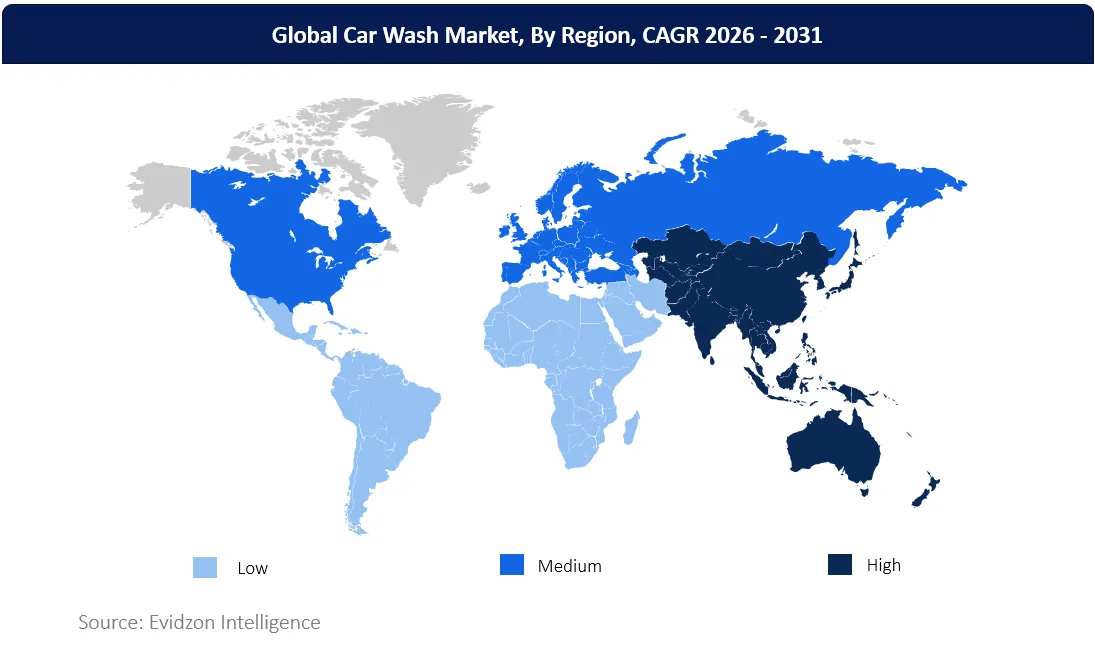
North America represents a developed market due to widespread automated car wash infrastructure organized service provider and strong adoption of subscription-based washing models. Asia Pacific is gaining importance through rising vehicle ownership, expanding urban populations, increasing disposable income and growing acceptance of organized car wash facilities across China, India, Japan and Southeast Asia. Europe represents a significant market, driven by professional vehicle maintenance and increasing emphasis on water-efficient cleaning technologies. While, demand from commercial vehicle fleets, rental companies, ride-hailing operators and corporate transportation providers is supporting recurring washing requirements. Additionally, Investment in water-recycling systems, low consumption equipment and environmentally compliant cleaning solutions shaping additional opportunities for operators seeking to improving their operational efficiency and expand their service offerings.
Key Takeaways
- By service type, automatic tunnel / conveyor wash account for 40.8% market share in 2025, and are expected to grow at a CAGR of 7.20% during 2026–2031.
- By vehicle type, passenger vehicles account for 78.6% market share in 2025, while commercial vehicle is expected to grow at a CAGR of 7.40% during 2026–2031.
- By customer type, individual vehicle owners account for 81.70% market share in 2025, while commercial fleet operators are expected to grow at a CAGR of 8.10% during 2026–2031.
- By payment mode, cashless payments account for 54.80% market share in 2025, while subscription-based payments are expected to grow at a CAGR of 9.20% during 2026–2031.
- By region, North America accounts for 40.60% market share in 2025, while Asia Pacific is expected to grow at a CAGR of 8.30% during 2026–2031.
About the Study
The global car wash market study covers car wash services across major service types, vehicle types, washing methods, payment modes, customer types, and major global regions and countries. The study analyzes demand across automatic and self-service car wash facilities, in-bay automatic systems, tunnel car washes, and manual washing services. The study excludes vehicle detailing products, standalone washing equipment sales, household cleaning services, automotive repair and maintenance, and other activities outside the commercial car wash service industry.
Market Dynamics Analysis
Drivers
A larger vehicle parc increases recurring exterior cleaning requirements.
Time-constrained motorists increasingly outsource routine vehicle washing.
Automation enables faster vehicle processing and consistent cleaning results.
Membership plans encourage repeat visits and predictable customer spending.
Specialized treatments attract customers seeking higher-value vehicle care.
Fleet operators require regular cleaning across multiple vehicles.
Restraints
Equipment, property, and installation costs raise entry barriers.
Water-intensive operations face restrictions in water-stressed locations.
Weather patterns create uneven customer traffic throughout the year.
Nearby operators compete through discounts and service differentiation.
Global car wash market is transitioning towards organized, technology-enabled and service-oriented vehicle cleaning, driven by rising vehicle ownership and changing consumer preferences. A growing vehicle parc continues to expand routine washing requirements, while busy lifestyles are encouraging motorists to shift towards professional cleaning services. Automated wash systems are improving service throughput and cleaning consistency, allowing operators to process higher vehicle volumes with reduced service time. Subscription-based models are strengthening customer retention and recurring revenue generation. Meanwhile, growing interest in premium detailing is increasing demand for specialized vehicle care and higher-value services. Expanding commercial fleets are also creating a steady demand pool for regular, bulk vehicle cleaning across business operations.
Global car wash market faces several operational and cost-related challenges that can restrict business expansion and profitability. High initial investments in land, equipment, installation, and facility development create entry barriers, particularly for small-scale operators. While, water-intensive washing processes increase operating costs and create environmental compliance challenges, especially in regions facing water scarcity and stricter conservation regulations. Seasonal weather variations influence customer footfall, resulting in fluctuating facility utilization and revenue throughout the year. Additionally, intense competition among local car wash operators leads to frequent discounting and pricing pressure, making it difficult for businesses to maintain profit margins while investing in service quality and differentiation.
Segment Analysis
By Service Type
The global car wash market is dominated by automatic tunnel/conveyor wash accounted for 40.8% of the largest service type market share in 2025 and anticipated to register fastest growth at CAGR of 7.20% during the forecast period (2026-2031). The segment is driven by high-vehicle processing capacity, shorter washing cycles and consistent cleaning quality. The automatic tunnel/conveyor wash use conveyor-based systems to move vehicles through multiple cleaning stages, includes pre-soaking, high- pressure washing, brushing, rinsing and drying. while their ability to handle high vehicle volume makes suitable for high-traffic urban locations, fuel stations and commercial car wash centers. Such facilities are relevant for operators to serving regular customer, commercial fleets and subscription-based members. While the automated operations reduce manual intervention, improve service turnaround time and support higher facility utilization. Rising preference for convenient vehicle cleaning and expansion of organized car wash chain supports demand segment.
Meanwhile, increasing investments in automated car wash infrastructure and growing demand for higher operational throughput. While, operators are adopting advanced conveyor systems, frictionless washing equipment, water-recycling technologies and integrated payment solutions to improve service efficiency and limiting operating costs Meanwhile, growing vehicle density, expansion of organized car wash chains and adoption of monthly membership programs increasing demand for high- capacity washing facility. Such attributes are encouraging operators to expand automated tunnel installations across urban centers, fuel stations and commercial locations.
Global Car Wash Market, By Service Type, Market Share, 2025
By Vehicle Type
Passenger Vehicles account for 78.6% of largest share in 2025 of global car wash market, driven by global passenger vehicle parc, frequent personal vehicle usage and growing consumer preference for professional cleaning service. While passenger car owners require regular exterior washing, interior vacuuming polishing and detailing to maintain vehicle appearance and cleanliness. Sedans, hatchbacks and SUVs generate recurring demand across automatic tunnel washes, in-bay automatic facilities, self-service stations and full-service car wash centers. While, growing urbanization, rising disposable incomes and limited time for home-based vehicle cleaning are encouraging consumers to use car wash facilities, and increasing adoption of monthly, washing subscriptions and premium detailing packages and supports repeat service demand across passenger car of global car wash market.
Commercial vehicles are expected to grow at 7.40% CAGR by 2031, supported by logistics operations, e-commerce deliveries, fleet-based transportation and rising demand for regular vehicle maintenance. Commercial vehicle includes trucks, buses, vans and LCV, require frequent washing to maintain cleanliness, vehicle presentation and operating standards. While fleet operators, logistics companies, public transportation providers, rental businesses and construction companies increasingly rely on scheduled and contract-based washing services to manage multiple vehicles. Meanwhile expansion of organized fleet washing facilities, high-pressure cleaning equipment and automated truck wash systems is improving the ability of service providers to handle a large vehicle efficiently. Such requirements are increasing demand for dedicated commercial vehicle washing facilities and recurring fleet service agreements.
Global Car Wash Market, By Vehicle Type, Market Share, 2025
Geographic Analysis
Largest Region
North America accounted for the largest share of the global car wash market, representing 40.60% in 2025. The region's dominance is primarily driven by high passenger vehicle ownership, an established professional car wash industry, widespread automated washing infrastructure, and strong consumer acceptance of subscription-based cleaning services. The United States remains the primary market within North America, supported by strong consumer spending on vehicle maintenance, and widespread adoption of professional washing services. The United States leads regional demand through its extensive network of automatic tunnel washes, in-bay automatic facilities, self-service stations, and organized car wash chains. Automated tunnel and conveyor wash systems are particularly important due to their ability to process high vehicle volumes and support recurring subscription-based visits. Major operators, including Mister Car Wash, Whistle Express Car Wash, Quick Quack Car Wash, Zips Car Wash, and Autobell Car Wash, are strengthening their presence through multi-location expansion, automated facilities, and membership-based washing programs.
Canada contributes to regional demand through regular vehicle cleaning requirements associated with winter road salt, snow, mud, and seasonal driving conditions, while additional growth opportunities are likely to be fueled by rising vehicle ownership, urbanization, and expanding commercial transportation activities. The presence of established car wash operators, equipment suppliers, and water-recycling technologies further strengthens North America's position as the leading regional market.
Global Car Wash Market, By Region, Market Share,2025
Fastest-Growing Region
Asia Pacific is projected to be the fastest-growing region accounts for 8.30% CAGR by 2031 in the global car wash market ,driven by rising vehicle ownership, rapid urbanization, increasing disposable incomes and the gradual shift towards organized vehicle cleaning services. The region is experiencing growing demand for professional car wash facilities as expanding passenger vehicle sales and commercial vehicle fleets increase the need for regular vehicle maintenance. India and China are expected to remain important growth contributors, supported by expanding middle-income populations, rising vehicle density and increasing consumer preference for convenient cleaning solutions. Meanwhile, Indonesia, Thailand and Vietnam are emerging as promising markets, where expanding automotive ownership and urban development are encouraging investments in automatic washing centers, self-service facilities and professional detailing services.
The growth is supported by the gradual expansion of organized car wash chains, adoption of automated tunnel washing systems and increasing investments in water-recycling technologies. In India, the growing presence of organized car wash operators and app-based vehicle cleaning services is improving access to professional washing solutions beyond major metropolitan areas. China is witnessing increasing adoption of automated and premium vehicle cleaning services, supported by its large automotive market and established equipment manufacturing ecosystem. Additionally, Japan and South Korea are contributing through advanced touchless washing technologies, automated equipment and water-efficient cleaning systems. Growing demand from logistics fleets, ride-hailing operators, vehicle rental companies and commercial transportation providers is further creating opportunities for recurring washing contracts across Asia Pacific.
Competitive Landscape
- 1Mister Car Wash
- 2Whistle Express Car Wash
- 3Quick Quack Car Wash
- 4Zips Car Wash
- 5Autobell Car Wash
Market Concentration Level: Moderate
The global car wash market comprises organized car wash chains, regional operators, independent service providers, and equipment-led businesses. Mister car wash is one of the largest organized operators with extensive network of express and exterior cleaning facilities across US. Driven brands include Zips Car Wash and Quick Quack Car Wash continue to expand through multi-location operations and membership-based services. Meanwhile, Autobell Car Wash and other regional operators compete through service quality, facility accessibility, wash packages, and customer retention.
Additionally, international operators include IMO Car Wash, Istobal-operated wash networks, and other regional car wash chains maintain their presence across Europe, North America, and others market through standardized washing formats, automated facilities, and partnerships with fuel stations and retail locations. While, equipment manufacturer such as WashTec, Daifuku, and Otto Christ support market development through automated tunnel systems, in-bay equipment, water-recycling technologies, and digital payment solutions. As well as operators are increasingly focusing on express wash formats, unlimited monthly memberships, automated service delivery, multi-site expansion and premium detailing to strengthen customer retention and improve revenue per vehicle.
Recent Development
El Car Wash Acquires Sparkle Express Car Wash to Enter Chicago
El Car Wash acquired Sparkle Express Car Wash in October 2026, marking its entry into the Chicago market. The company also announced a 50-location development pipeline across metropolitan Chicago, strengthening its Midwest presence and supporting its broader geographic expansion strategy.
Sonny's Enterprises Partners with Moleaer to Advance Car Wash Water Recycling
Sonny's Enterprises partnered with Moleaer to distribute nanobubble-based water-treatment technology to car wash operators. The partnership aims to increase water reuse, reduce freshwater consumption, and lower operating costs across commercial car wash facilities.
Mister Car Wash Completes USD 3.1 Billion Take-Private Acquisition
Mister Car Wash completed its USD 3.1 billion take-private acquisition, transitioning from a publicly traded company to private ownership. The transaction marks a significant ownership change for the car wash operator, providing a new ownership structure to support its business strategy, operational priorities and potential future expansion.
Table of Content
- 1.Introduction
- 1.1Scope and Objective of the Study
- 1.2Market Definition & Study Assumptions
- 2.Research Methodology
- 3.Executive Summary
- 4.Market Outlook
- 4.1Market Overview
- 4.2Market Drivers
- 4.2.1Rising Vehicle Ownership Expands Car Wash Demand
- 4.2.2Busy Lifestyles Encourage Professional Vehicle Cleaning
- 4.2.3Automated Wash Systems Improve Service Throughput
- 4.2.4Subscription Models Support Recurring Car Wash Revenue
- 4.2.5Premium Detailing Services Increase Average Customer Spending
- 4.2.6Commercial Fleet Growth Creates Bulk Washing Requirements
- 4.3Market Restraint
- 4.3.1High Initial Investment Limits Facility Expansion
- 4.3.2Water Consumption Creates Environmental Compliance Challenges
- 4.3.3Seasonal Demand Fluctuations Affect Facility Utilization
- 4.3.4Strong Local Competition Pressures Service Pricing
- 4.4Supply/Value Chain Analysis
- 4.5Regulatory Landscape
- 4.6Porter's Five Forces Analysis
- 4.6.1Threat of New Entrants
- 4.6.2Bargaining Power of Buyers
- 4.6.3Bargaining Power of Suppliers
- 4.6.4Threat of Substitutes
- 4.6.5Competitive Rivalry
- 5.Market Segmentation (Includes market size in Value (USD) and Forecast up to 2031, and market analysis with growth attributes)
- 5.1By Service type
- 5.1.1Roll-over / In-Bay Automatic
- 5.1.2Automatic Tunnel / Conveyor Wash
- 5.1.3Self-Service Bay
- 5.1.4Manual / Hand Wash
- 5.2By Vehicle Type
- 5.2.1Passenger Vehicles
- 5.2.1.1Sedans
- 5.2.1.2Hatchbacks
- 5.2.1.3SUVs/MUVs
- 5.2.2Commercial Vehicles
- 5.2.2.1Light Commercial Vehicles
- 5.2.2.2Medium &Heavy-duty Trucks
- 5.2.2.3Buses and Coaches
- 5.3By Customer Type
- 5.3.1Individual Vehicle Owners
- 5.3.2Commercial Fleet Operators
- 5.4By Payment Mode
- 5.4.1Cash
- 5.4.2Cashless
- 5.4.3Subscription Based
- 5.5By Region
- 5.5.1North America
- 5.5.1.1United States
- 5.5.1.2Canada
- 5.5.2Latin America
- 5.5.2.1Brazil
- 5.5.2.2Argentina
- 5.5.2.3Mexico
- 5.5.2.4Rest of Latin America
- 5.5.3Europe
- 5.5.3.1Germany
- 5.5.3.2Italy
- 5.5.3.3France
- 5.5.3.4Spain
- 5.5.3.5United Kingdom
- 5.5.3.6Russia
- 5.5.3.7Rest of Europe
- 5.5.4Asia Pacific
- 5.5.4.1China
- 5.5.4.2India
- 5.5.4.3Japan
- 5.5.4.4South Korea
- 5.5.4.5Indonesia
- 5.5.4.6Australia
- 5.5.4.7Rest of Asia-Pacific
- 5.5.5Middle East & Africa
- 5.5.5.1Saudi Arabia
- 5.5.5.2United Arab Emirates (UAE)
- 5.5.5.3South Africa
- 5.5.5.4Egypt
- 6.Competitive Landscape
- 6.1Market Concentration Overview
- 6.2Market Share Analysis
- 6.3Company Profiles
- 6.3.1Mister Car Wash
- 6.3.2Whistle Express Car Wash
- 6.3.3Quick Quack Car Wash
- 6.3.4Zips Car Wash
- 6.3.5Autobell Car Wash
- 6.3.6WashTec AG
- 6.3.7Istobal S.A
- 6.3.8IMO Car Wash
- 6.3.9Tommy's Express Car Wash
- 6.3.10Hoffman Car Wash
- 6.3.11National Carwash Solutions
- 6.3.12Go Car Wash
- 6.3.13RYKO solutions
- 6.3.14Mod Wash
- 7.Future Outlook
- 7.1Growth Opportunities & White-Space Analysis
- 7.2Analyst Recommendations
Market Size Methodology
Market value is calculated based on on car wash service volumes multiplied by the corresponding average selling price (ASP), estimated by Service type, vehicle type, Customer, Payment mode and region region to capture washing technology, vehicle category, customer purchasing behavior, pricing variations, payment preferences, service frequency, and regional demand.
Historical market estimates are benchmarked against car wash facility counts, wash volumes, vehicle parc, new vehicle registrations, automatic wash system installations, service prices, commercial fleet washing contracts, payment and subscription revenues, company disclosures, and regional industry data.
Forecasts incorporate expected changes in vehicle ownership, professional car wash adoption, automated wash technology, tunnel and in-bay facility expansion, commercial fleet activity, subscription-based memberships, cashless payment adoption, labor costs, water consumption regulations, environmental requirements, service pricing, facility investment, and regional vehicle parc growth.
FAQ
What is the current size of the global car wash market?
The global car wash market was valued at USD 39.91 billion in 2025 and is estimated to reach USD 42.38 billion in 2026. The market is projected to reach USD 57.07 billion by 2031, growing at a CAGR of 6.13% during 2026–2031.
Which service type dominates the global car wash market?
Automatic Tunnel / Conveyor Wash dominates the global car wash market, accounting for 40.8% of the market share in 2025. Its high vehicle-processing capacity, shorter washing cycles, consistent cleaning quality, and suitability for subscription-based services support its leading position.
Which vehicle category accounts for the largest share of the global car wash market?
Passenger vehicles dominate the market, accounting for 78.6% of the market share in 2025.
Which region dominates the global car wash market, and which is expected to grow fastest?
North America dominates the global car wash market, accounting for 40.6% of the market share in 2025, supported by established automated washing infrastructure and widespread subscription-based services. Asia Pacific is expected to be the fastest-growing region, registering a CAGR of 8.30% during 2026–2031, driven by rising vehicle ownership, urbanization, and expansion of organized car wash facilities.
What are the key factors driving the global car wash market?
The market is primarily driven by rising vehicle ownership, busy consumer lifestyles, increasing adoption of automated washing systems, subscription-based membership models, premium detailing services, and expanding commercial vehicle fleets.
Have a question about this report?
Talk to the analyst behind this research, or browse the full report catalogue.
Contact Us