
Global Automotive Glass Market
The global automotive glass market report is segmented by glass type (Standard Automotive Glass and Advanced / Smart and Functional Automotive Glass), by application ( Windshields, Side Windows, Real Windows, Sunroofs and Panoramic Roofs and Others ),by vehicle type (Passenger Cars, Commercial Vehicles), by propulsion (Internal Combustion Engine (ICE) vehicles and EV (Electric Vehicle), by sales channel (OEM and Aftermarket), and by regions (North America, Latin America ,Europe, Asia pacific and Middle East & Africa). The global automotive glass market report includes market size in value and (USD) and Volume (Units), forecasts through 2031.
Global Automotive Glass Market
Market Size in USD Billion
Market Size Overview
USD Billion
Market Snapshot
- Study Period
- 2019-2031
- Forecast Period
- 2026-2031
- Base Year Market Size (2025)
- USD 25.31 Billion
- Market Size (2026)
- USD 27.19 Billion
- Market Size (2031)
- USD 39.01 Billion
- Growth Rate (2026-2031)
- 7.49% CAGR
- Market Concentration
- Consolidated
Major Players*





*Disclaimer: Major Players sorted in no particular order
Market Overview
The global automotive glass market value is anticipated to grow from USD 25.31 billion in 2025 to 27.19 billion in 2026 and is expected to reach USD 39.01 billion in 2031, with a CAGR (2026-2031) of 7.49%.
The global automotive glass market is moving toward high-value-added glazing glass with automakers increasingly seeking greater functionality. Windshields continue to be the largest application, supported by application across vehicle safety, vision, structural integrity, and ADAS sensor integration. At the same time, panoramic roofs and larger sunroofs are increasing the average glass content of a passenger vehicle across SUVs, premium vehicles, and EVs.
The competitive landscape of global automotive glass is consolidated by key players including AGC, Fuyao Glass, Saint-Gobain Sekurit, NSG Group, Xinyi Glass, and Vitro, competing across OEM and aftermarket channels. The automotive glass demand is shifting towards laminated, acoustic, solar-control, heated, lightweight, smart, and HUD-compatible glazing. While the aftermarket sales channel provides significant growth due to an expanding vehicle parc, road incidents, and ADAS-equipped vehicles increase 0recalibration requirements after windshield replacement.
Asia Pacific remains the largest regional automotive glass market due to high vehicle production volumes across China, India, Japan, and South Korea, with strong manufacturing bases of automotive glass companies. Meanwhile, Europe's demand for automotive glass is driven by a premium vehicle production base, EV penetration, safety requirements, and increasing adoption of advanced glazing technologies. Additionally, North American demand is fueled by SUV production, replacement demand, and growing use of larger roof systems.
Key Takeaways
- By glass type, standard automotive glass accounts for 79.40% market share in 2025, while advanced, smart and functional automotive glass is expected to grow at a CAGR of 12.60% during 2026–2031.
- By application, windshields accounts for 43.60% of global automotive glass market share in 2025, while sunroofs and panoramic roofs are expected to grow at a CAGR of 9.30% during 2026-2031.
- By vehicle type, passenger cars account for 77.80% market share in 2025, while commercial vehicles are expected to grow at a CAGR of 8.40% during 2026–2031.
- By propulsion, ICE vehicles account for 72.60% of global automotive glass market share in 2025, while electric vehicles are expected to grow at a CAGR of 14.20% during 2026–2031.
- By end-use, OEM sales account for 82.20% market share in 2025, while the aftermarket is expected to grow at a CAGR of 8.10% during 2026–2031.
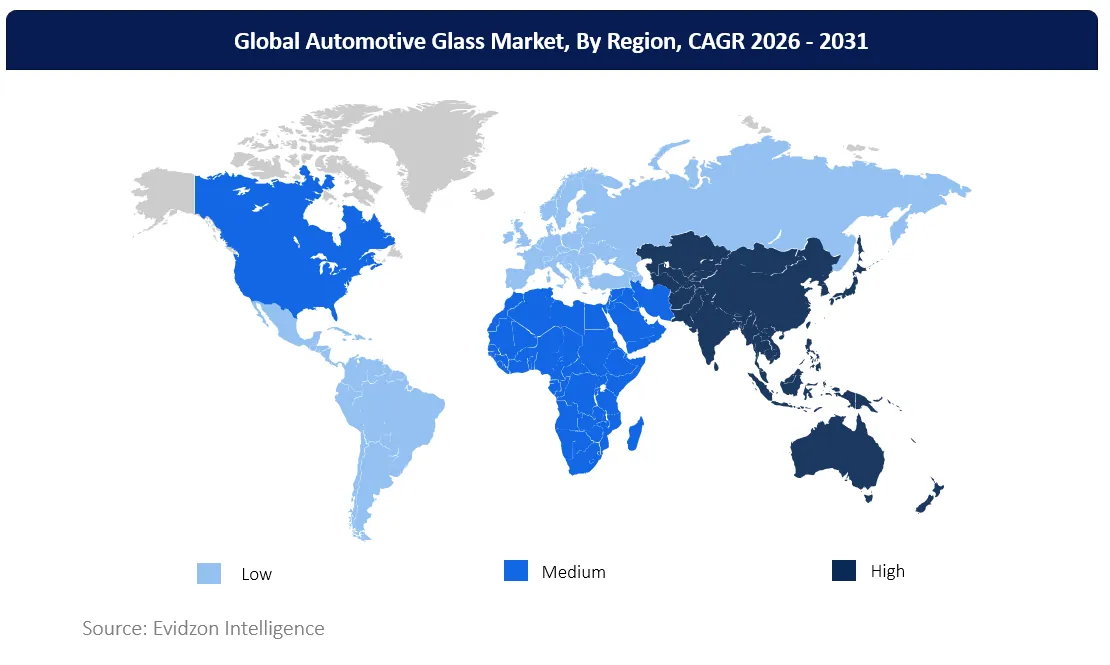
- By region, Asia Pacific accounts for 48.70% of global automotive glass market share in 2025 and is expected to grow at a CAGR of 9.30% during 2026–2031.
About the Study
The global automotive glass market study covers glass types, product type, vehicle type, propulsion, end- use across major global regions and countries. The study analyzes demand across OEM and aftermarket channels and evaluates automotive glass requirements based on vehicle design, glass specifications, safety requirements, glazing technologies, and application. The study excludes residential and architectural glass, industrial glass, consumer electronics glass, complete vehicles, vehicle repair and maintenance services, automotive glass installation services, vehicle rental and leasing services, and non-automotive glass products and applications.
Market Dynamics Analysis
Drivers
High vehicle outputs expand OEM glass demand across manufacturing plants.
Automakers increasingly specify acoustic, solar-control, heated, and coated glazing systems.
Modern windshields require tighter optical standards for ADAS camera system.
Larger roof opening increase glass content within passenger vehicles.
Lightweight glazing helps manufacturers manage vehicle weight and improve driving efficiency.
Consumer increasingly value quieter cabins, heat control and visibility.
Restraints
Advanced coating and processing requirements increase manufacturing expenses for suppliers.
Tighter distortion limits manufacturing and quality control more demanding.
Energy, silica, chemicals, and logistics disruption can interrupt manufacturing schedules.
Camera recalibration and specialized installation increase aftermarket replacement expenses.
Automotive glass demand is being driven by new vehicle production and the growing number of functionalities automakers are looking to embed in automotive glass. Expanding vehicle production capacity across Asia-pacific is channelizing the OEM automotive glass demand, with increasing emphasis on product differentiation. Acoustic windshields, solar-control glazing, heated glass and camera-compatible windshields are becoming increasingly crucial as vehicles add safety and comfort features. ADAS is a significant demand driver, glass integrated in front of ADAS camera have to meet tight optical tolerances, since distortion can impact the ability for the system to read the road. Panoramic sunroofs also increase the amount of glazing fitted per vehicle, while EV manufacturers are seeking to manage vehicle weight without impacting cabin comfort and safety. Meanwhile, buyers are inclined towards quieter cabins and better heat control, glass that offer such combination of features is pushing suppliers toward higher-value glass rather than relying purely on volume growth.
The economics of the glass production are increasingly getting complicated owing to increasing demand for special purpose automotive glass, solar-control coating, acoustic laminates, heated elements, smart glass, and other features that require additional steps and increased control over the process, making it more expensive than standard production. Another challenge is windshields’ production has to solve the problem of cameras, heads-up displays, and other sensors placement behind the glass, which requires extreme precision since minor inaccuracies eliminate the proper functioning of such systems. The availability of raw materials is another potential roadblock, production of automotive glass requires immense amounts of energy. While, the replacement procedure is significantly more complicated than OEM installation, requiring recalibration of cameras and other systems, thus adding to the costs.
Segment Analysis
By Glass Type
Standard automotive glass is the largest glass type segment of global automotive glass market; represents 79.40% market share in 2025. Standard automotive glass dominance reflects the wide integration across windshields, side windows, rear windows, and other applications across passenger cars and commercial vehicles. Most automotive manufacturers rely on tempered and laminated glass products to meet standard automotive vehicle requirements for safety reasons, manage production costs, and continue to maintain production volumes. Additionally, standard automotive glass manufacturing processes and supplier networks also make standard glass suitable for high-volume vehicle production. Replacement demand extends from damaged windshields and windows across the existing vehicle fleet.
Meanwhile, advanced, smart, and functional automotive glass is forecast to record a CAGR of 12.60% by 2031. Vehicle manufacturers are adding features due to dynamically shifting customer demand towards panoramic roofs, solar-managed windshields, windows with acoustic insulation, heads-up display-compatible windshields, and glass designed to support camera-based ADAS systems. EVs offer additional growth opportunities through large roof panels and glazing solutions that help to manage solar heat control and cabin comfort. However, higher production costs and technical integration requirements can limit adoption in lower-priced. While, advanced automotive glass is expected to capture a share of new vehicle glazing value, while standard automotive glass retains the dominant position through high-volume applications.
Global Automotive Glass Market, By Glass Type, Market Share, 2025
By Application
Windshields is the largest application segment of global automotive glass market, holding 43.60% of market share in 2025, driven by the role in driver visibility, occupant protection, vehicle structural integrity, and high cost in comparison to other application segments. Unlike other applications, windshields have to meet safety requirements for impact resistance and passenger protection. Laminated glass is widely used in windshields, with an interlayer that helps to hold broken glass together during an impact. The growth of the laminated windshield glass market is attributed to the rising need for advanced driver-assistance systems (ADAS) equipped with front-facing cameras placed on the windshield or behind the windshield. ADAS systems require precise glass specifications to maintain camera visibility and support accurate calibration. Moreover, heated windshields, acoustic interlayers, and solar-control coatings are also gaining importance in passenger cars and premium vehicles. Manufacturer introduce more safety features and integrated electronics; windshield design and replacement requirements continue to influence demand across both original equipment manufacturing (OEM) and aftermarket channels.
Sunroofs and panoramic roofs are expected to be fastest growing application segment account at 9.30% CAGR by 2031. Manufacturer are integrating large glass roof panels in SUVs, premium passenger cars, and electric vehicles to improve cabin brightness and create more spacious looking interior. Panoramic roofs cover a substantial portion of the vehicle roof, increasing the amount of glass used per vehicle compared with conventional sunroofs. Demand is driven by the introduction of tinted, solar-control, heat-reflective, and switchable glass technologies that helps to manage cabin temperature and sunlight exposure. However, the use of large glass roofs poses a challenge in managing heat gain, weight, impact resistance, and roof integrity. Innovations in glass coatings, laminated glazing, and lightweight designs are enabling manufacturers to meet all requirements. Wider adoption across mid-range vehicle models, rather than limited to premium vehicle will be a critical growth factor over the coming years.
Global Automotive Glass Market, By Applications, Market Share, 2025
Geographic Analysis
Largest Region
Asia-Pacific is the largest regional automotive glass market, accounts for 48.70% market share in 2025. The Asia-Pacific automotive glass market is driven by extensive vehicle manufacturing along with vertically integrated supply chain of automotive glass. China remains the epicenter of global vehicle production and the expansion of electric vehicle manufacturing. While, Japan and South Korea are shaping the regional automotive glass demand with established automotive manufacturers, advanced glazing technologies, and automotive glass suppliers. India contributes with rising vehicle production and growing replacement demand for windshields and windows.
Automotive glass manufacturers based in Asia-Pacific region are increasingly inclined towards panoramic roofs, larger windshields, acoustic glass, and glazing designed to work with advanced driver-assistance systems. Such applications are unfolding opportunities for suppliers, while increasing adoption of electric vehicles is shaping a distant set of demand emphasized on specialized glazing with panoramic roofs and larger glass panels. Additionally, Asia-Pacific vehicle parc is sustaining the replacement demand channel across windshields and other glass applications.
Global Automotive Glass Market, By Region, Market Share, 2025
Fastest- Growing Region
Asia-Pacific is the fastest-growing regional automotive glass market with a CAGR of 9.30% by 2031, supported by continued growth in vehicle production, increasing EV penetration, and the gradual shift towards higher-value glazing systems. China is a key demand source fueled by electric vehicle manufacturers integrating panoramic roofs, larger glass surfaces, acoustic windshields, and advanced glazing features into new models. Such automotive glass features raise the glass value used across vehicles. Meanwhile, India offers additional growth through expanding passenger vehicle manufacturing, rising demand for SUVs, and growing adoption of electric vehicles. Larger vehicles often require more glass, and higher-specification models feature solar-control glazing, laminated side windows, and panoramic roofs to a wide range of buyers.
While, Japan and South Korea support automotive glass demand by the presence of key OEMs and automotive glass supplier with advanced glazing technologies. The Asia-Pacific automotive glass market growth varies by country and product category. Advanced glazing requires accurate shaping, consistent optical quality, specialized coatings, and compatibility with onboard cameras and sensors; manufacturers that meet all such requirements at competitive cost are better positioned to capitalize.
Competitive Landscape
- 1ACG Automotive
- 2Fuyao Glass Industry Group
- 3Saint- Gobain Sekurit
- 4Xinyi Glass (XYZ)
- 5Nippon Sheet Glass
Market Concentration Level: Consolidated
The global automotive glass market is concentrated around a group of established glass manufacturers with strong OEM relationships, extensive production networks, and specialized automotive glazing capabilities. AGC, Fuyao Glass, NSG Group, Saint-Gobain Sekurit and Xinyi Glass are the key players competing on manufacturing scale, product quality, technology development, and long-term automaker contracts. AGC and Saint-Gobain have better positioning in development of premium automotive glazing including, acoustic glass, solar-control solutions, HUD-compatible windshields and smart glass technologies, while Fuyao Glass is characterized by extensive automotive glass manufacturing base and footprint in China and international OEM market. Additionally, NSG Group continues to leverage its Pilkington automotive glass business, laminated glazing and value-added glass technologies. Competition is shifting toward higher-value glazing rather than conventional glass volume.
OEMs are driving demand for windshields featuring built-in and retrofitted cameras, sensors, and heating elements, and acoustic requirements as well as panoramic roofs and large-format glazing, creating additional opportunities in SUVs and electric vehicles. Moreover, suppliers are investing in product innovations and strategic partnerships to develop markets for lightweight automotive glass, solar-control coatings, switchable glazing, transparent antennas, recycling, and lower-carbon manufacturing. The aftermarket is another significant competitive channel, with suppliers competing through replacement availability, distribution networks, installation support, and recalibration capabilities.
Recent Development
Fuyao Glass Expands Smart Automotive Glazing Portfolio
Fuyao presented smart dimming glass, PHUD windshields using augmented-reality technology, and smart automotive trim at Automechanika Frankfurt. The company aims to expand advanced automotive glazing applications and capture growing demand for technology-integrated vehicle glass.
Apollo Funds announced acquired Nippon Sheet Glass (NSG)
Apollo-managed funds completed the $ 3.7 billion acquisition of global giant NSG Group, strengthening financial capacity for technology and manufacturing investments. The transaction supports NSG’s focus on advanced automotive glazing, smart glass, solar-control products, and higher-value automotive glass applications.
Automotive Glass Expert (AGE) announced a partnership with AGC Global Alliance
The automotive glass expert announced a strategic partnership with AGC Global Alliance across 26 countries to expand distribution of advanced automotive glazing, improve availability of technology-rich replacement windshields, and strengthen AGE’s aftermarket network for increasingly connected and ADAS-equipped vehicles.
Table of Content
- 1.Introduction
- 1.1Scope and Objective of the Study
- 1.2Market Definition & Study Assumptions
- 2.Research Methodology
- 3.Executive Summary
- 4.Market Outlook
- 4.1Market Overview
- 4.2Market Drivers
- 4.2.1Rising ADAS Adoption Across New Vehicle Programs
- 4.2.2Greater Electrification Raises Battery Sensing Requirements
- 4.2.3Connected Vehicle Functions Need Continuous Data Inputs
- 4.2.4Tighter Emission Rules Increase Monitoring Hardware
- 4.2.5Increasing Electronic Control Across Core Automotive Functions
- 4.2.6Automated Driving Development Demands Multimodal Perception
- 4.3Market Restraint
- 4.3.1High Integration Expenses Limit Advanced Sensor Deployment
- 4.3.2Complex Calibration Procedures Increase Engineering Workloads
- 4.3.3Semiconductor Shortages Disrupt Component Availability Worldwide
- 4.3.4Harsh Operating Conditions Reduce Sensor Reliability
- 4.4Supply/Value Chain Analysis
- 4.5Regulatory Landscape
- 4.6Porter's Five Forces Analysis
- 4.6.1Threat of New Entrants
- 4.6.2Bargaining Power of Buyers
- 4.6.3Bargaining Power of Suppliers
- 4.6.4Threat of Substitutes
- 4.6.5Competitive Rivalry
- 5.Market Segmentation (Includes market size in Value (USD) and Volume (Units), Forecast up to 2031, and market analysis with growth attributes)
- 5.1By Glass type
- 5.1.1Standard Automotive Glass
- 5.1.2Advanced / Smart & Functional Automotive Glass
- 5.2By Application
- 5.2.1Windshield
- 5.2.2Side Windows
- 5.2.3Real Windows
- 5.2.4Sunroofs and Panoramic Roofs
- 5.2.5Others( Quarter glass, vent glass etc.)
- 5.3By vehicle type
- 5.3.1Passenger Cars
- 5.3.1.1Hatchback
- 5.3.1.2Sedan
- 5.3.1.3SUV/MUV
- 5.3.2Commercial Vehicles
- 5.3.2.1Light Commercial Vehicles (LCV)
- 5.3.2.2Medium & Heavy Duty Truck
- 5.3.2.3Buses & Coaches
- 5.4By propulsion
- 5.4.1Internal Combustion Engine (ICE)
- 5.4.2Electric Vehicle
- 5.5By End-use
- 5.5.1OEM
- 5.5.2Aftermarket
- 5.6By Region
- 5.6.1North America
- 5.6.1.1United States
- 5.6.1.2Canada
- 5.6.2Latin America
- 5.6.2.1Brazil
- 5.6.2.2Argentina
- 5.6.2.3Mexico
- 5.6.2.4Rest of Latin America
- 5.6.3Europe
- 5.6.3.1Germany
- 5.6.3.2Italy
- 5.6.3.3France
- 5.6.3.4Spain
- 5.6.3.5United Kingdom
- 5.6.3.6Russia
- 5.6.3.7Rest of Europe
- 5.6.4Asia Pacific
- 5.6.4.1China
- 5.6.4.2India
- 5.6.4.3Japan
- 5.6.4.4South Korea
- 5.6.4.5Indonesia
- 5.6.4.6Australia
- 5.6.4.7Rest of Asia-Pacific
- 5.6.5Middle East & Africa
- 5.6.5.1Saudi Arabia
- 5.6.5.2United Arab Emirates (UAE)
- 5.6.5.3South Africa
- 5.6.5.4Egypt
- 5.6.5.5Rest of the Middle East & Africa
- 6.Competitive Landscape
- 6.1Market Concentration Overview
- 6.2Market Share Analysis
- 6.3Company Profiles
- 6.3.1AGC Automotive
- 6.3.2Fuyao Glass Industry Group
- 6.3.3Saint-Gobain Sekurit
- 6.3.4Xinyi Glass (XYZ)
- 6.3.5Nippon Sheet Glass
- 6.3.6TAIWANGLASS GROUP
- 6.3.7Şişecam
- 6.3.8Guardian Industries
- 6.3.9Schott AG
- 6.3.10Vitro Automotive
- 6.3.11Carlex Glass America LLC
- 6.3.12Shanghai Yaohua Pilkington Glass
- 6.3.13Asahi India Glass Ltd.
- 6.3.14CSG Holding
- 6.3.15Corning Incorporated
- 7.Future Outlook
- 7.1Growth Opportunities & White-Space Analysis
- 7.2Analyst Recommendations
Market Size Methodology
Global automotive glass market value is calculated based on automotive glass sales volumes multiplied by corresponding average selling price (ASP), estimated by glass type, product type, vehicle type, propulsion, end -use, and region to capture glass specifications, vehicle applications, pricing levels, replacement patterns, purchasing channels, and regional demand.
Historical market estimates are benchmarked against automotive glass shipments, vehicle production, vehicle parc, new vehicle registrations, OEM fitment volumes, aftermarket replacement volumes, import-export data, replacement rates, and company disclosures.
Forecasts incorporate expected changes in vehicle production, electric vehicle penetration, panoramic roof adoption, advanced glazing technologies, glass prices, replacement cycles, ADAS integration, smart glass adoption, OEM demand, aftermarket activity, and regional vehicle parc growth.
FAQ
What is the projected size of the global automotive glass market by 2031?
The global automotive glass market is projected to grow from USD 25.31 billion in 2025 to USD 27.19 billion in 2026 and reach USD 39.01 billion by 2031, registering a CAGR of 7.46% during 2026–2031.
Which glass type segment holds the largest share of the global automotive glass market?
Standard automotive glass holds the largest share by glass type, accounting for 79.40% in 2025.
Which application segment is expected to grow fastest in the global automotive glass market?
sunroofs and panoramic roofs automotive glass is expected to be the fastest-growing segment by application, with a projected CAGR of 9.30% during 2026–2031.
Which region dominates the global automotive glass market?
Asia Pacific dominates the global automotive glass market, accounting for 48.70% of the market in 2025.
Who are the major players in the global automotive glass market?
Major players include AGC Inc., Fuyao Glass Industry Group, Saint-Gobain Sekurit, Nippon Sheet Glass (NSG Group), and Xinyi Glass.
Have a question about this report?
Talk to the analyst behind this research, or browse the full report catalogue.
Contact Us