
Global CNG Conversion Kit Market
The global CNG conversion kit report is segmented by kit type (Sequential CNG Kits, Venturi CNG Kits, and Closed-Loop Kits), by components type (Cylinder, Valve & Burst Disc, Refilling Valve, High-Pressure Tubing, Reducer, Gas Filter, Injector Rail / Gas-Air Mixer, ECU/ECM, Changeover Switch, Wiring Harness & Sensors, and Others), by vehicle type (Passenger Vehicles and Commercial Vehicles), by fuel delivery system (Carburated System, Port Fuel Injection (PFI) / Multi-Point Injection, Gasoline Direct Injection (GDI),Common Rail Direct Injection (CRDI), and Others), by sales channel (OEM and Aftermarket), by end-user (Private Vehicle Owners, Commercial Fleets, Government & Public Fleets, and Industrial / Specialized Fleets), and by region (North America, Latin America, Europe, Asia Pacific, and Middle East & Africa) The global CNG conversion kit market report includes market size in value (USD) and Volume (Units), forecasts through 2031.
Global CNG Conversion Kit Market
Market Size in USD Billion
Market Size Overview
USD Billion
Market Snapshot
- Study Period
- 2019-2031
- Forecast Period
- 2026-2031
- Base Year Market Size (2025)
- USD 3.94 Billion
- Market Size (2026)
- USD 4.26 Billion
- Market Size (2031)
- USD 6.26 Billion
- Growth Rate (2026-2031)
- 8.02% CAGR
- Market Concentration
- Moderate
Major Players*



*Disclaimer: Major Players sorted in no particular order
Market Overview
The global CNG conversion kit market value is anticipated to grow from USD 3.94 billion in 2025 to 4.26 billion in 2026 and is expected to reach USD 6.26 billion in 2031, with a CAGR (2026-2031) of 8.02%
Global CNG conversion kit offers compelling value proposition for cost-conscious vehicle owners and fleet operators, lower-cost alternatives against conventional gasoline and diesel powertrain. The market constitute aftermarket systems converting gasoline internal-combustion vehicles to compressed natural gas, demand is strongest in regions with extensive CNG stations, customer inclination towards fuel-price savings and retrofit support. Passenger cars dominate the market, while commercial vehicle and fleet operators play an important role due to high mileage. The CNG kit technology has evolved beyond basic gas mixers, with current systems increasingly using sequential injection, electronic control units, pressure regulators, dedicated injectors and vehicle-specific calibration. Direct-injection compatibility is becoming a key consideration as newer petrol engines enter the retrofit market.
The market consists multiple suppliers across the globe, tier-1 CNG conversion kit player includes Landi Renzo, BRC, Prins, Lovato Gas, Westport Fuel Systems, Tomasetto Achille, OMVL and Atiker, offering compatibility across vehicle type, calibration, installer coverage and competitive pricing. The market is moving towards OEM-supported retrofit programs, Nissan announced a government-approved twin-cylinder CNG retrofit kit in 2026 Gravite model, demonstrating OEM-supported conversion programs can drive broader customer adoption. However, the vast majority of CNG retrofit suppliers still rely on independent installer networks and distribution channels.
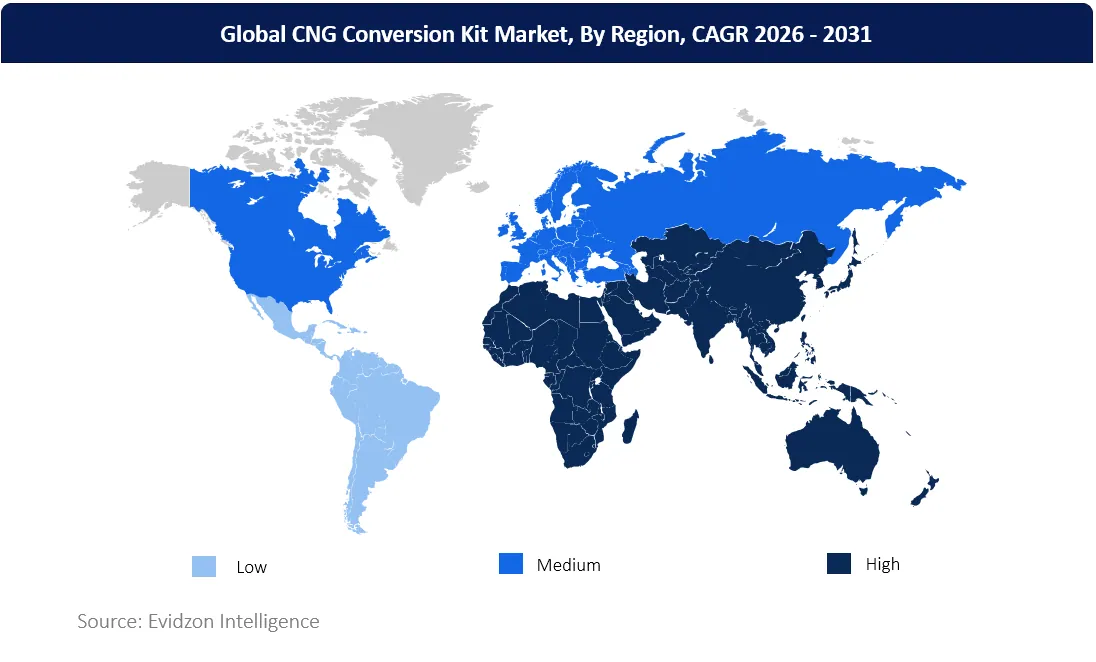
The global CNG conversion kit market varies by differences in fuel-price, vehicle usage, retrofit regulations, and access to CNG refueling stations. Asia Pacific leading demand in India taxis, auto-rickshaws, private cars, and commercial fleets use CNG to reduce fuel cost. India has established retrofit CNG kit market, with approved kits and authorized installers influencing vehicle conversions. China’s demand is shaping by factory-fitted natural gas vehicles playing an important role alongside aftermarket opportunities. In Europe, Italy has long history of CNG vehicle use, supporting demand for compatible conversion systems. Argentina and Brazil provide established markets in Latin America with high-mileage vehicle users. In the Middle East and Africa, opportunities rely on CNG availability, fuel-price differences, refueling coverage, and regulations governing vehicle modifications.
Key Takeaways
- By kit type, sequential CNG kits accounts for nearly 70.10% market share in 2025 and closed-loop kits is expected to grow at a CAGR of 9.20% by 2031.
- By component, cylinder segment accounts for nearly 34.10% market share in 2025 of the global CNG conversion kit market. Whereas, ECU/ECM is expected to be the fastest growing component segment expanding at 9.60% CAGR by 2031
- By vehicle type, passenger vehicles accounts for nearly 63.10% market share in 2025 of global CNG conversion kit market. However, commercial vehicles is expected to grow at a 10.40% CAGR over the forecast Period.
- By fuel delivery system, port fuel injection (PFI) / multi-point injection remains the dominant demand base with more than 60.70% market share in 2025, and GDI is projected to grow at 9.60% CAGR by 2031.
- By sales channel, OEM accounts for 73.10% global CNG conversion kit market share in 2025. However, aftermarket is projected to witness a CAGR of 8.70% during 2026–2031.
- By end user, private vehicle owners segment accounts for nearly 54.60% market share in 2025. However, commercial fleets expected to grow at a CAGR of 10.10% by 2031.
- By region, Asia-Pacific accounts for 39.10% global CNG conversion kit market share in 2025. However, Middle-East & Africa is projected to witness a CAGR of 14.80% during 2026–2031.
About the Study
The global CNG conversion kit study covers passenger vehicles and commercial vehicles across sequential, venturi, closed loop kits types, with analysis across major global regions and countries. The market serves private vehicle owners, corporate operators, commercial fleets, taxi and ride-hailing fleets, government and public-sector fleets and delivery & logistics operators. The study excludes standalone CNG components sold separately, CNG system maintenance and repair services, vehicle financing, and CNG vehicle rental and leasing.
Market Dynamics Analysis
Drivers
Lower running costs improve conversion economics.
More stations reduce range concerns, fueling time, traffic on fueling station and support daily usage.
Emission rules encourage alternatives to conventional gasoline and diesel.
High-mileage fleets recover installation costs through fuel savings
Lower equipment prices make retrofits practical for older vehicles
Cleaner combustion supports cities in reducing urban transport emissions
Restraints
Customers with low vehicle usage refrain CNG conversion due to high upfront cost.
Limited expertise can create installation and maintenance concerns.
Tank packaging led to compromise luggage room in passenger vehicles.
Volatile fuel price may extend investment recovery period.
CNG conversion kit market will continue to be propelled by fuel price differences despite of high upfront installation cost. Private vehicle owners with high utilization is likely to witness sudden cost advantage, while taxis, delivery vehicles, and other commercial fleets accumulating high mileage will see stronger cost economics. The availability of CNG refueling station is one of the crucial attribute affecting customer's purchasing decision, regions with high distribution of CNG stations is likely to corner large demand. Moreover, increasingly stringent urban emission regulations and air quality control programs are driving demand for cleaner fuel alternatives. Meanwhile, lower-priced aftermarket options are making conversion more accessible to fleets with older vehicles left with significant years of service. Fleet operators are increasingly considering conversion as an option to reduce operating costs.
The upfront cost of the conversion kit is a significant barrier, especially for private owners who drive limited kilometers. Despite the benefits of lower running costs of CNG vehicles, an owner has to pay for the kit, installation, certification, and related equipment before seeing any profit. while the poor quality of the installation and calibration of the system can affect drivability, component life and fuel consumption, this led buyers to prefer certified workshops with trained technicians. While, vehicle packaging creating a separate limitation, CNG cylinder takes space in boot and reduce the luggage capacity. Viability of the conversion is also dependent on fuel prices, If CNG becomes more expensive or closer to petrol or diesel, the breakeven point of the CNG conversion kit will not justify the shift on CNG.
Segment Analysis
By Kit Type
Sequential CNG conversion kits accounted for 70.10% of the CNG conversion kit market in 2025. The Sequential CNG conversion kit market dominates the global market, fueled by compatibility with modern petrol engines and ability to deliver more controlled gas injection. Unlike basic mixer-based systems, sequential kits inject CNG into each cylinder through electronically controlled injectors, allowing the system to adjust fuel delivery according to engine load, speed and operating conditions. Meanwhile, strong demand is driven by passenger cars, taxis, and high-mileage commercial vehicles, where fuel economy, range, and consistent engine performance are major considerations. Landi Renzo, BRC Gas Equipment, LOVATO Gas, OMVL and Tomasetto Achille offer sequential CNG systems across different engine capacities and vehicle categories. The product competition increasingly centers on ECU, injector accuracy, pressure regulation, calibration quality and compatibility with newer engines.
Whereas, closed-loop CNG conversion kit market is projected to grow at 9.20% CAGR during 2026-2031, driven by increasing demand for improved fuel control, engine performance and emissions management. Closed-loop CNG conversion kit use feedback from oxygen sensors to regulate the air-fuel mixture, helping to maintain more consistent combustion as driving conditions change. Compared with conventional open-loop systems, closed-loop kits reduce fuel wastage and support better emissions control.The shift toward electronically controlled fuel systems is encouraging closed-loop kit adoption, as newer vehicles require more precise calibration and compatibility with existing engine controls. Closed-loop kits remain relevant to suitable retrofit applications, although newer vehicles may require advanced sequential injection or OBD-compatible systems.
Global CNG Conversion kit Market , By Kit type, Market share, 2025
By component Type
By component type, cylinder constitutes the largest CNG conversion kit market share of 34.10% in 2025, fueled by prevalence of high pressure cylinders as storage media for compressed natural gas in converted vehicles. The demand for CNG conversion kits in passenger cars, taxis, commercial vehicle fleet and fleets remains high due to the dependence of the range on the gas storage capacity. The steel cylinders continue to dominate the market with installed base of their lower cost and well-established manufacturing infrastructure although composite and light-weight cylinders technologies gaining attention due to their potential to reduce the overall weight of the vehicle. Meanwhile cylinder selection varies according to vehicle size, required range and installation space and payload requirements. Passenger cars and taxis use single-cylinder or multi-cylinder or multi-cylinder modules in various capacities, While Twin-cylinder more relevant where manufacturers and retrofit suppliers need to increase gas capacity without sacrificing passenger or cargo space.
The ECU/ECM is projected to witness the highest growth of 9.60% CAGR in the global CNG conversion kit market, due to the increasing requirement for advanced electronic controls in newer vehicle engines as compared to simple mechanical conversion kits. ECU/ECM facilitates the regulation of fuel delivery in accordance with the operating conditions of the engine, thus ensuring drivability even when switching between petrol and CNG. With retrofitting applications being increasingly adopted for newer vehicles, a majority of kit suppliers are witnessing the need for advanced controllers that are capable of managing diverse engine variants and onboard electronics. This has created avenues for the development of controlling and calibration solutions, particularly in the case of passenger cars and taxi fleets with high mileage.
Global CNG Conversion Kit Market, By Component type, Market share, 2025
Geographic Analysis
Largest Region
Asia-Pacific is the largest regional CNG conversion kit market, accounts for 39.10% market share in 2025, fueled by large vehicle parc and increasing CNG (Compressed Natural Gas) adoption across commercial vehicles. India is major emerging markets for CNG conversion kits widely used across passenger cars, taxis, three-wheelers and commercial fleets, supported by expanding gas distribution and refueling infrastructure.
Asia-Pacific region is characterized by large population of older petrol vehicles that converted to CNG rather than replaced, creating steady aftermarket opportunities. Additionally, cost remains a major purchasing factor, supports demand for locally manufactured kits and competitively priced CNG kits components, and increasing fuel costs. Emission regulations and government support for cleaner transportation encouraging fleet operators and private vehicle owners to consider CNG conversions kit. The broad install networks help supplier to reach retrofit kits across vehicle segments.
Global CNG Conversion Kit Market, By Region, Market Share, 2025
Fastest- Growing Region
Middle-East & Africa CNG conversion kit market dominate the global market, projected to expand at 14.80% CAGR during 2026-2031. The estimated highest growth rate of MEA CNG conversion kit market is fueled by the increasing preference of regional bodies and fleet operators in natural gas as a lower-cost transport fuel. Moreover, several countries in Middle East & Africa, includes Egypt, Saudi Arabia, United Arab Emirates and other Gulf markets are expanding natural-gas vehicle adoption while fleet operators are increasingly evaluating CNG for taxis, delivery vehicles, buses and commercial applications.
While, Egypt emerged as an significant Middle East & Africa CNG conversion kit market due to developed natural gas vehicle ecosystem and government-backed conversion programs. whereas, Gulf countries growing commercial transportation and urban mobility create opportunities for high-mileage vehicle conversions. The abundance of natural gas availability supports competitive fuel economics, where refueling infrastructure is accessible. Meanwhile demand is shifting towards certified systems with electronic control, reliable pressure regulation and vehicle-specific calibration creates opportunities for established international suppliers and regional conversion players.
Competitive Landscape
- 1Landi Renzo
- 2Westport Fuel Systems
- 3BRC Gas Equipment
- 4Lovato Gas S.p.A
- 5Tomasetto Achille S.p.A
Market Concentration Level: Moderate
Global CNG conversion kit market is dominated by specialized CNG conversion system manufacturers, key players include Landi Renzo, BRC Gas equipment, Westport Fuel system, Lovato Gas, Tomasetto Achille, and ATIKER Autogas Systems. While the competition landscape is increasingly inclined on system compatibility, injector and pressure-regulator performance, ECU calibration, installation support and ability to covering the new direct-injection engines. Differentiating factors on which suppliers are trying to create mote is the kit technology suitable for older and simpler engines but increasingly sophisticated ECUs, injectors, pressure regulation and calibration, compatibility with direct-injection. Meanwhile price remains a distinction in price sensitive regions such as India, Latin America and MEA, local manufacturers attract customers with low cost kits and installation packages.
Recent Development
Nissan Motor India Launched Government-Approved CNG Retrofit kit
Nissan Motor India launched government-approved CNG retrofit kit for Gravite model, developed, manufacturer and quality certified by Motozen. The launch expands government-approved retrofit options for seven-seat passenger vehicles addressing the space constraints of the conventional CNG installation systems. The kit is offered through Nissan's authorized dealer across 60 cities of 16 Indian states.
Westport Fuel Systems Announced Next-Generation High-Pressure CNG Fuel-Storage System
Westport Fuel System announced next generation high pressure CNG fuel-storage system in North America heavy-duty fleets. The systems were showcased on a Volvo VNL 300 at the ACT Expo 2026 and Compatible with Cespira’s high pressure direct injection technology. The project is aimed at higher-capacity CNG applications for heavy-duty transportation supporting the integration of advanced fuel-storage and injection technologies for commercial vehicles.
Tomasetto Achille Introduced two Straight Versions of NGV1 CNG Filling Valve
Tomasetto Achille introduced two straight versions of NGV1 CNG filling valve provide more flexible installation options across different vehicle layouts and space constraints. it is expected to support the broader CNG retrofit applications by simplifying component selection for installers and improving compatibility across conversion-system configurations.
Table of Content
- 1.Introduction
- 1.1Scope and Objective of the Study
- 1.2Market Definition & Study Assumptions
- 2.Research Methodology
- 3.Executive Summary
- 4.Market Outlook
- 4.1Market Overview
- 4.2Market Drivers
- 4.2.1Rising Demand for On-Demand Driverless Rides
- 4.2.2Lower Long-Term Commercial Fleet Operating Costs
- 4.2.3Advances in Autonomous Driving System Reliability
- 4.2.4Expansion of Purpose-Built Robotaxi Vehicle Platforms
- 4.2.5Regulatory Approvals for Commercial Driverless Passenger Services
- 4.2.6Strategic Investment in Robotaxi Fleet Expansion
- 4.3Market Restraint
- 4.3.1High Vehicle and Autonomous System Deployment Costs
- 4.3.2Unresolved Safety Risks in Complex Traffic Conditions
- 4.3.3Fragmented Rules for Driverless Commercial Passenger Operations
- 4.3.4Limited Charging and Fleet Support Infrastructure
- 4.4Supply/Value Chain Analysis
- 4.5Regulatory Landscape
- 4.6Porter's Five Forces Analysis
- 4.6.1Threat of New Entrants
- 4.6.2Bargaining Power of Buyers
- 4.6.3Bargaining Power of Suppliers
- 4.6.4Threat of Substitutes
- 4.6.5Competitive Rivalry
- 5.Market Segmentation (Includes market size in Value (USD) and Volume (Units), Forecast up to 2031, and market analysis with growth attributes)
- 5.1By Kit Type
- 5.1.1Sequential CNG Kits
- 5.1.2Venturi CNG Kits
- 5.1.3Closed-Loop Kits
- 5.2By Component
- 5.2.1Cylinder
- 5.2.2Valve & Burst Disc
- 5.2.3Refilling Valve
- 5.2.4High-Pressure Tubing
- 5.2.5Reducer (Pressure Regulator)
- 5.2.6Gas Filter
- 5.2.7Injector Rail / Gas-Air Mixer
- 5.2.8ECU/ECM
- 5.2.9Changeover Switch
- 5.2.10Wiring Harness & Sensors
- 5.2.11Others (Mounting Bracket, MAP Sensor, Pressure Gauge, etc.)
- 5.3By Vehicle Type
- 5.3.1Passenger Vehicles
- 5.3.1.1Sedans
- 5.3.1.2Hatchbacks
- 5.3.1.3SUVs / MUVs
- 5.3.1.4Others (Coupes / Convertibles)
- 5.3.2Commercial Vehicles
- 5.3.2.1Light Commercial Vehicles
- 5.3.2.2Medium &Heavy commercial Vehicle
- 5.3.2.3Buses and Coaches
- 5.4By Fuel Delivery System
- 5.4.1Carbureted System
- 5.4.2Port Fuel Injection (PFI) / Multi-Point Injection
- 5.4.3Gasoline Direct Injection (GDI)
- 5.4.4Common Rail Direct Injection (CRDI)
- 5.4.5Others (Single-Point / Throttle-Body Injection, Dual / Multi-Injection Systems, etc.)
- 5.5By Sales Channel
- 5.5.1OEM
- 5.5.2Aftermarket
- 5.6By End User
- 5.6.1Private Vehicle Owners
- 5.6.2Commercial Fleets (Taxi, Delivery, Logistics, & Corporate Fleets)
- 5.6.3Government & Public Fleets (Municipal Fleets, Public Transport, & Government Vehicles)
- 5.6.4Industrial / Specialized Fleets
- 5.7By Region
- 5.7.1North America
- 5.7.1.1United States
- 5.7.1.2Canada
- 5.7.2Latin America
- 5.7.2.1Brazil
- 5.7.2.2Argentina
- 5.7.2.3Mexico
- 5.7.2.4Rest of Latin America
- 5.7.3Europe
- 5.7.3.1Germany
- 5.7.3.2Italy
- 5.7.3.3France
- 5.7.3.4Spain
- 5.7.3.5United Kingdom
- 5.7.3.6Russia
- 5.7.3.7Rest of Europe
- 5.7.4Asia Pacific
- 5.7.4.1China
- 5.7.4.2India
- 5.7.4.3Japan
- 5.7.4.4South Korea
- 5.7.4.5Indonesia
- 5.7.4.6Australia
- 5.7.4.7Rest of Asia-Pacific
- 5.7.5Middle East & Africa
- 5.7.5.1Saudi Arabia
- 5.7.5.2United Arab Emirates (UAE)
- 5.7.5.3South Africa
- 5.7.5.4Egypt
- 5.7.5.5Rest of the Middle East & Africa
- 6.Competitive Landscape
- 6.1Market Concentration Overview
- 6.2Market Share Analysis
- 6.3Company Profiles
- 6.3.1Landi Renzo
- 6.3.2Westport Fuel Systems
- 6.3.3BRC Gas Equipment
- 6.3.4Lovato Gas S.p.A.
- 6.3.5Tomasetto Achille S.p.A
- 6.3.6ATIKER Autogas Systems
- 6.3.7Tartarini Auto S.p.A.
- 6.3.8Prins Autogassystemen B.V
- 6.3.9OMVL
- 6.3.10AEB S.p.A.
- 6.3.11Gastech Italy
- 6.3.12Romano
- 6.3.13STAG
- 6.3.14KME
- 6.3.15MIJO Auto Gas
- 7.Future Outlook
- 7.1Growth Opportunities & White-Space Analysis
- 7.2Analyst Recommendations
FAQ
What is the projected size of the global CNG conversion kit market by 2031?
The global CNG conversion kit market is projected to grow from USD 3.94 billion in 2025 to USD 4.26 billion in 2026 and reach USD 6.26 billion by 2031, registering a CAGR of 8.02% during 2026–2031.
Which CNG conversion kit type dominates the market, and which is expected to grow fastest?
Sequential CNG kits dominated the market with a 70.10% share in 2025. Closed-loop kits are expected to be the fastest-growing kit type, with a projected CAGR of 9.20% through 2031.
Which vehicle segment accounts for the largest market share, and which is expected to grow fastest?
Passenger vehicles accounted for 63.10% of the global CNG conversion kit market in 2025. Commercial vehicles are expected to grow at a CAGR of 10.40% during the forecast period.
Which fuel delivery system dominates the market, and which is projected to grow fastest?
Port fuel injection (PFI) / multi-point injection accounted for more than 60.70% of the market in 2025. Gasoline direct injection (GDI) is projected to grow at a CAGR of 9.60% through 2031.
Which region dominates the global CNG conversion kit market, and which is expected to grow fastest?
Asia Pacific hold the largest regional market share at 39.10% in 2025. The Middle East and Africa region is projected to be the fastest-growing, with a CAGR of 14.80% during 2026–2031.
Market Methodology
Market value is calculated based on CNG conversion kit installation volumes multiplied by the corresponding average selling price (ASP), estimated by kit type, components, vehicle type, fuel delivery system, sales channel, end-use, and region to capture differences in kit configurations, component specifications, vehicle compatibility, installation costs, purchasing patterns, and pricing levels.
Historical market estimates are benchmarked against vehicle registrations, vehicle parc, CNG vehicle conversion volumes, CNG refueling station availability, aftermarket installation activity, conversion workshop networks, CNG vehicle adoption, and company disclosures.
Forecasts incorporate expected changes in CNG and conventional fuel prices, vehicle ownership, commercial fleet utilization, environmental regulations, CNG infrastructure expansion, conversion costs, technological improvements in electronic control units and fuel injection systems, government incentives, and consumer adoption of CNG-Powered vehicles.
Have a question about this report?
Talk to the analyst behind this research, or browse the full report catalogue.
Contact Us