
Global Bicycle Component Market
The global bicycle component market report is segmented by component (Frames, Suspension System, Wheels & Tyres, Drivetrain, Braking System, Disc Brakes, Rim Brakes, Drum & Coaster Brakes, Handlebars & Stems, Saddles& Seat Posts, Pedals, and Others), by bicycle category (Mechanical and Electric), by bicycle types (Mountain Bicycle, Road Bicycle, Gravel Bicycle, Folding Bicycles, BMX Bicycles, Youth Bicycles & Dirt Bikes, Cross Bicycles, Cruiser Bicycles, Cargo Bicycles & Folding Bicycles), by material (Aluminum, Carbon Fiber, Steel ,Titanium, Composite Materials and Others), by propulsion (Conventional and E-Bicycles), by Sales Channel (OEM and Aftermarket), by region (North America, Latin America, Europe, Asia Pacific and Middle East & Africa). The global bicycle component market report includes market size in value (USD) and Volume (Units), forecasts through 2031.
Global Bicycle Component Market
Market Size in USD Billion
Market Size Overview
USD Billion
Market Snapshot
- Study Period
- 2019-2031
- Forecast Period
- 2026-2031
- Base Year Market Size (2025)
- USD 25.75 Billion
- Market Size (2026)
- USD 27.63 Billion
- Market Size (2031)
- USD 39.3 Billion
- Growth Rate (2026-2031)
- 7.30% CAGR
- Market Concentration
- Fragmented
Major Players*




*Disclaimer: Major Players sorted in no particular order
Market Overview
The global bicycle component value is anticipated to grow from USD 25.75 billion in 2025 to 27.63 billion in 2026 and is expected to reach USD 39.30 billion in 2031, with a CAGR (2026-2031) of 7.30%.
The global bicycle component market growth curve is underpinned by bicycle production, replacement rate, and bicycle sales through upgrades and market expansion across conventional and E- bicycle category. Component such as drivetrains, braking systems, wheels, tyres, frames, and suspension are primarily driving the demand across across commuting, road cycling, mountain biking, and cargo applications. Moreover, growing adoption of electric bicycles is increasing demand for reinforced drivetrains, high-performance braking systems, motors, batteries, and electronic control components.
Customers are increasingly seeking faster, efficient, comfortable, and durable bicycles for commuting, recreational riding, competitive cycling, and off-road applications resulting to propel demand for lightweight and performance-oriented bicycle components. This led to encourage bicycle component manufacturers focus on material innovation, precision engineering, weight optimization, and performance differentiation. Aluminum is one of the crucial material employed across mass-market and mid-range bicycles, while carbon fibre components are gaining traction in premium road and mountain bicycle categories.
Competitive landscape of global bicycle component market is fragmented, however the tier-1 manufacturers Fox Factory, and Campagnolo, Shimano, SRAM, and DT Swiss compete on drivetrain performance, braking technology, wheel systems, suspension engineering, and product specialization. Moreover, aftermarket demand for chains, cassettes, brake pads, tyres, and cables supports recurring sales. Higher price for premium components, supply disruptions, counterfeit products, and compatibility issues across bicycle standards remains the key challenges for manufacturers and distributors. Asia Pacific is the largest manufacturing base, with China and Taiwan supporting the component production and supply-chain networks, while India shaping additional opportunities through bicycle application across commuting and recreation. Europe is driven by established cycling infrastructure, e-bicycle adoption, and demand for premium equipment and replacement parts.
Key Takeaways
- By component type, drivetrain accounts for nearly 22.60% of global bicycle component market share in 2025 and suspension system is expected to grow at a CAGR of 9.10% by 2031.
- By braking system, disc brakes accounts for nearly 64.30% market share in 2025, whereas it is expected to be the fastest-growing segment, expanding at a 9.50% CAGR by 2031.
- By bicycle category, mechanical bicycle accounts for nearly 61.80% market share in 2025 of the global bicycle component market. However, electric bicycle is expected to grow at a 12.40% CAGR over the forecast Period.
- By bicycle type, mountain bicycle remains the dominant demand base with more than 25.60% of global bicycle component market share in 2025, and cargo is projected to grow at a 13.20% CAGR by 2031.
- By material type, aluminum accounts for 43.70% of the global bicycle component market share in 2025. However, carbon fiber is projected to witness a CAGR of 10.20% during 2026–2031.
- By propulsion, conventional (Human-Powered) accounts for 61.80% market share in 2025. However, E-bicycles are expected to grow at a CAGR of 12.40% by 2031.
- By sales channels, OEM is the largest segment, accounting for 67.20% market share in 2025. Whereas, aftermarket is the fastest-growing segment, expanding at a CAGR of 8.40% by 2031.
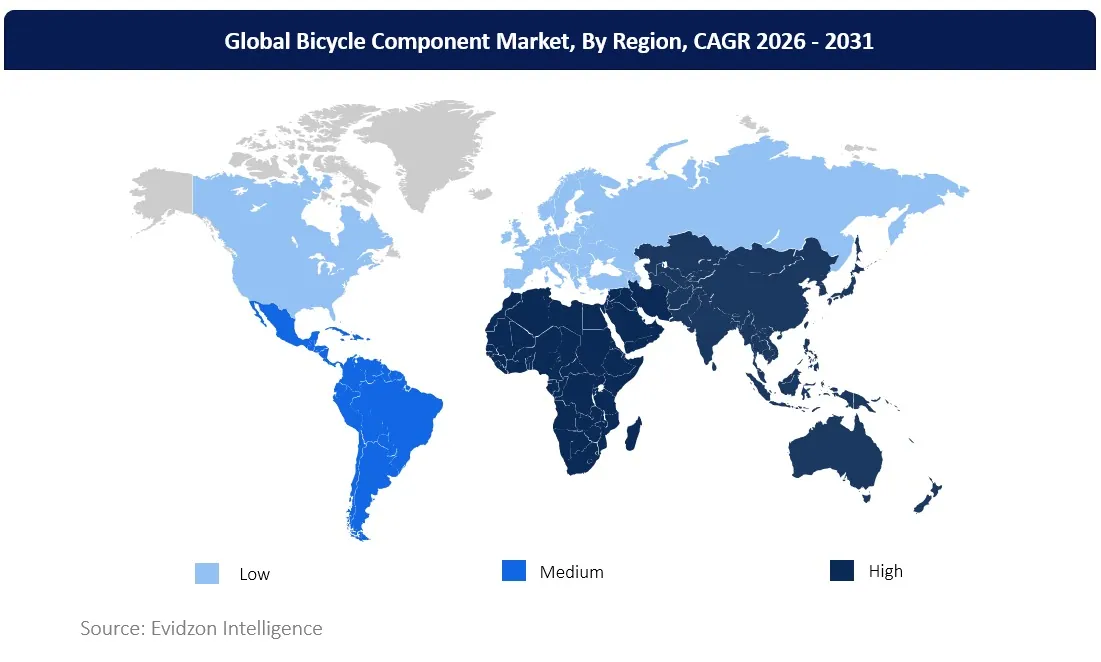
- By region, Europe accounts for 39.60% of global bicycle component market share in 2025. However, Asia Pacific is projected to witness a CAGR of 9.20% during 2026–2031.
About the Study
The global bicycle component market study covers component categories, bicycle categories, bicycle types, materials, propulsion, sales channels, across major global regions and countries. The market analysis covers mechanical and electric bicycles, including mountain, road, gravel, folding, BMX, youth and dirt, cross, cruiser, and cargo bicycles, across conventional and e-bicycle propulsion. The study analyzes demand across OEM and aftermarket sales channels and evaluates component requirements based on bicycle design, material selection, performance requirements, and application. The study excludes complete bicycles, bicycle rental and leasing services, repair and maintenance services, cycling apparel, financing and insurance services, and non-bicycle mobility products and services.
Market Dynamics Analysis
Drivers
Increasingly preferences for lighter parts for improved handling and acceleration.
E-bicycle volumes increasing demand for specialized motors, batteries, brakes, and drivetrains.
Increasing recreational riders creating replacement demand across multiple component categories.
Frequent wear encourages consumers to replace chains, tyres, brake parts, and cassettes.
Enthusiasts spend on precision parts, upgraded drivetrains, wheels, and suspension.
High regional production expands component requirements among bicycle manufacturers and assemblers.
Restraints
Advanced materials and precision manufacturing push prices beyond mainstream budgets.
Production disruptions delay availability of parts and replacement products.
Different standards make selecting compatible replacement parts difficult for consumers and retailers
Low-cost imitation parts create pricing pressure and can weaken established brand image.
Dynamically shifting customer preferences towards light weight high performance components and increasing demand for e-bicycles is the key attribute driving the global bicycle component market beyond regular components towards lightweight aluminum and composite material, and e-bicycle focused components like motor, batteries, charger, and others. Professional riders and enthusiasts upgrade conventional (human powered) bikes with high performance hydraulic brakes, suspension parts, cockpit components and carbon wheels while manufacturers developing higher-specification parts for premium models. The aftermarket provides significant revenue source from frequent replacement parts such as chains, brake pads, cassettes, tyres and cables. this led suppliers recurring sales rather than reliant entirely on new bicycle production. Meanwhile, growth in bicycle assembly in Asian manufacturing hubs continues to drive large-volume component demand for standardized parts.
Premium components face challenge of high price, carbon fiber frames, high-end wheelsets, electronic shifting systems, and sophisticated suspension systems cost several times more than mainstream counterparts, limiting the adoption outside enthusiast and performance segments. Another challenge stems from bicycle components relying on specialized manufacturing, disruption in single supplier affects entire product line. High-end parts, including different axle dimensions, drivetrain speeds, bottom-bracket standards, brake mounts, and electronic systems, are component that can’t be replaced without checking the entire bicycle setup, which is difficult for consumers and retailers. Counterfeit and imitation parts also add pressure at a retail level, especially for drivetrain, braking, and wheel brands. The counterfeit products are hindering the price equilibrium and adversly impacting the brand presence of legitimate components.
Segment Analysis
By Component Type
Drivetrain is the largest component segment of the global bicycle component market in 2025, accounting for 22.60%, reflecting the importance of gear selection, pedaling efficiency, and power transfer across road, mountain, hybrid, and E-bicycles. The drivetrain components includes chains, chainrings, cranksets, derailleurs, and shifters, dependent on pedalling motion, gear range, and riding performance. The parts generate recurring replacement demand and require timely servicing, while major manufacturers such as Shimano and SRAM serve different price points from entry-level bicycles to premium road bicycles and mountain bicycles. E-bicycles are shaping another layer of demand stream, with torque placing greater stress on chains and drivetrain components, while riders also upgrade to wider gear ranges and more precise shifting, and wider gear options continue to support product differentiation across both original equipment and aftermarket channels.
Suspension systems are anticipated to be the fastest-growing component segment with a CAGR of 9.10% by 2031, driven by demand for improved control and comfort across mountain, trail, and E-bicycles. Growing interest in mountain bicycling, where riders prioritize adjustable damping, suspension travel, and weight management, makes suspension performance and durability a crucial attribute. Manufacturers such as Fox Factory serve different price and performance categories, from recreational riding to higher-trail applications. Moreover, rough terrain bicycles are expected to drive demand for advanced suspension components across mid-range and premium models through 2031.
Global Bicycle Component Market, By Component Type, Market Share, 2025
By Bicycle Categories
In bicycle category, mechanical bicycle accounts the largest global bicycle component market share of 61.80% in 2025, driven by widespread application in commuting, recreational cycling, fitness, and competitive sports. Moreover, affordability, familiar operation, and lower & frequent maintenance requirements make it accessible to broad replacement components, sustaining demand across developed and emerging markets. Mechanical bicycle rely on conventional drivetrain systems including, chains, derailleurs, cranksets, gear shifters, brake assemblies, and wheel hubs driven by both original equipment manufacturing and aftermarket replacement. While, mechanical bicycles simpler construction and independent from battery charging infrastructure make them suitable for daily transportation and recreational use. Manufacturer such as Shimano, SRAM, and other key players continue to support the segment through extensive component portfolios offering across price categories and applications.
Electric bicycle is poised to grow at a CAGR of 12.40% by 2031, as consumers are shifting towards pedal-assist models for commuting, recreation, and longer-distance travel. Electric assistance helps riders to cover longer routes, hills and reduce physical efforts during daily journeys, supporting demand for specialized components. The transition shaping demand for electric bicycle-specific components, including motors, battery systems, electronic controllers, sensors, and integrated braking and drivetrain technologies. Regulatory body supports for low-emission transportation, expanding cycling infrastructure, and improvements in battery performance are further encouraging adoption. Components suppliers are investing in lightweight designs, efficient power delivery, and integrated electronic systems to meet evolving requirements.
Global Bicycle Component Market, By Bicycle Category, Market share, 2025
Geographic Analysis
Largest Region
Europe is the largest regional bicycle components market accounting for 39.60% in 2025, driven by cycling infrastructure, strong e-bicycle ownership, and consistent demand for replacement parts. Germany, Netherlands, Italy, France, and the United Kingdom represent substantial markets for commuter cycling, recreational riding, road cycling, and mountain cycling. While premium components including precision drivetrains, lightweight wheels, hydraulic disc brakes, suspension systems, and carbon Fiber parts are likely to drive the future growth.
The growing adoption of e-bicycles drives demand for reinforced chains, durable braking systems, compatible drivetrains and components that can handle the extra weight loads wheels. Additionally, regular use of bicycles fuels the recurring demand for brake pads, chains, cassettes, and tyres, and upgradation of components to improve ride quality. Meanwhile, the presence of specialist retailers and repair networks help to sustain both replacement sales and demand for performance-focused equipment across Europe.
Global Bicycle Component Market, By Region, Market Share, 2025
Fastest-Growing Region
Asia Pacific is projected to be the fastest-growing region, with a CAGR of 9.20% in the global bicycle component market by 2031. The market is supported by extensive manufacturing footprint and rising adoption of electric bicycles. China and Taiwan are the production centers supported by extensive supplier networks for drivetrains, frames, wheels, braking systems, and other parts. While, India is shaping up additional opportunities with expansion of bicycle application in fitness, and recreational activities.
The adoption of e-bicycles is supporting the demand for specific components, with manufacturers requiring strong brakes, battery-related electrical systems, durable drivetrains, sensors, and reinforced wheels. While the regional customer is moving towards higher specification bicycles, demand for hydraulic disc brakes, improved gear systems, and lightweight materials is gaining traction. Asia region is a key market for a combination of bicycle components manufacturing and opportunities to serve both entry-level volume markets and higher-value bicycle categories.
Competitive Landscape
- 1Fox Factory
- 2Campagnolo
- 3Shimano Inc.
- 4SRAM LLC
- 5DT Swiss
Market Concentration Level: Fragmented
The global bicycle component market is fragmented, while, Fox Factory, Campagnolo, Shimano, SRAM, and DT Swiss are the key players operating in the market. The companies compete on component weight, electronic integration, braking performance, durability and compatibility across road, mountain, gravel, urban, and e-bike platforms. Shimano maintain the position with providing high quality of the products and for bicycles of different categories includes braking, wheel, pedal, and electronic shifting products, drivetrain while SRAM competes with wireless electronic drivetrains, MTB systems, and premium road components. Campagnolo focused on high-end road and gravel biking equipment and focused on its product range and brand positioning to defend its niche. on the other side, component suppliers expanding individual parts toward integrated systems as well as electronic shifting, e-bike drive integration, hydraulic brakes, suspension, and connected components.
Meanwhile companies invest to expand their production capacity and supply-chain control to improve availability and reduce delivery time. Competition increasingly relies on supply agreements, manufacturing scale, product reliability, pricing, dealer networks, and aftermarket parts availability. E-bicycle adoption is shaping distant competitive dimension, as suppliers are developing components capable of handling higher torque, increased loads, and electronic integration. Meanwhile, compatibility across drivetrain speeds, axle standards, brake mounts, and electronic systems affects replacement demand.
Recent Development
Röko AB Acquires 99% Stake in Cycling Supplier CyTech
Roko AB acquired a 99% stake in CyTech, an Italian focused on Elastic Interface, Berenis, and Bikepad. CyTech develops cycling chamois shoe insoles, and protective padding. The acquisition strengthens Röko’s cycling portfolio and reflects continued consolidation among specialized bicycle component suppliers.
SPAC SA Takes Minority Stake in Campagnolo
SPAC SA acquired a minority stake in Campagnolo, the investment support product development, supply-chain improvements, OEM expansion, and future growth transaction. It will strengthens Campagnolo’s financial position while maintaining control over the bicycle-component manufacturing.
Shimano Launches New Mechanical DEORE MTB Groupsets
Shimano launch the DEORE M7200 and M6200 mechanical MTB group sets, the new group sets offer 12-speed HYPERGLIDE+ and 11-speed LINKGLIDE configurations. The new range expands Shimano’s mid-range MTB portfolio for mountain bikes, providing manufacturers and riders with additional cable-operated shifting options across mid-range trail and off-road applications.
Table of Content
- 1.Introduction
- 1.1Scope and Objective of the Study
- 1.2Market Definition & Study Assumptions
- 2.Research Methodology
- 3.Executive Summary
- 4.Market Outlook
- 4.1Market Overview
- 4.2Market Drivers
- 4.2.1Rising demand for Lightweight Bicycle Components
- 4.2.2Growth of Electric bicycle adoption Across Major markets
- 4.2.3Increasing Participation in Recreational Cycling Activities
- 4.2.4Growing Aftermarket Replacement and upgrade demand
- 4.2.5Expansion of Performance-Oriented Cycling Culture
- 4.2.6Rising Bicycle Production Across Emerging Asian Economies
- 4.3Market Restraint
- 4.3.1High price for premium Bicycle components
- 4.3.2Supply Volatility Across Specialized Component Categories
- 4.3.3Complex Compatibility Requirements Between Bicycle Components
- 4.3.4Counterfeit products affecting component brand revenue
- 4.4Supply/Value Chain Analysis
- 4.5Regulatory Landscape
- 4.6Porter's Five Forces Analysis
- 4.6.1Threat of New Entrants
- 4.6.2Bargaining Power of Buyers
- 4.6.3Bargaining Power of Suppliers
- 4.6.4Threat of Substitutes
- 4.6.5Competitive Rivalry
- 5.Market Segmentation (Includes market size in Value (USD) and Volume (Units), Forecast upto 2031, and market analysis with growth attributes)
- 5.1By Component type
- 5.1.1Frames
- 5.1.2Suspensions system
- 5.1.3Wheels & tires
- 5.1.4Drivetrain Components
- 5.1.4.1Chain and Cassettes
- 5.1.4.2gears
- 5.1.4.3Chainrings
- 5.1.4.4Forks
- 5.1.4.5Shifters
- 5.1.4.6derailleurs
- 5.1.4.7cranksets
- 5.1.5Braking system
- 5.1.6Disc Brakes
- 5.1.6.1Hydraulic Disc Brakes
- 5.1.6.2Mechanical Disc Brakes
- 5.1.7Rim Brakes
- 5.1.8Drum & Coaster Brakes
- 5.1.9Handlebars & Stems
- 5.1.10Saddles & Seatposts
- 5.1.11Peddals
- 5.1.12Others (Hubs,Spokes,Bottom Brackets,Grips,Cables & Housing,Fenders,Kickstands)
- 5.2By Bicycle Category
- 5.2.1Mechanical Bicycle
- 5.2.2Electric Bicycle
- 5.3By Bicycle types
- 5.3.1Mountain bicycle
- 5.3.2Road Bicycle
- 5.3.3Gravel Bicycle
- 5.3.4Folding Bicycles
- 5.3.5BMX Bicycles
- 5.3.6Youth Bicycles & Dirt Bikes
- 5.3.7Cross Bicycles
- 5.3.8Cruiser Bicycles
- 5.3.9Cargo Bicycles
- 5.3.10Folding Bicycles
- 5.4By Materials types
- 5.4.1Aluminum
- 5.4.2Carbon Fiber
- 5.4.3Steel
- 5.4.4Titanium
- 5.4.5Composite Materials
- 5.4.6Others(Magnesium, Scandium, Wood, etc)
- 5.5By Propulsion
- 5.5.1Conventional (Human-Powered)
- 5.5.2E-Bicycles
- 5.6By Sales Channels
- 5.6.1OEM
- 5.6.2Aftermarket
- 5.7By Region
- 5.7.1North America
- 5.7.1.1United States
- 5.7.1.2Canada
- 5.7.2Latin America
- 5.7.2.1Brazil
- 5.7.2.2Argentina
- 5.7.2.3Mexico
- 5.7.2.4Rest of Latin America
- 5.7.3Europe
- 5.7.3.1Germany
- 5.7.3.2Italy
- 5.7.3.3France
- 5.7.3.4Spain
- 5.7.3.5United Kingdom
- 5.7.3.6Russia
- 5.7.3.7Rest of Europe
- 5.7.4Asia Pacific
- 5.7.4.1China
- 5.7.4.2India
- 5.7.4.3Japan
- 5.7.4.4South Korea
- 5.7.4.5Indonesia
- 5.7.4.6Australia
- 5.7.4.7Rest of Asia-Pacific
- 5.7.5Middle East & Africa
- 5.7.5.1Saudi Arabia
- 5.7.5.2United Arab Emirates (UAE)
- 5.7.5.3South Africa
- 5.7.5.4Egypt
- 5.7.5.5Rest of the Middle East & Africa
- 6.Competitive Landscape
- 6.1Market Concentration Overview
- 6.2Market Share Analysis
- 6.3Company Profiles
- 6.3.1Shimano Inc.
- 6.3.2SRAM LLC
- 6.3.3Fox Factory Holding Corp.
- 6.3.4DT Swiss
- 6.3.5Campagnolo
- 6.3.6Bosch eBike Systems
- 6.3.7Tektro Technology Corporation
- 6.3.8Magura GmbH
- 6.3.9Mavic SAS
- 6.3.10Accell Group
- 6.3.11KMC Chain Industrial
- 6.3.12Cane Creek Cycling Components
- 6.3.13SR Suntour Inc.
- 6.3.14Hope Technology Ltd.
- 6.3.15Easton Cycling
- 7.Future Outlook
- 7.1Growth Opportunities & White-Space Analysis
- 7.2Analyst Recommendations
FAQ
What is the size of the global bicycle component market?
The global bicycle component market was valued at USD 25.75 billion in 2025 and is projected to grow from USD 27.63 billion in 2026 to USD 39.30 billion by 2031, registering a CAGR of 7.30% during 2026–2031.
Which component segment holds the largest share of the global bicycle component market?
Drivetrain components hold the largest share, accounting for 22.60% of the market in 2025. Demand is supported by the widespread use of chains, cassettes, cranksets, derailleurs, and shifters, along with recurring replacement and upgrade requirements.
Which bicycle category is expected to grow the fastest in the global bicycle component market?
Electric bicycles are expected to be among the fastest-growing category, with a projected CAGR of 12.40% during 2026–2031. Rising adoption of pedal-assist bicycles is increasing demand for motors, batteries, electronic controllers, compatible drivetrains, and high-performance braking systems.
Which region dominates the global bicycle component market, and which is expected to grow the fastest?
Europe leads the market, accounting for 39.60% of the market in 2025, supported by cycling infrastructure, e-bike adoption, and demand for premium and replacement components. Asia Pacific is projected to be the fastest-growing region, with a CAGR of 9.20% during 2026–2031, driven by its manufacturing base and expanding demand for electric bicycles.
Who are the major players in the global bicycle component market?
Major players include Fox Factory, Campagnolo, Shimano Inc., SRAM LLC, and DT Swiss, competing on drivetrain technology, braking performance, suspension systems, lightweight materials, product durability, and compatibility across road, mountain, gravel, conventional, and electric bicycles.
Market Size Methdology
Market value is calculated based on bicycle component sales volumes multiplied by corresponding average selling price (ASP), estimated by components, bicycle category, bicycle type, material type, propulsion, sales channels and region to capture differences component specifications, bicycle applications, pricing levels, replacement patterns, purchasing channels, and regional demand.
Historical market estimates are benchmarked against bicycle production, component shipments, bicycle parc, e-bicycle sales, import-export data, aftermarket replacement volumes, retailer sales and company disclosures.
Forecasts incorporate expected bicycle production and sales, replacement sales by component1, e-bike penetration, component prices, cycling participation, OEM demand, technological improvements, aftermarket network, and regional manufacturing expansion.
Have a question about this report?
Talk to the analyst behind this research, or browse the full report catalogue.
Contact Us