
Global Automotive Upholstery Market
The global automotive Upholstery market report is segmented by material (Fabric, Genuine Leather, Synthetic leather, Vinyl and thermoplastic polymers), by application (Seats, Door Panels, Headliners, Carpet & Floor Coverings, Dashboard/Instrument Panel, Steering Wheel, Armrests & Console and Others), by vehicle (Passengers Vehicles and Commercial Vehicles), by vehicle class (Economy, Mid-range, Premium and Luxury), by Sales (OEM and Aftermarket), and by Region (North America, South America, Europe, Asia pacific and Middle-East & Africa). The global automotive upholstery market report includes market size in value (USD) and forecasts through 2031.
Global Automotive Upholstery Market
Market Size in USD Billion
Market Size Overview
USD Billion
Market Snapshot
- Study Period
- 2019-2031
- Forecast Period
- 2026-2031
- Base Year Market Size (2025)
- USD 5.98 Billion
- Market Size (2026)
- USD 6.38 Billion
- Market Size (2031)
- USD 9.09 Billion
- Growth Rate (2026-2031)
- 7.35% CAGR
- Market Concentration
- Fragmented
Major Players*





*Disclaimer: Major Players sorted in no particular order
Market Overview
The global automotive upholstery market value is anticipated to grow from USD 5.98 billion in 2025 to USD 6.38 billion in 2026 and is expected to reach USD 9.09 billion in 2031, with a CAGR (2026-2031) of 7.35%.
The global automotive upholstery market is supported by vehicle production, increasing customer preference for comfortable and visually appealing interiors, and growing use of premium and sustainable materials. Upholstery includes seat covers, door-panel fabrics, headliners, armrests, and other interior trim, made from fabric, leather, and synthetic leather. Electric vehicles are creating opportunities for lightweight, recycled, and easy-to-maintain interior materials, while the aftermarket supports seat-cover replacement, customization, and interior refurbishment. Passengers’ cars account significant demand share, supported by customer preference in comfortable seating, attractive interior finishes, and customization options. While, commercial vehicles require durable upholstery materials that can withstand frequent use and harsh operating conditions.
Key players operating in global automotive upholstery market includes Adient plc, Lear Corporation, FORVIA SE, and Toyota Boshoku Corporation. Tier-1 competitive landscape is formed on material innovation, product quality, design capabilities, manufacturing efficiency, and long-term OEM relationship. Growing emphasis on sustainable materials and improved cabin aesthetics is expected to influence product development and supplier strategies over the forecast period.
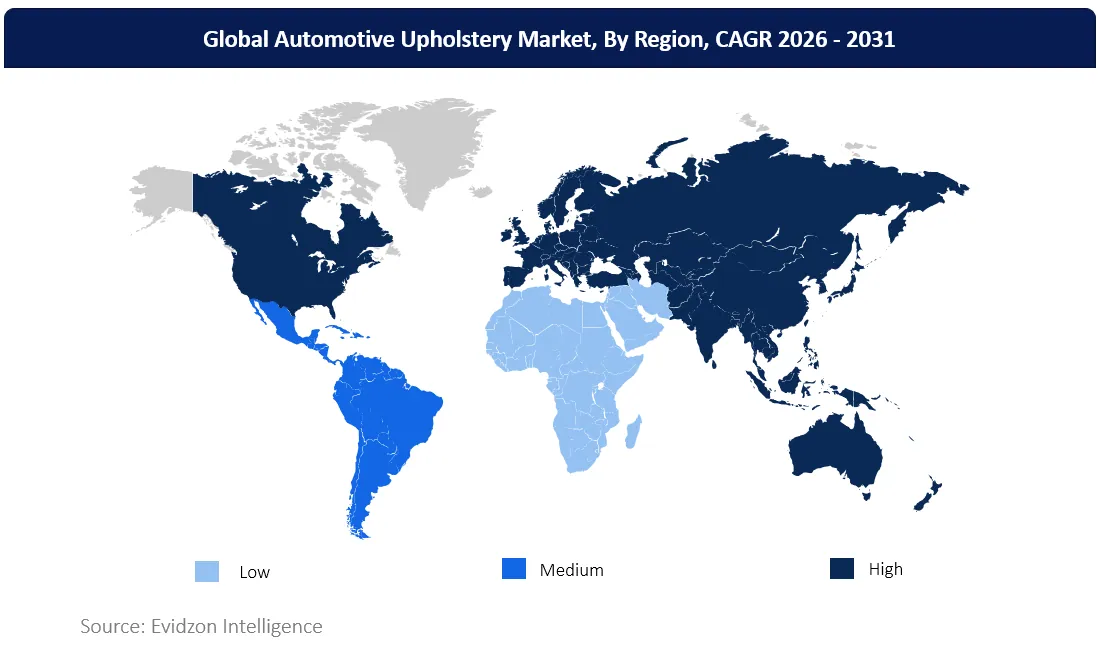
Asia Pacific automotive upholstery market is the fastest and largest regional market, driven by key countries and regions such as China, Japan, India, South Korea, and South-east Asian region. China's extensive vehicle manufacturing capabilities, expanding supplier network in India, and product development technology across Japan and South Korea is collectively driving the Asia-pacific growth curve. While, Europe remain a significant region on the back of premium vehicle market, driving demand for high-value and sustainable material upholstery. North America automotive upholstery market is primarily driven by large SUVs and pick-up trucks, while commercial vehicles is fueling durable upholstery demand. Replacement and customization to meet frequent use applications are the key attributes fueling Latin America and Middle-East and Africa automotive upholstery market.
Key Takeaways
- By material, fabric led the largest segment market, accounting for 36.0% in 2025. thermoplastic polymers is expected to be the fastest-growing segment, with a projected 8.20% CAGR through 2031 over the forecast period.
- By application, seats remain the largest share, accounting for 48.0% in 2025. However, dashboard/Instrument panel are expected to grow at the highest CAGR of 9.6% by 2031.
- By vehicle, passengers vehicle has the largest shares accounts for 86.0% of the market in 2025, while medium & heavy commercial vehicles are expected to be the fastest-growing category, registering a CAGR of 8.8% by 2031.
- By vehicle class, mid-range led the market with 39.0%% in 2025, whereas premium is expected to grow at 8.9%CAGR through 2031.
- By sales, OEM led the largest share account for 89.0% in 2025, while aftermarket is expected to grow at 5.8%CAGR through 2031.
- By region, Asia pacific accounts for 46.0% in 2025. and it is anticipated to be the fastest-growing at 8.4% CAGR by 2031.
About the Study
The global automotive upholstery market study covers the upholstery materials integrated in passenger cars and commercial vehicles. The study is segmented by materials, applications, vehicle type, vehicle class, sales channels, across major regions and countries. The study excludes complete vehicles, used vehicles, standalone furniture and residential upholstery services, and automotive components unrelated to upholstery, other vehicle maintenance, aftermarket services, materials outside the automotive upholstery ecosystem.
Market Dynamics Analysis
Drivers
Higher vehicle output increases demand for installed interior materials.
Customers prefer refined material finishes, textures, and comfort.
EV interiors create demand for lightweight, distinctive upholstery solutions.
Personalization encourages varied colours, materials, patterns, and finishes.
Automakers seek recycled, bio-based, and lower-impact materials.
Automated cutting and stitching support precision and production efficiency.
Restraints
Textile, leather, and polymer price swings significantly impacts the production cost.
Testing requirements lengthen supplier qualification and launch timelines.
Bonded fabrics, foams, and adhesives complicate material separation.
Cost-sensitive customer segment prioritize affordability over upgraded cabin finishes.
Increasing vehicle production across the globe is primarily driving the demand curve of global automotive upholstery market, fueled by factory-fitted seat covers, door trims, headliners, carpets, and other upholstered interior surfaces. Upholstery manufacturers capitalizes on dynamically shifting customer preferences towards cabin comfort and interior quality, driving integration of high-value fabrics, leather, and synthetic leather. While, electric vehicles are creating a distant opportunity pool for automotive upholstery market, owing to OEMs emphasis on upholstery suppliers to develop lightweight interior upholstery materials suited to distinctive cabin layouts. Personalization further broadens material and color choices across vehicle models and trim levels, allowing suppliers to serve across price points. Meanwhile, sustainability requirements encourage recycled and bio-based alternatives, while automated cutting and stitching help manufacturers manage design variation, improve material utilization, and meet OEMs quality standards and expectations.
Volatile pricing trend of automotive upholstery materials including leather, fabrics, synthetic materials, and foam led to shrink the profit margins of upholstery manufacturers, as passing on the price pressure to OEMs is constrained by long-term supply contracts. New product development is restricted by stringent quality compliances including durability, abrasion resistance, color retention, emissions, fire safety, and production consistency. Such factors may delay product development and increase development costs. Whereas fabrics, foam, coatings, and adhesives are often bonded together, making it difficult to separate materials and recover them from end-of-life vehicles leading to increase the overall carbon foot print of vehicle.
Segment Analysis
By Material
By material segment, fabric led the automotive upholstery market accounting for 36.0% market share in 2025. Fabrics are the most preferred choice of OEMs across mid-range passenger cars, and value-oriented commercial vehicles segments as fabrics offers balance between durability and cost. Recycled PET yarns, knitted fabrics, and multi-layer textiles offers greater design flexibility, incorporating post-customer preferred materials without requiring complete change in seat architecture making it more feasible. While, fabric automotive upholstery is shifting towards higher stain resistance, UV stability, colour retention and easier cleaning product developments, reflecting higher consumer preference for long-term interiors surfaced. OEMs are shifting towards fabrics that combine recycled content, abrasion resistance, thermal comfort and premium appearance, driven increasingly by the use of recycled PET and bio-based fibers, engineered textiles in seat coverings, door inserts, headliners and armrests.
Thermoplastic polymers are anticipated to grow at a CAGR of 8.20% by 2031, due to advantages like weight reduction, design flexibility and manufacturing efficiency. Thermoplastic polymers including PP, TPO, and ABS are extensively employed across dashboards, door panels, consoles and structural interior. Manufacturers are preferring thermoplastic polymers across electric propulsion vehicle to reduce the weight to increase overall vehicle efficiency and comfort. Although, OEMs are increasing the use of recyclable thermoplastics to address end-of-life requirements and reduce dependency on mixed-material structures.
Global Automotive Upholstery Market , By Material, Market Share,2025
By Application
Seats dominate the application segment of global automotive upholstery market, accounting for 48% market share in 2025, offering occupant comfort, durability, safety and increasing electrical functionality. OEMs are diversifying material mixes, including synthetic leather, recycled textiles, coated fabrics, and bio-based materials. Meanwhile, the increasing demand for seat materials that withstand repeated loading, abrasion, temperature variation, embedded ventilated seating, massage functions, and integrated sensors and electrically adjustable mechanisms is creating opportunities for lighter seat assemblies to achieve utmost passenger comfort. suppliers strategically combining premium tactile quality, durability, sustainability and compatibility with advanced seating assistance.
Dashboard /Instrument panel is fastest growing application segment anticipated to grow at 9.6% CAGR by 2031. Rising consumer preference for premium materials, while OEMs are moving towards integrated cockpit architectures, thermoplastic polymers, and synthetic leather, engineered fabrics, and soft-touch surfaces. Meanwhile, EV and software-defined vehicles are enhancing dashboard requirements, to achieve quieter cabins, squeak-and-rattle free performance, tactile feel, and interior aesthetics. Manufacturers prefer lightweight thermoplastics, low-VOC materials and thin-wall molded components to reduce vehicle weight maintain the dimensional stability, durability and design flexibility. Market is moving towards multi-material dashboards, and increasing the demand for high-quality surface materials and engineered substrates.
Global Automotive Upholstery Market, By Application, Market Share, 2025
Geographic Analysis
Largest Region
Asia Pacific is the dominating regional automotive upholstery market accounting largest market share of 46.0 % in 2025, supported by China, Japan, India, South Korea, Thailand and Indonesia. Such countries drive largest installation demand base for seats, door trims, headliners, dashboards and other upholstered interior components. Asia Pacific vehicle production units in 2025 has reached 59.2 million units and represents 61% of global vehicle production output, creating a substantial installation base for the upholstery market from OEM sales channel. China manufactured approximately 34.53 million vehicles in 2025, while Japan produced approximately 8.4 million vehicles in 2025, and India manufactured 6.5 million vehicles in 2025, expanding vehicle production is driving OEM demand for upholstery materials across the region [Source: OICA].
South Korea, Thailand and Indonesia remain strong driving forces, with extensive vehicle assembly plants, component manufacturers, textile processors, polymer producers and interior-system suppliers. This allows OEMs to source upholstery materials and components locally, reducing logistics costs and enabling suppliers to develop materials around specific vehicle platforms. Additionally, China produced 16.63 million new-energy vehicles (NEVs) in 2025 and increasing 29% year-on-year [Source: CAAM]. EV manufacturers are using distant interior design, light weight and sustainable upholstery. The region's broad vehicle-segment coverage, ranging from entry-level passenger cars and commercial vehicles to luxury SUVs and premium EVs has driven demand across the segments.
Global Automotive Upholstery Market, By Region, Market Share, 2025
Fastest- Growing Region
Asia Pacific is anticipated to be the fastest growing region in global automotive upholstery market, accounting for 8.4% CAGR. Rising vehicle production, expanding automotive manufacturing capacity, and increasing demand for improved vehicle interiors has collectively anticipated to drive the demand curve over the forecast period. China and India are significant growth levers with large passenger vehicle markets and growing vehicle production across SUVs, electric vehicles, and mid-range cars. Automotive upholstery manufacturers compete on quality, fabrics durability, synthetic leather range, and improved foam materials.
Moreover, the expansion of e-vehicle production is shaping distant opportunity pocket for upholstery suppliers, while manufacturers introduce lightweight materials, recycled fabrics, and modern interior finishes. Rising purchasing power and evolving customer preferences are encouraging automakers to offer better seating comfort, improved aesthetics, and more premium cabin materials across vehicle categories. Furthermore, the presence of established automotive component manufacturers and regional material suppliers supports local sourcing and production. However, manufacturers raw material price fluctuations and cost sensitive markets will remain competitive across vehicle segments.
Competitive Landscape
- 1Adient plc
- 2Lear Corporation
- 3FORVIA(Faurecia)
- 4Toyota Boshoku Corporation
- 5Grammer AG
Market Concentration Level: Fragmented
Global automotive upholstery market competitive landscape is shaped by long-term OEM relationships, seating and interior-system production expertise, material innovation, manufacturing scale, cost competitiveness, product quality, and distribution network. Key plers operating in the market includes, Adient, Lear Corporation, FORVIA, Toyota Boshoku, and Grammer AG, focused on premium upholstery, lightweight materials, thermal comfort, durability, and customization. Adient growth is driven by its large OEM base, maintaining a global manufacturing footprint by including seat structure, foam, armrests, and trim.
Competitive differentiation in the automotive upholstery market is increasingly focused on sustainable and recycled materials, lightweight upholstery, synthetic leather, and high-performance materials, premium textures, durability, thermal comfort, customization, advanced seating technologies, and EV-oriented interior solutions. Automotive upholstery manufactures emphasized to secure long-term OEM contracts while controlling material costs and maintaining consistent quality to remain competitive.
Recent Development
Bentley Introduces Merino Wool Upholstery for Its First EV
Torcal, Bentley's first electric vehicle, collaborated with Fox Brothers to manufacture upholstery made of Merino wool. The material offers premium upholstery options beyond traditional leather and synthetic materials and meets vehicle durability criteria.
Ultrafabrics Launches Certified High-Performance Upholstery Collections for Passenger Transport
Ultra Fabrics introduced two ECE R118.04-certified collections that provide sturdy substitutes for conventional leather in passenger seats. The introduction strengthens its synthetic upholstery line and encourages the use of high-performance leather substitutes in car seats.
Toyota Boshoku Showcases Advanced Automotive Seat-Cover Textiles at Japan Mobility Show
Toyota Boshoku highlighted textile advances for automobile seats at the Japan Mobility Show 2025 by showcasing next-generation seat-cover textiles. The advancement supports the need for practical, aesthetically pleasing upholstery textiles and increases the variety of materials available.
Table of Content
- 1.Introduction
- 1.1Scope and Objective of the Study
- 1.2Market Definition & Study Assumptions
- 2.Research Methodology
- 3.Executive Summary
- 4.Market Outlook
- 4.1Market Overview
- 4.2Market Drivers
- 4.2.1Rising Global Vehicle Production Expands Upholstery Demand
- 4.2.2Premium Interior Preferences Increase Upholstery Content Value
- 4.2.3Electric Vehicles Reshape Cabin Material Requirements
- 4.2.4Customization Trends Broaden Automotive Upholstery Choices
- 4.2.5Sustainable Material Adoption Changes Upholstery Procurement
- 4.2.6Advanced Manufacturing Improves Upholstery Design Flexibility
- 4.3Market Restraint
- 4.3.1Volatile Raw Material Prices Pressure Upholstery Margins
- 4.3.2Automotive Quality Standards Limit New Upholstery Suppliers
- 4.3.3Complex Material Recycling Limits End-of-Life Upholstery Recovery
- 4.3.4Price Sensitivity Restricts Premium Upholstery Adoption
- 4.4Supply/Value Chain Analysis
- 4.5Regulatory Landscape
- 4.6Porter's Five Forces Analysis
- 4.6.1Threat of New Entrants
- 4.6.2Bargaining Power of Buyers
- 4.6.3Bargaining Power of Suppliers
- 4.6.4Threat of Substitutes
- 4.6.5Competitive Rivalry
- 5.Market Segmentation (Includes market size in Value (USD) and Volume (Units), Forecast up to 2031, and market analysis with growth attributes)
- 5.1By Material Type
- 5.1.1Fabric
- 5.1.2Genuine Leather
- 5.1.3Synthetic Leather
- 5.1.4Vinyl
- 5.1.5Thermoplastic Polymers
- 5.2By Application
- 5.2.1Seats
- 5.2.2Door Panels & Trims
- 5.2.3Headliners
- 5.2.4Carpet & Floor Coverings
- 5.2.5Dashboard / Instrument Panel
- 5.2.6Steering Wheel
- 5.2.7Armrests & Consoles
- 5.2.8Others (Pillars, sun visors, gear-shift covers, Boot / Cargo, Other interior surfaces)
- 5.3By Vehicle Type
- 5.3.1Passenger Vehicles
- 5.3.1.1Sedans
- 5.3.1.2Hatchbacks
- 5.3.1.3SUVs
- 5.3.1.4MPVs / MUVs
- 5.3.1.5Coupes / Convertibles
- 5.3.2Commercial Vehicles
- 5.3.2.1Light Commercial Vehicles
- 5.3.2.2Medium &Heavy commercial Vehicle
- 5.4By Vehicle Class
- 5.4.1Economy
- 5.4.2Mid-Range
- 5.4.3Premium
- 5.4.4Luxury
- 5.5By Sales Channel
- 5.5.1OEM
- 5.5.2Aftermarket
- 5.6By Regions
- 5.6.1North America
- 5.6.1.1United States
- 5.6.1.2Canada
- 5.6.2Latin America
- 5.6.2.1Brazil
- 5.6.2.2Argentina
- 5.6.2.3Mexico
- 5.6.2.4Rest of Latin America
- 5.6.3Europe
- 5.6.3.1Germany
- 5.6.3.2Italy
- 5.6.3.3France
- 5.6.3.4Spain
- 5.6.3.5United Kingdom
- 5.6.3.6Russia
- 5.6.3.7Rest of Europe
- 5.6.4Asia Pacific
- 5.6.4.1China
- 5.6.4.2India
- 5.6.4.3Japan
- 5.6.4.4South Korea
- 5.6.4.5Indonesia
- 5.6.4.6Australia
- 5.6.4.7Rest of Asia-Pacific
- 5.6.5Middle East & Africa
- 5.6.5.1Saudi Arabia
- 5.6.5.2United Arab Emirates (UAE)
- 5.6.5.3South Africa
- 5.6.5.4Egypt
- 5.6.5.5Rest of the Middle East & Africa
- 6.Competitive Landscape
- 6.1Market Concentration Overview
- 6.2Market Share Analysis
- 6.3Company Profiles
- 6.3.1Adient plc
- 6.3.2Lear Corporation
- 6.3.3FORVIA (Faurecia)
- 6.3.4Toyota Boshoku Corporation
- 6.3.5Grammer AG
- 6.3.6Sage Automotive Interiors
- 6.3.7AUNDE Group
- 6.3.8Grupo Antolin
- 6.3.9Tachi-S Co., Ltd.
- 6.3.10TS TECH Co., Ltd.
- 6.3.11Eissmann Automotive Deutschland GmbH
- 6.3.12BOXMARK Leather GmbH & Co. KG
- 6.3.13The Haartz Corporation
- 6.3.14Wollsdorf Leder Schmidt & Co.Ges.m.b.H.
- 6.3.15Katzkin Leather, Inc.
- 7.Future Outlook
- 7.1Growth Opportunities & White-Space Analysis
- 7.2Analyst Recommendations
Market Size Methodology
Market value is calculated based on the number of automotive upholstery units installed or replaced, multiplied by the corresponding average selling prices (ASPs). It is estimated by upholstery material, application, vehicle Type, Vehicle class, sales channel, and region, capturing differences in material composition, coverage, specifications, installation rate and pricing. Demand is assessed based on upholstery fitment rates across passenger and commercial vehicles across OEM and aftermarket, considering the number and type of upholstered surfaces per vehicle, material adoption, and replacement requirements.
Historical market estimates are benchmarked against upholstery fitment rates, OEM and Tier-1 supplier disclosures, upholstery material shipment volumes, government statistics, industry associations, trade data, and company financial filings.
Forecasts incorporate expected changes in vehicle production, upholstery penetration, leather and synthetic leather adoption, textile and sustainable-material uptake, material pricing, replacement cycle, aftermarket OEM sourcing strategies, demand, advancements in upholstery materials, sustainability regulations, and manufacturing technology.
FAQ
What is the global automotive upholstery market size?
The global automotive upholstery market was valued at USD 5.98 billion in 2025 and is projected to grow from USD 6.38 billion in 2026 to USD 9.09 billion by 2031, registering a CAGR of 7.35% during 2026–2031.
Which material segment dominates the global automotive upholstery market?
Fabric dominated the market in 2025, accounting for 36.0% of the total market share. Its demand is supported by affordability, durability, design flexibility, and widespread use in vehicle seat coverings and interior trim.
Which application segment holds the largest market share?
Seats represent the largest application segment, accounting for 48.0% of the market in 2025. Demand is driven by seating comfort, durability requirements, and the growing use of synthetic leather, recycled textiles, and advanced upholstery materials.
Which region dominates the global automotive upholstery market?
Asia Pacific hold the largest regional share at 46.0% in 2025 and is also projected to be the fastest-growing region, with a CAGR of 8.4% through 2031. High vehicle production in China, India, Japan, and South Korea supports regional demand.
Who are the key players in the global automotive upholstery market?
Major players include Adient plc, Lear Corporation, FORVIA SE, Toyota Boshoku Corporation, and Grammer AG. These companies compete through material innovation, product durability, manufacturing efficiency, interior design capabilities, and long-term relationships with automotive manufacturers.
Have a question about this report?
Talk to the analyst behind this research, or browse the full report catalogue.
Contact Us